


How remote work, offshore internet and bluewater catamarans are changing the way owners live, sail and run their professional lives.
Working from a catamaran has moved from fantasy to practical reality. The change has come from three forces: remote work culture, better satellite internet and yachts designed as genuine homes at sea. For many owners, the attraction is direct. They want professional continuity without being tied to one city, one office or one season. Yet the idea only works when the yacht is prepared as a workplace, not only as a place to sail. Internet, power, desk ergonomics, sound control, redundancy, data security and weather planning matter as much as comfort. At Privilège Marine, this is where the concept becomes serious. A bluewater catamaran must cross oceans safely. It must also support daily life with calm, privacy and technical reliability. The modern owner does not simply want escape. The modern owner wants freedom with structure, and a yacht capable of making that freedom work.
The desire to work from sea has become a serious lifestyle choice
The desire behind working from a catamaran is easy to understand. It is the wish to keep one’s professional life while changing the frame around it. A call begins with a horizon outside the window. A report is written while the boat lies at anchor. A strategic decision is made after a morning swim. The office has not disappeared. It has moved.
This desire became stronger after remote work became normal in many professional sectors. Gallup’s 2026 data on remote-capable jobs in the United States shows 26% of employees working fully remotely, 52% working in a hybrid model and 22% working on site. The same research indicates that six in ten remote-capable employees want hybrid work, while about one-third prefer fully remote work. That is a large cultural shift. It explains why the yacht is no longer seen only as a holiday object.
For entrepreneurs, investors, consultants, designers, senior executives and owners of international businesses, work is already mobile. Many no longer measure productivity by presence in a building. They measure it by output, decisions, trust and availability. This is why the image of the digital nomad sailor has matured. It is no longer limited to a young freelancer on a small boat with a laptop. It can describe an owner managing a company, a family office, a portfolio, a creative studio or a professional practice from a bluewater catamaran.
The attraction is strong, but it must be treated with honesty. Working remotely from a cat is not a permanent holiday. It requires discipline. Calls still happen at fixed times. Deadlines still apply. Clients still expect clarity. A yacht creates freedom, but it also creates constraints: weather, power, time zones, maintenance, anchorage rules and connectivity limits. The owners who succeed are the ones who respect both sides of the equation.
The catamaran changes the feeling of remote work
A sailing catamaran offers a different experience from a monohull. The wide beam gives more living space. The platform is more stable at anchor. The saloon is bright. Cabins are separated by two hulls. Outdoor and indoor spaces connect naturally. These details matter when work becomes part of life on board.
Remote work is sensitive to space. A laptop on a dining table may be enough for one email. It is not enough for a full working week. A proper workspace needs privacy, ventilation, good light, seating comfort, charging points and a surface that stays useful when the boat moves. It also needs acoustic separation. Nobody wants to join a board call from the middle of a busy saloon while guests prepare lunch.
This is where the design of a true bluewater catamaran becomes decisive. At Privilège Marine, we build yachts as safe, capable ocean-crossing platforms. We also build them as homes. This balance is essential for remote work. The owner needs safety at sea, but also domestic intelligence. A yacht used for work must allow different parts of life to coexist. One person may be on a video call. Another may be reading. Children may be studying. Guests may be resting. The boat must absorb these routines without constant compromise.
The Privilège Signature 600 shows this evolution clearly. Its aft portside cabin can be designed as a dedicated office, private cinema, gym, storage room, artist’s studio or walk-in wardrobe. In a remote-work context, that flexibility is not decorative. It is structural. A dedicated office changes the quality of life on board. It separates work from leisure. It makes concentration easier. It gives the owner a real professional space inside a home at sea.
The internet connection is the new technical backbone
The central question is no longer whether a boat can connect to the internet. The question is how well it connects, where it connects and what happens when the main system fails. Working from boat internet must be designed as a system, not as a gadget.
A modern catamaran can use several layers of connectivity. Near land, 4G and 5G routers can provide fast service, depending on local coverage and antennas. Some marine systems advertise useful coastal range up to about 46 kilometres (25 nautical miles) from shore. In a marina, shore Wi-Fi may be useful, although it is often crowded and inconsistent. Offshore, satellite becomes the primary solution.
Low Earth orbit satellites have changed expectations. Starlink Maritime, using Global Priority plans, is marketed for maritime and global connectivity, with plans starting from $250 per month and hardware listed at $1,999 in the United States. The system has made high-speed internet at sea more accessible than traditional VSAT for many yacht owners. For people trying to work from sailing catamaran remotely, this is a major development.
The Starlink Mini also illustrates how compact satellite hardware has become. Its official specification sheet lists a terminal of 298.5 x 259 x 38.5 millimetres (11.75 x 10.2 x 1.45 inches), a weight of 1.10 kilograms (2.43 pounds), an IP67 environmental rating when installed with the DC cable and plug, and average power consumption of 25 to 40 watts. It can connect up to 128 devices. These numbers matter because space, weight and power are always serious on a yacht.
Yet a serious offshore work setup should not depend on one system alone. Catamaran Wi-Fi offshore needs redundancy. A common architecture may include Starlink or another high-speed satellite service, a 4G or 5G marine router, marina Wi-Fi capture, an Iridium GO! exec or similar L-band backup, and a separate emergency communications system. The Iridium GO! exec, for example, uses Iridium Certus 100 and offers IP data speeds up to 88 Kbps. That is not enough for video meetings. It is enough for essential messaging, weather files, compressed email and emergency communications.
The lesson is direct. Offshore internet should be fast enough for work and robust enough for failure.
The bandwidth required for real work is measurable
Video calls are often the first test. Zoom states that 1080p video can require 3.8 Mbps upload and 3.0 Mbps download. A 720p group video call can require 2.6 Mbps upload and 1.8 Mbps download. Google Meet lists up to 3.6 Mbps outbound and 3.6 Mbps inbound for 1080p video. These are not extreme numbers by land standards. At sea, they are serious because bandwidth may fluctuate.
This is why the owner should define work needs before choosing equipment. A writer, investor or consultant who mainly uses email, cloud documents and voice calls needs one level of connectivity. A founder who runs daily video calls, transfers large files and manages a distributed team needs another. A designer, architect or engineer working with heavy files needs a more disciplined data plan.
The practical rule is simple. The boat should be prepared for peak work, not average work. A system that handles email at anchor may fail during a three-hour video call in bad weather. The planning should include data allowance, antenna placement, router quality, onboard Wi-Fi distribution, cybersecurity and power.
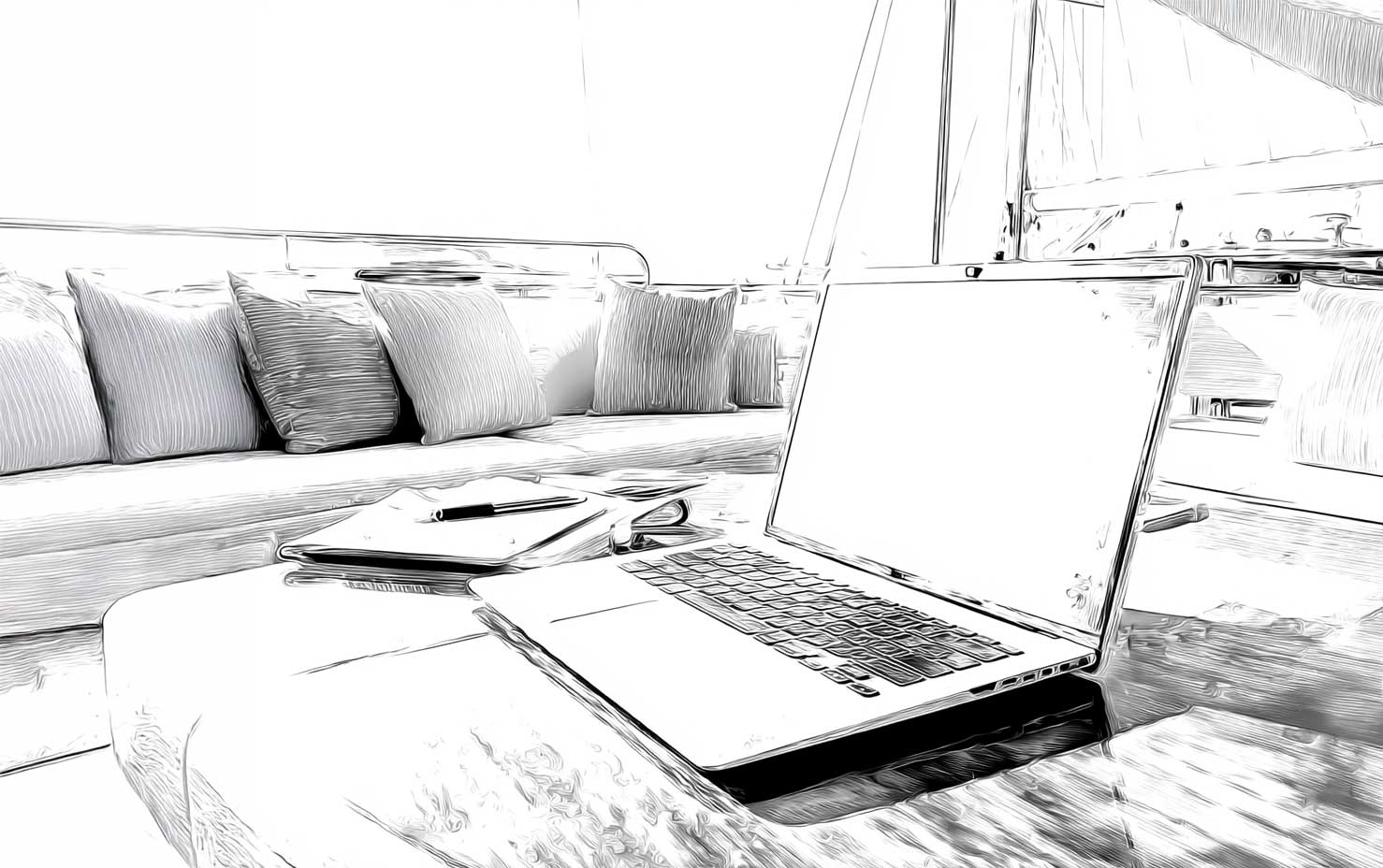
The onboard network should be built like a small office
A yacht that supports remote work needs a network architecture. The satellite terminal is only the start. The data must reach the desk, the saloon, the cabins and the cockpit. It must do so without weak zones, repeated resets or improvised cables.
A practical setup includes a marine-grade router, external antennas, network switching, separate guest and work networks, password management and automatic failover between sources. Products such as Peplink’s MAX BR1 Pro 5G, Raymarine YachtSense Link, Digital Yacht 5G Xtream and KVH hybrid systems show how the market has moved toward multi-source connectivity. The aim is to combine satellite, cellular and shore Wi-Fi rather than depend on one path.
The owner should also separate professional data from leisure traffic. Family streaming, children’s tablets, navigation updates and guests’ phones can consume bandwidth quickly. A professional call should not compete with a film download. Network rules can prioritise work devices, limit streaming, and reserve bandwidth for calls, cloud access and navigation.
Cybersecurity deserves the same attention. A floating office still handles sensitive information. A remote-working owner should use a VPN when appropriate, strong passwords, multi-factor authentication, device encryption and regular updates. Cloud backups should be scheduled when bandwidth is stable. A local backup drive should remain on board. Sensitive calls should be taken in a private space with a headset, not in the cockpit during a crowded anchorage.
The workspace must be designed before the first long passage
A real office on a catamaran needs physical planning. The desk should face a calm visual field. The chair should support long sessions. The screen should be visible in daylight. The lighting should work at night without glare. Ventilation should be quiet. The microphone should not pick up wind, pumps, galley noise or cockpit conversation.
The details are small, but they decide whether the owner works well. A second monitor may improve productivity. A headset with noise reduction can save a difficult call. A docking station can reduce cable clutter. A document scanner may be useful for legal and administrative tasks. A printer is rarely essential, but some owners still want one for contracts, forms or customs documents.
Power outlets must be placed where work actually happens. USB-C charging, 230V or 110V sockets, inverter capacity and battery reserve should be planned together. This is where yacht design and electrical engineering meet daily life.
The power system becomes part of the working day
Remote work consumes energy. A laptop may draw 30 to 100 watts, depending on model and load. A Starlink Mini draws 25 to 40 watts on average. A router, display, phone chargers, lighting and ventilation add more. A full workday may look modest compared with air conditioning or galley equipment, but it still matters during long periods at anchor.
This is why energy management is central to working from a boat. Solar panels, battery capacity, alternators, hydrogeneration, inverters and monitoring systems define the real autonomy of the office. The owner should know how long the network can run without engines or generator. The answer should be measured in practice, not guessed.
On a serious bluewater catamaran, power is a safety issue as well as a comfort issue. Navigation, communications, autopilot, refrigeration, water pumps and bilge systems all depend on electrical discipline. Remote work should be integrated without weakening the yacht’s core systems.
A practical schedule helps. Heavy uploads can be done when power generation is strong. Video calls can be grouped. Cloud backups can run at anchor during daylight. Non-essential devices can be disconnected during passages. This is not a downgrade of comfort. It is seamanship applied to digital life.
The working rhythm must respect weather and time zones
The sea changes the working day. Time zones shift during ocean passages. Weather windows dictate departures. Maintenance interrupts plans. A squall line does not care about a client meeting. A marina check-in may take longer than expected. A customs visit can break an afternoon.
The successful remote-working owner builds margin into the week. Critical meetings should not be scheduled during landfall, departure or complex pilotage. Long passages should include lower-bandwidth days. Team members should understand when the owner is available and when the boat has priority. The calendar should follow the sea, not fight it.
This does not mean work becomes less serious. It becomes better planned. A founder on a catamaran may be highly productive because distractions are fewer and the environment is calm. Gallup data shows that hybrid employees cite improved work-life balance, more efficient use of time and less burnout among the main benefits of flexible work. Those benefits can be amplified at sea, provided the owner has structure.
The emotional side is also real. There is a special clarity in working from a quiet anchorage. There is also loneliness in long-distance remote work if routines are weak. The yacht should support both concentration and connection. Family time, exercise, reading, sailing and rest should have their place. A remote-working catamaran is a platform for life, not a machine for answering emails in exotic places.
The Privilège approach turns freedom into a working environment
At Privilège Marine, the starting point is always the owner. Every yacht must answer a specific way of living. For remote work, that means asking direct questions before the boat is built.
Where will the owner work? How many hours per day? How many video calls per week? Will two people work at the same time? Is privacy essential? Will the yacht cross oceans? Will it stay mainly in the Mediterranean, Caribbean or Pacific? Is the owner managing confidential information? Does the boat need a dedicated office, or can the workspace be integrated into a cabin or saloon zone?
These questions shape the yacht. They affect layout, electrical capacity, antenna placement, ventilation, acoustic comfort, lighting, storage and network architecture. They also affect the owner’s satisfaction years later. A yacht designed for occasional holidays will not support the same life as a yacht designed for work, family and offshore movement.
The Privilège Signature 600 gives a clear example. With an overall length of 18.28 metres (60 feet), a beam of 9.18 metres (30 feet 11 inches), 259 square metres of total sail area (2,787 square feet), 2 x 485 litres of fuel capacity and 2 x 450 litres of freshwater capacity, it remains a serious long-distance cruising catamaran. Its customizable aft portside cabin makes the professional dimension concrete. It can become a proper office rather than an improvised corner.
That is the difference between adding internet to a yacht and designing a yacht that can support a professional life.
The future office will be designed around relevance
The ability to work from sea changes what owners expect from luxury. Finish quality still matters. Materials still matter. Silence, light, storage and craftsmanship still matter. Yet relevance matters more. A yacht becomes more valuable when it supports the owner’s real life.
For one owner, that means a private office with redundant connectivity and acoustic control. For another, it means a family learning space. For another, it means a cockpit table that works for morning emails and evening dinner. The best solution is not the most spectacular one. It is the one that fits the routine.
The dream of working from a catamaran is powerful because it connects two modern desires. One is freedom from fixed geography. The other is the need for a stable, beautiful and reliable place to live well. A Privilège catamaran can bring those two desires together because it is built for distance and designed around the owner.
The sea gives perspective. The yacht gives structure. The work continues. The office becomes quieter, wider and closer to the horizon.