


Hard, ablative or copper-based? Privilège Marine breaks down antifouling paint for catamarans, with real costs, sailing-area advice and application tips.
A catamaran carries two hulls below the waterline, so it asks for roughly twice the paint, labour and budget of a monohull of the same length. The right choice starts with how the boat is used. Self-polishing ablative paints suit cruising cats that move often and haul out between seasons. Hard antifouling rewards boats that stay wet for years or sail fast. Copper-epoxy systems such as Coppercoat can protect for a decade when applied and maintained well, while biocide-free foul-release coatings cut drag and fuel use for owners who sail regularly. Sailing area weighs as much as paint chemistry: warm Mediterranean and tropical anchorages foul far faster than cool northern waters. At Privilège Marine we favour hard-matrix antifoulings for their repairability and predictable behaviour worldwide. Expect to spend roughly €2,000 to €6,000 per haul-out, and plan that haul-out around your cruising calendar.
The Reason a Catamaran Needs Its Own Antifouling Strategy
At Privilège Marine, we build catamarans to cross oceans and to live aboard for years at a time. That double mission shapes everything below the waterline. A catamaran has two slender hulls, so it presents close to twice the wetted surface of a monohull of the same length. Every extra curve, keel, shaft and rudder adds area to coat and hours to the bill. A boatyard quote that looks reasonable for a 15-metre (50-foot) monohull will often double for a catamaran of the same length.
A note on propulsion. Unlike many production catamarans fitted with saildrives, Privilège yachts use shaft drives. This removes the saildrive diaphragm from the equation and reduces the maintenance burden of the underwater propulsion system. It also leaves fewer aluminium leg castings to protect below the waterline, and a simpler set of running gear to coat and inspect at each haul-out.
The way a cruising cat is used matters just as much. These boats sail flat and spend long spells at anchor in sheltered bays. Static water is where marine growth thrives. Barnacles, weed and slime settle fastest on a hull that sits still in warm, calm conditions. A coating that depends on movement to stay clean can disappoint an owner who anchors for a fortnight in a tropical lagoon.
Fouling is not only a cosmetic problem. A fouled hull drags. Even a thin film of slime raises fuel consumption, and heavier growth can lift it by 10 to 20 per cent. A heavily fouled catamaran may lose between 0.5 and 2 knots, depending on conditions. The penalty reaches well beyond the fuel tank. Drag slows the boat under sail and power alike, and it raises electrical consumption when the engines are run to charge the battery bank. Today’s owners carry lithium banks, watermakers, air conditioning and Starlink, so anything that forces longer engine hours quietly erodes the autonomy those systems are meant to provide. On a boat designed for efficient passages, that loss is felt in the tanks, the logbook and the comfort aboard.
The Difference Between Hard and Ablative Antifouling
The first real decision in any ablative vs hard antifouling comparison is how the biocide is released.
The Case for Self-Polishing Ablative Coatings
An ablative paint wears away slowly as water flows past the hull, much like a bar of soap. As the surface erodes, it exposes a fresh layer of biocide. Modern self-polishing copolymers refine this idea with a controlled release, so they keep working even during quiet weeks at anchor. Two qualities make them a common choice for cruising catamarans. They do not build up year after year, and they keep their antifouling power when the boat is hauled out for a month or longer. An owner who lays the boat up for a Mediterranean winter, then relaunches in spring after a light scuff sand, gets clean protection without stripping anything back.
The Place for Hard Antifouling
A hard antifouling, sometimes called a modified epoxy or hard matrix, dries to a firm film and leaches copper steadily whether the boat moves or not. It can be burnished smooth, which is why racers favour it for speed. It suits a boat that stays in the water for two or three years at a stretch. The trade-offs are clear. The film does not erode, so it accumulates with each season and eventually needs a careful removal. Its biocide also fades faster once the hull dries out for more than about 60 days. Repairs, on the other hand, are simple, and the surface stays fair and predictable.
The Copper-Epoxy and Foul-Release Alternatives
Two further families deserve a serious look.
Copper-epoxy coatings such as Coppercoat suspend high-purity copper powder in a water-based epoxy. The carrier holds the maximum copper allowed by law, and the manufacturer states it can provide protection for ten years or more when correctly applied and maintained. The appeal for a bluewater owner is obvious: one application instead of annual repaints. The reality is more demanding. The surface slimes up and needs regular cleaning, an occasional light abrasion is required to expose fresh copper, and application must be faultless. Owner reports range from a decade of quiet success to early failures traced to poor preparation. The application matters almost more than the product itself.
Foul-release coatings, the silicone and fluoropolymer systems led by International Intersleek and Hempel Silic One, take a different path. They carry no biocide. Their ultra-smooth, slippery surface gives fouling almost nothing to grip, and water flow shears off whatever settles. Towing-tank work has shown roughly 15 per cent less drag than self-polishing systems, and manufacturers quote fuel savings of 4 to 9 per cent. The catch is that they rely on movement. A foul-release hull left static for weeks will still grow a beard that needs wiping. For a catamaran sailed often and kept moving, the efficiency gain is real. For a boat that swings on a mooring all summer, it is a harder sell.
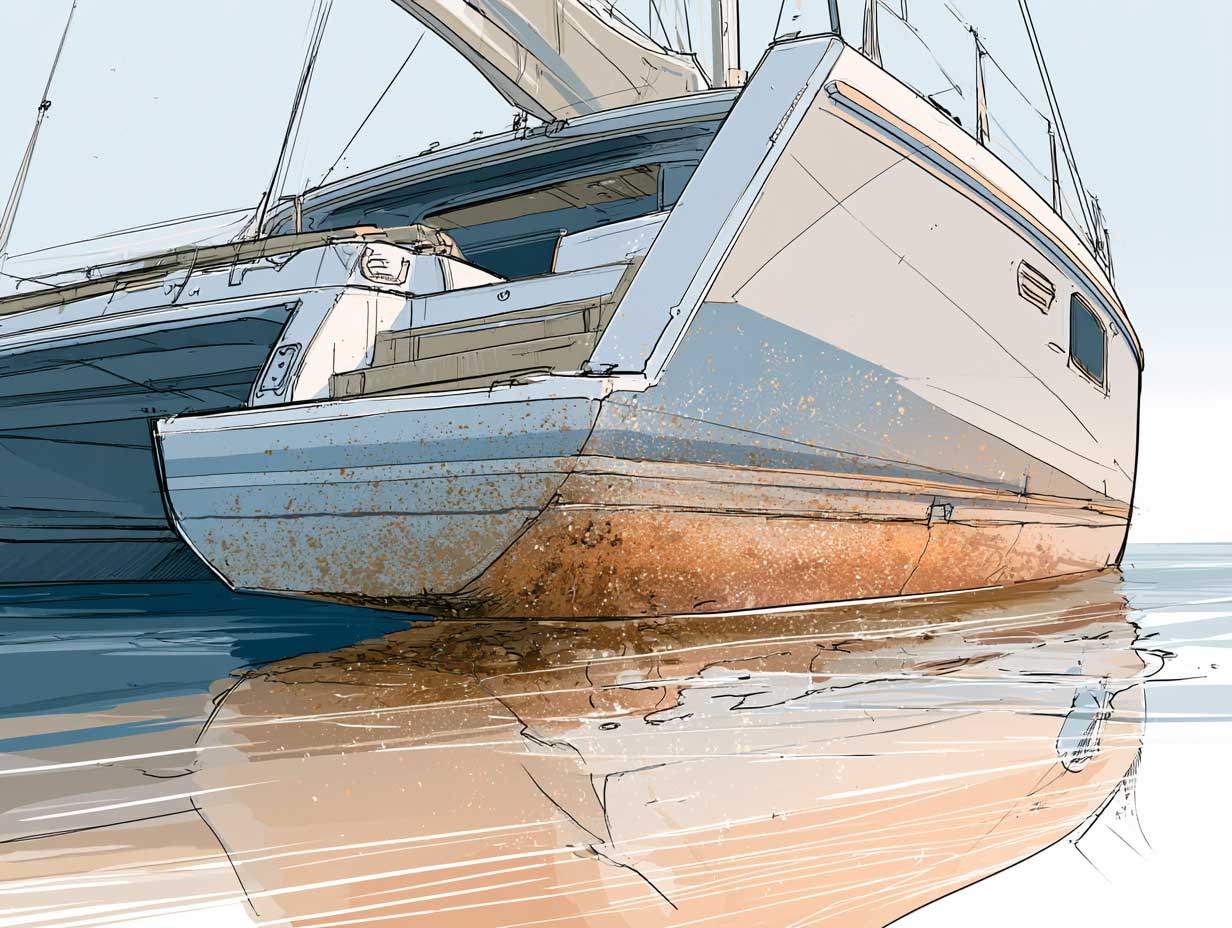
The Right Paint for Your Sailing Area
Choosing antifouling type by sailing area is not a refinement. It is the heart of the decision.
Warm water grows fouling fast. A boat in the eastern Mediterranean or the Caribbean fouls far quicker than one in the Baltic or on Scotland’s west coast. Salinity, current, sunlight and water quality all play a part. A high-copper self-polishing paint that lasts two seasons in cool northern water may struggle to see out a single summer in a Grenada anchorage. Tropical cruisers tend to choose the most aggressive copper loadings their hull and law allow, and accept mid-season scrubs as routine.
Regulation now shapes the shelf as well. Tributyltin has been banned for years. Since 1 January 2023 the biocide cybutryne, sold as Irgarol, is prohibited in new antifouling applications, and the European Union already barred it from sale. Some Dutch and Scandinavian waters restrict copper paints further. An owner cruising widely should confirm what is legal where the boat will float, not only where it is painted.
The Reason We Favour Hard Antifouling at Privilège
Every owner weighs these options differently, and there is no single right answer for all of them. For the sailing programme our clients follow, and for the way we think about maintenance, we favour hard-matrix antifoulings on Privilège yachts today.
The first reason is control of the result. A hard matrix is a known quantity. It is reproducible, repairable and forgiving to apply. Copper-epoxy systems reward a faultless job, but they demand controlled humidity, precise recoat windows and exact preparation. When the application falls short, the result suffers, and years later it is hard to say whether the product, the application or the upkeep was to blame. For a yard that stands behind its boats, that uncertainty is a risk worth avoiding.
The second reason is worldwide compatibility. Privilège owners cruise the Caribbean, the Pacific, the Mediterranean and Scandinavia. A hard matrix can be touched up or recoated in almost any yard on the planet, because every yard knows how to work with it. After a grounding or a structural repair, the coating is made good quickly and locally, without specialist protocols or visible mismatches. For a circumnavigation, that simplicity is itself a feature.
The thinking runs deeper than paint. We tend to choose the most reliable and most maintainable solution rather than the most novel one. The same logic explains our shaft drives, our dedicated engine rooms and our generous tankage. A well-applied hard matrix holds its thickness and its geometry, which keeps the hull surface fair and its behaviour predictable over the long run. That is the kind of dependability an ocean voyage rewards.
The True Cost of Antifouling a Catamaran
The honest figure surprises many first-time cat owners. Professional bottom work runs from roughly €300 per metre (€100 per linear foot) upward for a monohull, and a catamaran can double that because of its two hulls. On top of paint, the yard charges a haul-out fee, commonly €30 to €65 per metre (€10 to €20 per foot), plus storage and labour.
The cost per season therefore lands wide. Paint alone for a 13- to 15-metre (43- to 50-foot) cruising cat often falls between €600 and €1,500, depending on the product. A full professional haul-out, scrub, prep and recoat frequently totals €2,000 to €6,000. Industry surveys put annual routine maintenance for a well-kept catamaran, including haul-out, bottom paint and anodes, at around €3,000 to €5,000. Owners who do their own application save the labour, which is the largest single line, though the physical work across two hulls is considerable.
A copper-epoxy system reframes this maths. The upfront outlay is steep, but spread across ten years it can undercut a decade of annual repaints, provided it performs as intended.
The Art of Annual Haul-Out Planning
Sound annual haul-out planning protects both the hull and the budget. Most cruising yachts repaint every 12 to 24 months, and yard professionals advise hauling before growth takes hold rather than after. Stretching the interval to chase a saving usually costs more later in scraping and lost coating.
Timing should follow the cruising calendar and the climate. A spring relaunch suits a boat laid up over winter, since fresh paint then protects through the active growing season. Book the slot early; well-run yards fill their travel-lift schedule months ahead, and a catamaran needs a wide-enough hoist and hardstand. While the boat is ashore, inspect the propeller shafts, struts, cutless bearings and folding propellers, change the sacrificial anodes and check the through-hulls. These small jobs share the haul-out cost and rarely come cheaper than when the hull is already dry and accessible.
The Application Details That Decide Performance
Even the best antifouling paint for catamaran hulls fails if it is applied poorly. A few application tips separate a clean season from an early scrub.
Preparation comes first. Pressure-wash the hull, remove loose or flaking paint, and lightly wet-sand to give the new coat a key. Confirm compatibility before you start, since most paints want to go over their own family unless a tie-coat primer is used. Apply at the right temperature, usually between 10 and 25 degrees Celsius (50 and 77 Fahrenheit), and respect the drying window before relaunch.
What matters most is film thickness, not coat count. Two coats is the working minimum, with an extra coat at the high-wear zones: the waterline, leading edges, keels, rudders, shafts and struts. A practical trick is a contrasting signal coat applied first; when it shows through next season, the paint is worn and due for renewal. Stir thoroughly and often, because the heavy biocide settles fast and uneven mixing leaves weak spots.
The Clean Hull as Offshore Safety
Before any ocean crossing, hull condition deserves the same attention as rigging, sails and safety equipment. A clean hull is one of the simplest ways to improve safety, autonomy and comfort offshore. It holds boat speed, shortens passages, saves fuel and spares the battery bank that runs everything aboard.
A catamaran rewards this discipline twice over, once per hull. The boat we build is meant to carry its owners across oceans in confidence. A well-chosen, well-applied antifouling keeps it fast, clean and ready for the next horizon, and turns a yard chore into one of the quiet foundations of a good year afloat.