


A true bluewater catamaran is engineered to cross oceans safely. Here is why charter-spec boats fall short and what real offshore capability demands.
The best catamaran for offshore sailing is the one engineered, from the keel up, to cross oceans in safety and in comfort. A real bluewater catamaran is defined by structural strength, generous bridgedeck clearance, careful weight distribution and true self-sufficiency. Charter-spec boats are built around berth count and quick turnaround, and they struggle once the nearest harbour is two weeks astern. Buying the wrong boat is the most expensive mistake in cruising. At Privilège Marine, the ocean crossing is the design brief, not an afterthought. For forty years, our shipyard in Les Sables d’Olonne has built catamarans that are also true floating homes, shaped around their owners. Even fast performance multihulls tend to ease their pace at sea, settling into the steady rhythm a Privilège holds naturally. This article explains what real offshore capability requires, and why it matters before you sign.
The Ocean Does Not Forgive a Charter-Spec Compromise
An ocean crossing is a different discipline from a long coastal hop. The Atlantic trade-wind route from Las Palmas to Saint Lucia runs about 2,700 nautical miles (5,000 km) and takes the average cruising yacht eighteen to twenty-one days. For most of that passage, no safe harbour is within reach. Weather shifts. Squalls arrive at night. Gear works loose. Crews grow tired. The Atlantic Rally for Cruisers, which has guided more than 8,000 boats across the ocean since 1986, exists for one reason: crossing an ocean rewards preparation and punishes improvisation.
A catamaran carries a specific risk here. A monohull can be knocked flat and still right itself. A multihull, once capsized by an exceptional sea, stays inverted. That single fact raises the bar for offshore safety. Motion, structure and seamanship matter more, not less, on two hulls. The boat has to resist the loads, keep the crew rested, and stay controllable when the wind passes Force 8.
The Gap Between a Marina Showpiece and a Sea Boat
Most catamarans look similar at the dock. Wide beam, bright saloon, twin engines, a cockpit built for entertaining. Look closer and the priorities diverge. A charter-spec catamaran is designed around revenue: maximum cabins, fast turnaround, a week at a time in protected waters. Full-beam glass doors and light scantlings serve that life well. They serve an ocean poorly. Multihulls now make up thirty to forty percent of the ARC fleet, and many first-time buyers discover the difference only once provisions, fuel and water are aboard, and the boat sits low and slams in a seaway.
The Anatomy of a Real Bluewater Catamaran
A true bluewater catamaran starts with the structure. Vacuum-infused laminates produce a hull that is stiffer, lighter for its strength and more resistant to impact. Generous bridgedeck clearance keeps waves from hammering the underside of the platform, the slamming that exhausts a crew and stresses the boat. Weight is carried low and central, so the motion stays predictable when the yacht is fully loaded. These choices are invisible in a brochure photograph. They decide how the boat behaves on day twelve.
The Numbers That Separate Ocean Boats From Coastal Ones
Certification gives a useful floor. CE Category A covers vessels built for extended, self-sufficient voyages in winds above Force 8 (over 40 knots) and significant wave heights above 4 m (13 ft), short of abnormal conditions such as hurricanes. Every Privilège is certified CE Category A. The Signature 510 measures 17.09 m (56 ft) and displaces 22.8 t (50,700 lbs) fully loaded. The Signature 600 stretches to 18.28 m (60 ft) and 35 t (77,162 lbs) at full load. That displacement buys reserve. It is the margin that lets a boat carry stores, water and fuel for weeks and still sail with composure.
The Systems That Keep a Crew Independent at Sea
Self-sufficiency is the heart of bluewater capability. A real offshore catamaran carries serious tankage, energy and storage. The Signature 510 holds 800 L (211 gal) of fuel and 600 L (158 gal) of fresh water. The Signature 600 doubles much of that, with twin 485 L (256 gal) fuel tanks and twin 450 L (237 gal) water tanks. Add a watermaker, lithium storage and solar, and the crew stops depending on marinas. Deep storage matters just as much. Food, spares and safety gear need a proper home, not a forward bunk.
The Mistake of Buying the Wrong Boat
Buying the wrong boat is the costliest error in cruising, measured in money and in confidence. A catamaran chosen for its charter-style volume can feel generous at the dock and fragile at sea. Owners then spend heavily to reinforce, re-rig and re-equip, or they simply sail less because the boat is uncomfortable when it matters. The honest test comes three weeks out, short-handed, with the family aboard and the weather turning. A boat-show walkthrough tells you little about that. Short-handed crews in particular need a boat that forgives fatigue.
The Privilège DNA, Forty Years of Ocean Crossings
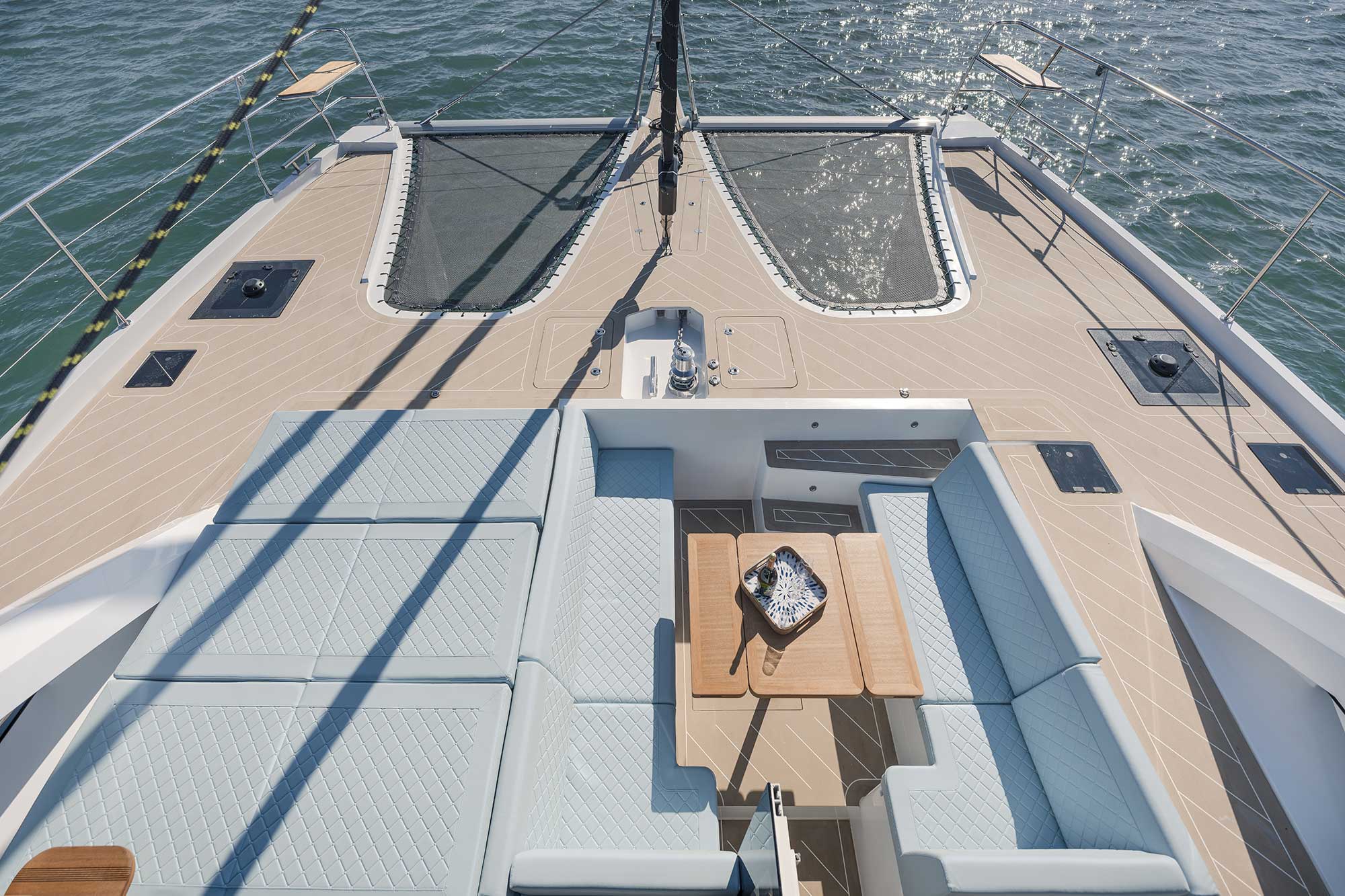
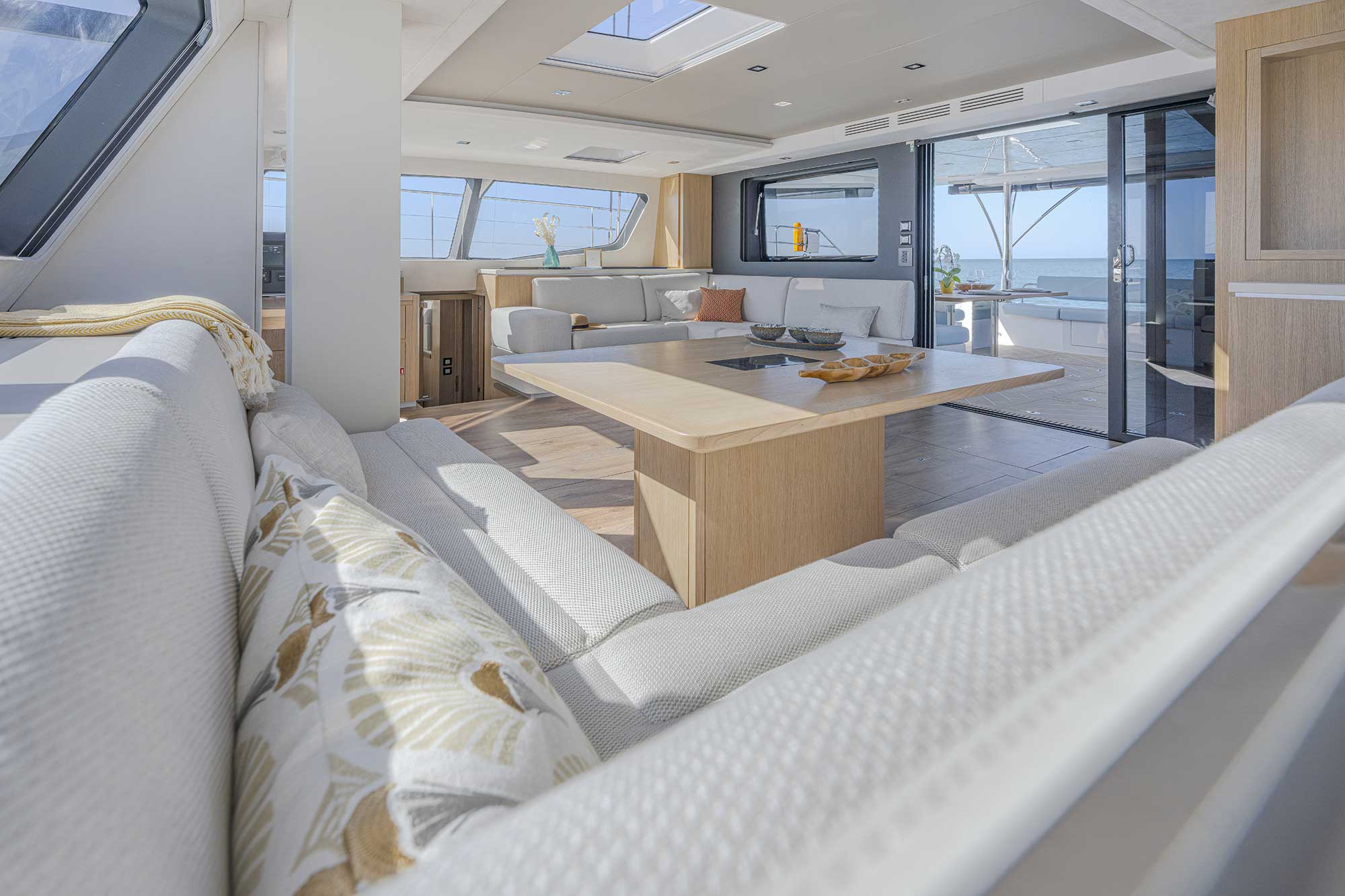
Privilège Marine has built ocean-going catamarans for forty years from Les Sables d’Olonne, on the French Atlantic coast, a town shaped by offshore racing and long-distance sailing. The DNA is plain: boats made to cross oceans, year after year, with confidence. Naval architecture comes from Cabinet Marc Lombard, with interior and exterior design by Darnet Design. Each hull is built to last and tailored to its owner. A Privilège is a true floating home, planned around how a family actually lives aboard, with a full-beam owner’s suite and layouts shaped to the owner’s life rather than to a charter spreadsheet. Safety and comfort are treated as one brief.
The Safety Standard Now Built Into Every Hull
In 2026, Privilège became the first multihull builder to fit SEA.AI as standard across its entire range. The system pairs optical and thermal cameras with artificial intelligence to spot floating debris, lost containers and other craft that radar and AIS can miss, by night or in poor visibility. The Watchkeeper 320 is standard, and the Watchkeeper 1024 is offered as an option. That extra set of eyes earns its place on a night watch, when the off-watch crew is asleep and the sea ahead is dark.
The Pace That Comfort Chooses
Speed sells, and a light performance multihull can post daily runs above 250 nautical miles (460 km). At sea, though, most crews choose comfort over the number on the log. They reef early, ease the boat and protect sleep, gear and nerves. A press of canvas that batters the bridgedeck and throws the off-watch from their bunks makes for a slow, tiring passage, whatever the log says. So the quick cats slow down. They converge on the steady, sea-kindly motion a heavier bluewater design holds without trying. That is the rhythm a Privilège is built around from the first sketch: far, safe and settled, with the saloon still feeling like home when the trades blow up.
The best catamaran for ocean crossings is the one you forget to worry about. It carries its load without complaint, holds its motion through a building sea, and lets the crew arrive rested. That is the standard Privilège has pursued for four decades, and it is why the question deserves a clear answer long before the lines come off the dock.