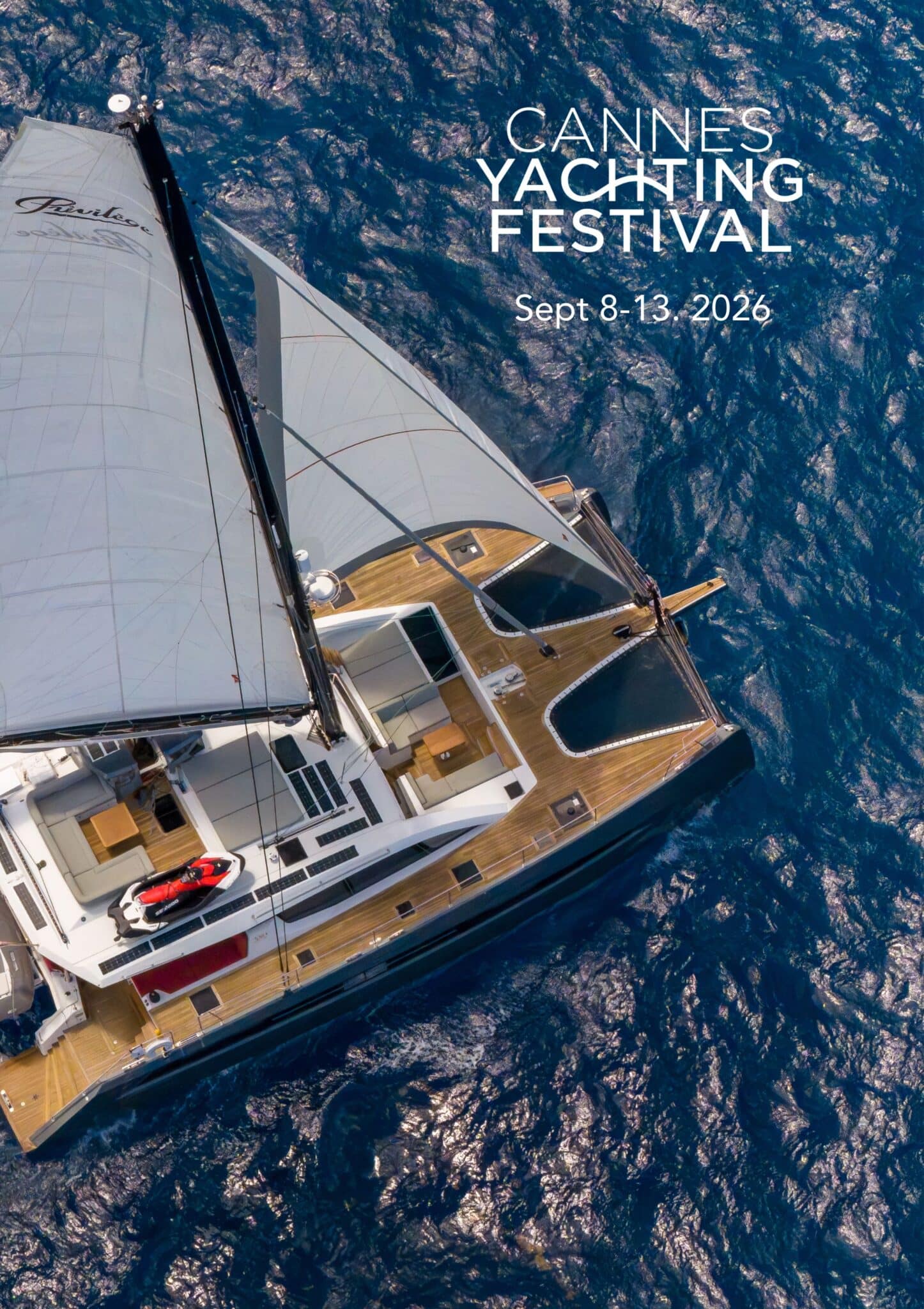
Series production sells a proven specification. Privilège owner-first construction shapes an offshore catamaran around the people who will live aboard.
The difference between a series-production catamaran and an owner-first yacht is not simply the number of options on a price list. It is the order in which decisions are made. Series production begins with factory efficiency, repeatable layouts and a specification designed for a broad market. The owner then selects from what the production system can accommodate. Owner-first construction reverses that sequence. It starts with the owner’s cruising program, privacy needs, crew structure and autonomy requirements, while retaining proven naval architecture. At Privilège Marine, that distinction appears in the full-beam owner’s suite, meaningful interior flexibility, offshore engineering and an after-sales relationship that continues beyond delivery. Series production has legitimate advantages, including speed, familiarity and cost control. But an owner planning years of bluewater cruising is not buying only a platform. The owner is commissioning a long-term operating environment.
The Series-Production Model Is Built Around Repetition
Series production is not inherently inferior. It is an efficient answer to a clear market need. A production catamaran builder reduces variation, repeats manufacturing processes and uses common layouts, joinery modules, wiring plans and option packages across many hulls.
That model improves predictability. It can shorten delivery times, simplify staff training and make parts easier to identify. It also suits owners seeking a familiar layout, controlled pricing or a yacht intended partly for charter.
The compromise is equally clear. The production system defines the limits of the yacht. Layout changes disrupt workflow. Bespoke cabinetry affects drawings and weight estimates. Unusual equipment can alter electrical loads, ventilation and commissioning.
This is why many production ranges offer an “owner’s version” and a “charter version.” The difference often concerns cabin count. One hull becomes a larger private area, while the platform remains largely fixed. That is personalization, but it is not owner-first construction.
The Owner-First Model Begins With the Cruising Program
Privilège Marine works from a proven range rather than designing every yacht from a blank sheet. Repeatable naval architecture, validated structures and established engineering reduce technical risk.
But the first question is different: What must this yacht allow its owner to do?
A couple preparing for a circumnavigation may require extensive stores, redundant communications and easy machinery access. A family may prioritize separate living zones, school space and privacy. An owner using professional crew may need different circulation between service and private areas.
Those choices influence refrigeration, battery capacity, solar generation, water production, ventilation, furniture, technical access and weight distribution. Personalization therefore involves design and engineering, not merely decoration.
Privilège states a typical delivery horizon of about 12 to 18 months, depending on the model and degree of personalization. That timetable reflects limited-production construction to order. The yacht is not treated as stock.


The Owner’s Suite Reveals the Yacht’s Real Priority
The clearest architectural difference is often found in the most private space aboard.
On many catamarans, the owner’s cabin occupies one hull. It can be comfortable, but its proportions remain governed by hull width and a platform designed to support several cabin configurations.
Privilège takes a more structural approach. The Signature 510 uses the forward central nacelle to create a full-beam owner’s suite. The owner is not given a slightly larger cabin inside a guest-oriented plan. The private suite becomes part of the yacht’s architecture.
The Signature 510 is 17.09 meters (56 feet) long and 7.98 meters (26 feet) wide. Its central suite uses that beam to create panoramic views, lateral volume and separation from guest accommodation.
This is the point often missed in comparisons between a production catamaran and a semi-custom catamaran. Usable privacy matters more than nominal cabin count.
The Personalization Must Remain Technically Coherent
Owner-first construction does not mean accepting every request. A serious custom catamaran builder must sometimes say no.
Every appliance consumes power. Larger battery banks add weight. Additional refrigeration creates heat. New furniture can obstruct wiring, plumbing or structural access. Heavy equipment can alter trim and motion.
The shipyard’s role is not to accumulate options. It is to translate a lifestyle into a coherent vessel.
The Signature 600 illustrates this approach through its aft portside cabin. Instead of fixing the space as another guest cabin, Privilège can configure it as an office, gym, cinema, studio, enlarged wardrobe or additional storage area.
The surrounding platform remains controlled. The Signature 600 measures 18.28 meters (60 feet), carries 259 square meters (2,787 square feet) of sail and displaces 35 tonnes (77,162 pounds) at full load. Freedom remains subject to balance, access and reliability.
The Offshore Capability Appears in the Numbers
The phrase “bluewater cruising catamaran” should describe measurable design intent.
The Signature 510 carries 800 liters (211 US gallons) of fuel and 600 liters (158 US gallons) of fresh water. It has a full-load displacement of 22.8 tonnes (50,700 pounds), twin 80-horsepower diesel engines and CE A-12 certification.
The Signature 600 carries 970 liters (256 US gallons) of fuel and 900 liters (237 US gallons) of fresh water. These figures matter because offshore autonomy depends on capacity, access, reliability and load-carrying margin.
European Category A is intended for extended voyages in conditions that may exceed Beaufort Force 8 and significant wave heights of 4 meters (13 feet), excluding abnormal conditions. Certification is not a guarantee against extreme weather. It is a technical baseline.
A series yacht can also be ocean-capable. The honest distinction is that owner-first construction allocates more decisions to the intended voyage, rather than to the broadest possible market.
The After-Sales Philosophy Extends the Build
The difference continues after handover.
In a conventional sales model, support may move progressively from the shipyard to dealers, equipment suppliers and local contractors. That structure can work well when many identical boats create broad technical familiarity.
Privilège treats catamaran after-sales service as part of the ownership product. Owners remain connected through dedicated contacts and WhatsApp assistance groups. The after-sales manager can coordinate the shipyard, captains, marinas, subcontractors and manufacturers. When an important issue requires builder knowledge, a technician can travel to the yacht.
This matters because personalized yachts contain decisions that may not be obvious to an unrelated technician. The builder retains the design history and reasoning behind installations. Continuity reduces diagnostic uncertainty.
Feedback also returns to production. Recurrent failures, difficult access points or supplier weaknesses can be corrected in future yachts.
The Better Choice Depends on Who Should Adapt
A series-production catamaran is often the rational choice for an owner who values quicker availability, established specifications, broad familiarity and disciplined pricing. There is no virtue in paying for customization that will not be used.
Owner-first construction becomes relevant when the yacht will serve as a home, offshore sailing platform and private environment for years. In that case, compromises made for factory repetition can become daily irritations. Poor storage, unsuitable circulation or insufficient technical capacity do not remain small details after several ocean passages.
The divide is straightforward. In series production, the owner adapts to a carefully defined product. At Privilège Marine, a proven offshore platform is adapted, within sound technical limits, to the owner.
That does not mean every yacht should be bespoke. It means serious long-range ownership demands a different order of priorities. The boat must begin with the life it will carry.