Privilège Marine is growing capacity without becoming mass production, protecting quality, personalization and owner-led yacht building.
Privilège Marine is increasing capacity, but we are not becoming a mass-production catamaran builder. That distinction matters. In yacht building, scale can serve two opposite strategies. It can push volume, standardization and speed. Or it can support quality, predictability, skilled teams and better delivery control. Our choice is the second path. We build a limited number of bluewater luxury catamarans each year because every Privilège is shaped around its owner, sailing programme and life aboard. A delivery time of around 12 to 18 months, depending on the model and level of personalization, is not a sign of slowness. It reflects the reality of building a serious offshore yacht. Our growth is therefore not about volume for volume’s sake. It is about strengthening people, know-how, infrastructure and individual follow-up, so that a French boat builder can remain bespoke while becoming more resilient.
The difference between capacity and mass production is not semantic
There is a common misunderstanding in the yacht market. When a shipyard says it is growing, some assume it is preparing to become industrial in the wrong sense of the word. Faster lines. More units. Less individuality. Narrower choices. Lower tolerance for special requests. That is not our strategy.
At Privilège Marine, growth means controlled capacity. It means better planning, stronger teams, improved infrastructure and more reliable delivery. It does not mean turning a bluewater catamaran into a standard product.
This distinction is essential for our owners. A Privilège is not a commodity. It is not bought from stock and handed over after a list of minor options. It is designed around a way of sailing. One owner may want a yacht for family circumnavigation. Another may want professional crew, a full-beam owner’s suite, extra freezer capacity and serious technical storage. Another may need a dedicated office, a flexible guest cabin or a layout adapted for long periods at anchor. These are not decorative choices. They shape the boat.
That is why limited production and personalization must remain linked. If we increase capacity without protecting personalization, we lose the reason owners come to us. If we protect personalization without investing in capacity, delivery can become less predictable. The right answer is not nostalgia. It is disciplined growth.
The Privilège Marine growth story is about quality before quantity
Privilège Marine has been building ocean-going catamarans in Les Sables d’Olonne, on the French Atlantic coast, for more than 40 years. This location matters. Les Sables d’Olonne is not a generic industrial address. It is a serious sailing environment, shaped by offshore culture, ocean racing and the Vendée Globe. Building yachts there means working in a community where long-distance sailing is not an abstract marketing phrase.
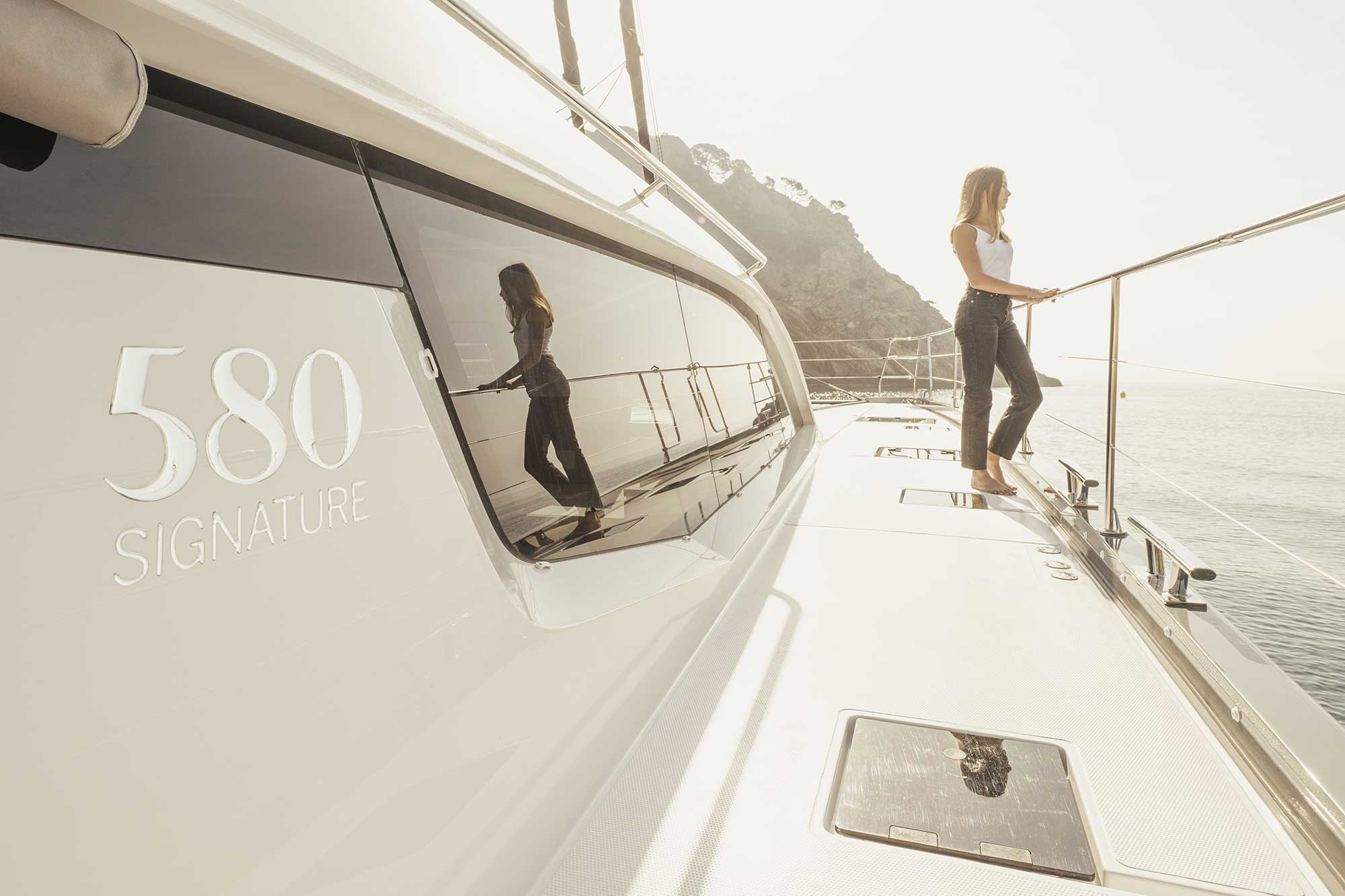
Our current range reflects that position. The Signature 510 is 17.09 m (56 ft) long, with a 7.98 m (26 ft) beam, 165 m² (1,775 sq ft) of sail area and CE A-12 certification. The Signature 580 is 19.10 m (62 ft 8 in) long, with a 9.18 m (30 ft 1 in) beam, 259 m² (2,787 sq ft) of sail area and a full-load displacement of 35 tonnes (77,162 lb). The Signature 650 reaches 19.60 m (64 ft 3 in) in LOA, with a 9.20 m (30 ft 2 in) beam, 264 m² (2,840 sq ft) of sail area and fuel capacity of 2 x 1,000 L (2 x 264 gal).
These are not small boats. They are complex offshore yachts. They require structural integrity, engineering consistency, finish quality and serious systems integration. A 60-foot catamaran is not simply a larger leisure product. It is a moving home, a technical platform and a long-distance sailing machine.
This is why Privilège Marine growth cannot be judged by unit numbers alone. The real measure is whether each yacht remains coherent, reliable and personal.
The limited-production model protects the owner’s yacht
Limited production is sometimes presented as a constraint. In the luxury catamaran sector, it is often a strength.
A small production cadence allows a shipyard to stay close to each project. It protects the dialogue between owner, sales team, design office, production team and after-sales support. It also allows better attention to choices that are difficult to standardize: interior layouts, circulation, material selection, cabinetry, storage, technical options, navigation equipment and owner-specific uses.
The Signature 600 illustrates this logic. It is not simply a catalogue model with a fixed interior. One of its strongest ideas is the reimagined aft portside guest cabin as a flexible space. It can become a home cinema, a gym, a dedicated office, additional storage, an artist’s studio or an XXL walk-in wardrobe. This is not a gimmick. It shows how a yacht can adapt to the owner’s real life.
That is the opposite of mass production. Mass production tends to reduce variation because variation complicates flow. Our model accepts complexity because it creates value. The goal is not to build identical yachts more quickly. The goal is to build fewer yachts with greater relevance.
A Privilège is never standard in the strict sense. It starts from proven naval architecture and a coherent range. But it becomes personal through the details that matter aboard: where the owner sleeps, where the crew moves, where the tools are stored, where the children study, where the watchkeeper rests, where technical access is kept clear and where guests can enjoy privacy without taking over the boat.
The delivery time reflects the real work behind a bluewater and bespoke catamaran
A delivery time of around 12 to 18 months, depending on the model and level of personalization, should be read honestly. It is not a delay. It is the normal time required to build a serious owner-led yacht.
A bluewater catamaran has several lives before launch. The project begins with the owner’s brief. Then come layout choices, technical specification, materials, systems definition, composite construction, structural assembly, joinery, electrical installation, plumbing, mechanical integration, deck hardware, rig preparation, finishing, commissioning and sea trials. Each phase affects the next.
Rushing this process is not a virtue. It can create hidden costs later. Poor access to systems becomes a maintenance problem. Weak planning creates rework. Late changes can affect weight, balance, wiring routes, ventilation or storage. A yacht built for ocean crossing cannot be treated like a seasonal consumer product.
This is why we invest in planning and people. The objective is not to promise impossible speed. It is to make the build process more reliable, more transparent and better controlled. Owners deserve clear follow-up. They also deserve a yacht that has not been compromised to satisfy a production target.
In luxury yacht building, the fastest answer is not always the best one. The best answer is the boat that still feels right after five years of ownership.
The investment in people is the real foundation of scale
A shipyard does not grow because a spreadsheet says it should. It grows when its people can absorb complexity without losing precision.
At Privilège Marine, investment in people is central to our luxury catamaran brand strategy. Composite specialists, engineers, cabinetmakers, electricians, plumbers, painters, upholsterers, rigging teams, project managers and quality-control staff all shape the final yacht. Their work is visible in different ways. Some of it is obvious, such as woodwork, upholstery and interior finish. Much of it is hidden, such as bonding, wiring, routing, reinforcement, access panels and technical installation.
The hidden work is often the most important. Owners rarely buy a yacht because a cable route is clean or a technical locker is well organized. But they appreciate it when something needs inspection at sea. They appreciate it when maintenance is possible without dismantling half the interior. They appreciate it when systems are logical, accessible and robust.
This is where know-how becomes value. It cannot be rushed into existence. It must be trained, transmitted and protected. A shipyard that grows too quickly can dilute its own knowledge. A shipyard that grows carefully can strengthen it.
For us, team expansion is therefore not about putting more hands on the same line. It is about protecting the quality of decision-making at every stage of the build.
The infrastructure must support craftsmanship rather than replace it
There is a false opposition between craftsmanship and modern infrastructure. A serious French boat builder needs both.
Craftsmanship without proper infrastructure can become fragile. It may depend too much on individual improvisation. Infrastructure without craftsmanship can become sterile. It may produce consistency without character. The Privilège model needs the two together.
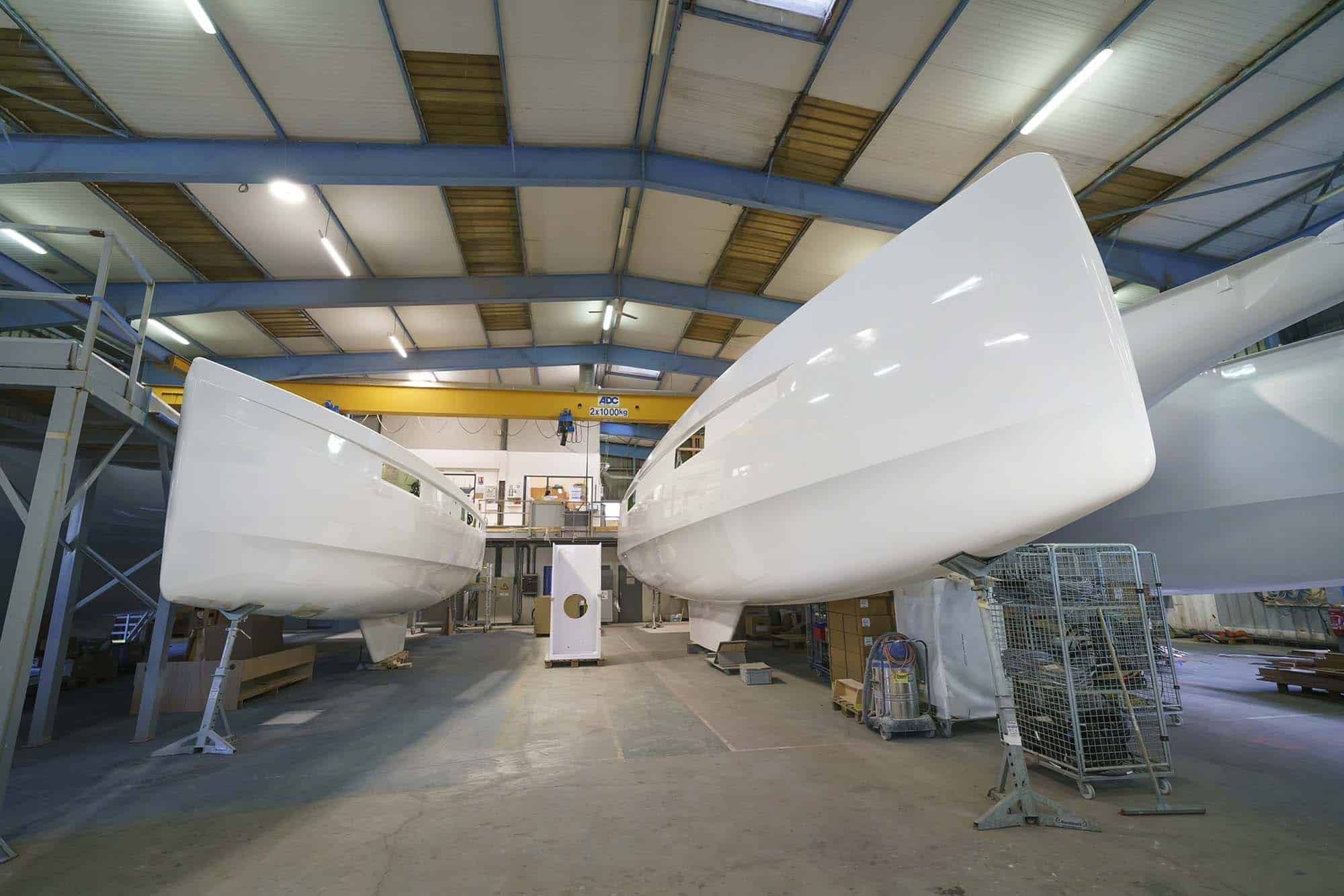
Quality infrastructure means better working conditions, better organization, better storage of materials, better control of production stages, better sequencing and better coordination between trades. It allows the team to spend time on precision rather than correction. It also reduces the risk of errors when several complex projects move through the yard at the same time.
This is the useful meaning of scale. Scale should not flatten the product. It should give the shipyard the tools to build bespoke yachts more reliably.
The European recreational boatbuilding sector is diverse. It includes thousands of companies, from series builders to one-off specialists. That diversity matters because not every boat has the same purpose. A dayboat, a charter catamaran, a racing yacht and a private bluewater catamaran do not require the same industrial logic.
Our infrastructure must reflect our purpose. We are not building for the broadest possible market. We are building ocean-going catamarans for owners who expect robustness, comfort, autonomy and a high level of individual definition.
The owner follow-up is part of the product
In a mass-market approach, the product is often defined by the unit itself. In our world, the product includes the relationship.
Individual follow-up is not a luxury extra. It is part of the build. The owner’s choices must be understood, documented, challenged when necessary and translated into a coherent yacht. A good shipyard does not say yes to everything without thinking. It explains consequences. It protects the project. It helps the owner distinguish between a useful customization and a decision that may create problems later.
This is where experience matters. Extra equipment has weight. More storage changes usage. Larger battery banks affect energy management. More refrigeration increases electrical demand. A different cabin use can change ventilation, lighting, access and noise. A yacht is a system. Personalization has to respect that system.
That is why individual follow-up is technical as much as commercial. It requires listening, but it also requires judgment. Our role is not simply to deliver a dream image. It is to build a yacht that can live safely, comfortably and intelligently at sea.
That is why each Privilège is different. The difference is not randomness. It is the result of a structured conversation between the owner’s vision and the shipyard’s experience.
The luxury catamaran market rewards coherence, not noise
The luxury catamaran market has grown more visible in recent years. Owners want space, stability, autonomy and a more residential way of living at sea. Catamarans also appeal to families and long-distance sailors because they offer generous volume and a different relationship with the water.
But visibility can create pressure. Brands can be tempted to chase volume, widen distribution too fast and promise shorter delivery times than the product deserves. That may work for some segments. It is dangerous for bespoke bluewater yachts.
A serious luxury catamaran brand strategy must be more patient. It must ask what the brand should never compromise. For Privilège Marine, the answer is clear: offshore capability, owner-led personalization, French craftsmanship, reliability and long-term comfort.
Growth must reinforce those principles. It must not blur them. A larger team should improve build control. Better infrastructure should improve quality. More capacity should reduce production bottlenecks. Clearer planning should help owners understand the process. None of these things require us to become a mass-production builder.
The market does not need another brand trying to be everything to everyone. It needs builders that know exactly what they are for.
The future of Privilège is measured in trust
We are growing capacity because the shipyard needs to serve owners with greater strength, clarity and resilience. But we are not changing the nature of what we build.
A Privilège will remain a limited-production yacht. It will remain personal. It will remain built around the owner’s sailing project, not around a factory’s need for repetition. It will continue to take time because serious work takes time. A 12-to-18-month delivery horizon is not a weakness when the result is a yacht designed for years of navigation.
The honest promise is this: we are not scaling to become ordinary. We are scaling so that our standards can be delivered with more consistency.
That is the line we intend to hold. Capacity must serve quality. Growth must serve know-how. Infrastructure must serve craftsmanship. And every Privilège must still feel like what it has always been: a yacht designed with its owner, built for the ocean and shaped to last.