


A clear guide to keel types, foils and daggerboards, and how each choice changes stability, speed, draft and offshore comfort.
A keel is not just a piece of structure below a yacht. It is one of the design decisions that defines how the boat moves, heels, tracks, turns, accelerates, dries out, grounds, and survives heavy weather. On a monohull, the keel normally carries ballast and creates both righting moment and lateral resistance. On a multihull, stability comes mainly from beam, not ballast, so the underwater appendages serve a different purpose: they reduce leeway, protect the hulls, manage draft, or, in extreme cases, create lift. That distinction matters. A long keel favours tracking and protection. A cruising fin keel balances performance and usability. A racing fin keel cuts drag and adds leverage. A canting keel separates ballast from symmetry. Daggerboards sharpen windward performance. Foils change the equation again by lifting part of the boat out of the water. There is no universal winner. There are only honest trade-offs.
The keel is the boat’s hidden contract with the sea
At Privilège Marine, we look at appendages through a bluewater lens. A yacht must sail well, but it must also remain understandable, serviceable and safe when the nearest shipyard is several days away. That is why the debate around sailboat keel types should never be reduced to speed alone.
A keel performs two main functions. First, it resists sideways drift, known as leeway. Second, on a monohull, it often carries ballast, which helps the yacht stand back up after being pushed over by the wind. These two jobs are not identical. A deep, narrow foil creates efficient lateral lift. A heavy bulb placed low creates stability. Designers combine these functions in many ways.
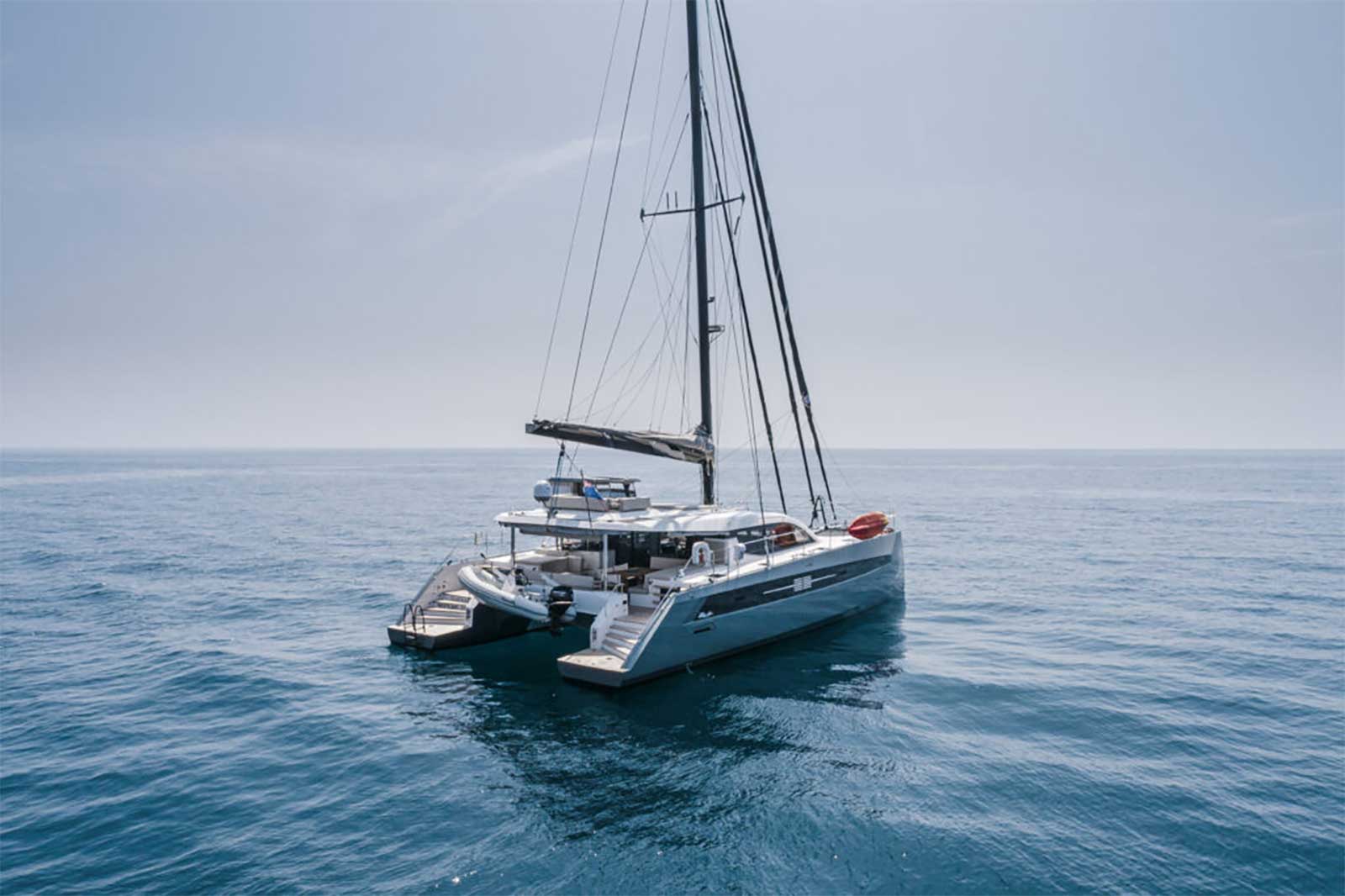
On a catamaran or trimaran, the story changes. The boat does not rely on a deep ballast keel to stay upright. Its wide stance creates stability. A Privilège Signature 510, for example, has a beam of 7.98 metres (26 ft), a draft of 1.57 metres (5 ft 10 in) and a light displacement of 16.8 tonnes. The larger Signature 650 has a beam of 9.20 metres (30 ft 2 in) and a draft of 2.04 metres (6 ft 8 in). These figures show the point clearly: a bluewater cruising catamaran gains stability from its platform, not from dragging several tonnes of lead deep below the hull.
That is why the language must be precise. A “keel” on a monohull is usually a ballasted appendage. A “keel” on a cruising catamaran is often a shallow fixed fin or skeg-like structure that protects the hull and provides lateral resistance. It is not the same object, even if the word is the same.
The long keel trades speed for tracking and protection
The long keel, often called a full keel in English, is the oldest serious offshore solution. It runs along much of the hull length. It gives directional stability, protects the rudder and propeller, and gives the boat a steady feel at sea. In heavy following seas, that steadiness can be reassuring.
The price is agility. A long-keel yacht does not tack with the crispness of a modern fin-keeler. It also reverses poorly in marinas. The boat likes to go straight. That is valuable offshore and frustrating in tight harbours.
Brands such as Island Packet have long defended the concept for offshore cruising. Their “Full Foil Keel” approach is built around seakeeping, grounding protection and control. This makes sense for conservative bluewater owners. It makes less sense for sailors who want acceleration, pointing ability and lively handling.
The frank view is simple: a long keel is not slow because it is badly designed. It is slower because it accepts more wetted surface and less hydrodynamic efficiency in exchange for tracking, protection and psychological comfort. For some owners, that is a fair exchange. For others, it is a brake.
The centreboard brings freedom in shallow water
The French term “dérive” can be misleading when translated into English. In most yacht contexts, the right words are centreboard, swing keel, lifting keel, or daggerboard, depending on the geometry. If the board pivots, “centreboard” or “swing keel” is usually correct. If it moves vertically, “daggerboard” or “lifting board” is more precise. If its angle can be adjusted for performance, “adjustable daggerboard” or “canted daggerboard” may be appropriate.
A centreboard lets a yacht reduce draft in shallow water and increase lateral resistance offshore. This is useful in tidal regions, lagoons, rivers and shoal cruising grounds. It allows a boat to explore anchorages that a deep fin keel cannot reach.
The trade-off is engineering. A centreboard case occupies interior volume. The pivot, lifting system and sealing surfaces require inspection. In a grounding, the loads can be severe. On a serious cruising yacht, the system must be simple, strong and accessible. If it is not, the promise of versatility becomes a maintenance liability.
The RM 1380 is a useful example of the concept in practice. It offers either twin keels with a draft of 1.95 metres (6 ft 5 in), or a lifting keel with draft ranging from 1.45 metres to 3.35 metres (4 ft 9 in to 11 ft). That spread shows the power of the idea: shallow-water access when lifted, deep lateral plane when lowered.
The bilge keel puts tidal freedom ahead of peak speed
The bilge keel, or twin keel, uses two shallow keels placed to port and starboard. It is often seen in tidal regions such as Britain and northern France, where boats may need to dry out upright on mud, sand or a harbour bed.
Its advantage is practical. A twin-keel yacht can take the ground without a cradle. It can also reduce draft and protect the hull in coastal cruising. For sailors who operate in tidal harbours, this matters more than an extra half-knot of theoretical speed.
The cost is hydrodynamic. Two keels create more wetted surface. They are usually less efficient upwind than a single deep fin. As the boat heels, the immersed keel may not produce the same clean lift as a deep central foil. The result is more leeway and lower pointing ability.
This does not make the bilge keel a poor design. It makes it a regional and operational design. If the yacht’s life includes drying harbours and shallow estuaries, it is rational. If the programme is ocean passage-making with long upwind legs, it is less convincing.
The cruising fin keel became the modern default for good reason
The cruising fin keel is the most common compromise in modern monohull yacht design. It is shorter than a long keel, deeper and more efficient, with a separate spade rudder. It gives better manoeuvrability, better tacking and less wetted surface.
A family cruiser such as the Beneteau Oceanis 30.1 illustrates the range. It is offered with draft options from about 1.30 metres (4 ft 3 in) to 2.30 metres (7 ft 7 in), depending on configuration. Larger cruisers follow the same logic. The Oceanis 47 lists a minimum draft of 1.87 metres (6 ft 2 in) and a maximum draft of 2.47 metres (8 ft 1 in). The owner chooses between shallow-water convenience and deeper-water efficiency.
The cruising fin keel is not glamorous, but it is effective. It works for coastal cruising, club racing, charter fleets and offshore passages. It gives acceptable speed without radical systems. It is also easier to produce at scale.
Its weakness is exposure. A fin keel is more concentrated structurally than a long keel. Grounding loads are transferred through a smaller area. The keel-to-hull structure must therefore be engineered and inspected properly. When owners neglect this, the problem is not the concept. It is maintenance and structure.
The racing fin keel turns ballast into leverage
The racing fin keel is more extreme. It is deeper, narrower and often carries a bulb at the bottom. The objective is to place ballast as low as possible while reducing drag. The fin provides lateral resistance. The bulb provides stability. The hull can then be lighter, wider and more powerful.
This is the world of sportboats, grand-prix racers and offshore race yachts. The J/70, for example, uses a lifting keel with a stainless-steel structure and lead bulb. It is only 6.93 metres (22 ft 9 in) long, with a draft of 1.50 metres (4 ft 11 in), displacement of 795 kg and ballast of 285 kg. Those numbers show a simple principle: even a small racing keelboat uses ballast depth to turn sail power into speed.
The deeper the keel, the more efficient the righting moment. But there are costs. Deep draft limits cruising grounds. The structure must be precise. The boat may be harder to handle in shallow marinas. For a racing crew, those costs are acceptable. For a bluewater family yacht, they often are not.
A racing fin keel is not “better” than a cruising fin keel. It is narrower in purpose. It converts design freedom into performance, then charges the owner in draft, loads and operational limits.
The canting keel changes the physics of righting moment
The canting keel is one of the most important inventions in modern offshore racing. Instead of keeping the ballast on the centreline, hydraulic rams swing the keel to windward. This increases the horizontal distance between the ballast and the centre of buoyancy. In plain English, the same ballast becomes more powerful.
The Volvo Ocean 65 is a clear example. It is a 22.14-metre (72 ft 8 in) offshore racing monohull with a maximum draft of 4.78 metres (15 ft 8 in), an empty weight of 12,500 kg, and a canting keel that moves to plus or minus 40 degrees. It also carries twin daggerboards and ballast tanks. That is not a cruising compromise. It is an integrated racing machine.
The benefit is speed. The yacht can carry more sail area for the same ballast weight. It can remain powerful in conditions that would force a conventional keelboat to reef earlier.
The cost is complexity. A canting keel depends on bearings, rams, hydraulics, sensors and emergency systems. It also loses lateral efficiency when canted because the keel is no longer vertical. That is why canting-keel yachts usually need daggerboards or foils to provide side force. The ballast does the stabilising. The boards do the gripping.
For a race boat, that separation is brilliant. For a cruising yacht, it is usually excessive.
The canting keel with daggerboards separates power from grip
The combination of canting keel and daggerboards is central to IMOCA 60s and other high-performance offshore monohulls. The IMOCA class is limited to 18.28 metres (60 ft), with boats built to be light, powerful and strong enough for the Vendée Globe. Modern IMOCA yachts use a canting keel for righting moment, two rudders, and either foils or daggerboards for lateral resistance and lift.
This architecture is sophisticated because it breaks the old logic of the keel. The keel is no longer expected to do everything. Once it cants to windward, its job is primarily to create stability. The daggerboard or foil on the leeward side generates much of the side force needed to stop the boat sliding sideways.
The performance gain is real. Designers can reduce displacement, increase sail power and manage the hydrodynamic load more precisely. But the system demands skill. Board angle, foil rake, keel cant and rudder load all interact. If the crew gets the setup wrong, the boat can become slower, not faster.
This is the point often missed in simplified discussions of “advanced keels”. The faster the appendage package becomes, the more it becomes a system. The keel is no longer a single answer. It is part of a moving network of loads.
The foils turn appendages into lifting surfaces
The foils debate is sometimes romanticised. Foils do not magically make every yacht better. They create hydrodynamic lift. That lift can reduce displacement, cut hull drag and increase speed. But foils also add load, ventilation risk, impact exposure and structural complexity.
In the America’s Cup, the AC75 goes further than almost any other monohull. It has no conventional keel. Its large canting foil arms provide lift and righting leverage, while the boat flies on the leeward foil with the windward arm raised. It is a spectacular technical answer to a racing rule. It is not a sensible template for ocean cruising.
In the Ultim trimaran world, foils have pushed offshore multihulls into another speed category. The 32-metre Gitana 17, Maxi Edmond de Rothschild, has exceeded 40 knots under sail. The newer Gitana 18, also 32 metres, has been reported with foil wings spanning more than 10 metres and a design objective centred on sustained ocean flight. These boats are laboratories as much as yachts.
On IMOCA 60s, foils have transformed reaching performance. They help lift the hull, reduce drag and stabilise the boat at high speed. Yet they remain retractable because offshore reality is brutal. Floating objects, slamming loads and Southern Ocean sea states punish exposed appendages.
For cruising owners, the honest conclusion is clear. Foils are fascinating. They are not automatically appropriate. A yacht designed for private bluewater voyaging must prioritise repeatable performance, repairability and comfort. Flying is exciting. Arriving safely matters more.
The multihull problem is different from the monohull problem
A multihull does not need a heavy keel to stand up. It relies on beam. This single fact changes the entire appendage debate.
On a catamaran, underwater fins mainly reduce leeway and help the boat sail closer to the wind. They may also protect the hull, propeller and rudder. They are not ballast keels. That is why comparing a monohull keel with a catamaran keel can be misleading.
A fixed mini-keel on a cruising catamaran is simple, strong and useful. It protects the hull if the boat touches bottom. It allows moderate draft. It does not intrude into the living space. It requires little handling. For a long-distance cruising catamaran, these are serious advantages.
A daggerboard catamaran can sail higher and faster, especially upwind. The board is a more efficient foil. It can be lifted off the wind to reduce drag and lowered upwind to increase grip. Performance catamarans use this logic well.
But daggerboards bring trade-offs. The cases take interior space. The boards need controls. They can be damaged by grounding or debris. If a board jams offshore, the owner must solve the problem at sea.
At Privilège Marine, our design culture is shaped by bluewater cruising. The aim is not to win a windward-leeward race. It is to cross oceans with confidence, carry stores, protect the crew, and offer a stable life aboard. That is why draft, appendage protection, structural simplicity and helm balance matter as much as pure speed.
The fixed mini-keel prioritises reliability on cruising catamarans
The fixed mini-keel is often underestimated because it is not fashionable. It should not be. On a cruising catamaran, it offers a practical package: shallow draft, hull protection, simple construction and predictable handling.
For an owner planning the Caribbean, the Pacific islands or long Mediterranean passages, these qualities count. The yacht can approach anchorages with less anxiety. There is no board to raise before every shoal. There is no case cutting through the accommodation. There is less to break.
The performance penalty exists. A fixed mini-keel creates more drag than a clean retractable daggerboard when the board is correctly managed. It also points lower. A performance catamaran may feel sharper and faster with daggerboards.
The question is not whether one is faster. The question is whether the speed gain is worth the operational cost. For many luxury bluewater catamaran owners, the answer is no. Ease of use is not a weakness. It is a design requirement.
The daggerboard rewards active sailors
The catamaran daggerboard is the performance sailor’s answer to leeway. It gives a deeper, cleaner foil without forcing the whole boat to carry permanent draft. Upwind, it improves lift. Reaching and running, it can be lifted to reduce drag.
This is an elegant solution for sailors who enjoy trimming the boat actively. It is also useful in light displacement multihulls, where small reductions in drag produce visible speed gains.
But the board is not free. It adds structure, cost and handling. It can slam in its case if poorly controlled. It can be damaged by grounding. It can create noise. It can also give the owner another system to manage when conditions deteriorate.
For a performance crew, that is acceptable. For a family crossing an ocean at night, simplicity may have more value than a few degrees of pointing ability.
The real choice is not speed versus comfort, but risk versus purpose
The keel conversation is often framed badly. People ask which keel is best. The better question is: best for what?
A long keel is credible for conservative offshore voyaging. A bilge keel is rational for tidal cruising. A cruising fin keel is the modern mainstream because it balances performance, cost and handling. A racing fin keel is a lever for speed. A canting keel is a racing tool. A canting keel with daggerboards is a system for elite offshore performance. Foils are a separate revolution, powerful but unforgiving. On multihulls, fixed keels, daggerboards and foils are not substitutes for ballast. They are instruments for grip, protection and lift.
For Privilège Marine, the priority is clear. A bluewater catamaran must be safe, balanced, repairable and calm enough to make distance without exhausting its crew. Performance matters. But performance without serenity is the wrong bargain for an owner’s yacht.
The underside of a yacht rarely appears in the brochure photograph. Yet it is where much of the truth lives. The keel, board or foil decides how much freedom the owner really has: freedom to cross oceans, freedom to enter shallow anchorages, freedom to sail efficiently, and freedom from unnecessary complication. That is why appendage design is not a technical footnote. It is one of the most honest statements a naval architect makes.