From twin engines and anchors to dual autopilots and segregated power, Privilège builds critical redundancy into safer ocean-crossing yachts.
On an ocean crossing, reliability is not the same as redundancy. A reliable component is expected to work. A redundant system allows the yacht to continue safely when that component does not.
This distinction shapes the engineering of a Privilège bluewater catamaran. Most critical functions can be duplicated, separated or supported by an independent fallback. Twin engines provide two propulsion sources. Separate tanks limit the consequences of contamination or leakage. Multiple bilge pumps protect different compartments. A second anchor provides another means of securing the yacht. A properly designed dual-autopilot installation protects a short-handed crew from one of the most disruptive offshore failures.
The principle extends to electricity, communications, navigation and emergency steering. Yet redundancy must be genuine. Two instruments connected to the same network, power supply or sensor can fail together.
Privilège Marine’s semi-custom approach allows redundancy to be designed around the owner’s route, crew, technical ability and appetite for independence.
The Ocean Exposes Every Single Point of Failure
A yacht crossing the Atlantic may spend two or three weeks beyond immediate technical assistance. A Pacific passage can keep the crew far from specialist support for much longer.
In those conditions, a minor defect can become an operational problem. A failed refrigerator is inconvenient. A failed steering system, charging source, bilge pump or anchor windlass can change the safety of the passage.
The central question is therefore not whether equipment is considered reliable. It is whether the yacht can continue operating after that equipment fails.
Reliability reduces the probability of failure. Redundancy reduces its consequences.
This is the logic behind redundant marine systems. It is also one of the clearest differences between a yacht prepared for coastal holidays and a genuine bluewater cruising catamaran.
European Design Category A applies to craft designed for extended voyages and largely self-sufficient operation in demanding conditions, excluding abnormal events. The current Privilège range is certified in Category A, but certification should be viewed as a technical foundation. It does not define every detail of an owner’s offshore specification.
The Twin Engines Provide More Than Additional Power
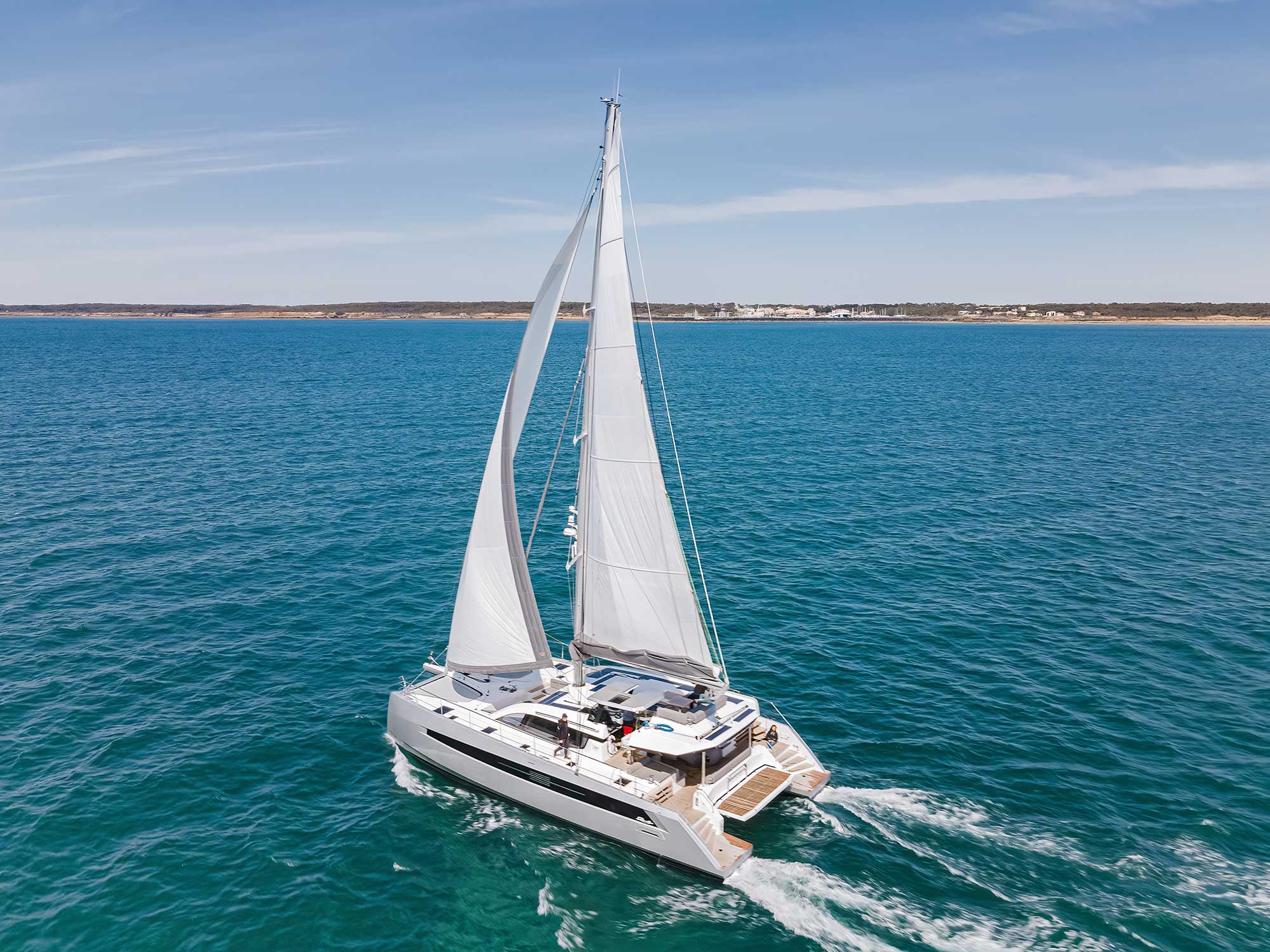
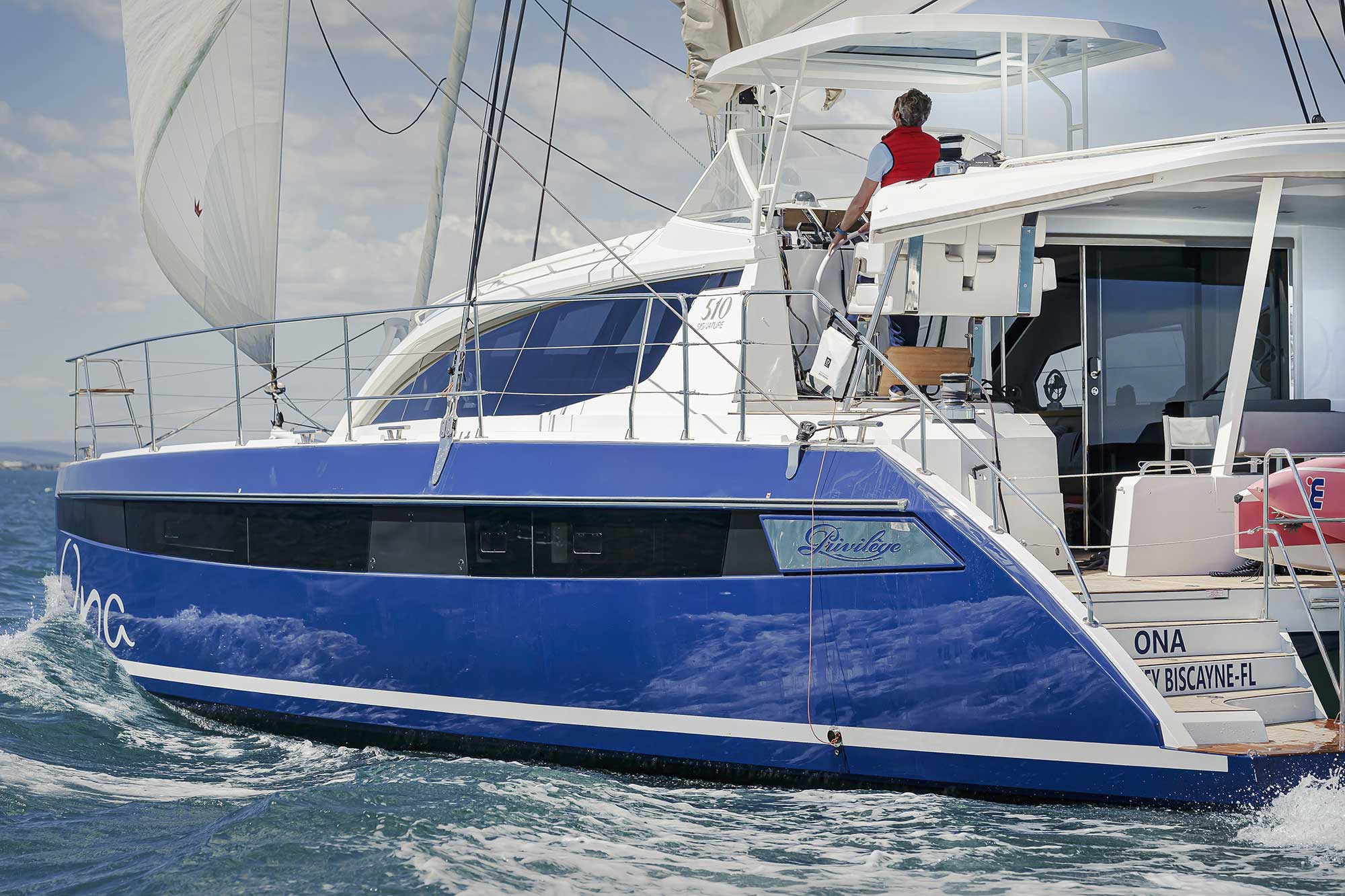
Every current Privilège model uses two diesel engines. The Signature 510 has twin 80 hp engines. The Signature 600 uses two 110 hp units. The Signature 650 carries two 150 hp engines. Each engine is installed in a separate hull.
This is partly inherent to the catamaran platform. It is also a major form of propulsion redundancy.
If one engine becomes unavailable, the yacht retains a second propulsion source. It can continue making progress in calm conditions, charge batteries and manoeuvre with reduced capability. The remaining engine does not reproduce the performance of both units. Nor does it make an engine failure irrelevant. It provides options.
Separation matters. Two engines installed beside each other and supplied through the same vulnerable systems would offer weaker redundancy. On a catamaran, the engines, exhausts, transmissions and seawater circuits can be distributed between the two hulls.
The installation must still be designed carefully. Fuel contamination can affect both engines if they are filled from the same source. Shared electrical controls can create common failure points. A fire, flooding event or damaged cable route can also disable more equipment than expected.
Two engines are valuable because they are separated.
Privilège’s technical installations are designed to remain visible and accessible. A published technical review of the Signature 510 noted the clear arrangement of its raw-water intakes, strainers, fuel filters, plumbing and machinery. Access does not sound glamorous, but it determines whether a crew can identify and repair a problem at sea.
The Separate Tanks Contain Problems Before They Spread
Redundancy is also visible in the yacht’s tankage.
The Signature 600 carries two 485-litre fuel tanks and two 450-litre freshwater tanks. The Signature 650 increases this to two 1,000-litre fuel tanks and two 650-litre water tanks. A tested Signature 510 was documented with two 400-litre fuel tanks and two 300-litre water tanks.
The purpose is not simply to create more capacity.
Two tanks can help preserve trim. They can also contain the consequences of leakage, contamination or a defective gauge. If the plumbing allows the crew to isolate each tank, clean fuel or water can remain available when the other side becomes unusable.
That last condition is essential. Two tanks connected permanently through common valves and pipework may behave like one larger tank. Physical duplication without isolation is incomplete redundancy.
A proper long-range configuration should allow the crew to identify the source in use, close cross-connections and protect uncontaminated reserves. The same principle applies to filters. Twin switchable fuel filters can allow one element to be serviced while the engine continues operating through the other.
The Backup Anchor Is an Independent Safety System
Anchoring is often treated as a matter of convenience. Offshore sailors know otherwise.
A primary anchor can be lost, damaged or trapped beneath an obstruction. Its windlass can fail. The chosen anchor may also be poorly suited to the seabed. A design that performs well in sand may be less effective in weed, soft mud or rock.
A long-distance Privilège can therefore be prepared with a principal anchor and a fully operational secondary anchor. The second anchor should have its own suitable rode, shackles and deployment method. Carrying an anchor without the equipment needed to use it quickly is little more than carrying ballast.
The secondary system can serve several purposes. It can replace a lost primary anchor. It can secure the yacht when the main windlass is unavailable. It can be deployed from the stern. It can also help control the yacht in a restricted anchorage or changing current.
The two anchors need not be identical. In many cases, different geometries provide better coverage across different seabeds.
The second anchor must be ready, not merely stored.
This is especially important on a large cruising catamaran. The windage generated by the coachroof, mast and superstructure can be substantial. The loads on the ground tackle rise quickly when wind strength increases.
The Dual Autopilot Protects the Crew’s Ability to Function
Few systems work harder during a long passage than the autopilot.
On an ocean crossing, the pilot may steer for hundreds of hours. It works while the crew sleeps, prepares food, checks weather information, makes repairs and reduces sail. On a short-handed yacht, its failure immediately changes the watch system.
A spare control display is not a second autopilot.
A credible dual-autopilot sailing yacht should duplicate the components most likely to stop the system: the computer, heading reference, drive or actuator, control interface and electrical protection. The two systems should share as little as reasonably possible.
If two autopilot computers depend on one drive unit, one power feed and one network backbone, the redundancy is limited. If the drive fails, both computers become irrelevant.
On a Privilège intended for serious long-distance cruising, the owner can specify a more complete dual-autopilot architecture. The correct design depends on the yacht, steering arrangement and intended route. It may use two independent computers with separate drives, sensors and protected supplies. It should also preserve a manual or emergency steering method.
World Sailing’s offshore safety regulations provide a useful benchmark. They require an emergency tiller in many offshore categories and a proven method of steering when the rudder itself is disabled. They also recognise the value of two steering methods that do not share components apart from the rudder stock.
The principle is clear: The backup must survive the primary failure.
The Bilge System Uses Several Layers of Protection
A bilge pump is not a damage-control system by itself. Its first role is to remove normal water accumulation. Yet multiple pumps, alarms and manual alternatives give the crew time to locate a leak and respond.
A published review of the Signature 510 listed four electric bilge pumps and two manual pumps. This creates more than simple duplication. It creates distributed protection across the two hulls and provides a manual fallback if electrical power is lost.
A serious arrangement should include high-water alarms in relevant compartments. The alarm is often as important as the pump. A pump can operate quietly while the source of ingress worsens.
The crew must also be able to reach strainers, test float switches and operate manual pumps under difficult conditions. A sophisticated pump hidden behind fixed furniture is less useful than a simpler system that can be inspected immediately.
Redundancy also includes portable equipment. A high-capacity mobile pump with sufficient cable and hose can support several compartments. Wooden plugs, sealing materials and damage-control tools provide another layer.
No practical yacht can duplicate the entire hull. It can, however, provide several methods of controlling water while the crew diagnoses the problem.
The Electrical Architecture Must Survive a Local Failure
Modern luxury catamarans depend heavily on electricity. The autopilot, navigation instruments, communications, water pumps, refrigeration and safety equipment all require dependable power.
A Privilège can draw energy from several sources. These may include engine alternators, solar panels, a generator and shore power. Multiple charging sources improve autonomy, but they are not automatically redundant.
The architecture must permit isolation.
Engine-starting batteries should remain protected from domestic consumption. Essential navigation equipment should not depend solely on the hotel battery bank. Critical circuits should remain available if an inverter, battery-management system or high-power appliance develops a fault.
A well-designed system can include separate battery banks, independent charging paths, distributed protection and controlled cross-connection. The cross-connect allows one source to support another. It should not turn every local problem into a yacht-wide shutdown.
The same distinction applies to inverters. Two inverter-chargers operating in parallel may increase output, but a shared control failure can affect both. True redundancy may require a separate supply path for selected critical loads.
More equipment does not always create more resilience.
Every additional relay, connector and software interface introduces another potential fault. The objective is not to double everything blindly. It is to remove the most dangerous single points of failure.
The Navigation Systems Must Detect Different Threats
Navigation redundancy should not mean installing several screens that display the same information.
Radar detects targets through reflected radio energy. AIS reports information transmitted by equipped vessels. Optical systems observe what is physically present. Depth sounders measure water beneath the yacht. Each system answers a different question.
In April 2026, Privilège Marine announced that SEA.AI Watchkeeper 320 would become standard across its catamaran range. The system combines optical and thermal cameras with onboard artificial intelligence to identify floating objects and other risks that radar or AIS may not detect reliably.
This does not replace radar, AIS or a proper visual watch. It creates sensor diversity.
Diversity is an important form of redundancy. Two GPS receivers can suffer from the same satellite or antenna problem. A paper chart, independent handheld GNSS and offline navigation device fail differently. A fixed VHF and a waterproof handheld radio do not depend on the same antenna or electrical supply.
The strongest offshore navigation system is therefore not the one with the most displays. It is the one that combines independent sensors, power sources and methods of interpretation.
The Spares Must Be Chosen Around the Failure Consequence
Not every backup needs to be permanently installed.
Some components are more efficiently carried as spares. These can include freshwater pressure pumps, float switches, impellers, alternator regulators, filters, electrical relays, autopilot sensors and critical hoses.
The correct inventory depends on the owner’s route. A Mediterranean cruising yacht remains relatively close to technical support. A yacht crossing the Pacific may face weeks without access to the correct pump, belt, sensor or connector.
World Sailing’s regulations call for tools and spare parts suitable for the duration and nature of the passage. That language is deliberately broad because a spare-parts list should follow the actual yacht rather than a generic checklist.
The crew also needs the knowledge to use them. A spare autopilot drive has limited value if it cannot be fitted at sea. A second pump is ineffective without compatible fittings. A replacement sensor is useless if the system cannot be recalibrated.
The Privilège Difference Lies in Designing the Failure Plan
Privilège Marine builds semi-custom owner’s yachts. This allows offshore redundancy to be considered before construction rather than added later as a collection of disconnected upgrades.
A couple planning an Atlantic circuit may prioritise dual autopilots, independent communications, substantial solar charging and owner-serviceable machinery. A yacht heading towards remote Pacific islands may require deeper electrical segregation, more spares and greater watermaking resilience. A professionally crewed Mediterranean yacht may choose a different balance.
This is where customisation becomes technical.
The shipyard can examine how each owner will sail, who will maintain the yacht and what failures must be tolerated without outside assistance. It can then decide which systems should be duplicated, which require a manual fallback and which can be supported by onboard spares.
The honest objective is not to claim that nothing will fail. Offshore equipment eventually does.
A safer yacht is one whose essential functions do not depend on a single pump, one computer, one battery, one anchor or one source of information. Redundancy preserves choices when circumstances remove them.
That is what matters during a long crossing. Far from land, the most valuable luxury is not excess. It is the ability to keep sailing.