


Owner’s suite or charter layout? The choice changes privacy, storage, comfort and the real meaning of life aboard a luxury catamaran.
The difference between an owner’s suite and a charter layout is not cosmetic. It changes the way people live, sleep, move, store, work and recover at sea. A charter catamaran is usually designed to carry more guests for short periods. Its logic is commercial. It needs cabins, heads, berths and equal accommodation. An owner’s catamaran follows a different rule. It is built around the daily life of the people who will actually live aboard. This is where Privilège Marine occupies a specific position. Its yachts are not conceived as floating hotel rooms but as long-distance homes for private owners. A full-beam owner suite, private circulation, serious storage, natural light, acoustic separation and adaptable spaces can change the experience more than an extra cabin ever will. On a bluewater liveaboard catamaran, the question is not only how many people can sleep aboard. It is who can truly live there.
The cabin count is not a detail. It is the business model
In yacht brochures, layouts often appear as neutral diagrams. They are not neutral. They reveal the purpose of the boat.
A charter layout is designed around occupancy. Four cabins, five cabins or six cabins make sense for a fleet operator. More cabins mean more guests, easier cabin allocation and a clearer commercial proposition. The Moorings 5000, for example, is listed as a 50 ft 6 in catamaran with four cabins, four toilets, four showers and capacity for up to 10 passengers. Lagoon’s 55 is offered with 8 to 16 berths and 4 to 6 cabins. These figures are not accidents. They reflect a market where a boat must work for one-week holidays, rotating guests and revenue.
There is nothing wrong with that model. It serves a valid purpose. A charter catamaran must be easy to sell by the week. It must offer symmetry. It must avoid arguments between guests. It must maximize use of the available interior envelope.
An owner’s catamaran starts from a different question. It does not ask how many cabins can fit into the hulls. It asks how the owner wants to live. That single change alters the whole design brief. A cabin can become a study. A forepeak can become a technical locker. A guest cabin can become storage for long passages. A corridor can become a private route between the owner’s suite and the saloon. Volume stops being a number. It becomes personal space.
That is the first serious difference between a charter boat and a private bluewater yacht. One is optimized for temporary occupancy. The other is designed for continuity.
The owner’s suite changes the rhythm of life aboard
A catamaran owner suite is often described in square metres, bed size and glazing. Those are useful details. But the deeper point is behavioural. The owner’s suite changes the rhythm of the day.
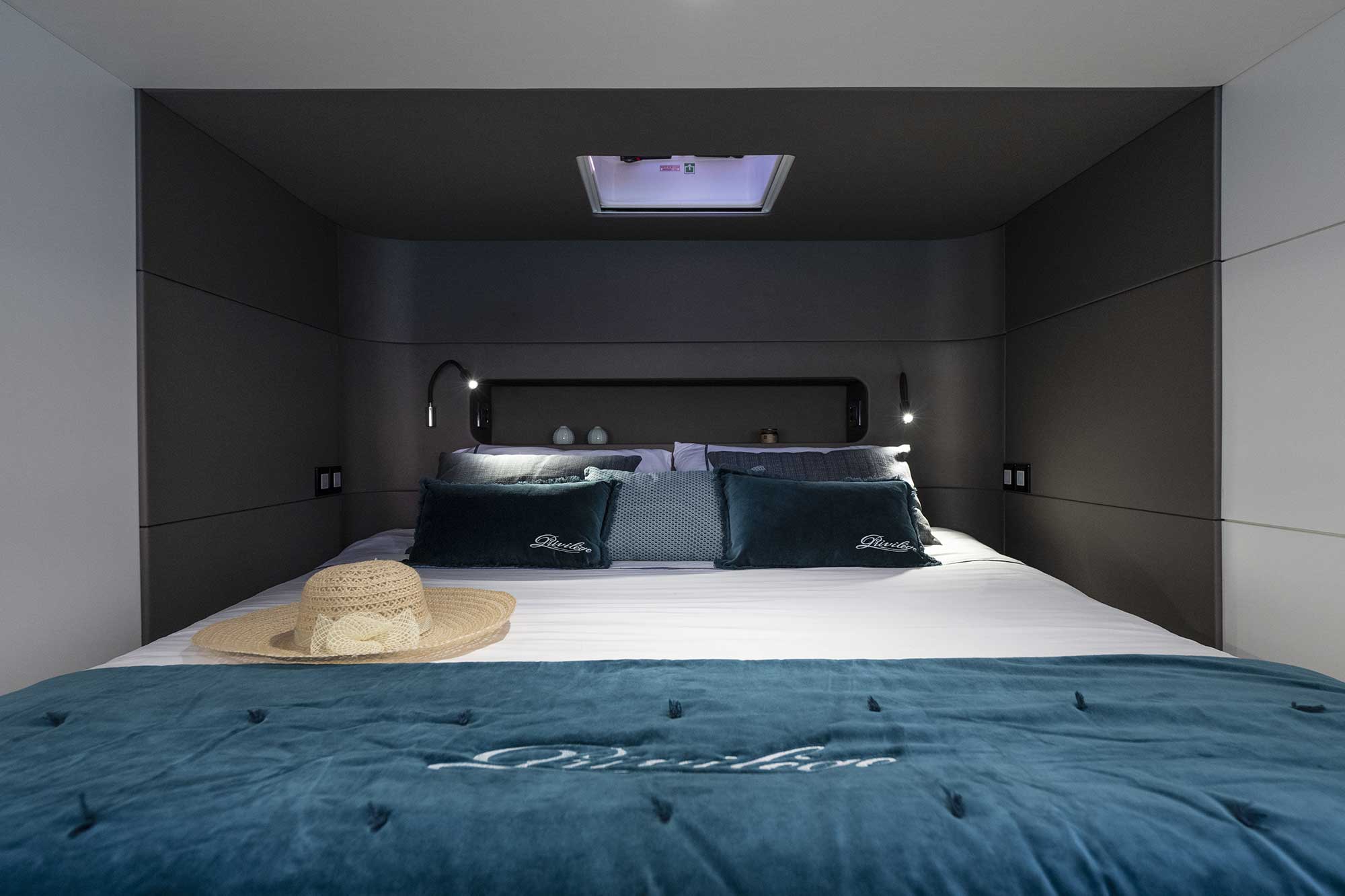
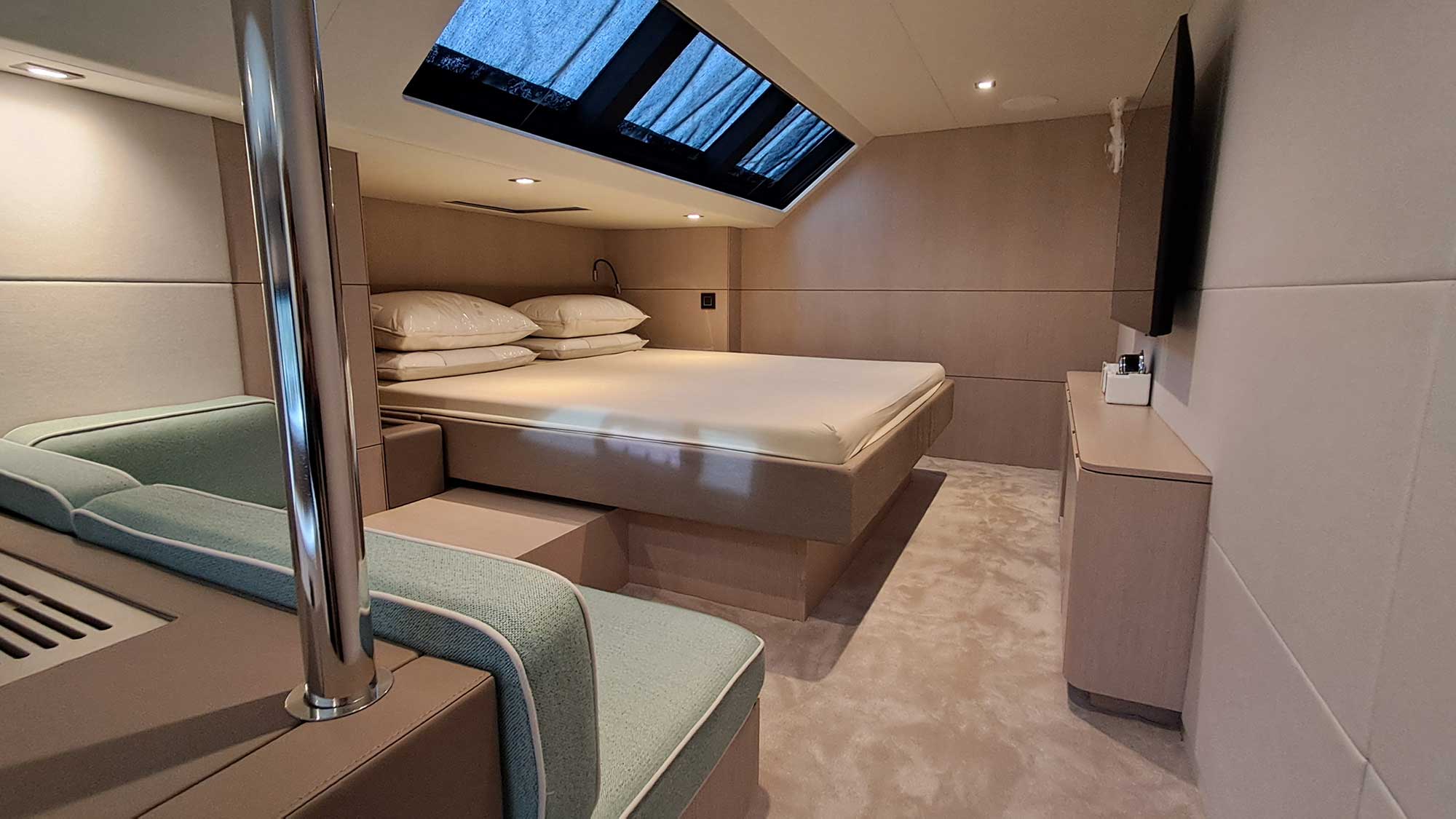
On many production catamarans, the owner’s version means one hull is given over to the owner. This is already a major step up from a symmetrical charter arrangement. It usually brings a larger bed, a private bathroom, a desk area and more storage. On a Privilège, the concept goes further because the owner’s suite is often placed in the nacelle or rostrum, using the full beam of the yacht rather than simply occupying a hull.
The Privilège Signature 510 makes this clear. At 17.09 m (56 ft) overall, with a beam of 7.98 m (26 ft), it includes a full-beam owner’s suite positioned forward in the nacelle. The shipyard presents it as the largest in its category. This matters because the owner is no longer placed in a narrow hull corridor. The suite gains width, light and separation. It becomes a central private apartment.
On the Signature 650, the logic is even more explicit. The central owner’s suite is set within the nacelle, with panoramic forward-facing views. On a 19.60 m (64 ft 3 in) yacht with a 9.20 m (30 ft 2 in) beam, that forward volume is not just a sleeping cabin. It is one of the defining spaces aboard.
This is where the expression luxury catamaran cabin can be misleading. Luxury is not only leather, joinery or lighting. It is waking up without feeling buried in the hull. It is having enough room to dress properly. It is being able to read, work or rest without occupying the saloon. It is having a private retreat after a night watch, a difficult passage or a long evening with guests.
For a private owner, that is not indulgence. It is endurance.
The charter layout compresses privacy into symmetry
The charter layout has one great strength. It is democratic. Each couple gets a similar cabin. Each guest knows where they stand. On a one-week charter in Greece, the Caribbean or Croatia, that symmetry is practical. Nobody wants to pay the same share and receive the weak cabin.
But symmetry has a cost. It breaks the boat into repeated private boxes. It gives everyone a cabin, yet rarely gives the owner a home. It can produce good sleeping accommodation, but it often leaves limited room for personal possessions, technical storage, quiet work or long-term routines.
A charter-oriented catamaran is usually judged at anchor. The question is simple: does it provide enough beds, showers, refrigeration, sun pads and social space for a holiday group? A private long-range catamaran must also be judged after several weeks at sea. Where do wet-weather clothes dry? Where do spares live? Where is the printer, the medical kit, the compressor, the offshore safety equipment, the extra bedding, the tools, the charts, the winter clothing, the dive gear, the children’s school materials or the owner’s professional equipment?
These are not small questions. They decide whether life aboard feels controlled or chaotic.
That is why losing one cabin can be the intelligent decision. A private owner may be better served by three exceptional cabins and serious storage than by five cabins that remain half-used outside guest periods. Space that creates revenue in charter can create comfort in private ownership. The best layout is not the one with the highest berth count. It is the one that matches the real use of the yacht.
The storage question is the real test of liveaboard design
Storage is the least glamorous subject in yacht design. It is also one of the most important.
A bluewater liveaboard catamaran is not a weekend apartment. It is a moving home, a technical platform and a self-contained base for remote cruising. Owners who sail long distances carry more than clothes. They carry filters, pumps, lines, shackles, tools, chargers, medicine, food, spare parts, documents, safety gear and sometimes specialist equipment for diving, photography, fishing, remote work or children’s education.
This is where layout becomes engineering. Storage cannot simply be added at the end. It has to be planned into the yacht. Heavy equipment must be placed intelligently. Frequently used items must be accessible. Emergency gear must not be buried. Personal storage must not invade the saloon. Technical storage must not become a guest cabin by default.
Privilège Marine’s positioning is clear on this point. The Signature 510 is listed with 600 L (158 gal) of fresh water, 800 L (211 gal) of fuel and a full-load displacement of 22.8 tonnes (50,700 lb). The Signature 580 carries 2 x 450 L of fresh water, 2 x 485 L of fuel and a full-load displacement of 35 tonnes (77,162 lb). The Signature 650 increases this again, with 2 x 650 L of fresh water and 2 x 1,000 L of fuel.
These figures matter because autonomy is not abstract. Tankage, equipment and storage shape the cruising range and the comfort margin. A long-distance yacht needs reserves. It also needs places to put those reserves without turning the interior into a storeroom.
In a private owner layout, storage volume is not leftover space. It is part of the yacht’s core architecture.
The private route through the boat matters as much as the bed
Privacy aboard is often reduced to cabin doors. That is too simple. Real privacy depends on circulation.
A private owner does not only need a larger bed. The owner needs a way to move through the yacht without constantly passing through guest territory. This matters at sea, when watches change. It matters in the morning, when some people are asleep and others are already in the cockpit. It matters with crew aboard. It matters when children, friends or family occupy guest cabins for several weeks.
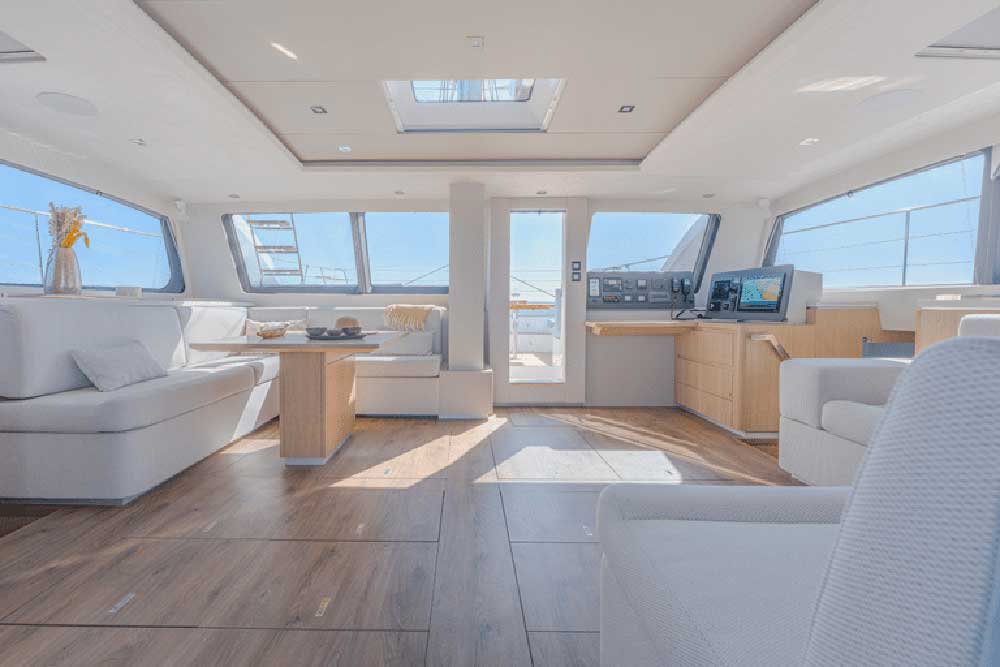
Private access between an owner’s suite and the main saloon can change the feeling of the entire yacht. It makes the suite part of the owner’s daily route, not a compartment at the end of a hull. It reduces friction. It makes the boat calmer.
The Privilège 510 illustrates this with a full-beam owner’s suite positioned forward in the nacelle. The Privilège 650 develops the same principle at a larger scale with a central owner’s suite and forward-facing views. The design is not only about space. It is about hierarchy. The owner’s area has a defined status aboard.
That hierarchy is normal on a private yacht. It is less visible on a charter catamaran, where the design must avoid privilege between guests. This is the honest difference. Charter layouts try to equalize the cabins. Owner layouts deliberately create a primary private domain.
For long-term ownership, that distinction changes everything.
The acoustic boundary separates comfort from endurance
A yacht is never silent. Hulls move. Water passes. Ropes work. Bulkheads transmit vibration. Engines, generators, pumps, watermakers, air conditioning and autopilots all create sound. At anchor, small noises become noticeable. Offshore, repeated noise becomes fatigue.
This is why acoustic separation is a serious design subject. It is not only about insulation. It is about distance, structure, equipment placement, doors, joinery, ventilation routes and the way cabins are arranged around technical zones.
A charter guest may accept noise for a week. An owner living aboard for months will not. Poor acoustic separation makes a boat tiring. It affects sleep. It reduces the feeling of privacy. It turns technical systems into permanent background stress.
Owner-focused design can address this more intelligently because the priorities are clearer. The owner’s suite can be separated from machinery zones. Guest cabins can be placed with privacy in mind. Technical spaces can be isolated. Materials can be chosen not only for appearance but for durability and sound behaviour. The result is not laboratory silence. It is a quieter, more stable domestic atmosphere at sea.
This is one reason why a bespoke approach matters. A couple sailing alone does not need the same acoustic plan as a family with teenagers, a captain, rotating guests and a remote-work routine. The layout must follow the life aboard.
The owner’s yacht is a platform for a sailing project
A private catamaran is rarely bought for one generic use. It is bought for a project.
One owner may want to cross the Atlantic with family. Another may plan to live aboard in the Mediterranean for six months a year. A third may want to sail with a captain but retain strong private areas. Another may need a real office because the yacht is also a base for business. Some owners want a gym. Others want a wine cellar, a workshop, a library, a school area, a media room, a diving locker or additional freezer capacity.
This is where the language of options becomes too weak. A bespoke catamaran is not a boat with a choice of fabrics. It is a boat whose interior, storage, equipment and circulation are shaped around a defined life.
The Privilège Signature 600 shows this direction clearly. The model keeps the bluewater DNA of the 580 while refining the interior experience. Its aft portside guest cabin is presented as a flexible, open-ended space. It can become a home cinema, a gym, an office, additional storage, an artist’s studio or a large walk-in wardrobe. That is not a superficial upgrade. It reflects a mature understanding of private ownership.
A yacht that will be used for two weeks does not need that level of personal adaptation. A yacht that will carry its owners across oceans does.
The Privilège difference is a design philosophy, not an option list
Privilège Marine has built its reputation around luxury long-distance cruising catamarans from Les Sables d’Olonne, on the French Atlantic coast. The location is not incidental. This is a sailing town shaped by offshore culture, the Vendée Globe and ocean racing. The brand’s connection to bluewater sailing is part of its identity.
The Signature 510, 580, 600 and 650 express that identity at different scales.
The Signature 510 makes the owner suite the centre of the yacht
The 510 is a 17.09 m (56 ft) catamaran designed for autonomous bluewater sailing. Its 7.98 m (26 ft) beam is used to create a full-beam owner’s suite forward in the nacelle. It is also offered with 3 to 4 cabins and CE A-12 certification. This is important because the yacht is not trying to be a small charter platform with the maximum possible berth count. It is presented as a long-distance owner’s boat that can be handled without a crew.
The Signature 580 and 600 refine space for longer ownership
The Signature 580 is 19.10 m (62 ft 8 in) long, with a beam of 9.18 m (30 ft 1 in), 259 m² (2,787 sq ft) of total sail area and 4 to 5 cabins. Its design emphasizes circulation, connection between interior and exterior spaces, protected helm visibility and a more residential experience aboard.
The Signature 600 builds on this platform with a stronger emphasis on interior fluidity, indirect light, material harmony and adaptable use. The point is not only to make the yacht look more contemporary. It is to make long-term living feel calmer and more coherent.
The Signature 650 turns the owner suite into a private sanctuary
The Signature 650 is listed at 19.60 m (64 ft 3 in) LOA, with a 9.20 m (30 ft 2 in) beam, 264 m² (2,840 sq ft) of total sail area and 3 to 5 cabins. Its central owner’s suite in the nacelle gives the owner a rare position aboard: forward-facing views, natural light and strong spatial separation from the guest accommodation.
This is not the usual cabin logic of a charter catamaran. It is closer to the logic of a private residence at sea.
The honest comparison is that charter can be excellent, but it is not the same life
There is no need to dismiss charter catamarans. The best of them are practical, spacious and well adapted to their mission. For a group holiday, a four-cabin catamaran with equal cabins and en-suite heads is often exactly right. It is easy to book, easy to share and easy to understand.
But it is a mistake to confuse that model with ownership.
An owner’s yacht has to answer harder questions. Can the owners rest properly after a passage? Can they store what they need for real autonomy? Can they host guests without losing their own privacy? Can they work aboard? Can they live with the sound of the boat? Can they move through the yacht naturally? Can they keep technical systems accessible? Can the interior still feel good after months, not days?
These questions are not solved by adding more cabins. They are solved by design discipline.
For Privilège Marine, the answer lies in building each yacht around the owner’s requirements, sailing plans and life aboard. That is why each Privilège is different. The owner’s suite is not just a larger bedroom. It is the visible part of a broader philosophy: the yacht must fit the owner, not the other way around.
The real luxury is a boat that stops asking for compromise
The next phase of luxury catamaran design is unlikely to be defined by more decoration. The market already has plenty of polished interiors, large windows and social decks. The more interesting question is fit.
A serious private yacht should feel obvious to its owner. The cabin plan should match the way people sleep, work, host and recover. The storage should match the sailing programme. The owner’s suite should protect privacy without isolating the owner from life aboard. The technical spaces should support autonomy without invading daily comfort. The yacht should be capable of crossing oceans, but also of making breakfast, reading quietly, working remotely and sleeping well in an anchorage.
That is what separates a charter layout from an owner’s catamaran. One is measured by occupancy. The other is measured by quality of life.
On paper, the change may look like a cabin lost. Aboard, it often feels like a home gained.