


How Philippe Jeantot turned solo ocean racing into the Vendée Globe and helped shape Privilège Marine’s bluewater catamaran DNA.
Philippe Jeantot’s legacy cannot be reduced to one race, one shipyard, or one line in sailing history. He belongs to the generation that turned French offshore sailing into a serious technical, sporting and industrial culture. A former deep-sea diver, he came to sailing through endurance, risk and self-reliance rather than through yacht-club tradition. He won the BOC Challenge twice, helped redefine what solo ocean racing could mean, then created the Vendée Globe in 1989 as a harder, purer version of the round-the-world race: one skipper, one boat, no stopovers and no assistance. At the same time, he channelled his experience into Jeantot Marine, later associated with the Privilège catamaran line. The result was not a marketing story invented after the fact. It was a direct transfer from offshore hardship into bluewater catamaran design: safety, autonomy, comfort and long-distance capability.
The diver who became a sailor through discipline, not romance
Philippe Jeantot was born in Antananarivo, Madagascar, in 1952. Before he became one of the defining figures of French offshore sailing, he was a professional deep-sea diver. That detail matters. It explains much of his later approach to boats, risk and endurance.
Deep-sea diving is not an aesthetic relationship with the sea. It is technical, physical and unforgiving. Jeantot worked in a world where equipment, preparation and discipline could decide whether a man came back alive. In 1977, he took part in the Janus IV dive programme run by COMEX, during which divers reached a depth of 501 metres. That background placed him far from the romantic image of the solitary yachtsman guided only by instinct.
His route into sailing was similarly direct. Jeantot was influenced by Bernard Moitessier’s book The Long Way, one of the great texts of solo ocean sailing. But he did not simply buy into the myth of escape. He built himself a 13.5-metre steel ketch, equivalent to about 44 feet, and prepared for single-handed ocean sailing. The boat was heavy, strong and practical. It was not an object of leisure. It was a machine for survival.
That distinction is central to the Philippe Jeantot legacy. He approached sailing as a system. The sailor, the hull, the rig, the deck layout, the repair strategy and the mental reserve had to function together. Later, this same thinking would influence both the Vendée Globe and the early Privilège catamarans.
The BOC Challenge turned Jeantot into a global offshore figure
Jeantot’s sporting reputation was built in the BOC Challenge, the solo round-the-world race with stopovers that later became known under other names, including Around Alone and Velux 5 Oceans. In 1982-1983, he entered the first edition and won. Contemporary accounts describe a race of more than 27,000 nautical miles, or roughly 50,000 kilometres, through calms, storms, high-latitude depressions and repeated damage.
The race format was already brutal. It was solo. It crossed the Southern Ocean. It demanded that one person manage navigation, sleep, repairs, weather analysis, sail changes and fear. But it was not yet the Vendée Globe. The BOC Challenge allowed stopovers. Skippers could rest, repair and restart from major ports around the world.
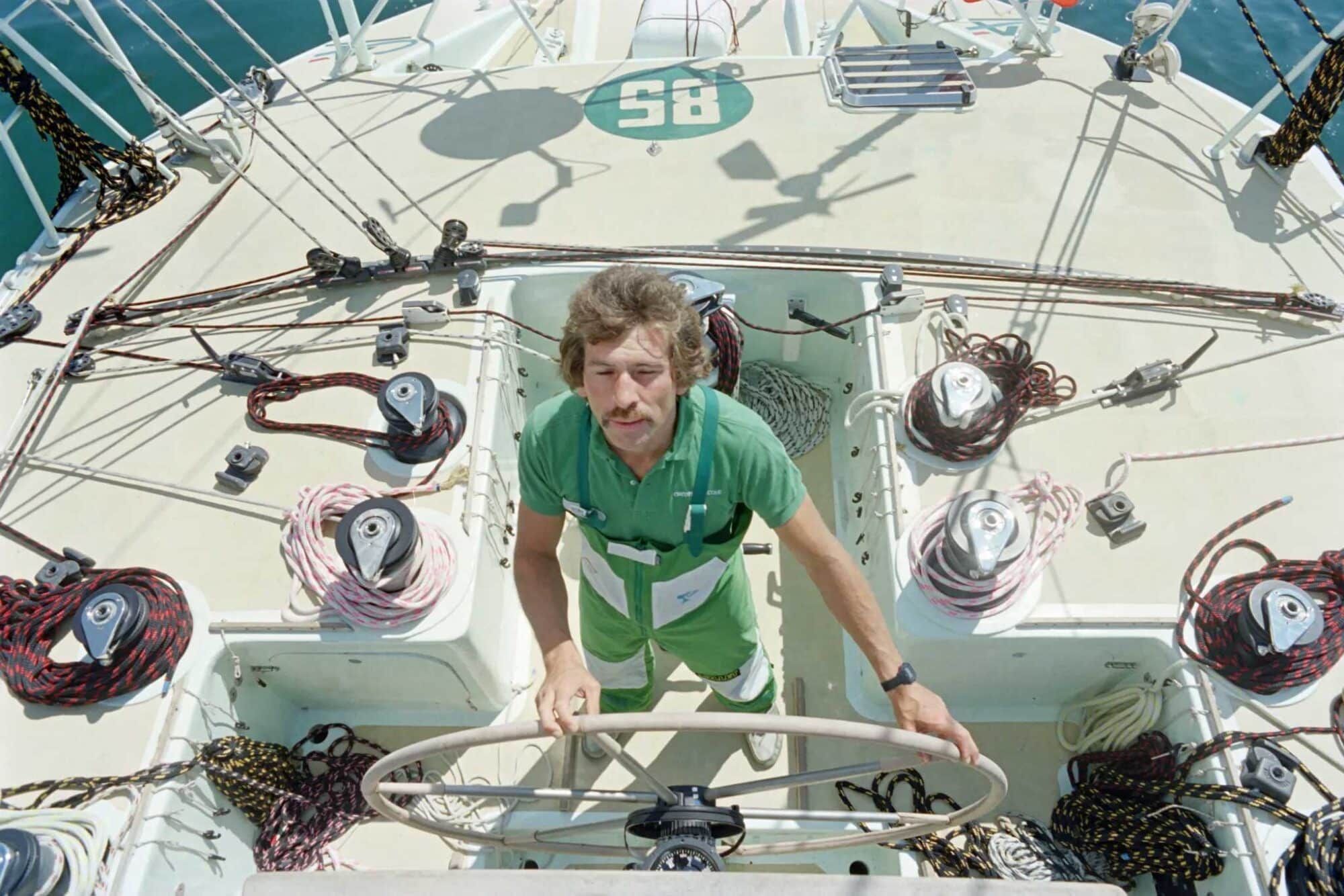
Jeantot mastered that format. He won the 1982-1983 edition and then returned to win again in 1986-1987 aboard Crédit Agricole III. Winning once could be called a breakthrough. Winning twice made him a reference point. He was no longer just a French adventurer. He had become a sailor whose experience carried technical weight.
The numbers are important because they separate fact from legend. The first BOC Challenge was not a coastal race inflated by storytelling. It was a full circumnavigation. Jeantot’s victory required months of isolation, weather management and mechanical resilience. His second win confirmed that the first was not an accident.
This period also connected him to a broader French offshore movement. France was developing a particular culture of ocean racing: pragmatic, inventive, sponsor-backed and technically ambitious. Jeantot’s sponsor, Crédit Agricole, became part of that story. His boats, named Crédit Agricole, helped bring professional structure to a sport that still carried traces of amateur adventure.
The Vendée Globe was born from dissatisfaction with compromise
The Vendée Globe did not appear as a comfortable evolution of existing racing. It was born from dissatisfaction. Jeantot had won the BOC Challenge twice, but the stopover format left a question unresolved. If a sailor could stop, repair and recover, was the race truly the purest test of one person and one boat around the world?
Jeantot’s answer was blunt: no.
In 1989, he created a new race from Les Sables-d’Olonne. The principle was simple and severe: solo, non-stop, round the world, without assistance. The theoretical distance was around 24,000 nautical miles, or about 44,000 kilometres. The route sent skippers down the Atlantic, around the Cape of Good Hope, across the Indian and Pacific Oceans, around Cape Horn, then back up the Atlantic to Vendée.
The first edition started on 26 November 1989. Thirteen skippers took the start. Only seven finished. Titouan Lamazou won in 109 days, 8 hours and 48 minutes. Jeantot himself finished fourth aboard Crédit Agricole IV, in 113 days, 23 hours and 47 minutes.
Those figures still carry force. The first Vendée Globe was not a polished sporting product. It was an experiment conducted at full scale, in public, with real consequences. Boats broke. Skippers withdrew. Philippe Poupon’s capsize and rescue by Loïck Peyron became one of the defining images of the first edition. The race immediately proved both its power and its danger.
This is why the Vendée Globe founder label matters. Jeantot did not merely create another event on the sailing calendar. He created a format that changed offshore racing. The Vendée Globe turned individual endurance into a global sporting narrative. It also forced boat design to advance. Autopilots, rigging, hull structures, energy systems, weather routing and onboard ergonomics all became matters of survival.
The race made Les Sables-d’Olonne a capital of ocean endurance
The choice of Les Sables-d’Olonne was not incidental. The port gave the race a fixed emotional geography. The Vendée Globe starts and finishes in the same place. That loop matters. It gives the event a ritual structure: departure, disappearance, danger, return.
For the region, the race created an identity that went beyond tourism. Les Sables-d’Olonne became linked to the hardest form of solo ocean racing. Every four years, the town became a stage for technology, courage and national attention. The relationship between place and race helped turn the Vendée Globe into something more durable than a one-off challenge.
The long-term effect is measurable. From 13 starters in 1989-1990, the race grew into a major international offshore event. The 2024-2025 edition had 40 starters, reflecting both the globalisation of the IMOCA class and the continuing appeal of the race format Jeantot created. The event remains rare in sport because its rule is easy to understand and almost impossible to execute: sail around the world alone, without stopping, without outside help.
That clarity is part of Jeantot’s genius. Great sporting properties often have simple grammar. The Vendée Globe has one of the simplest. It is a human being, an 18-metre IMOCA, the oceans and time.
The shipyard translated offshore experience into cruising design
Jeantot’s other major legacy is industrial. In 1985, before the Vendée Globe began, he founded Jeantot Marine with René Bernard in Les Sables-d’Olonne. The company would become associated with the Privilège range of catamarans. Early models included boats such as the Privilège 47, followed by other designs that helped establish the brand’s reputation in long-distance multihull cruising.
The link between racing and cruising is often exaggerated in the yacht industry. In this case, it is real. Jeantot had spent years learning what breaks offshore and what sailors need when land is far away. That experience did not lead him to design minimalist racing machines for private owners. It pushed him toward a different idea: a cruising catamaran that could cross oceans with stability, space, redundancy and confidence.
A bluewater cruising catamaran is not simply a wide yacht with two hulls. It is a long-range platform. It must carry water, fuel, batteries, food, spare parts, safety equipment and people for extended passages. Its structure must cope with torsional loads between hulls. Its deck layout must allow watchkeeping and sail handling without exposing the crew unnecessarily. Its interior must remain livable at sea, not just impressive at anchor.
That is where Jeantot’s offshore background mattered. The early Privilège philosophy was not built around marina glamour. It was built around ocean-crossing capability. Comfort was important, but not as a substitute for seriousness. Space had to serve life offshore. Volume had to be balanced against strength. The boat had to feel like a home without forgetting that the sea is indifferent to comfort.
The first Privilège boats helped define a serious multihull niche
The Privilège story began in a market that was very different from today’s catamaran sector. In the mid-1980s, cruising multihulls were still fighting for credibility. Many sailors associated serious ocean passagemaking with monohulls. Catamarans were often seen as charter boats, coastal platforms or experimental alternatives.
Jeantot Marine entered that environment with a different claim. A catamaran could be comfortable and serious. It could offer privacy, stability and volume without abandoning offshore ambition. It could appeal to private owners who wanted to cross oceans rather than merely entertain guests in protected waters.
This positioning proved important. The Privilège 47 and later models helped build a brand identity around strength, liveability and long-range cruising. The company was not the largest builder. It did not become a mass-production machine. Its place was narrower and more demanding: the premium end of the bluewater catamaran market.
That niche still matters today. The modern catamaran market is crowded. Some brands focus on charter volume. Others focus on speed. Others push extreme luxury. Privilège Marine’s strongest argument remains the one rooted in its origin story: a boat shaped by offshore experience, designed for owners who care about the difference between coastal comfort and real bluewater confidence.
The legacy is also complicated, and should be treated honestly
A serious account of Philippe Jeantot cannot read like a brochure. His sporting and industrial contributions are substantial. They are also not the whole record. Jeantot later faced legal troubles in France, including convictions connected with financial and tax matters. Those facts do not erase the Vendée Globe. They do not cancel the technical influence he had on Privilège. But they do complicate the portrait.
That distinction is important for credibility. Legacy is not sainthood. It is consequence. Jeantot’s consequence in sailing is clear. He helped professionalise French solo offshore racing. He founded the Vendée Globe, now one of the world’s most demanding ocean races. He helped create a shipyard whose identity was built around long-distance multihull cruising. These achievements stand because they produced institutions, boats and a culture that outlasted the man’s direct control.
For Privilège Marine, the right lesson is not to mythologise Jeantot. It is to understand what made the origin powerful. The brand was born from a sailor who knew the cost of poor preparation. That is a stronger story than nostalgia. It gives the yard a technical inheritance: build boats for owners who may one day be far from rescue, far from shipyards and far from excuses.
The real inheritance is a design ethic, not a name
The phrase Philippe Jeantot legacy should not be treated as a decorative keyword. It describes a chain of cause and effect. Deep-sea diving taught discipline. Solo racing taught autonomy. The BOC Challenge taught the value of stopover repair and the limits of that format. The Vendée Globe removed the stopover and created the purest version of the test. Jeantot Marine then translated ocean experience into cruising catamarans designed for real passages.
That is the story’s value for modern readers and serious yacht buyers. The sea does not care about branding. It tests structure, systems, crews and decisions. A convincing bluewater authority is not built by saying the word “bluewater” often. It is built by proving that design choices come from hard experience.
Privilège Marine’s early story has that advantage. It begins with a man who had been deep under the sea, then alone across it, then ambitious enough to create a race that still defines the outer edge of solo sailing. The first Privilège boats emerged from that world. They were part of a broader French moment when offshore sailing, design and industry began to reinforce one another.
The cleanest reading of Jeantot’s legacy is therefore not sentimental. It is practical. He helped make the ocean a stricter judge of sailors and boats. The Vendée Globe did that in sport. Privilège Marine carried part of the same logic into cruising. For a shipyard that still wants to speak credibly about safe ocean passages, private ownership and long-range autonomy, that origin remains more than history. It is a standard to meet.