


From an owner-operated 50-footer to a crewed 80-foot yacht, the right catamaran depends on experience, family, range and life aboard.
Choosing the right catamaran begins with the way the owner intends to sail. A 50-foot bluewater catamaran can provide a genuine ocean-going home while remaining manageable by an experienced couple. A 60-foot yacht creates more privacy, storage and residential flexibility, alongside substantially greater sail loads and displacement. Around 65 feet, the vessel becomes a private yacht in the fullest sense, with greater autonomy and a stronger case for professional support. At 80 feet, permanent crew and formal yacht management become the practical norm.
Length alone gives an incomplete answer. Beam, full-load displacement, sail area, draft, windage and technical complexity often matter more. Family structure, physical ability, guest expectations, preferred destinations and the willingness to manage maintenance must also shape the decision.
At Privilège Marine, we begin with the owner’s intended life at sea. The right catamaran size delivers sufficient space, autonomy and privacy while remaining genuinely usable.
The first decision concerns the owner rather than the yacht
Future owners often begin with a number. They ask whether they need 50, 60, 65 or 80 feet.
The more useful starting point concerns the operating model.
Who will sail the yacht? How many months will the owners spend aboard? Will children live on the boat? How often will guests join? Will the yacht cross oceans or remain within familiar cruising areas? Do the owners want to maintain direct control, or would they rather rely on a captain and crew?
These questions define the correct size more accurately than the number of cabins or the area of the saloon.
A retired couple planning a gradual circumnavigation has different needs from a family spending school years aboard. Owners who entertain regularly require more privacy and hospitality space. A couple who values independence may prefer a smaller yacht that they can handle and maintain themselves.
The right choice also depends on experience. A larger catamaran can feel calm and simple when conditions are favourable and every powered system works. The real test comes during a night approach, a squall, a technical failure or a difficult marina manoeuvre.
At Privilège Marine, we build bluewater catamarans as ocean-going homes. Size therefore has to serve two purposes. It must support the owner’s life aboard and preserve the ability to operate the yacht safely.
The dimensions that reveal the yacht’s real scale
Model names provide a useful reference. They do not always correspond directly to overall length.
The Privilège Signature 510 has a hull length of 15.24 metres (50 feet), while its overall length reaches 17.09 metres (56 feet). Its beam is 7.98 metres (26 feet 2 inches).
The Signature 600 measures 18.28 metres (60 feet) overall and 9.18 metres (30 feet 1 inch) across the beam.
The Signature 650 has a hull length of 19.60 metres (64 feet 4 inches). Its maximum overall dimension reaches 21.25 metres (69 feet 9 inches), while its beam measures 9.20 metres (30 feet 2 inches).
A marina, insurer or shipyard may use a different measurement depending on the service involved. Hull length, overall length, waterline length and load-line length describe different things. Buyers should always examine the full technical specification.
Displacement creates an even more important distinction.
The Signature 510 weighs 16.8 tonnes in light condition and 22.8 tonnes fully loaded. The Signature 600 weighs 29 tonnes light and 35 tonnes at full load.
The increase in nominal hull length from 50 to 60 feet appears moderate. Full-load displacement rises by approximately 54 percent. Working sail area increases from 165 square metres (1,776 square feet) to 259 square metres (2,788 square feet), an increase of about 57 percent.
A 60-foot catamaran is therefore much more than an extended 50-footer. It carries greater inertia, higher sheet loads, more domestic systems and a significantly larger wind profile.
The 50-foot catamaran keeps experienced owners in command
A well-designed 50-foot bluewater catamaran occupies an important position in the market. It provides enough volume for long-term cruising while preserving realistic owner operation.
The Signature 510 carries three or four cabins. It provides 800 litres (211 US gallons) of fuel and 600 litres (158 US gallons) of fresh water. Its twin 80-horsepower engines support close-quarters manoeuvring, while its working sail plan covers 165 square metres.
The protected helm remains connected to the cockpit. The principal sail controls are centralized. The arrangement reduces unnecessary movement around the deck and allows a trained couple to manage the yacht without permanent professional crew.
The owner profile suited to 50 feet
This category suits owners who enjoy sailing the yacht themselves. They want direct control over navigation, manoeuvres and maintenance. They may welcome guests, although the yacht remains primarily their own home rather than a hospitality platform.
A 50-foot catamaran can work well for a couple on a world cruise. It can also accommodate a family with children. Shared areas will serve several functions, and storage requires planning, yet the yacht can support genuine long-distance autonomy.
This category also preserves greater freedom in marinas and service yards. A beam approaching 8 metres already requires a suitable catamaran berth. The yacht still has access to more infrastructure than a boat measuring over 9 metres across.
Shorthanded sailing remains realistic at this size. Single-handed operation is technically possible for a highly experienced skipper on a yacht configured for it. A couple provides a safer and more credible operating model for most private owners.
The limits that still demand serious seamanship
A 50-foot catamaran remains a large yacht. At full load, the Signature 510 weighs more than 22 tonnes. Its mainsail measures 88 square metres (947 square feet).
Electric winches, furling systems and autopilots reduce physical effort. They do not remove the forces involved. A jammed sheet, failed windlass or damaged furler can expose the crew to the full mechanical load.
Owners need to understand reefing, engine manoeuvring, anchoring and emergency procedures. They should be able to control the yacht when a powered system stops working.
The advantage lies in relative manageability. Distances across the deck remain reasonable. Equipment can remain accessible to an owner who participates in maintenance. The sail plan stays within the range that a properly trained couple can operate.
For experienced sailors who value independence, a 50-foot catamaran often represents the most balanced choice.
The 60-foot catamaran adds a different quality of life
The transition from 50 to 60 feet produces one of the most significant changes in the range.
The Signature 600 measures 18.28 metres overall, with a beam of 9.18 metres. Its full-load displacement reaches 35 tonnes. It carries 259 square metres of working sail, 970 litres (256 US gallons) of fuel and 900 litres (238 US gallons) of fresh water.
The additional dimensions create much more than a larger saloon. They provide wider circulation routes, larger machinery spaces, greater storage and stronger separation between private and shared areas.
The aft portside space on the Signature 600 can become an office, studio, gym, cinema, dressing room or technical storage area. This flexibility reflects the changing role of the yacht. Owners may spend several months aboard. They may work remotely, welcome adult children or carry equipment for extended cruising.
The couple that can still operate the yacht
An experienced couple can operate a modern 60-foot catamaran when the deck plan and systems are designed for shorthanded use.
Powered winches, furling sails, reliable autopilots and centralized controls become central operating systems. Early reefing becomes essential. Every manoeuvre should be prepared before the yacht enters confined water.
A 35-tonne platform carries substantial momentum. Engine control must manage the approach and stop the yacht. Human strength on a mooring line cannot compensate for excessive speed or poor positioning.
Twin engines positioned far apart give a catamaran excellent turning authority. One engine ahead and the other astern can rotate the yacht within a limited area. Windage and current still influence the result. The high sides and deckhouse create a large aerodynamic surface.
A 60-footer can remain an owner-operated bluewater catamaran. The crew needs meaningful experience and a disciplined approach. Describing this category as an easy solo yacht would misrepresent the physical scale involved.
The family that benefits from the extra volume
The 60-foot category suits owners who live aboard for long periods and regularly welcome family or friends.
Children can have distinct spaces for school, sleep and privacy. Adults can work without occupying the main saloon. Guest cabins can remain available rather than becoming permanent storage rooms.
This separation matters during long voyages. Life aboard becomes tiring when every space serves several unrelated purposes. A larger platform allows work, rest and social life to occur simultaneously.
The yacht can also carry a larger tender, more provisions, additional refrigeration and greater technical redundancy. Each addition must remain part of a coherent weight and energy plan.
A couple moving from a smaller catamaran will usually understand these compromises. First-time catamaran owners should consider structured training and professional support during the first season. Experience on a smaller monohull does not fully prepare someone for manoeuvring a yacht more than 9 metres wide.
The 65-foot catamaran becomes a complete private yacht
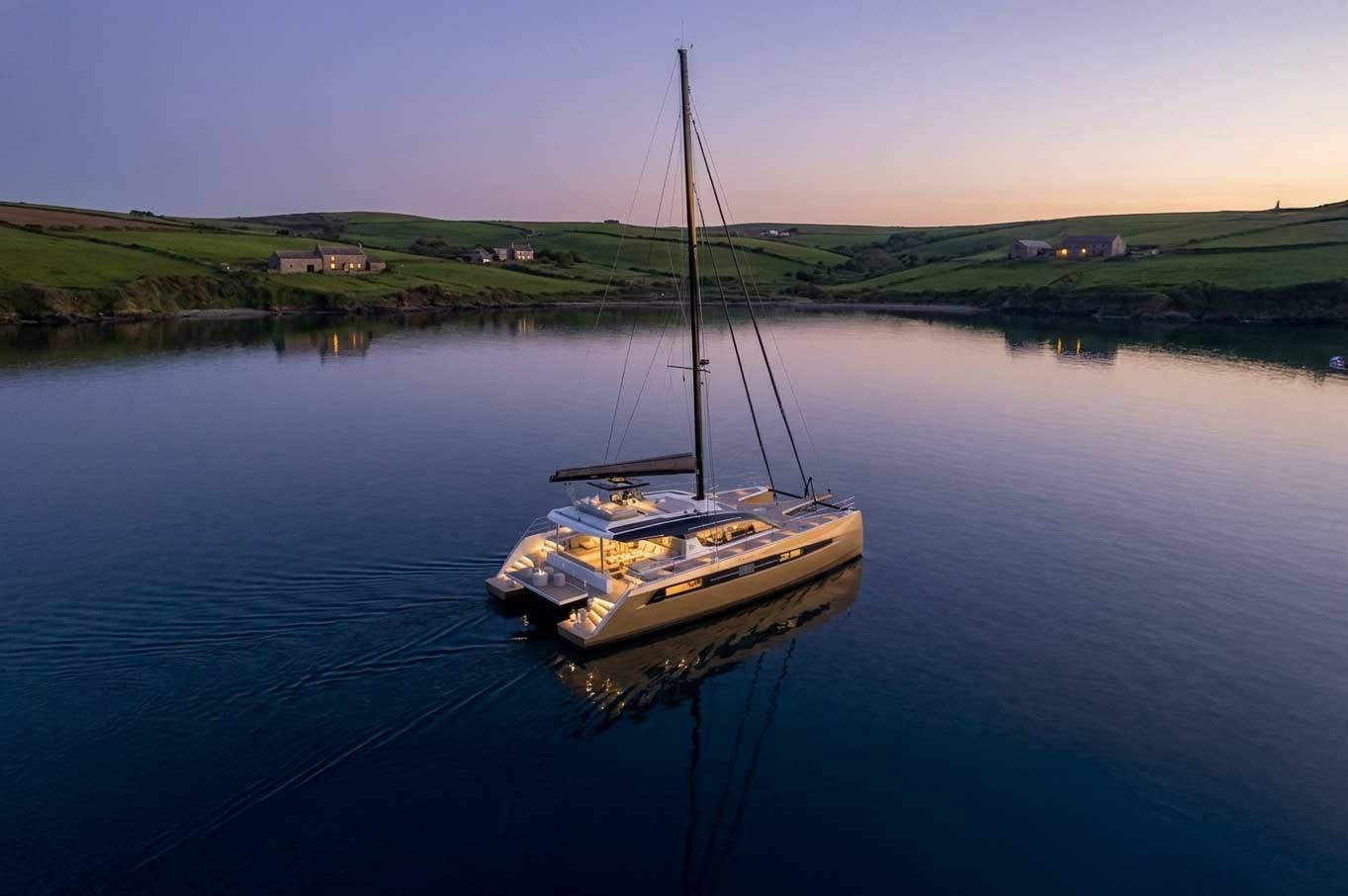
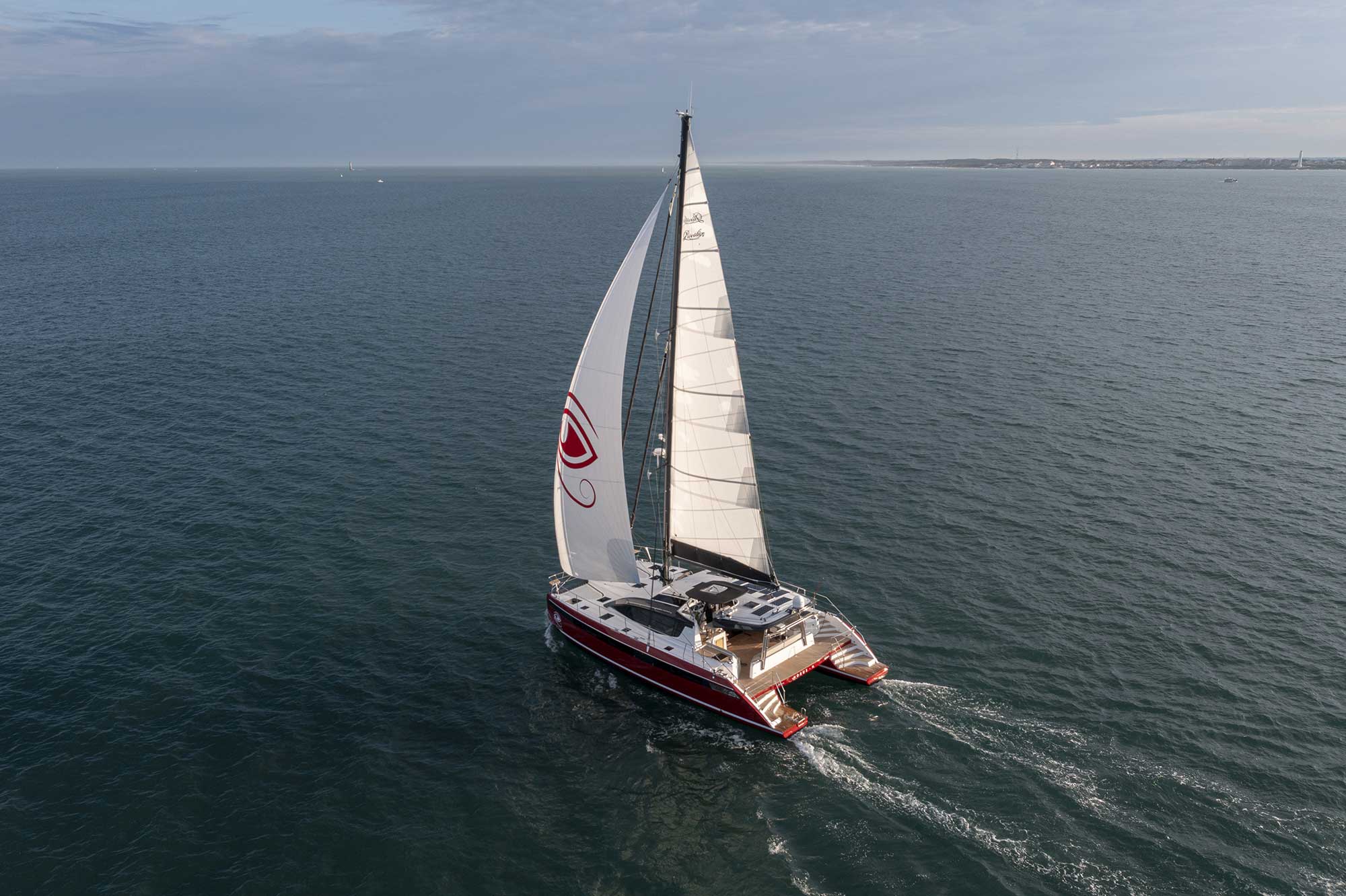
Around 65 feet, the catamaran begins to function as a private yacht in the full sense. It can still be sailed directly by its owners. Professional support becomes increasingly valuable.
The Signature 650 has an overall hull length of 19.60 metres and a maximum overall dimension of 21.25 metres. Its beam is 9.20 metres, and its draft reaches 2.04 metres (6 feet 8 inches).
Full-load displacement rises to 37 tonnes. The working sail plan covers 264 square metres (2,841 square feet), including a 140-square-metre (1,507-square-foot) mainsail. Twin 150-horsepower engines provide the power required for a yacht of this mass.
Autonomy increases substantially. Fuel capacity reaches 2,000 litres (528 US gallons), while fresh-water capacity totals 1,300 litres (343 US gallons).
These figures support longer periods away from shore, larger domestic systems and more extensive equipment. They also create more maintenance and greater reliance on powered handling systems.
The experienced owners who want to retain control
A highly experienced couple can operate a 65-foot catamaran when the yacht has been configured around their abilities and intended programme.
The meaningful question concerns abnormal conditions.
Can either owner bring the yacht alongside after the other becomes injured? Can one person secure the mainsail after a powered system fails? Can the crew recover the anchor if the windlass stops? Can they manage an overnight approach after several days with interrupted sleep?
These scenarios define the practical limit more accurately than a calm-water sea trial.
At this size, experience matters more than confidence. Powered systems can make a large yacht feel deceptively simple. Their failure reveals the true loads.
A seasonal captain offers a useful compromise. Owners can sail privately in familiar regions and bring in professional support for ocean deliveries, difficult passages, intensive guest periods or maintenance seasons.
The guests and crew who require proper separation
A 65-foot yacht suits a multigenerational family, owners who entertain frequently or sailors who expect to spend much of the year aboard.
The yacht can provide adult-size guest accommodation, better acoustic separation and distinct circulation routes. The owner’s suite can retain privacy while guests use the cockpit, saloon or flybridge.
Crew accommodation also becomes a real design question. A professional skipper needs a proper cabin, ventilation, storage and access to a bathroom. An improvised berth in a sail locker does not support safe watchkeeping or long-term service.
The decision to use crew should be made before the interior is finalized. It influences the galley, laundry, refrigeration, technical access and storage. It also affects the relationship between owners and guests.
A 65-foot catamaran can function without permanent crew. It becomes easier to enjoy when the operating model includes professional help at the right moments.
The 80-foot category enters the world of superyachts
An 80-foot sailing catamaran belongs to a different class.
A current 80-foot yacht may measure slightly more than 24 metres overall. The Sunreef 80 Graya, for example, measures 24.4 metres (80 feet) and accommodates up to four professional crew members alongside its guests.
The increase in scale supports larger tenders, water toys, commercial-grade galleys, extensive refrigeration, formal crew quarters and several distinct exterior living areas.
The owner may still take the helm. The yacht itself operates through a professional structure.
The crew that becomes part of ownership
An 80-foot catamaran requires continuous preparation. Engineering systems need inspection. Decks and interiors require regular care. Provisions, fuel, water, waste and guest logistics need management.
A captain will normally oversee navigation, safety, compliance and maintenance. An engineer or technically skilled deckhand may be required depending on the machinery and propulsion systems. A chef or steward becomes relevant when the owners host several guests.
The architecture must support this organisation. Crew members need private accommodation, bathrooms, working routes and access to technical areas. The galley may become a professional workspace. Laundry and cold storage grow considerably.
At this level, crew privacy and owner privacy must be designed together. A poorly planned layout creates constant interaction between service routes and private spaces.
The threshold that carries regulatory consequences
The 80-foot category also sits close to a significant regulatory boundary.
The European Recreational Craft Directive covers recreational craft with hull lengths up to 24 metres. Large commercial yacht codes in several jurisdictions apply from 24 metres in load-line length.
Hull length, overall length and load-line length are separate measurements. The yacht’s flag, private or commercial status, passenger capacity and operating region also affect the applicable rules.
The Red Ensign Group Yacht Code, for example, covers commercial yachts measuring 24 metres or more in load-line length and carrying no more than 12 passengers.
An owner approaching this category needs advice from the naval architect, flag administration, insurer and maritime lawyer before the design is finalized. A seemingly small change in dimension can influence certification, crew qualifications and operating requirements.
The manoeuvres that become harder faster than length suggests
Twin engines give catamarans strong close-quarters control across every size category. The engines are separated by the full width of the yacht, creating substantial turning leverage.
Size introduces three further forces: windage, inertia and distance.
Windage increases as the hull sides, superstructure, mast and flybridge become larger. Aerodynamic force rises broadly with the square of wind speed. Under comparable conditions, a rise from 20 to 30 knots can produce approximately 2.25 times the force on the exposed surfaces.
Inertia increases with displacement. The Signature 510 reaches 22.8 tonnes at full load. The Signature 600 reaches 35 tonnes. Every approach has to begin more slowly and earlier on the larger boat.
Distance also matters. A crew member on the opposite bow of a 60- or 65-foot yacht may be several seconds away from the helm. Clear communication becomes essential. Headsets can be more effective than shouting across the deck.
Fenders and lines should be prepared before entering the harbour. A crew member should never attempt to stop a large yacht through physical force. The engines, rudders and planned approach must control the movement.
The larger yacht can feel easier offshore because it has space to move and often carries its momentum comfortably through waves. Marinas provide less margin. A crosswind, narrow fairway and fixed concrete quay expose every weakness in planning.
The anchor and sails that reveal the hidden loads
Anchoring equipment grows with displacement and windage. The anchor becomes heavier. Chain diameter and windlass capacity increase. Recovering the system manually becomes progressively less realistic.
The larger yacht also carries more sail.
The Signature 510 has an 88-square-metre mainsail. The Signature 600 carries 121 square metres. The Signature 650 reaches 140 square metres.
A 140-square-metre sail contains almost 60 percent more area than an 88-square-metre sail. Loads also rise with wind speed. The difference becomes critical when a sail jams, a batten catches or the powered system fails.
Owners should examine more than normal push-button operation. They should understand the backup procedure. They should know how the mainsail can be lowered, how a furler can be released and how the yacht can be stabilized while a problem is addressed.
Automation extends the practical operating range of a couple. It does not change the underlying physics.
The cruising programme that should determine the platform
A couple planning an Atlantic circuit may find a 50-foot catamaran entirely sufficient. It provides ocean capability, storage and privacy while preserving access to more marinas and service yards.
A family living aboard full time may benefit from 60 feet. Children need space for school, sleep and personal routines. Parents need areas for work and privacy. Longer water and fuel capacity can support extended time away from shore.
Owners planning world cruising with frequent guests may prefer 65 feet. The greater autonomy, guest separation and technical volume support several roles without forcing every space to perform multiple functions.
An 80-foot yacht suits owners seeking a floating residence with professional service. It provides extensive hospitality space, large tenders, water toys and clear separation between family, guests and crew.
The route also matters. Remote cruising favours storage, accessible systems, redundancy and fuel capacity. Mediterranean use brings greater attention to marina availability and stern-to mooring. High-latitude sailing requires heating, protected watchkeeping and space for equipment.
A yacht that suits the Caribbean may require a different specification for Norway, Patagonia or the South Pacific.
The family structure that changes the answer
Cabin count provides limited guidance without understanding who will use those cabins.
Young children often want to remain close to their parents. Teenagers value privacy. Adult children and their partners need proper double cabins and separate bathrooms. Older relatives may require wider steps, stable handholds and easy access between the cockpit and saloon.
Owners who frequently invite friends should also consider the rhythm of life aboard. Privacy depends on circulation, acoustic separation and the location of bathrooms, rather than cabin numbers alone.
A crewed yacht introduces another household. Crew members work, sleep and eat aboard. Their routes should allow them to provide service without crossing constantly through private areas.
The correct layout follows the real group that will spend time on the yacht. Designing around a theoretical maximum number of guests often creates compromises that affect the owners every day.
The physical profile that buyers should assess honestly
Age alone does not determine whether someone can operate a yacht. Mobility, balance, strength, reaction time and technical confidence provide a more useful picture.
Powered winches and furlers allow owners to sail larger yachts for longer. Cameras improve visibility. Bow and stern thrusters can assist certain manoeuvres. Electronic monitoring simplifies supervision of machinery and energy systems.
Every automated system still needs maintenance and an emergency procedure.
Prospective owners should walk the full yacht during a sea trial. They should move from the helm to the mast, bow, engine rooms and tender platform. They should imagine the same route at night, in rain and while the yacht is pitching.
They should also test technical access. Filters, pumps, sea cocks and electrical panels need to remain reachable without exceptional flexibility or strength.
The appropriate yacht remains manageable during an awkward day. Boat-show conditions reveal very little about this requirement.
The marina network that shrinks as the yacht grows
Beam creates one of the most practical limits on catamaran ownership.
The Signature 510 measures 7.98 metres across. The Signature 600 and Signature 650 exceed 9.18 metres. An 80-foot catamaran may approach or exceed 11 metres.
Many marinas cannot provide berths of this width. Others place catamarans on outer pontoons, alongside quays or across two conventional berths. Availability becomes more seasonal and expensive in popular destinations.
Haul-out capacity also matters. A marina may accept the yacht afloat while its travel lift lacks sufficient width or lifting capacity. The owner may need to travel to a specialist yard for antifouling, saildrive service or structural inspection.
Draft increases more gradually across the Privilège range. It rises from 1.57 metres on the Signature 510 to 1.85 metres on the Signature 600 and 2.04 metres on the Signature 650.
These remain moderate figures for yachts of their size. The difference can still affect shallow anchorages, tidal harbours and access to certain cruising grounds.
Owners should examine the infrastructure along their intended route before choosing the yacht. The freedom provided by additional onboard space can be reduced by limited access ashore.
The operating budget that grows through complexity
Purchase price represents only the beginning of the financial comparison.
A larger yacht requires more antifouling, heavier ground tackle, larger sails and more powerful machinery. Berthing and haul-out costs rise. Insurance reflects value, cruising region and crew arrangements.
Domestic systems also multiply. Additional cabins bring more toilets, pumps and air-conditioning outlets. Larger galleys require more refrigeration. Bigger tenders need stronger lifting equipment. Greater electrical demand may require larger generators, battery banks and charging systems.
Each system improves life aboard. Each system creates another inspection, service interval and potential failure point.
At 80 feet, professional crew adds salaries, travel, food, insurance, uniforms and training. Yacht management may become necessary for compliance, accounting and technical supervision.
The relevant measure is total ownership cost, considered over several years. Owners should model berthing, maintenance, haul-outs, sails, machinery replacement, crew and upgrades before deciding how much yacht their budget can support.
Buying the yacht and operating it comfortably are separate financial tests.
The final choice that should be tested on a difficult day
The strongest decision begins with an uncomfortable scenario.
The crew has sailed overnight. The wind increases during the marina approach. One engine develops a fault. Guests are tired. The available berth is narrow.
Can the owner remain in control?
For an experienced couple who values direct involvement, broad marina access and bluewater autonomy, the 50-foot category often provides the strongest balance.
For owners seeking more residential space, regular guest accommodation and long-term life aboard while retaining private operation, 60 feet offers a meaningful step forward.
For world cruising with extensive autonomy, adult guests and occasional or permanent professional support, 65 feet creates a complete private-yacht platform.
For owners who want superyacht space, service and clear separation between family and crew, 80 feet offers a different form of ownership. Professional operation forms part of the package.
At Privilège Marine, we begin with the owner’s experience, family, destinations and appetite for technical responsibility. The conversation then turns to length.
The largest yacht within budget is rarely the automatic answer. The best yacht remains fully usable by its owner. It should provide enough space for the intended life while preserving the freedom, confidence and pleasure that led to the purchase.
The right catamaran eventually disappears beneath the voyage. It fits its owners so well that they stop thinking about its size and begin thinking only about where it can take them.