


Bridgedeck clearance decides whether a catamaran glides over waves or pounds into them. Here is why the best bluewater cats feel calmer offshore.
On a catamaran, bridgedeck clearance is the vertical distance between the sea and the underside of the structure linking the two hulls. It sounds like a technical footnote. It is not. It is one of the measurements that most directly affects offshore comfort, noise, fatigue, speed and confidence on board. When clearance is too low, waves strike the underside of the bridgedeck. The result is catamaran slamming: a hard, hollow impact that can shake the saloon, disturb sleep, slow the boat and unsettle even experienced guests. Many charter catamarans are designed around volume, cabins and short holiday use, not necessarily around long bluewater passages. A true bluewater catamaran takes a different view. It gives waves room to pass between the hulls. Privilège Marine’s philosophy belongs to that second category: offshore safety, comfort, strong construction and a calmer ride in real sea conditions.
The measurement that tells the truth about a catamaran
Ask a first-time catamaran buyer what matters most and the answer usually comes quickly: cabins, saloon volume, cockpit space, flybridge, finish, price, brand and resale value. Ask an offshore sailor and the list changes. The sailor wants to know how the boat behaves when the weather is no longer designed for a brochure.
This is where catamaran bridgedeck clearance becomes crucial.
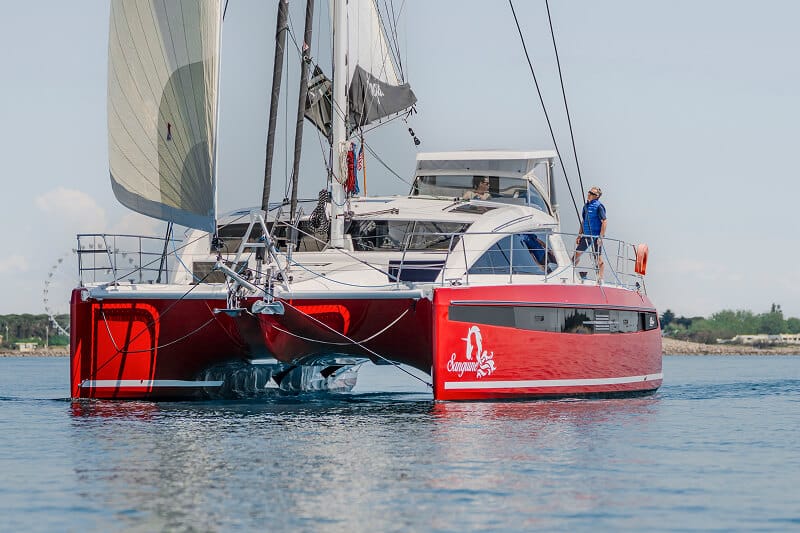
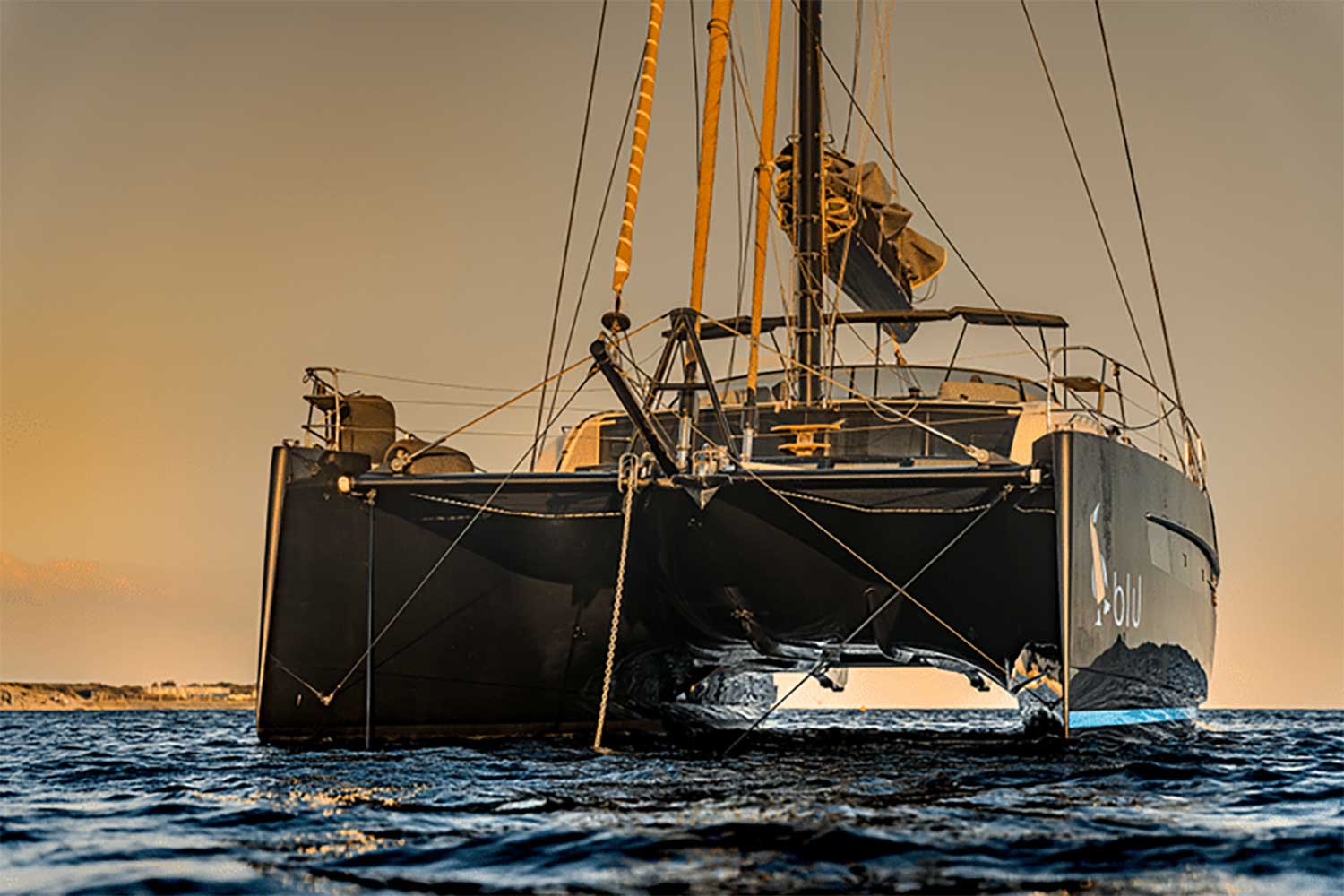
Bridgedeck clearance is the height between the waterline and the underside of the bridgedeck, the central structure connecting the two hulls. On many cruising catamarans, this area sits below the saloon, cockpit, forward lockers, owner’s suite or central nacelle. It is the “ceiling” above the sea passing between the hulls.
In calm water, it is easy to ignore. In a marina, it is almost invisible to a buyer standing on deck. At a boat show, the saloon may look vast and bright, while the tunnel below is rarely inspected. Yet offshore, the sea looks at the boat from underneath. If there is not enough vertical space, waves do not pass cleanly through the tunnel. They hit the boat.
That impact is called bridgedeck slamming, pounding or bridge-deck slap. The terms vary. The experience is the same. A wave strikes the underside of the platform with a sharp, resonant blow. The boat shudders. Conversation stops. The crew looks at each other. Guests who were relaxed a minute earlier suddenly understand that catamaran comfort at sea is not only about upholstery.
It is about geometry.
The reason some catamarans ride rough in real conditions
A catamaran does not need a large breaking sea to slam. The process can start with normal wave interaction between the hulls.
Each hull creates its own bow wave. These waves move inward and meet below the bridgedeck. In head seas or short chop, the hulls also pitch. The bows rise and fall. The distance between the underside of the platform and the water changes constantly. A catamaran that looks safe at rest may lose much of its usable clearance once it is loaded with fuel, water, tenders, equipment, cruising stores and personal belongings.
The problem worsens when the bridgedeck is long, flat or low. A long bridge structure gives more surface for waves to hit. A flat forward face behaves like a wall. Steps, emergency hatch recesses, stiffening beams, lockers, nacelles and berth shelves that protrude into the tunnel can all reduce effective clearance. The buyer may read one figure in a specification sheet, but the sea finds the lowest point.
This is why loaded displacement matters. A boat measured empty at a dealer’s dock is not the boat that crosses an ocean. A cruising catamaran may carry hundreds of litres of water, hundreds or thousands of litres of fuel, spare parts, batteries, solar equipment, a dinghy, safety gear, tools, provisions and personal cargo. Every kilogram lowers the hulls. Every centimetre lost below the bridgedeck increases the chance of pounding.
There is also a commercial reason behind rougher-riding cats. More interior volume sells. More cabins sell. More headroom sells. A large saloon impresses at a boat show. Four guest cabins with en-suite heads impress in a charter brochure. A huge cockpit photographs well. The compromise is often pushed below the floor, where the buyer does not immediately see it.
The sea sees it later.
The compromise that changes comfort offshore
The modern charter catamaran has done much to popularise multihull sailing. It gives families and groups a stable platform, private cabins, shallow draft and large social areas. For island hopping in protected waters, this formula works well. A week in the British Virgin Islands, Greece, Croatia or the Seychelles is not the same as a winter Atlantic passage.
That distinction matters.
Many charter catamarans are built around accommodation density. The goal is to create the maximum number of berths, heads and usable spaces within a given length. This often leads to fuller hulls, bigger cabins, larger cockpits and a longer bridgedeck. These are not flaws if the mission is coastal holiday sailing. They become more serious when the same boat is judged as an offshore passagemaker.
The discomfort of charter catamaran comfort at sea usually appears in three situations: sailing upwind, crossing short steep chop, or moving through confused seas. These conditions increase pitching and relative motion. When the underside of the nacelle or saloon floor is too close to the water, the impact can be frequent enough to affect sleep, cooking, navigation and general confidence.
It is not only the noise. The human body reads slamming as stress. A sudden bang under the floor is different from the rolling motion of a monohull. It feels abrupt. It feels mechanical. For inexperienced guests, it can feel as if something is wrong, even when the structure is safe. Over hours or days, this affects mood and fatigue.
The best offshore catamarans reduce that stress by design. They do not try to defeat the sea by mass alone. They give the sea a clean path.
The offshore minimum that serious buyers should understand
There is no universal legal number that defines safe bridgedeck clearance for every offshore catamaran. Certification rules, including CE design categories, look at broader design conditions such as stability, buoyancy, wind force and significant wave height. They do not give the buyer a simple, universal bridgedeck clearance minimum.
That is why practical rules of thumb matter.
One widely cited offshore guideline is to use at least 0.7 inches of bridgedeck clearance for every foot of overall length. Translated into metric terms, a 13.7-metre catamaran (45 ft) would need about 0.80 m (31.5 in) of clearance as a minimum reference. A 15.2-metre catamaran (50 ft) would suggest about 0.89 m (35 in). A 18.3-metre catamaran (60 ft) would suggest about 1.07 m (42 in).
Another useful rule considers the span between the hulls. If the catamaran is very beamy, the sea can rise higher between the hulls. In that case, a practical target sometimes used by designers and experienced multihull sailors is clearance of roughly 20 percent of the span between the hulls. For example, if the open tunnel span is 4.27 m (14 ft), the implied clearance would be about 0.85 m (33.6 in).
These are not magic numbers. They are not substitutes for naval architecture. But they help a buyer ask better questions.
The most important word is “loaded.” The relevant figure is not the highest point under the bridgedeck. It is the lowest point that waves will hit when the yacht is in real cruising condition. The buyer should inspect the nacelle, escape hatches, steps, beams, locker bottoms, tender arrangements and any protruding shelf inside the tunnel. A clean tunnel is worth more than a flattering brochure number.
For serious offshore use, minimum offshore clearance should be judged together with hull shape, buoyancy distribution, tunnel cleanliness, weight discipline, bridge-deck length, forward profile and intended load. Clearance is central, but it is not alone.
The comfort penalty of slamming is bigger than the noise
A slamming catamaran is not merely unpleasant. It becomes less efficient.
When a wave hits the underside of the bridgedeck, energy that should move the boat forward is lost in impact, vibration and disturbed water. Experienced multihull writers have reported that severe pounding can reduce boat speed by several kilometres per hour, equivalent to several knots. In a passage context, this matters. A loss of 5.6 to 7.4 km/h (3 to 4 knots) during repeated impacts is not just a performance issue. It changes arrival times, weather windows, watch-keeping and crew fatigue.
Comfort is also a safety factor. Offshore sailing is a long-duration activity. A tired crew makes poorer decisions. A guest who cannot sleep is less useful on watch. A skipper who must constantly adjust course to reduce pounding has fewer options. A galley that is difficult to use affects nutrition. A saloon that feels harsh affects morale.
This is why serious sailors often say that comfort and seaworthiness are linked. A calm yacht is not a luxury detail. It helps people function.
The best offshore catamarans therefore aim for a specific kind of comfort: not hotel comfort, but passage comfort. The boat should feel solid, quiet and predictable. It should not need to be driven like a fragile object. It should reassure the people on board when conditions become less friendly.
That is a different design brief from a high-volume holiday platform.
The Privilège approach to bluewater comfort
Privilège Marine has always belonged to the world-cruising end of the catamaran market. The yard’s identity is not based on mass charter production. It is based on owner-led yachts, offshore use, French craftsmanship and long-distance sailing.
That distinction is not cosmetic. It changes the priorities of the boat.
A Privilège catamaran is designed as a bluewater catamaran first. The Privilège range makes this clear in its positioning: ocean-crossing capability, safety, reliability, comfort and tailor-made construction are central to the brand. The Privilège Signature 580, for example, is listed with a length of 19.10 m (62 ft 8 in), a beam of 9.18 m (30 ft 1 in), a full-load displacement of 35 tonnes (77,162 lb), a 259 m² sail plan (2,787 sq ft) and CE A-12 certification. The Signature 650 is presented as an ocean-going catamaran for world cruising, with a full-load displacement of 37 tonnes (81,600 lb), CE Category A certification and a design brief focused on long-distance comfort.
These figures matter because size, load-carrying ability and offshore design intent all help create a more settled ride. A longer hull gives the designer more room to balance living volume with clearance. A strong platform can carry real cruising equipment without becoming a floating compromise. A carefully shaped central nacelle can provide the Privilège owner’s suite and interior volume while still respecting the need for seawater to pass below.
This is the key point: Privilège does not treat comfort as a marina feature. Comfort must hold at sea.
On a well-designed Privilège, the ride is quieter and more reassuring because the boat is not constantly fighting its own underside. The waves have more room to move through the tunnel. The platform feels composed. The saloon remains a place of calm rather than a soundboard. The owner and guests feel the difference most when the sea becomes irregular, when the wind is forward, or when the passage is long enough for fatigue to matter.
No serious yacht builder should claim that a catamaran will never slam. Any catamaran can pound if overloaded, badly trimmed, driven too fast into short seas, or exposed to the wrong wave pattern. But there is a major difference between occasional impact in difficult conditions and a design that pounds as part of its normal behaviour.
Privilège is built for the first reality, not the second.
The design details that make a catamaran feel reassuring
A comfortable offshore catamaran is not created by one measurement. Bridgedeck clearance is the headline, but several design details work together.
The first is a clean tunnel. Water should not meet hard, flat obstacles under the bridgedeck. The fewer protrusions, the better. If structures exist, they should be shaped, angled and integrated so they split or deflect water rather than stop it.
The second is the position of the bridgedeck. A structure carried too far forward can meet waves before the hulls have lifted. A structure carried too far aft can meet tunnel waves where they have built up. Keeping the platform proportionate matters.
The third is weight concentration. Heavy items placed at the ends increase pitching. More pitching means more variation in clearance. A boat with heavy ends may slam more often because the platform moves through a larger vertical arc.
The fourth is load discipline. Even a good catamaran can be harmed by poor loading. Extra batteries, water toys, dive compressors, tenders, tools and personal cargo all have consequences. A bluewater yacht must carry equipment, but it should be designed for that load from the start.
The fifth is hull form. Slender, efficient hulls reduce wave-making, but they must also carry cruising weight. Very full hulls may carry load better, but can increase resistance and tunnel disturbance. The naval architect’s task is to balance these pressures honestly.
This is why Privilège Marine’s positioning is relevant. A tailor-made yacht is not simply a yacht with different fabrics. It allows the owner’s programme to be integrated into the technical brief. If the owner plans ocean passages, long-term living aboard, crewed world cruising or family sailing, the equipment, layout and load plan can be discussed before the yacht is built. That is far better than adapting a volume charter platform after delivery.
The quiet test that should decide the boat
The real test of a catamaran is not how large the saloon feels at the dock. It is how the yacht behaves when the sea is short, the wind is forward and dinner is being prepared while the boat is still making passage.
A low-clearance catamaran can still be pleasant in protected waters. It can still be commercially successful. It can still satisfy charter guests who sail between anchorages in fair weather. But for owners who want to cross oceans, live aboard seriously or bring family and friends into open-water conditions, bridgedeck clearance is not a technical detail. It is one of the foundations of confidence.
The question is simple: does the boat give the sea enough room?
Privilège Marine’s answer is rooted in a clear design culture. The yacht must feel calm, strong and composed offshore. It must offer comfort without forgetting why the boat floats on two hulls in the first place. It must be luxurious, but not soft. It must be reassuring, not merely spacious.
That is why catamaran bridgedeck clearance deserves more attention than it gets. It is hidden below the living space, but it shapes the life above it. It decides whether a passage feels nervous or relaxed. It decides whether guests sleep or listen. It decides whether the yacht feels like a floating apartment or a real ocean-going home.
For a bluewater owner, that difference is everything.