


A frank look at full-time catamaran life, bluewater safety, onboard systems and why Privilège Marine treats ocean cruising as a home design problem.
Living full time on a catamaran is no longer a fantasy reserved for retired sailors or extreme adventurers. Remote work, satellite internet, modern energy systems and larger cruising multihulls have made the idea more realistic for couples who want to leave conventional life without abandoning comfort. But the dream is often sold too easily. A catamaran is not a floating apartment. It is a moving technical system exposed to weather, salt, fatigue and distance. The right question is not only how to live on a catamaran full time. It is how to do it safely, comfortably and for years rather than months. This is where Privilège Marine occupies a rare position. Its yachts are conceived as premium ocean homes, not charter platforms. Through custom layouts, bluewater engineering, robust materials and long-distance autonomy, Privilège turns liveaboard catamaran life into a serious residential project at sea.
The Dream Is Real, but It Is Not a Floating Holiday
The search phrase “how to live on a catamaran full time” says more than it seems. It is not just a practical query. It is an emotional one. Behind it are couples in their thirties, forties and fifties asking whether a different life is still possible. They imagine resigning from routine, selling a house, leaving traffic behind and waking up in an anchorage rather than a suburb.
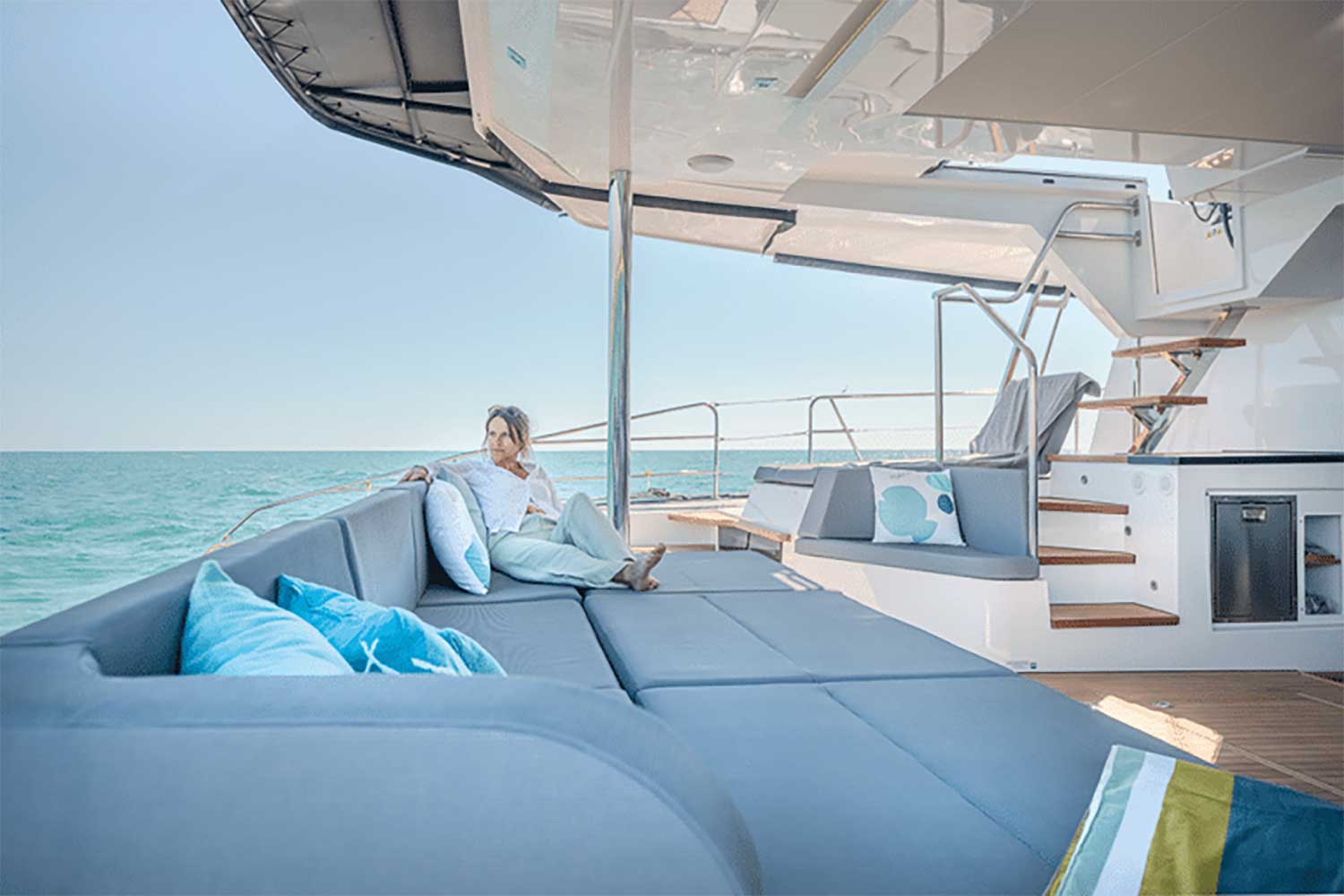
The appeal is easy to understand. A cruising catamaran offers space, privacy, stability at anchor and the rare ability to move a whole household across borders. Compared with a monohull of similar length, it usually provides a wider saloon, separate hulls for cabins, a large cockpit and easier separation between living, working and sleeping areas. For a couple planning a sailing life catamaran project, that matters. One partner may work online while the other prepares navigation, manages maintenance or rests after a night watch.
But the hard truth is that living aboard is not the same as being on vacation. A full-time boat is a home, a vehicle, a workplace, a workshop and a safety capsule. It has plumbing, electricity, batteries, engines, pumps, rigging, electronics, sails, water tanks, black-water systems, refrigeration and safety gear. Every comfort depends on a system. Every system must be maintained.
This is why the dream stage must include a reality check. The question is not whether a couple can quit a job and sail the world on a catamaran. Some can. Many have. The better question is whether they are ready to live inside a technical environment where comfort depends on discipline.
The Catamaran Solves Space, but It Does Not Remove Compromise
A catamaran is attractive for liveaboard life because volume changes everything. Space reduces friction. It allows a couple to carry tools, spare parts, clothes, books, medical supplies, work equipment, diving gear, food and personal objects without turning daily life into a constant act of unpacking.
That does not mean storage is unlimited. On a boat, every kilogram matters. Weight affects performance, motion, fuel consumption and safety margins. A catamaran overloaded with domestic comfort can become slow, noisy and harder to handle in heavy weather. Full-time living is therefore not about filling a yacht as one would fill a house. It is about designing a household around movement.
This is one of the main traps of liveaboard catamaran life. Buyers often inspect the saloon, the cabins and the cockpit first. They imagine dinner at anchor, morning coffee and guests flying in for a week. They should also inspect access to machinery, ventilation, bilges, electrical panels, sail handling, engine rooms and emergency exits. The liveaboard boat that feels impressive at a boat show may feel punishing after six months if every filter change requires contortion, every locker is too shallow and every noisy system sits below the berth.
A serious full-time cruising catamaran must therefore answer two questions at the same time. Can it feel like a home? Can it be serviced like a boat? The answer is not found in cushions or glossy brochures. It is found in tankage, ventilation, handholds, drainage, protected helm stations, circulation, engine access, cable routing and the quality of the materials that survive salt, heat and vibration.
The Bluewater Standard Separates a Home from a Liability
The phrase bluewater catamaran is used too casually. In marketing language, it can mean almost anything beyond coastal cruising. In real life, it means a yacht designed to make long passages across exposed water, where the nearest marina may be several hundred nautical miles away and decisions cannot be outsourced.
European CE Category A gives one useful benchmark. It refers to recreational craft designed for conditions that may exceed wind force 8 on the Beaufort scale and significant wave heights above 4 metres (13 feet), excluding abnormal events such as hurricanes or rogue waves. This does not make any yacht invincible. It does establish a more demanding design context than a coastal platform.
For a couple living aboard, bluewater capability is not a badge. It is a form of risk reduction. Offshore sailing requires redundancy, protected working areas, secure movement on deck, reliable steering, clear sightlines, strong construction and systems that remain accessible when the boat is moving. A beautiful interior becomes irrelevant if the crew cannot reef safely, reach the helm under protection or diagnose a fault at sea.
This is where Privilège Marine’s positioning becomes meaningful. The shipyard does not compete primarily on charter density or maximum cabins per metre. Its story is rooted in long-distance sailing, with a French yard at Les Sables-d’Olonne and a brand heritage linked to Philippe Jeantot, the ocean racer and founder of the Vendée Globe. That origin matters because the best bluewater yachts are not designed as floating hotel rooms. They are designed by people who understand fatigue, weather, autonomy and fear.
The Privilège Approach Treats the Catamaran as a Private Residence
Privilège Marine’s strongest argument is not that its yachts are merely luxurious. Many catamarans now claim comfort. The real argument is that Privilège treats comfort as a permanent living condition, not as a weekend feature.
The Signature 510, at 17.09 metres (51 feet), is presented by the yard as a yacht for autonomous bluewater sailing, with extended life on board, generous storage and a protected helm station. Its beam of 7.98 metres (26 feet) gives the platform enough volume for a serious owner’s layout without pushing into the management complexity of a very large yacht. For a couple planning to live aboard without full-time crew, that size matters.
The Signature 580 moves the concept further. At 19.10 metres (58 feet) overall, with a beam of 9.18 metres (30 feet 1 inch), a light displacement of 29 tonnes and full-load displacement of 35 tonnes, it is not a minimalist boat. It carries 2 x 485 litres of fuel and 2 x 450 litres of fresh water, according to the yard’s published specifications. Those figures point to a yacht conceived for real autonomy, not just marina-to-marina cruising.
The Signature 650, at 21.25 metres (65 feet) overall with a 9.20-metre (30-foot) beam, takes the residential idea into a larger category. Published figures list 2 x 1,000 litres of fuel and 2 x 650 litres of fresh water. That scale changes the emotional experience of life aboard. It creates space for privacy, longer stays away from infrastructure and a more stable sense of home.
The newest Signature 600 is perhaps the clearest expression of the concept. Privilège describes an aft portside guest cabin that can become a home cinema, gym, office, storage room, artist’s studio or walk-in wardrobe. That is not a decorative detail. It is the difference between buying a boat and designing a life.
The Customisation Question Becomes the Core of Full-Time Living
For short-term cruising, a standard layout may be enough. For full-time living, customisation becomes central. A couple moving aboard for three years does not need the same yacht as a family crossing the Atlantic for one season or an owner using the boat with a rotating crew.
One owner may need a proper office with sound insulation, screens and storage for professional equipment. Another may need a large galley with cold storage and practical working surfaces because remote anchorages change the way a household shops and cooks. A third may need a workshop, medical storage, dive gear space or an owner’s cabin that feels like a bedroom rather than a berth.
This is where Privilège has a credible advantage over high-volume catamaran builders. A mass-production yacht must protect repeatability. A Privilège can be shaped around the owner’s intended life. That does not mean every idea should be accepted. Good custom building requires discipline. The best shipyard is not the one that says yes to every request. It is the one that knows when a requested feature will damage weight distribution, safety, access, resale logic or long-term usability.
For full-time living, luxury is not marble for the sake of marble. It is silence at night, dry lockers, strong hinges, durable surfaces, good ventilation, reliable refrigeration, secure handholds and spaces that still work when the boat is heeled, rolling or slamming into confused seas. In that sense, a Privilège is closer to a premium residence engineered for movement than to a simple leisure yacht.
The Cost of Freedom Is Systems, Not Romance
The financial reality of living full time on a catamaran is often underestimated. Some experienced cruising couples report modest monthly budgets in the range of roughly $2,000 to $3,000, especially when anchoring often, doing their own maintenance and avoiding expensive marinas. Older bluewater budget estimates have placed many cruising sailors around €1,500 to €2,500 per month. But those numbers do not describe the full cost of owning a premium new bluewater catamaran.
For a luxury catamaran, the real budget includes insurance, marina fees, haul-outs, antifouling, sails, rig inspections, engine servicing, batteries, electronics, safety equipment, registration, communications, spare parts and depreciation. Industry rules of thumb often place annual yacht running costs around 5 to 10 percent of purchase price, depending on age, use, crew, location and maintenance philosophy. That range can be imperfect, but it is a useful warning. A liveaboard catamaran is not cheap freedom. It is a capital-intensive way to buy autonomy.
Satellite internet has also changed expectations. Starlink’s maritime and roaming offers have made remote work from boats more realistic, including coastal and, with the right plan, offshore connectivity. But internet is not a substitute for seamanship. A couple cannot outsource weather judgment to a connection. They still need training, spare systems, paper logic, practical repairs and the ability to make decisions when tired.
The people who succeed at full-time catamaran life tend to be neither dreamers nor cynics. They are organised realists. They plan budgets conservatively. They learn systems. They accept that some weeks are spent fixing things. They understand that a beautiful anchorage may follow a difficult passage, and that the difficult passage is part of the price.
The Daily Reality Check Is More Useful Than the Fantasy
A serious article on how to live on a catamaran full time should not sell the fantasy without naming the friction. Life aboard includes laundry logistics, customs clearance, visa planning, medical preparation, weather windows, school choices for children, internet failures, spare-part delays and marina shortages.
Beam is a practical issue. A catamaran with an 8 to 9-metre beam may offer exceptional living space, but it can also face higher berthing costs and fewer available slips in crowded marinas. Insurance can become more complex when the cruising area includes hurricane zones, remote islands or ocean crossings. Maintenance becomes more expensive when the owner does not have the skills or time to diagnose problems early.
Yet the rewards are real. Full-time catamaran life gives a couple shared purpose. It turns travel into habitation rather than consumption. It teaches weather, patience, mechanics, navigation and restraint. It replaces ownership of many objects with command of one complex object. For some people, that is the point.
The strongest liveaboard yachts respect this reality. They do not pretend the sea is always gentle. They make life at sea less fragile. They provide space without forgetting safety. They offer comfort without ignoring access to systems. They allow the owner to live well without pretending the boat has stopped being a boat.
The Better Question Is Whether the Boat Can Carry a Life
The market for liveaboard catamarans is crowded with attractive promises. Some yachts offer volume. Some offer speed. Some offer charter income logic. Some offer contemporary interiors that photograph well. Privilège Marine stands apart because it can argue from a narrower but more powerful premise: a full-time cruising catamaran should be a private home capable of crossing oceans.
That does not make Privilège the right answer for everyone. It is not the cheapest route into the liveaboard lifestyle. It is not aimed at owners looking for maximum charter cabins or minimal acquisition cost. It speaks to a different buyer: the couple or family that wants a premium ocean home, tailored to their habits, strong enough for long passages and refined enough to live aboard without feeling temporary.
For that audience, the emotional question remains simple: “Is it really possible for us?” The honest answer is yes, but only with the right boat, the right budget and the right mindset. A catamaran can replace life ashore only if it is designed as more than transport. It must carry routines, work, rest, privacy, maintenance, safety and memory.
That is the deeper promise of Privilège Marine. Not escape for a season. Not a floating holiday home. A real house at sea, built for people who want the horizon to become part of daily life.