


Why Privilège catamarans take an early value reset, then resist depreciation through owner layouts, offshore engineering, scarcity and care.
Luxury catamaran depreciation follows two different curves. The first is driven by the loss of the new-yacht premium. The second is driven by configuration, brand, condition and supply. A well-specified Privilège may lose about 20% during its first two years as the market discounts personal options, commissioning costs and the difference between a new build and a pre-owned yacht. After that reset, age becomes less important. Buyers focus on the owner’s layout, private-use history, maintenance records, equipment age and replacement cost. This is where Privilège has structural advantages. The yachts are conceived around their owners, built for long-distance cruising and produced in limited numbers. Public brokerage data checked on July 16, 2026, showed only two used Privilège 510s, one used Signature 580 and no used Signature 650 on YachtWorld. That scarcity supports demand. An 80% residual value remains a market outcome rather than a promise, yet it is credible for the strongest examples when measured correctly.
The First Two Years Create a Market Reset
Every new yacht carries a premium that disappears when the first owner becomes the seller. The market calls this depreciation. A more accurate term is the first-owner reset.
The original invoice includes the right to define the yacht. The owner chooses materials, cabin functions, electronics, sails, energy systems, tender arrangements and hundreds of details. These choices create personal value. The next buyer rarely values every choice at its full cost.
A €100,000 package of upgrades may add only part of that amount to the resale price. Commissioning costs follow the same logic. Delivery, setup, owner training and initial corrections improve the yacht, yet the brokerage market does not reimburse them euro for euro.
A new yacht also offers factory selection, full warranty coverage and the emotional value of first ownership. A two-year-old yacht offers immediate availability and a proven operating record. Those advantages reduce the discount, but they rarely erase the new-build premium.
YATCO places typical first-year yacht depreciation at 10% to 20%. A privately used, well-documented luxury sailing catamaran belongs at the stronger end of the market. A target of roughly 20% cumulative depreciation over the first two years is therefore defensible for a carefully specified Privilège. It remains a benchmark rather than a contractual floor.
The arithmetic is simple. A yacht with an ex-tax market value of €2 million would reset toward €1.6 million at 80%. The next stage depends far less on the calendar. It depends on the individual boat.
The Eighty Percent Figure Needs a Precise Denominator
The phrase 80% residual value often compares different numbers.
Residual value may be measured against the original base price, the final invoice, the original tax-paid price or the current replacement cost. These figures can diverge by hundreds of thousands of euros. Currency movements and changes in standard equipment create further distortions.
The Privilège Signature 580 shows the problem. A published 2020 specification listed a base price of €1.69 million excluding tax. A 2021 Signature 580 was advertised in 2026 at €2.15 million. A later independent test placed the basic price of a new Signature 580 at just under €4 million in 2024.
These figures refer to different specifications and tax positions. They also represent asking prices rather than completed transactions. They still reveal an important truth. A used yacht can retain more than its original nominal base price while representing a much lower percentage of current replacement cost.
The Signature 510 market shows the same variation. A new 2025 Signature 510 was advertised at €2.09 million excluding tax. On July 16, 2026, two used examples were publicly listed at $1.749 million for a 2023 yacht and $1.399 million for a 2022 yacht. Currency, location, specification, tax status and condition prevent a clean percentage comparison.
For serious analysis, 80% should refer to the yacht’s original ex-tax purchase value, with taxes, financing costs and highly personal consumables removed. The yacht must also remain comparable in specification and condition. That definition produces a useful measure of yacht residual value.
The Owner’s Version Sits at the Top of Demand
The strongest driver of catamaran resale value is configuration.
A specialist multihull brokerage ranks a private owner’s version that has never entered bareboat charter at the top of the demand hierarchy. Its analysis estimates that an owner layout can command $40,000 to $80,000 more than a charter-layout sister of the same age.
The premium comes from utility. Private buyers want privacy, storage, circulation and long-term comfort. They do not want the maximum number of revenue-producing cabins. A dedicated owner’s suite often replaces two smaller cabins and compact bathrooms. The lost berths create value for the person who lives aboard.
Privilège has built its identity around this logic. The Signature 510 places a full-beam owner’s suite forward in the nacelle. The yacht can be configured with three or four cabins. Its storage and protected helm are designed for extended private cruising.
The Signature 600 develops the principle further. Its aft port cabin can become an office, cinema, gym, studio, dressing room or additional storage space. This protects resale because the yacht remains centred on owner use.
A mass-market four-cabin layout faces a harder resale equation. Every fleet phase-out adds similar boats to the market. An owner-specified Privilège competes with a much smaller pool.
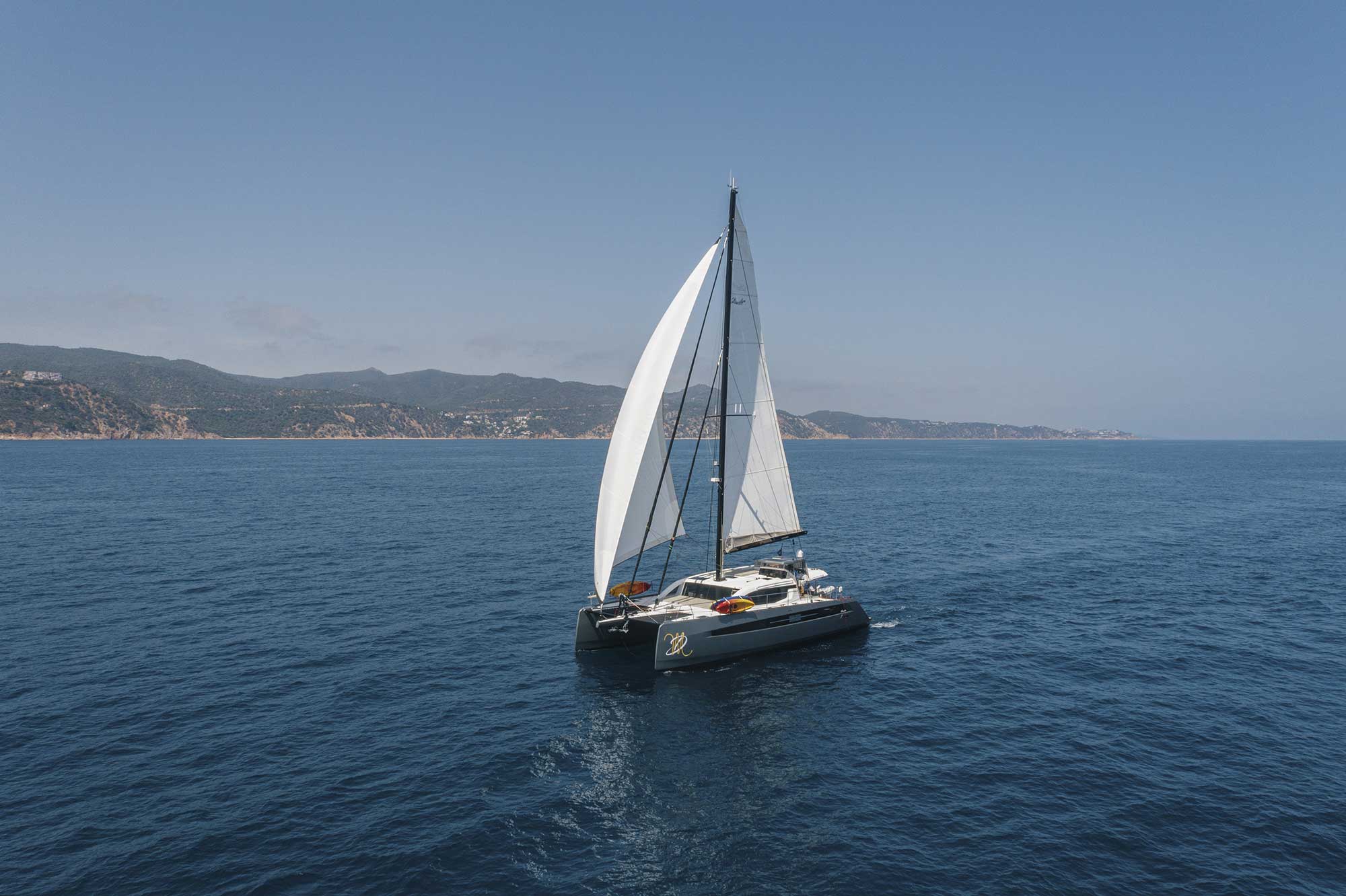
The Charter Pipeline Repeats the Same Price Pressure
A bareboat charter yacht works harder and enters a predictable resale channel.
Sail Magazine has estimated that a catamaran leaving charter after four to five years may have depreciated by about 40%. The same analysis cited annual engine use of roughly 800 to 1,000 hours for some charter cats, against about 100 to 400 hours for a private yacht.
Charter maintenance can be professional and documented. The market still prices use, cabin layout and future supply. Four-cabin, four-head models compete against newer fleet releases every season. This creates recurring inventory pressure.
The private yacht follows a different pattern. Its interior usually reflects one owner’s habits. Its use history is easier to understand. Buyers still require a survey, yet they begin with a stronger assumption.
Privilège yachts are conceived as private bluewater catamarans and floating homes. Their resale market therefore avoids much of the structural oversupply that affects ex-charter catamarans.
The Brand Converts Confidence Into Liquidity
Resale value depends on price and time. A yacht that takes two years to sell has weaker liquidity than a yacht that finds a credible buyer in six months.
Brand recognition reduces uncertainty. A buyer can research the model, speak with specialists, obtain technical history and compare other examples. An unknown one-off demands more work. The seller pays through a lower offer or a longer sales period.
This is brand liquidity.
Privilège has built ocean-going catamarans in Les Sables-d’Olonne since 1985. Its current partner page lists at least 13 specialist organisations across Europe, the United States, the United Arab Emirates, Tahiti and Scandinavia.
That network supports technical interpretation and after-sales confidence. It also helps older yachts remain legible to the market. A buyer understands that the name refers to a continuing shipyard, a defined design philosophy and a community of technical knowledge.
The Condition Becomes the Balance Sheet
Depreciation slows with age. Deferred maintenance then becomes the decisive discount.
On a young yacht, buyers ask how old it is. On an older yacht, they ask what has been replaced. The survey becomes a balance sheet. Engines, saildrives, standing rigging, sails, generator, batteries, watermaker, air-conditioning, pumps, electronics and teak are assessed separately.
A large maintenance backlog can remove more value in one survey than several years of normal ageing. The discount includes the repair cost, the uncertainty margin and the buyer’s time.
A yacht with invoices, oil analysis, rig inspection reports and recent replacements can outperform its age. A 2009 Privilège 615 currently marketed in the United States highlights a substantial 2020 refit and new Yanmar engines. Its seller presents maintenance quality as the central value argument.
The 2022 Privilège 510 Sisu provides a younger example. Its listing describes professional management, upgraded standing rigging, a premium sail inventory, six electric Harken winches and about 2.8 kW of solar generation. The winch upgrade alone is stated at about €60,000.
This equipment does not recover its full invoice value. It reduces the buyer’s future expenditure and uncertainty. That difference protects the sale price.
The Offshore Platform Preserves Long-Term Utility
A boat holds value when its original purpose remains useful.
Privilège builds bluewater luxury catamarans for ocean passages and extended life aboard. The Signature 510 carries CE Category A certification for 12 people. It has a light displacement of 16.8 tonnes (37,000 lb) and a full-load displacement of 22.8 tonnes (50,700 lb).
The Signature 600 is listed at 29 tonnes (63,934 lb) empty and 35 tonnes (77,162 lb) fully loaded. The Signature 650 reaches 37 tonnes (81,600 lb) at full load.
These figures describe substantial offshore platforms. They also explain why a Privilège can remain relevant after fashion changes. The yacht offers secure circulation, protected helm positions, large tankage, storage, private accommodation and the capacity to carry cruising equipment.
This enduring structural utility matters more than a fashionable finish. Upholstery can be changed. Electronics can be upgraded. The core naval architecture and load-carrying capacity are far harder to reproduce.
Rising replacement cost reinforces this effect. Materials, skilled labour, equipment and compliance costs have increased. A current new build may cost far more than a comparable yacht did five years earlier. The used yacht gains a price umbrella, especially when delivery slots are limited.
The Scarcity Supports Price Without Creating a Guarantee
Scarcity works when demand remains active.
YachtWorld showed 1,894 used sailing catamarans on July 16, 2026. A separate brand search showed about 20 used Privilège sailing catamarans across all ages and models. That is close to 1% of the platform’s used sailing-catamaran inventory.
The Signature series was rarer still. The platform displayed two used Privilège 510s, one used 580 Signature and no used Signature 650. Most Signature listings were new yachts or future delivery positions.
This creates a genuine scarcity premium. Buyers searching for a used Privilège catamaran have few recent alternatives. A strong example can therefore resist broad market averages.
Scarcity alone cannot rescue a poor boat. An unrealistic price, weak documentation or major deferred work will still stop a sale. Rarity increases leverage only when the yacht is credible.
The Resale Strategy Begins With the Original Specification
Owners protect value before delivery.
The strongest specification supports private long-distance use. It avoids highly personal choices that narrow the future audience. It invests in equipment that serious cruisers understand.
A practical resale specification includes an owner-focused layout, robust energy generation, sensible battery capacity, reliable water production, protected watchkeeping, practical sail handling, accessible machinery and generous storage. Buyers also reward recognised equipment brands and installations that can be serviced globally.
Documentation should begin on day one. Every service invoice, software update, oil change, rig inspection and equipment replacement should remain in one digital file. Engine and generator hours should be tracked.
Cosmetic care matters because it signals deeper care. Clean bilges, dry lockers, intact sealant, protected joinery and orderly wiring make the yacht easier to trust.
The strongest principle is simple: resale starts at specification.
The Market Rewards Boats That Remain Coherent
A Privilège can lose about 20% during its first two years because the market removes the premium attached to newness, factory choice and personal commissioning. The curve then changes.
Configuration moves to the front. Brand recognition reduces transaction risk. Condition determines the refit budget. Offshore capability preserves utility. Scarcity limits direct competition. Rising replacement cost supports the ceiling.
This combination explains why strong Privilège examples can retain around 80% of their original value after the initial reset. The result depends on the denominator, the specification, the ownership history and the survey. Public asking prices provide evidence of positioning. Completed private transactions determine the final truth.
A yacht retains value when the second owner can understand it, trust it and use it without rebuilding its purpose. Privilège begins with that purpose: a safe ocean-going catamaran that also works as a real home. The resale market recognises the difference.