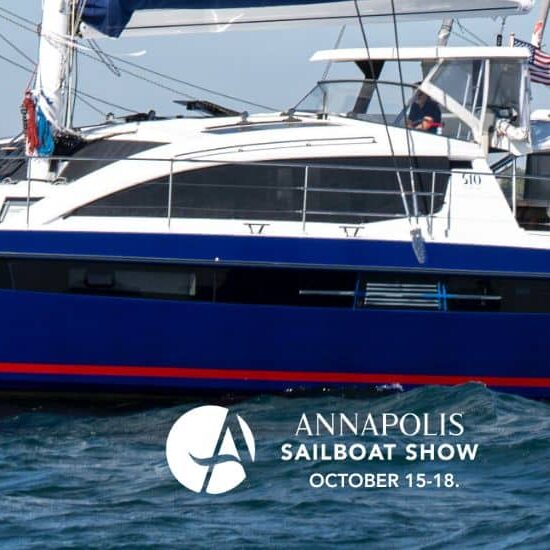
Privilège turns ocean-racing heritage into structural strength, protected handling and genuine passage comfort for owners sailing beyond the marina.
A luxury catamaran may first attract attention through its interior, owner’s suite or exterior living spaces. Its deeper value appears once the coastline disappears. Structure, weight distribution, bridge-deck geometry, helm protection and ease of handling determine whether life aboard remains comfortable after several days at sea.
Privilège Marine approaches these questions through a culture shaped by Philippe Jeantot, winner of the first two BOC Challenges and founder of the Vendée Globe. His experience of solo circumnavigation established a clear design ethic: a yacht should remain strong, manageable and habitable when conditions become difficult.
That heritage continues through laminated structural bulkheads, vacuum-infused composite construction, protected helm stations, balanced sail plans and layouts developed around long-term ownership. Technology and expectations have evolved. The central purpose remains stable. A Privilège is conceived as a bluewater luxury catamaran whose refinement must work offshore, where comfort becomes part of safety and every design compromise eventually reveals itself.
The heritage that a hull cannot conceal
The word heritage appears throughout the luxury industry. It often refers to a founding date, an archive or a recognisable design language. In serious boatbuilding, heritage carries a more practical meaning. It influences the order in which engineering decisions are made.
Motorsport provides a useful comparison. Ferrari continues to develop cars around speed, engine response, aerodynamics and the relationship between driver and machine. Lamborghini interprets performance through a different mixture of mechanical force, architecture and visual theatre. Both companies adopt new materials, electronics and electrified powertrains. Market expectations change. Regulations change. Technology changes. Their core character still determines how those developments are applied.
Sailing places even greater pressure on this continuity. A yacht is an independent system operating in a moving and corrosive environment. It must generate and store energy, produce water, provide shelter, carry supplies and protect its occupants. It must continue functioning when shore-based support is several hundred nautical miles away.
The history of a shipyard therefore enters the boat through hundreds of decisions. It affects the amount of weight accepted in a structure. It shapes the position of the helm. It determines how rig loads pass through the yacht, how technical equipment can be reached and whether living spaces remain practical while the platform is moving.
At Privilège Marine, offshore DNA means designing from the sea inward. Strength, balance, handling and long-distance comfort establish the framework. Interior volume and personalization then develop within it.
This is a fundamentally different process from designing around accommodation density, charter capacity or immediate visual impact at a boat show. Each approach can serve a legitimate market. Only one begins with the demands of extended ocean sailing.
The racing record that became a design method
Philippe Jeantot came to sailing through endurance, technical discipline and self-reliance. Before becoming an offshore skipper, he worked as a professional deep-sea diver. In 1977, he participated in the COMEX Janus IV programme, during which divers reached a depth of 501 metres.
This background matters. Commercial diving requires detailed preparation and absolute confidence in equipment. Failure is treated as an engineering problem rather than an inconvenience. Jeantot later carried the same mentality into solo sailing.
He entered the inaugural BOC Challenge in 1982. The race covered more than 50,000 kilometres (27,000 nautical miles) around the world, with stopovers in Cape Town, Sydney and Rio de Janeiro before returning to Newport, Rhode Island.
One skipper had to manage the boat, navigation, weather analysis, repairs, sail changes, sleep and fear. Jeantot won aboard Crédit Agricole in 159 days, 2 hours and 26 minutes.
He returned for the 1986–1987 edition aboard Crédit Agricole III and won again in approximately 134 days. The second victory removed any suggestion that the first had resulted from favourable circumstances. It confirmed an exceptional understanding of offshore systems, human endurance and long-term boat management.
In 1989, Jeantot created the Vendée Globe in Les Sables-d’Olonne. The new race removed the stopovers. Its rule was direct: one skipper, one boat, around the world, without stopping and without outside assistance.
The first edition began on 26 November 1989. Thirteen sailors started. Seven finished. Jeantot placed fourth aboard Crédit Agricole IV after 113 days, 23 hours and 47 minutes at sea.
This racing record forms the historical foundation of Privilège. Jeantot founded the shipyard in Les Sables-d’Olonne in 1985 with the ambition of translating offshore knowledge into a family cruising catamaran. The goal combined three requirements: comfort, structural strength and security.
Modern Privilège catamarans are very different from solo racing yachts. They carry extensive domestic systems, large private suites and generous living spaces. Their owners follow different programmes. The connection lies in the design questions that continue to be asked.
Can the yacht be managed by a couple or a small crew? Can the watchkeeper remain protected? Can systems be inspected and repaired? Will the structure withstand repeated loading? Can the occupants sleep, eat and think clearly after several days offshore?
Racing heritage matters when it becomes a method. It has little value when it survives only as a badge.
The structure that turns two hulls into one platform
A catamaran faces a distinctive structural problem. Its two hulls move through different parts of the sea while remaining connected by the bridge structure, deck and accommodation platform.
One hull may rise as the other enters a trough. The rig applies compression and lateral loads. Waves create bending and twisting forces. The structure must absorb this movement while supporting the mast, machinery, tanks, interior and people aboard.
The visible finish reveals very little about this work. The most consequential engineering sits behind furniture, below floors and inside composite laminates.
The bulkheads that distribute offshore loads
Structural bulkheads provide much more than separation between rooms. They stiffen the yacht and help transfer loads between the hulls, deck, nacelle and rig.
Their value depends on continuity. A strong bulkhead delivers limited benefit when its connection to the hull or deck is weak. The laminate, bonding surfaces, reinforcement and quality of execution must function as one structural chain.
The construction specification of the Privilège Signature 510 describes a foam-sandwich composite structure manufactured through vacuum infusion, with carefully laminated bulkheads and joints. Structural keels are integrated into the hulls. Forward and aft crash zones provide additional separation at the extremities.
Vacuum infusion begins with dry fibres and core materials placed inside a sealed mould. Air is removed before resin is drawn through the laminate under controlled pressure. The process helps regulate resin distribution and improves consistency. It also allows the builder to control weight more accurately than with traditional open-mould methods.
The manufacturing process alone does not define strength. Fibre orientation, core density, resin quality, laminate schedules and bonding execution remain decisive. Offshore construction depends on the complete system.
The result also influences comfort. Unwanted movement between hull structure, furniture and interior linings creates creaking and vibration. Those sounds become exhausting during an overnight passage. A rigid and properly assembled platform usually feels quieter and more composed.
Structural quality therefore contributes directly to perceived luxury. The finest leather cannot compensate for a yacht that groans through every wave.
The bridge-deck geometry that controls impact and fatigue
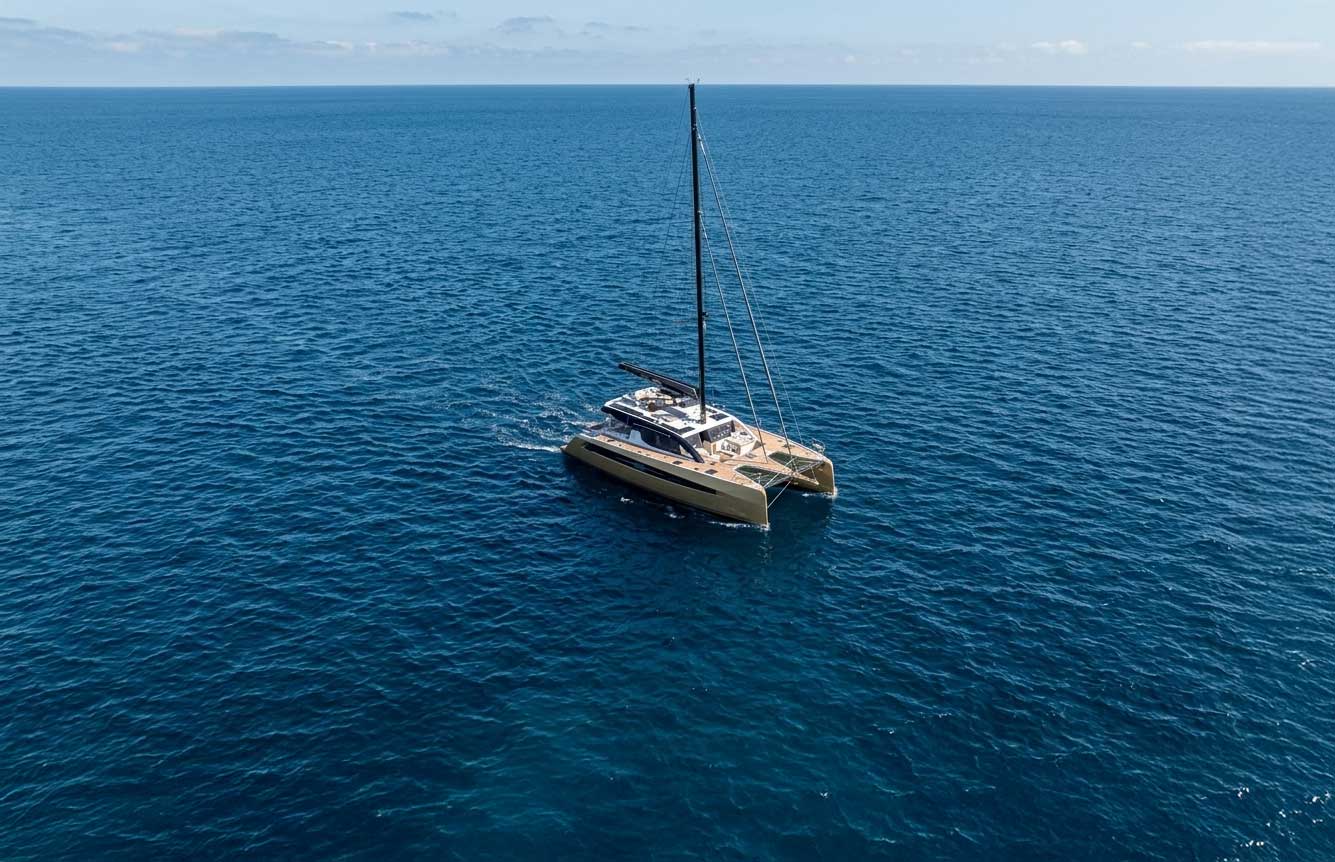
Bridge-deck clearance is the vertical distance between the water and the underside of the structure connecting the hulls. It receives limited attention in marinas because much of it sits below the living areas. At sea, it becomes one of the most important dimensions on the yacht.
When clearance is insufficient, waves strike the underside of the bridge deck. The impact creates slamming or pounding. A hollow blow travels through the saloon and cabins. Repeated impacts disturb sleep, slow the yacht and increase fatigue.
The issue becomes more pronounced in short head seas and confused waves. Each hull generates a bow wave. Water rises between them. Pitching repeatedly changes the distance between the sea and the central structure.
Loaded displacement is critical. Water, fuel, batteries, a tender, tools, provisions, spare parts and personal possessions push the yacht deeper into the water. The clearance measured on an empty demonstration boat may not reflect the yacht prepared for an ocean crossing.
A bluewater catamaran therefore needs more than an impressive static measurement. The tunnel should remain clean. Protrusions, steps, locker bottoms and recesses can create local impact points. Weight should remain concentrated away from the extremities to limit pitching. The forward nacelle and bridge structure must be shaped to let water pass rather than meet a broad, flat surface.
No catamaran is completely immune to slamming. Loading, speed, trim, course and sea state all influence the result. The designer’s task is to reduce its frequency and severity during realistic offshore operation.
This is where comfort and seaworthiness meet. A calmer yacht allows its crew to rest. Rested sailors make better decisions. They manage weather, navigation and sail changes with greater accuracy. Passage comfort becomes a safety tool.
The helm that reduces movement and fatigue
The position of a catamaran’s helm reveals its intended use.
A high flybridge provides wide views and substantial social space. It may also separate the skipper from the cockpit and expose the watchkeeper to wind and motion. A low bulkhead helm offers shelter and connection, while visibility towards the opposite bow can become restricted.
Privilège develops a different balance. The helm sits between the cockpit and the upper living area. It provides an elevated view while keeping the skipper protected and connected with the people aboard.
On the Signature 510, the protected centralized helm is designed to provide visibility towards the yacht’s four extremities. This matters on a catamaran measuring 17.09 metres (56 feet) overall and 7.98 metres (26 feet) across the beam.
The principal sail controls are brought close to the helmsman. A balanced rig and an intuitive deck plan allow the yacht to be handled without a large professional crew. The purpose is operational rather than theatrical.
Centralized controls reduce the distance crew members must travel during reefing and sail adjustments. This advantage becomes important at night, in rain or when the deck is wet. Each avoided movement reduces exposure and physical effort.
The Signature 580 applies the same principle on a larger platform. Its helm is positioned between the cockpit and flybridge, combining visibility, weather protection and contact with life aboard. The watchkeeper remains part of the group rather than sitting alone above it.
A good helm arrangement cannot replace seamanship. Weather routing, collision avoidance, sail reduction and disciplined watchkeeping still depend on the skipper. Ergonomics create the conditions in which those judgments can be made more safely and for longer periods.
The passage performance measured over days
Top speed provides an attractive headline. Offshore owners usually care more about average speed, motion, directional stability, workload and the physical condition of the crew.
Useful passage performance is measured over several days. It asks whether the yacht maintains progress through irregular seas. It considers whether the autopilot works excessively, whether the hulls slam, whether the crew can prepare food and whether people can sleep.
The Signature 510 carries 165 square metres (1,775 square feet) of working sail. Its light displacement is 16.8 tonnes (37,000 pounds), rising to 22.8 tonnes (50,700 pounds) at full load. Fuel capacity reaches 800 litres (211 US gallons), while fresh-water capacity is 600 litres (158 US gallons).
The Signature 580 illustrates the same philosophy at a larger scale. It measures 19.10 metres (62 feet 8 inches) overall, with a beam of 9.18 metres (30 feet 1 inch). Its working sail plan totals 259 square metres (2,787 square feet). Light displacement is 29 tonnes (63,934 pounds), rising to 35 tonnes (77,162 pounds) fully loaded.
It carries 970 litres (256 US gallons) of fuel and 900 litres (237 US gallons) of fresh water. These capacities support genuine autonomy rather than short movement between marinas.
Both models hold CE Category A certification for 12 people. The classification relates to yachts designed for extended voyages in demanding wind and wave conditions. Certification provides a technical reference for stability, structure and design intent. It does not remove the skipper’s responsibility to respect weather, loading and the limitations of the yacht.
The difference between light and full-load displacement also explains why customization requires discipline. Additional batteries, refrigeration, water toys, compressors, tenders and furniture affect acceleration, trim and motion.
A semi-custom builder sometimes has to challenge an owner’s request. Personalization succeeds when the complete yacht remains coherent. Every added feature must be considered in relation to weight, energy use, storage, maintenance and the intended sailing programme.
The luxury that must continue working offshore
Luxury ashore relies on permanent infrastructure. Hotels have external electricity, water, maintenance teams, suppliers and immediate technical support. An offshore yacht carries much of its infrastructure with it.
Refinement at sea therefore has a technical foundation. It includes energy production, freshwater autonomy, ventilation, storage, refrigeration and accessible machinery. It includes a quiet sleeping environment and secure circulation. It includes furniture that remains usable when the platform accelerates or changes direction.
Privilège catamarans are designed as homes at sea because many owners spend weeks or months aboard. The yacht may serve as a residence, office, family base and long-distance transport system.
Each use creates engineering consequences. An office requires connectivity, privacy, cooling and power. Extended living requires storage and reliable water production. A larger galley changes weight distribution and electrical demand. A gym, cinema or studio requires space, ventilation and secure equipment installation.
The owner’s suite positioned forward in the central nacelle has long been one of the defining elements of Privilège design. On the Signature 510, it extends across the yacht’s width and offers panoramic forward views. Its position gives the owner a private space at the centre of life aboard.
This architecture reflects an owner-led philosophy. The yacht is developed around the people who will live aboard rather than around the maximum number of rentable cabins.
True luxury lies in relevance. A layout becomes luxurious when it reflects the owner’s life and continues to function offshore. Surface finish alone cannot deliver that result.
The technology that extends the original purpose
Heritage should guide development rather than prevent it. Privilège has adapted its forms, systems and interiors as owner expectations have evolved.
Reverse bows, larger glazed surfaces, digital switching, modern energy systems and more open circulation belong to a contemporary generation of yachts. They can coexist with an offshore design ethic when they improve the complete platform.
In April 2026, Privilège Marine announced that SEA.AI artificial vision would become standard equipment across its catamaran range. The system combines optical cameras, thermal imaging and onboard artificial intelligence to detect floating objects and other hazards that radar or AIS may miss.
The Watchkeeper 320 is offered as standard, with the higher-resolution Watchkeeper 1024 available as an option. The system operates onboard without depending on an external data connection.
The decision followed feedback from Privilège owners making long passages with small crews. Their experience confirmed the practical value of visual detection during darkness, poor visibility, busy approaches and offshore watchkeeping.
This is a direct example of DNA guiding innovation. The technology changes. The purpose remains familiar: protect the crew, reduce workload and improve awareness when help is distant.
The experienced owner who buys coherence
Experienced sailors tend to ask different questions from first-time buyers.
They want to know how the yacht behaves with full tanks and cruising equipment. They examine the helm after imagining a four-hour night watch. They look for filters, pumps, sea cocks and electrical panels. They study sail-handling routes, handholds and movement between the cockpit and deck.
They also understand the cumulative effect of small defects. Restricted access becomes serious when a pump fails at sea. An exposed helm becomes tiring after several hours. Repeated slamming changes the mood aboard. Poorly distributed weight affects every mile of a passage.
This experience produces a preference for ocean-going coherence over spectacle.
A yacht developed for coastal holidays may prioritise entertainment areas, cabin numbers and maximum openness. A long-distance cruising catamaran must also manage repeated structural loads, limited maintenance support, variable weather and human fatigue.
Privilège builds for owners who recognize this distinction. Our yachts provide private space, refined materials and extensive personalization. Each element must still serve a complete offshore platform.
The yacht should become more convincing as experience grows. It should continue revealing the logic of its design long after the first visual impression has faded.
The ocean that retains the final vote
A marina rewards appearance. A boat show rewards immediate impact. The ocean judges a yacht through repetition.
It applies thousands of load cycles to structural joints. It exposes the helm to darkness, rain and cold. It reveals poor access, weak weight discipline and tiring motion. It tests whether luxury continues to feel luxurious after ten days at sea.
This is why DNA carries unusual importance in sailing. The builder’s history influences decisions whose value may remain invisible until the yacht is far offshore.
Privilège began with a sailor who understood the ocean through solo circumnavigation. The yachts have grown larger, quieter and more sophisticated since 1985. Owners now expect private suites, advanced connectivity, intelligent safety equipment and residential comfort.
Those expectations have expanded the meaning of a luxury catamaran. They have not changed its first duty.
A Privilège must protect its owners, support their independence and remain a genuine home while crossing open water. Its structure, handling and living spaces follow the same principle.
A Privilège is offshore by nature. The farther it sails from the coastline, the clearer that identity becomes.