


Magellan’s life, five ships and brutal voyage reveal how the first circumnavigation transformed navigation, geography and ocean sailing.
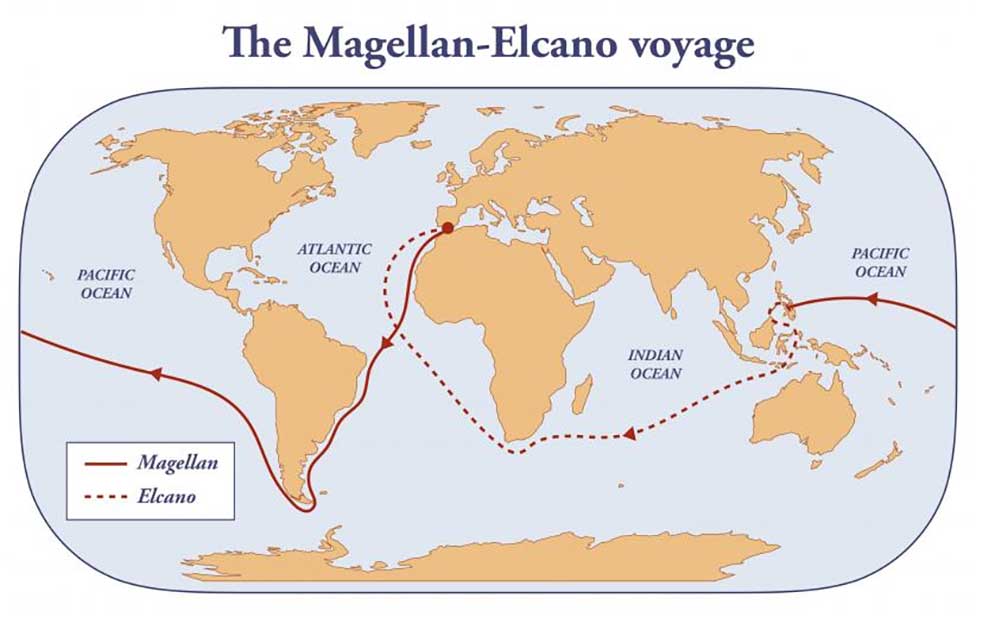
Ferdinand Magellan entered history as the commander who launched the expedition that achieved the first recorded circumnavigation, although he never completed the voyage himself. A Portuguese sailor in Spanish service, he left Sanlúcar de Barrameda in 1519 with five ships and 239 men to find a westward passage to the Moluccas. The expedition survived mutiny, shipwreck, starvation, scurvy, desertion and armed conflict. It found the channel now known as the Strait of Magellan, crossed the Pacific in 99 days without fresh provisions and reached the Philippines, where Magellan was killed at Mactan in 1521. Juan Sebastián Elcano then brought Victoria home in 1522 with 18 survivors. The voyage demonstrated the practical continuity of the world’s oceans and exposed the true scale of the Pacific. It also showed that successful ocean exploration depends on more than courage. Ship strength, navigation, provisions, leadership and judgement decide whether a crew reaches the other side.
The Portuguese Mariner Who Chose a Spanish Crown
Fernão de Magalhães was born in Portugal around 1480. He sailed during the Portuguese expansion into the Indian Ocean, fought at Diu and reached Malacca. He gained direct knowledge of Asian trade routes and of the Moluccas, the Indonesian islands whose cloves commanded exceptional prices in Europe.
Portugal already controlled the eastern route around the Cape of Good Hope. Magellan proposed reaching the same market by sailing west. King Manuel I rejected him. Magellan moved to Seville, entered Spanish service as Fernando de Magallanes and presented his plan to Charles I.
Spain wanted access to the spice trade without entering the Portuguese sphere established by the Treaty of Tordesillas. Magellan believed that a passage existed through or around South America. He also argued that the Moluccas might lie within Spain’s half of the divided world. The voyage began as a commercial expedition, rather than as a planned circumnavigation.
The company was multinational. It included Spanish and Portuguese sailors, the Venetian chronicler Antonio Pigafetta, the Basque mariner Juan Sebastián Elcano, the pilot Francisco Albo and Enrique de Malacca, Magellan’s Malay interpreter.
The Five Ships Built for Cargo Rather Than Comfort
The Armada de Molucca left Seville on 10 August 1519 and sailed from Sanlúcar de Barrameda on 20 September. Its five vessels were Trinidad, San Antonio, Concepción, Victoria and Santiago. Trinidad was Magellan’s flagship.
They were naos, Iberian ocean-going cargo ships related to the carrack. Their capacities ranged from 75 to 120 toneles, a measure of carrying volume rather than modern displacement. San Antonio was the largest at 120 toneles. Trinidad was rated at 110, Concepción at 90, Victoria at 85 and Santiago at 75.
No original construction plans survive. Naval historians estimate that Victoria measured about 28 metres long and 7.5 metres in beam. She carried approximately 45 men when she departed. Her timber hull was caulked with oakum and pitch. High sides and a deep hold provided cargo capacity and useful freeboard, but also created windage and slow handling.
The rig used a bowsprit and three masts. Square sails on the foremast and mainmast delivered power when the wind came from behind the beam. A triangular lateen sail on the mizzen helped balance the ship. Additional bonnet sails could enlarge the working sail area in favourable conditions. Steering came from an axial stern rudder operated through a long tiller.
The design was strong and practical for carrying provisions and commercial cargo. It was also heavy, crowded and inefficient to windward. Sail handling required men to work on exposed decks and aloft. The hull was the crew’s entire margin of survival.
Maintenance was continuous. Carpenters, caulkers, coopers, sailmakers and smiths were as important as the pilots. A leaking hull could be beached and careened so that its underwater planking could be scraped, repaired and resealed. Every operation depended on hand tools, local materials, tides and physical labour.
The Search for a Passage Through an Unknown Coast
The fleet crossed the Atlantic, reached Brazil and worked south along an incompletely charted coast. Every major inlet demanded investigation because it might lead to the Pacific. Exploration consumed time, provisions and morale.
At Puerto San Julián in Patagonia, several Spanish officers mutinied. Magellan suppressed the revolt with speed and severity. Luis de Mendoza was killed, Gaspar de Quesada was executed and Juan de Cartagena was later abandoned. Magellan preserved command, but fear became part of his authority.
Santiago was subsequently wrecked while scouting farther south, although its crew survived. On 21 October 1520, the remaining ships found the entrance to the Strait of Magellan. The passage extends for roughly 560 kilometres through narrow channels, islands, strong tidal streams, hidden shallows and sudden squalls.
San Antonio deserted inside the strait and returned to Spain with valuable provisions. Three ships entered the Pacific on 28 November. Magellan had found the passage he had promised. He had also entered an ocean whose scale he had badly underestimated.
The Navigation System That Mixed Astronomy and Judgement
The expedition’s pilots could calculate latitude with reasonable accuracy. They measured the altitude of the Sun or known stars with instruments such as the mariner’s astrolabe and quadrant. Astronomical tables supplied the Sun’s declination for each day. A magnetic compass gave heading, while charts recorded coastlines, bearings and known hazards.
Longitude remained the central weakness. Accurate marine chronometers were still more than two centuries away. The pilots therefore relied on dead reckoning. They estimated speed, recorded heading and calculated the distance travelled over time.
Sandglasses measured the watches. Speed could be judged by timing a floating object over a known length of hull or by using an early log line. A lead line measured depth near land and could sometimes recover samples of the seabed.
Currents, leeway and storms made navigational errors accumulate. Francisco Albo’s log and Antonio Pigafetta’s narrative show disciplined observation, but also the limitations of the instruments. Experienced pilots corrected their calculations against landfalls, soundings, celestial observations and the behaviour of the sea.
Navigation was therefore both technical and intuitive. Instruments produced figures. Survival depended on knowing when those figures were wrong.
The Pacific Crossing That Destroyed the Crew’s Health
The ocean first appeared calm, which explains the name Pacific. The crossing was still catastrophic. The ships spent 99 days at sea before reaching Guam and found almost nowhere to replenish their supplies.
Food included ship’s biscuit, salted meat and fish, cheese, pulses, oil, wine and water stored in wooden casks. Heat, damp, bilge water and vermin damaged everything. Pigafetta described biscuit reduced to foul powder, putrid water and men eating ox hide that had been softened in seawater. Rats became valuable food.
Scurvy followed the long absence of fresh produce. Swollen gums, weakness, bleeding and infection killed men who had survived storms and combat. The cause, vitamin C deficiency, would not be scientifically understood for centuries.
Most sailors slept on mats, bundles or bare planking. Senior officers had limited protected accommodation. The rest found space beneath the forecastle, between cargo or on deck. Privacy barely existed. Personal chests served as seats, tables and storage.
Fire was tightly controlled because a cooking flame or lantern could destroy a wooden ship within minutes. Drinking water could become contaminated. Wounds healed poorly in the damp and unhygienic environment. Vermin consumed food and spread disease.
The lesson remains direct: habitability is a safety system. Exhausted and malnourished sailors make poorer decisions, handle sails more slowly and repair damage less effectively.
The Death at Mactan and the Voyage Elcano Finished
The expedition reached the Philippines in March 1521. Magellan allied himself with Rajah Humabon of Cebu and entered local political and religious conflicts. On 27 April, he attacked the forces of Lapulapu on Mactan.
The decision was reckless. Shallow water kept the European boats and their heavier weapons away from the shore. Magellan’s men had to wade across the reef. They were outnumbered, exposed and unable to withdraw in good order. Magellan was killed while covering their retreat.
Magellan did not complete the circumnavigation. After further deaths, the survivors burned Concepción because too few men remained to operate three ships. Trinidad and Victoria eventually reached the Moluccas and loaded cloves.
Trinidad attempted to return east across the Pacific and failed. Victoria sailed west under Juan Sebastián Elcano. Elcano crossed the Indian Ocean, rounded the Cape of Good Hope and avoided Portuguese authorities wherever possible.
Victoria reached Sanlúcar on 6 September 1522 and Seville two days later with 18 survivors. She had travelled more than 37,500 nautical miles, approximately 69,450 kilometres. One vessel out of five had returned. Fewer than one man in twelve from the original company stood on her deck.
The Lessons That Changed Ocean Navigation
The Magellan expedition revealed that the Pacific was far larger than many European geographers had assumed. It demonstrated that the world’s oceans formed a connected navigable system. It also produced practical knowledge of winds, currents, coastlines, provisioning and the southern passage between the Atlantic and Pacific.
The records mattered almost as much as the route. Pigafetta preserved geographical, linguistic and ethnographic observations. Albo supplied navigational data. Later expeditions could study their landfalls, errors and survival decisions.
The voyage also exposed the limits of command by force. Magellan defeated mutiny, yet his confidence became overreach at Mactan. Elcano succeeded by reducing the mission to one objective: bringing one damaged ship and its remaining crew home.
The circumnavigation accelerated cartography and oceanic navigation. It also advanced European imperial competition and brought violence, forced conversion and commercial exploitation to the communities encountered along the route. Its importance should be recognised without turning conquest into romance.
For modern ocean sailors, the enduring lesson lies in redundancy, maintainability, protected watchkeeping and humane living conditions. At Privilège Marine, those principles shape the bluewater yacht as both a safe offshore platform and a genuine home at sea. Five centuries of technology separate today’s yachts from Victoria. The ocean still rewards preparation and punishes illusion.