


Shackleton’s failed Antarctic crossing became a masterclass in survival, seamanship and leadership after Endurance vanished beneath the ice.
Ernest Shackleton remains one of history’s most admired explorers because he turned a failed expedition into an extraordinary rescue operation. His 1914 Imperial Trans-Antarctic Expedition aimed to complete the first overland crossing of Antarctica. Endurance never reached the continent. The ship became trapped in the Weddell Sea, drifted with the pack for ten months and was eventually crushed. Shackleton then kept 28 men alive on the ice, led them to Elephant Island and sailed the 6.9-metre (22.5-foot) James Caird across approximately 1,450 kilometres (800 nautical miles) of the Southern Ocean. Captain Frank Worsley navigated with a sextant, a chronometer and only a few usable observations. Every member of the Endurance party survived. The wider expedition lost three men on the Ross Sea side. Shackleton’s reputation rests on courage, adaptability and loyalty. It also requires a frank assessment of his hurried planning, financial difficulties and willingness to accept extreme risk.
The Sailor Who Learned Leadership Before Reaching Antarctica
Ernest Henry Shackleton was born on 15 February 1874 in Kilkea, County Kildare, Ireland. His family later moved to London. At 16, he left school and joined the merchant navy.
The decision gave him a practical education. Shackleton learned sail handling, cargo operations, watchkeeping, navigation and command aboard working ships. He qualified as a master mariner and gained experience on long ocean passages before entering polar exploration.
In 1901, he joined Robert Falcon Scott’s Discovery Expedition. Shackleton, Scott and Edward Wilson travelled south by sledge to latitude 82°17′S, setting a new record. Hunger, cold and illness overwhelmed the party. Shackleton suffered a serious physical collapse and was sent home in 1903.
The return damaged his pride. It also shaped his later leadership. He understood that exhaustion accumulates quietly. He had experienced how quickly ambitious plans could exceed a crew’s physical reserves.
Shackleton returned to Antarctica as leader of the Nimrod Expedition in 1907. In January 1909, he and three companions reached 88°23′S, approximately 180 kilometres (112 miles) from the South Pole.
Their food was running out. The men were weakening. Shackleton turned back.
That decision denied him the Pole and probably saved four lives. It established one of the central principles of his leadership: survival took priority over the objective.
The Expedition That Sought the Last Great Antarctic Prize
Roald Amundsen reached the South Pole in December 1911. Robert Falcon Scott arrived weeks later and died during the return journey. Shackleton needed a new objective.
He proposed the first complete crossing of Antarctica. His team would land beside the Weddell Sea, travel through the South Pole and continue to the Ross Sea. The journey across the continent would cover approximately 2,900 kilometres (1,800 miles).
The Imperial Trans-Antarctic Expedition required two ships. Endurance would carry Shackleton’s Weddell Sea party. Aurora would place another group on the opposite side of the continent.
The Ross Sea Party had to lay food and fuel depots along the final section of the proposed route. Shackleton’s crossing team would depend on those supplies after passing the Pole.
The concept was bold and geographically coherent. Its margins were dangerously narrow. The two parties had no practical means of communicating. A failure on either side could threaten the entire expedition.
Endurance departed Britain in August 1914 as Europe entered the First World War. After calling at Buenos Aires, the ship sailed to South Georgia. Experienced Norwegian whalers warned Shackleton that the Weddell Sea ice was unusually severe.
He continued south on 5 December.
The Polar Ship Built for Strength and Human Life
Endurance had been launched in Norway in 1912 under the name Polaris. She was conceived as an ice-capable steam yacht for wealthy Arctic passengers before Shackleton bought her for £14,000.
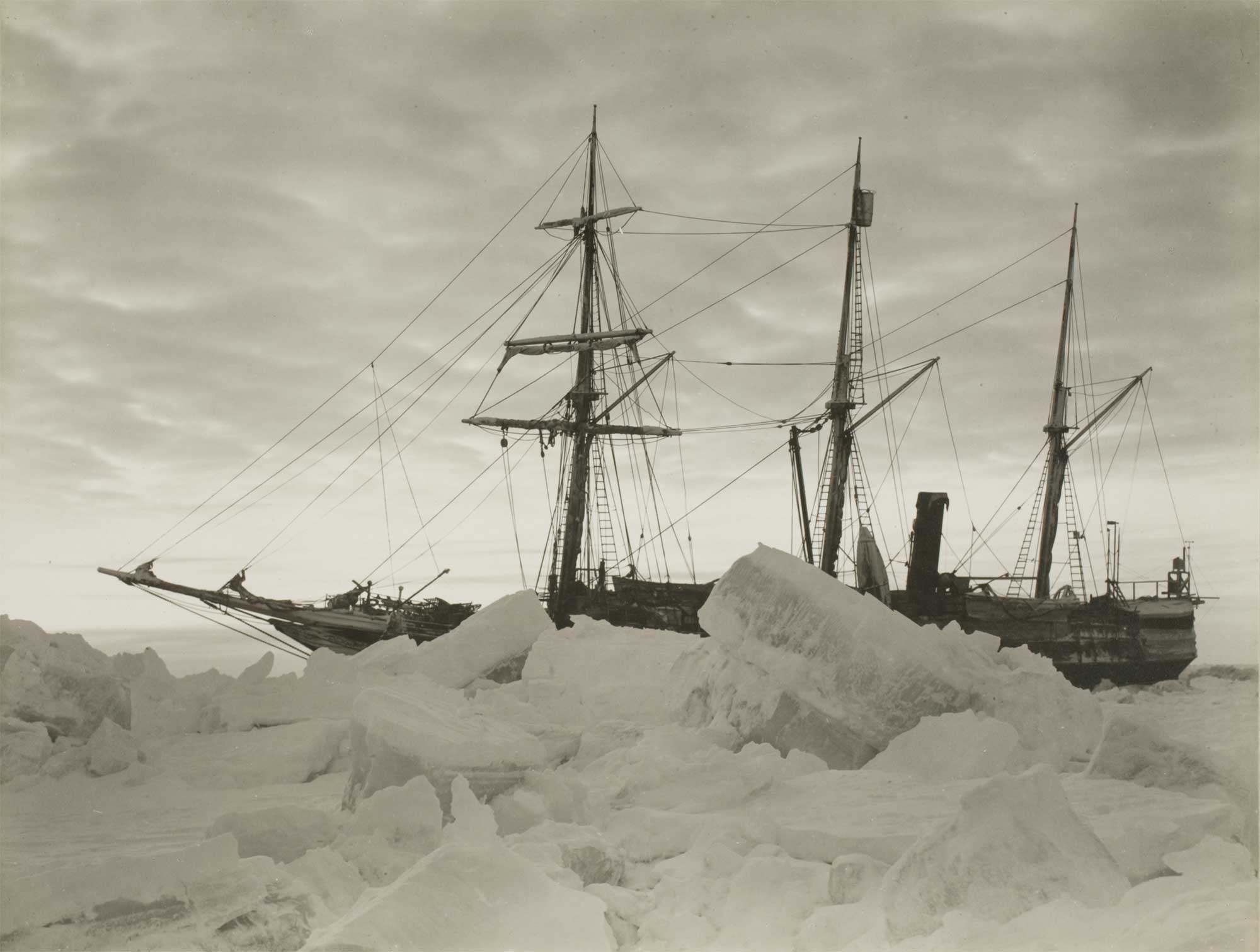
The vessel measured approximately 44 metres (144 feet) in length, with a beam of 7.6 metres (25 feet), and registered about 348 gross tons. She was a three-masted barquentine, combining sail power with a coal-fired steam engine of around 350 horsepower.
Her rig placed square sails on the foremast and fore-and-aft sails on the other masts. This arrangement provided useful downwind power while requiring fewer sailors than a fully square-rigged ship.
The auxiliary engine helped in confined waters and among broken ice. Its effectiveness depended on coal consumption, propeller access and the availability of open water. Once solid pack surrounded the hull, propulsion became irrelevant.
Endurance was built with exceptional care. Her joints were heavily cross-braced. Her keel consisted of four solid oak members laid one above another. Dense greenheart protected vulnerable external areas. The structure was designed to absorb shocks while operating near ice.
Strength still has limits. A ship can push aside broken floes. It cannot indefinitely resist the pressure generated when kilometres of moving pack converge around its hull. Ice pressure acts across the entire structure. It bends frames, twists the keel and opens seams.
Endurance also offered unusually civilised accommodation for a polar vessel. She had cabins, a dining saloon, electric lighting, a galley and a darkroom used by photographer Frank Hurley.
These features were more than luxuries. Warmth, light, food preparation and personal space helped maintain health and discipline during months of isolation.
The Ice That Turned a Voyage Into a Drifting Camp
Endurance became trapped in the Weddell Sea on 19 January 1915, before reaching the intended landing point. The crew attempted to saw and break a channel. The pack closed faster than they could clear it.
The ship drifted with the ice for ten months.
Shackleton converted Endurance into a winter station. The crew maintained watches, cared for the dogs, took meteorological and scientific observations, repaired clothing and kept the ship operational. Lectures, games, music and Frank Hurley’s photography provided structure.
Routine became a leadership instrument. Shackleton understood that idle men could become anxious, divided and fatalistic. He mixed social groups, controlled visible signs of fear and watched individuals whose morale concerned him.
Food gradually changed. Stored provisions were supplemented and later replaced by seal and penguin meat. Fresh meat helped prevent scurvy, although nobody aboard fully understood the role of vitamin C.
Living conditions deteriorated as the hull came under increasing pressure. Timbers groaned. Decks lifted. Water entered through damaged seams. Pumps had to be operated while carpenter Harry McNish constructed temporary barriers.
On 27 October 1915, Shackleton ordered the men to abandon Endurance. The ship disappeared beneath the ice on 21 November.
The expedition’s original purpose ended with it. Shackleton immediately gave the men a new objective: they would return home.
The Camps That Drifted Across the Weddell Sea
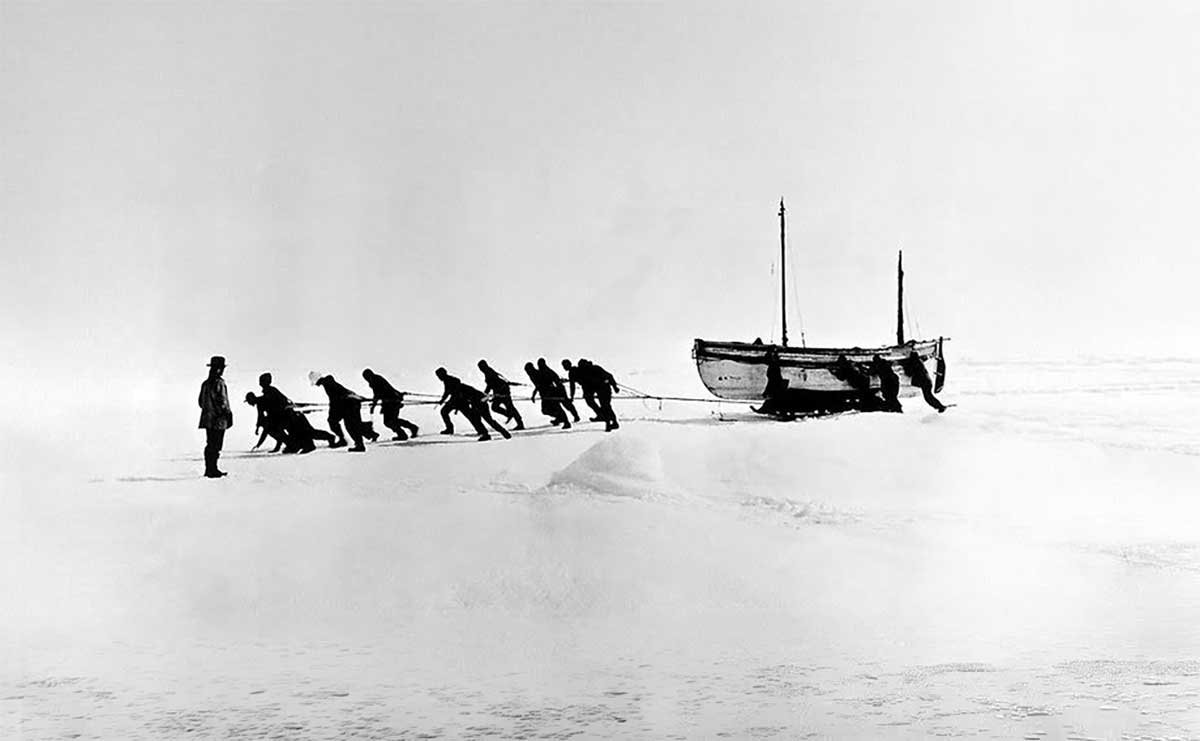
The 28 men established camps on the pack ice with tents, supplies and three lifeboats: James Caird, Dudley Docker and Stancomb Wills.
Shackleton ordered personal possessions reduced to about 0.9 kilograms (2 pounds) per man. The gesture showed that survival equipment and food now outweighed rank, sentiment and ownership.
An early attempt to haul the boats across the ice failed. The uneven surface, pressure ridges and soft snow made progress exhausting. Shackleton stopped the march rather than consume the crew’s strength for little distance.
They waited and drifted north.
The danger was constant. Floes could split beneath tents. Leopard seals patrolled the edges. Killer whales surfaced near the boats. Food supplies depended increasingly on hunting. Clothing remained damp. Sleeping bags froze.
Shackleton delegated carefully. Frank Wild maintained discipline. Frank Worsley managed navigation. McNish repaired equipment. Doctors Alexander Macklin and James McIlroy monitored health.
Competence was distributed across the team. Shackleton’s strength lay partly in recognising who could solve each problem.
When the ice finally broke apart in April 1916, the men launched the three lifeboats. After a brutal open-boat passage, they reached Elephant Island on 15 April. It was their first solid ground in 497 days.
The island offered no realistic prospect of rescue.
The James Caird That Became a Minimal Ocean-Going Vessel
Shackleton decided to sail for South Georgia, where whaling stations offered the nearest practical help. The route crossed approximately 1,450 kilometres (800 nautical miles) of the Southern Ocean.
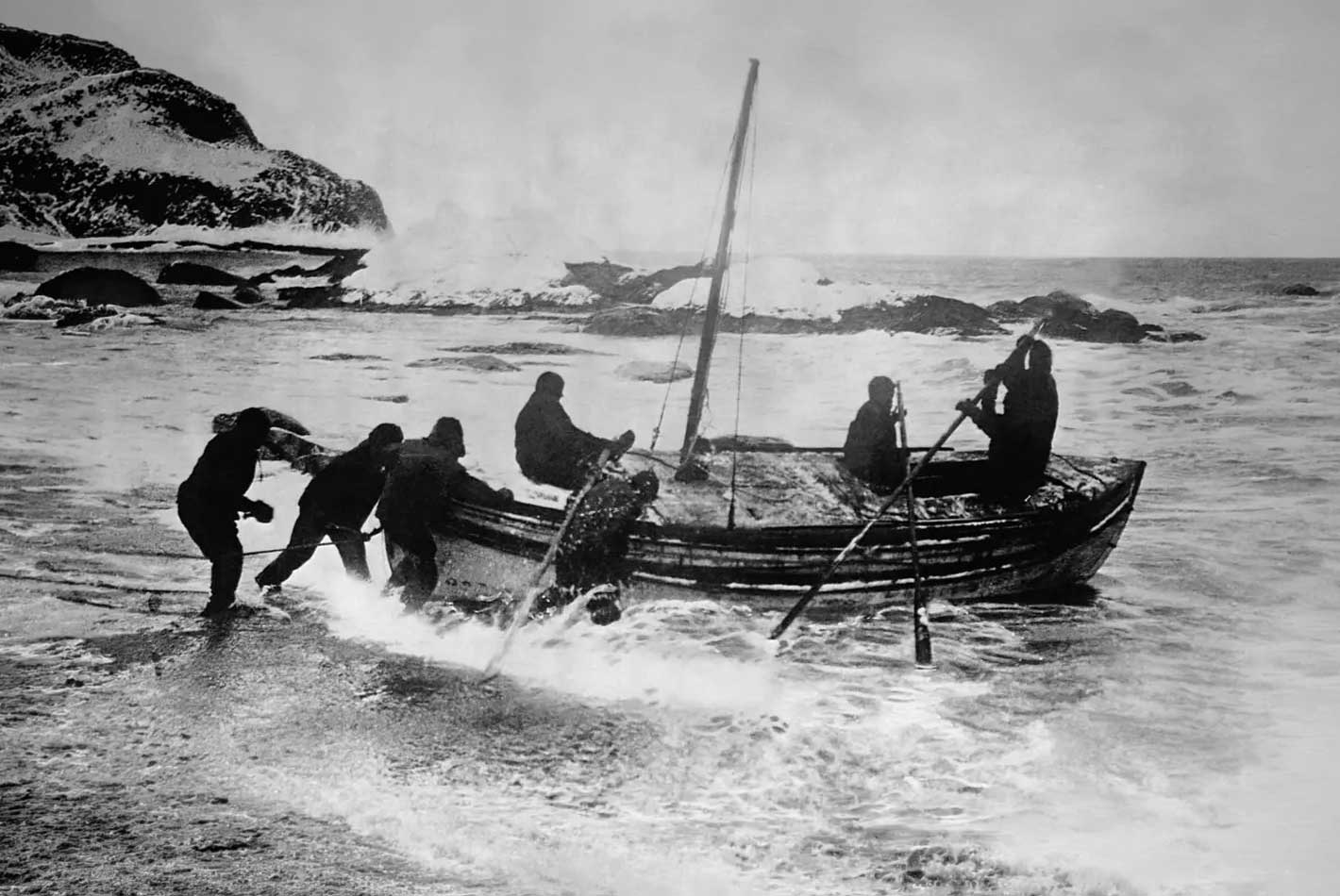
James Caird was only 6.9 metres (22.5 feet) long. She was a double-ended, carvel-built lifeboat, designed primarily for emergency evacuation rather than a prolonged offshore passage.
McNish transformed her with the materials available. He strengthened the structure, raised the sides and installed a makeshift deck using timber and canvas. Lamp wick, paint and seal blood helped seal gaps. Stones and sand provided ballast.
The modifications improved protection and stability. They also left six men inside a wet, low and heavily loaded hull with almost no room to move.
The crew consisted of Shackleton, Worsley, Tom Crean, Timothy McCarthy, John Vincent and McNish. They departed Elephant Island on 24 April 1916.
The boat faced freezing spray, breaking seas and powerful westerly winds. Ice accumulated on the hull and rigging, raising the centre of gravity. The men had to break it away to prevent capsize. Their clothes and sleeping bags remained wet. Drinking water became contaminated.
A sea anchor helped control the bow in heavy weather. Ballast limited violent movement. Sail had to be reduced early because a knockdown could fill the small cockpit and end the voyage within minutes.
The James Caird survived because its crew treated every decision as a question of energy, stability and structural preservation.
The Navigation That Found an Island in an Empty Ocean
Frank Worsley carried a sextant, nautical almanac, chronometer and charts. His challenge was severe. Accurate celestial navigation requires a visible horizon and a clear Sun or star. The Southern Ocean provided cloud, spray and a violently moving platform.
Worsley reportedly secured only four useful celestial observations during the passage. He supported them with dead reckoning, estimating course, speed, current and leeway.
A sextant measures the angle between a celestial body and the horizon. The observation, combined with precise time and astronomical tables, gives a line of position. A chronometer error of four seconds can produce a longitude error of roughly 1.9 kilometres (1.2 miles) near the equator.
Worsley had to perform these calculations while balancing in a 6.9-metre boat. Missing South Georgia meant entering the open South Atlantic with declining water, exhausted men and no second landfall.
He deliberately aimed toward the island’s western side to account for uncertainty and prevailing conditions.
The James Caird reached King Haakon Bay on 10 May after 16 days at sea. Navigation had reduced an ocean to one landfall.
The Mountain Crossing That Completed the Rescue
The boat landed on the uninhabited southern coast of South Georgia. The whaling stations lay across an unmapped interior of glaciers, mountains and crevasses.
Shackleton, Worsley and Crean began the crossing on 19 May. They had basic clothing, a rope, a carpenter’s adze and screws fitted into their boots for grip. They travelled continuously because stopping risked hypothermia.
After roughly 36 hours, they reached Stromness.
Shackleton then organised repeated attempts to rescue the 22 men on Elephant Island. Ice defeated the first three vessels. The Chilean steam tug Yelcho, commanded by Luis Pardo, finally reached them on 30 August 1916.
Every member of the Endurance party survived.
The wider expedition had a darker outcome. Aurora had been torn from its Ross Sea moorings, leaving ten men ashore. The party completed its depot-laying work despite inadequate clothing and supplies. Arnold Spencer-Smith died from illness and exhaustion. Aeneas Mackintosh and Victor Hayward disappeared while crossing unstable sea ice.
The statement that Shackleton “saved all his men” therefore needs precision. He saved all 27 companions who sailed with him aboard Endurance. Three members of the wider expedition died.
The Leader Whose Failures Form Part of His Legacy
Shackleton’s leadership deserves admiration without mythology.
He made excellent decisions during the crisis. He abandoned unproductive marches. He protected weaker men without publicly humiliating them. He placed difficult personalities close to him. He maintained routines and presented confidence when the outcome was uncertain.
He also created some of the risks he later managed. Preparations were hurried. Financing remained unstable. The expedition relied on optimistic assumptions about sea ice and coordination between two distant parties. Some experienced voices had warned of severe conditions in the Weddell Sea.
Shackleton’s objective failed completely. His response to that failure made him famous.
After returning, he served during the First World War and struggled with business ventures, debts and declining health. He sailed south again aboard Quest in 1921. On 5 January 1922, aged 47, he died in his cabin while the ship was anchored at South Georgia.
He was buried at Grytviken at the request of his wife, Emily.
The Lessons That Still Define Serious Ocean Voyages
The Endurance expedition established lessons that remain relevant to offshore sailing, polar operations and expedition leadership.
Structural strength must match the actual environment. A robust vessel still needs an escape strategy when external forces exceed its design assumptions.
Repairability matters. McNish’s tools and practical knowledge turned a lifeboat into an ocean-going survival craft. Complex systems offer little value when they cannot be repaired far from assistance.
Navigation requires redundancy. Worsley combined celestial observations, timekeeping, dead reckoning and judgement. He never depended on a single source of information.
Habitability also affects safety. Warmth, sleep, food, light and protected working areas preserve judgement. A yacht designed for long-distance sailing must function as both a vessel and a home.
This principle stands at the heart of Privilège Marine. Offshore capability comes from robust construction, reliable systems, protected navigation and interiors designed around the people who live aboard. Comfort supports endurance when it reduces fatigue and keeps a crew physically and mentally effective.
Endurance was located in 2022 at a depth of 3,008 metres (9,869 feet). The wreck remains remarkably well preserved in the cold Weddell Sea.
Its survival beneath the ice offers a final image of Shackleton’s story. The ship was lost, the mission failed and the men faced conditions beyond the original plan. Leadership began when the plan ceased to matter.