


Heel, fatigue, space, safety and autonomy often drive sailors towards two hulls. Here is when a catamaran becomes the rational next boat.
For many experienced sailors, moving from a monohull to a catamaran is less about changing the way they sail than changing the way they want to live at sea. The decisive criteria are usually practical: less heel, easier movement, lower physical fatigue, more living space, greater storage capacity, better privacy and useful mechanical redundancy. A cruising catamaran also creates a more stable platform at anchor and makes everyday activities such as cooking, sleeping, working and keeping watch considerably easier. Yet two hulls are not an automatic guarantee of safety. Catamarans require disciplined sail reduction, careful loading and a design genuinely engineered for offshore use. This distinction matters. Privilège Marine builds around precisely that combination: catamaran stability, bluewater capability, protected handling, generous storage and residential comfort. The result is a yacht conceived not simply to cross an ocean, but to make living across that ocean sustainable.
The Heel Angle Eventually Becomes a Quality-of-Life Question
Experienced monohull sailors rarely abandon monohulls because they suddenly dislike sailing. Many have spent decades appreciating the feedback, balance and responsiveness of a yacht sailing properly on its keel.
What changes is often the crew.
A cruising monohull commonly settles into its sailing groove at around 15 degrees of heel. In stronger conditions, the angle can increase considerably before sail is reduced. That is entirely normal sailing behaviour.
It also affects almost everything happening inside the boat.
Walking means compensating for the angle. Cooking requires bracing against the galley. A glass, computer or book must be secured. Sleeping on the wrong tack can become uncomfortable. Moving through the cockpit means reaching for a handhold before taking the next step.
After three hours, this may be part of sailing. After three days, it becomes work.
The physics of a cruising catamaran are fundamentally different. Instead of obtaining much of its stability from a deep ballasted keel, a catamaran derives enormous initial form stability from the distance between its hulls. Cruising World has illustrated the difference with an example in which a wind load producing roughly 15 degrees of heel on a cruising monohull produces around three degrees on a comparable catamaran.
That changes life aboard.
The floor remains close to horizontal. People move more naturally. Meals stay on tables. Cooking is easier. Watchkeeping is less physically demanding. Owners still use handrails and proper offshore procedures, but they are no longer compensating continuously for a boat living at an angle.
For many sailors, this is the first serious reason to consider a catamaran.
The Crew’s Energy Becomes More Valuable Than Sailing Tradition
Fatigue is one of the least glamorous subjects in yacht ownership and one of the most important offshore.
A boat that constantly requires its crew to brace, climb, balance and compensate consumes energy. On an overnight passage, this matters. On a transatlantic passage, it becomes a safety consideration.
A catamaran offers low-angle sailing and usually far less rolling at anchor. The motion offshore remains real. Catamarans can pitch, hobbyhorse and generate sharp accelerations in confused seas. Poorly designed boats can also suffer bridgedeck slamming when waves strike the underside of the nacelle.
This is why the question should never simply be: monohull or catamaran?
The better question is: what catamaran?
Hull shape, bridgedeck clearance, displacement, weight distribution and structural stiffness all affect offshore behaviour. Loading also matters because excessive weight lowers the hulls and reduces bridgedeck clearance.
For Privilège, comfort at sea begins with naval architecture rather than upholstery. The hulls, structural bulkheads, weight distribution and bridgedeck geometry are conceived for extended offshore use. The objective is a yacht whose comfort continues when the marina is hundreds of nautical miles behind.
This distinction becomes increasingly important with age. A sailor of 55 or 65 may possess considerably more experience than at 35 while having much less interest in spending every passage fighting the boat.
Experience often changes the definition of performance. Preserving the crew can become more important than preserving tradition.
The Width Changes What You Can Carry and How You Live
The space advantage of a cruising catamaran is immediately visible, yet the implications go much further than having a bigger saloon.
Two hulls separated by several metres create an entirely different architectural platform.
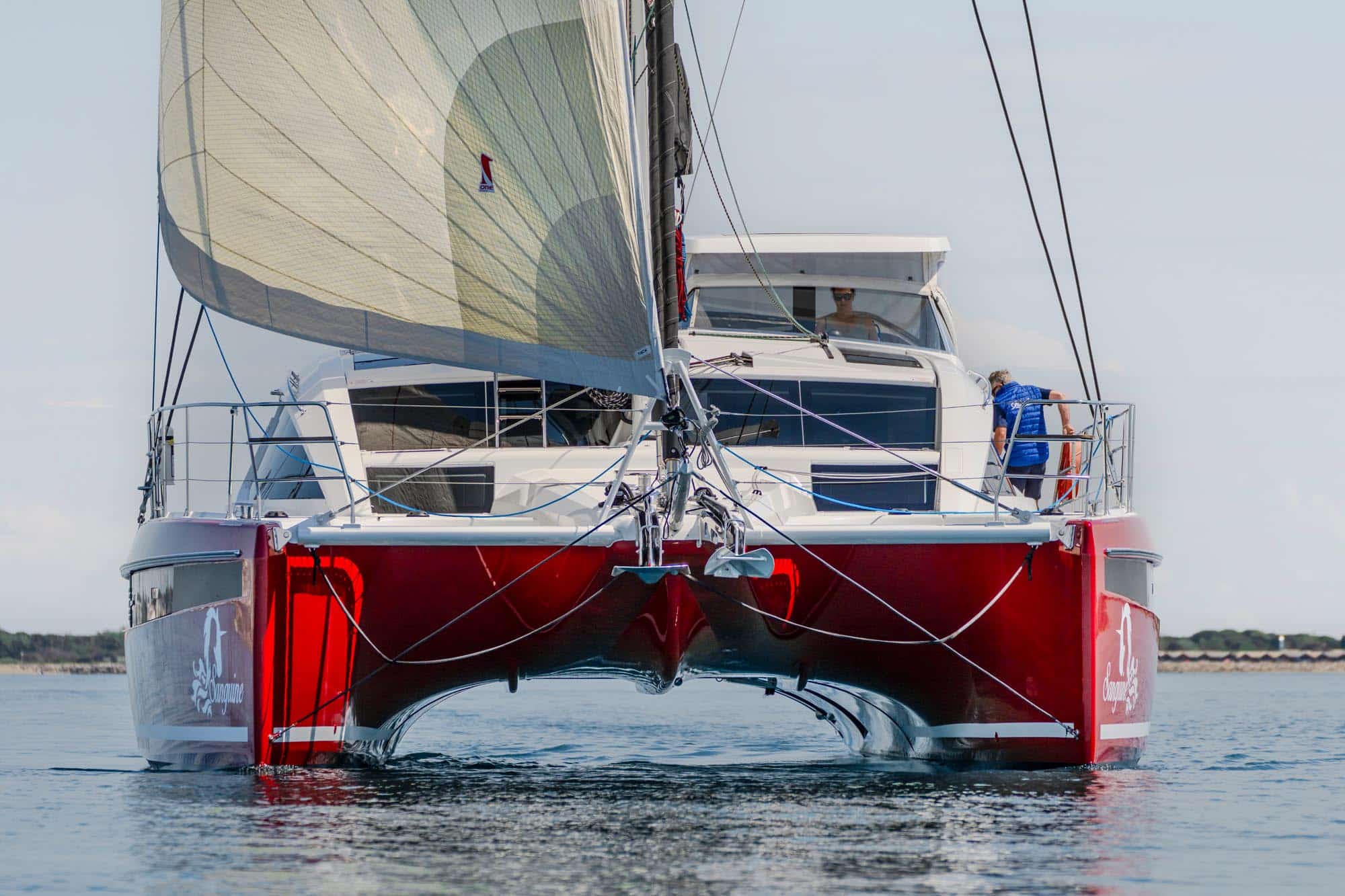
Consider the Privilège Signature 510. It measures 17.09 metres (56 ft) overall and 7.98 metres (26 ft) across the beam. Its light displacement is 16.8 tonnes, rising to 22.8 tonnes at full load.
That six-tonne difference illustrates the scale of the operational load envelope required for people, liquids, equipment, provisions and cruising gear.
The yacht carries 800 litres (211 US gal) of fuel and 600 litres (158 US gal) of fresh water. Storage is integrated throughout the boat for extended cruising.
Move to the Signature 650 and the scale becomes more pronounced. The yacht reaches 21.25 metres (approximately 70 ft) overall with a beam of 9.20 metres (30 ft 2 in). Full-load displacement reaches 37 tonnes.
These dimensions change what ownership can mean.
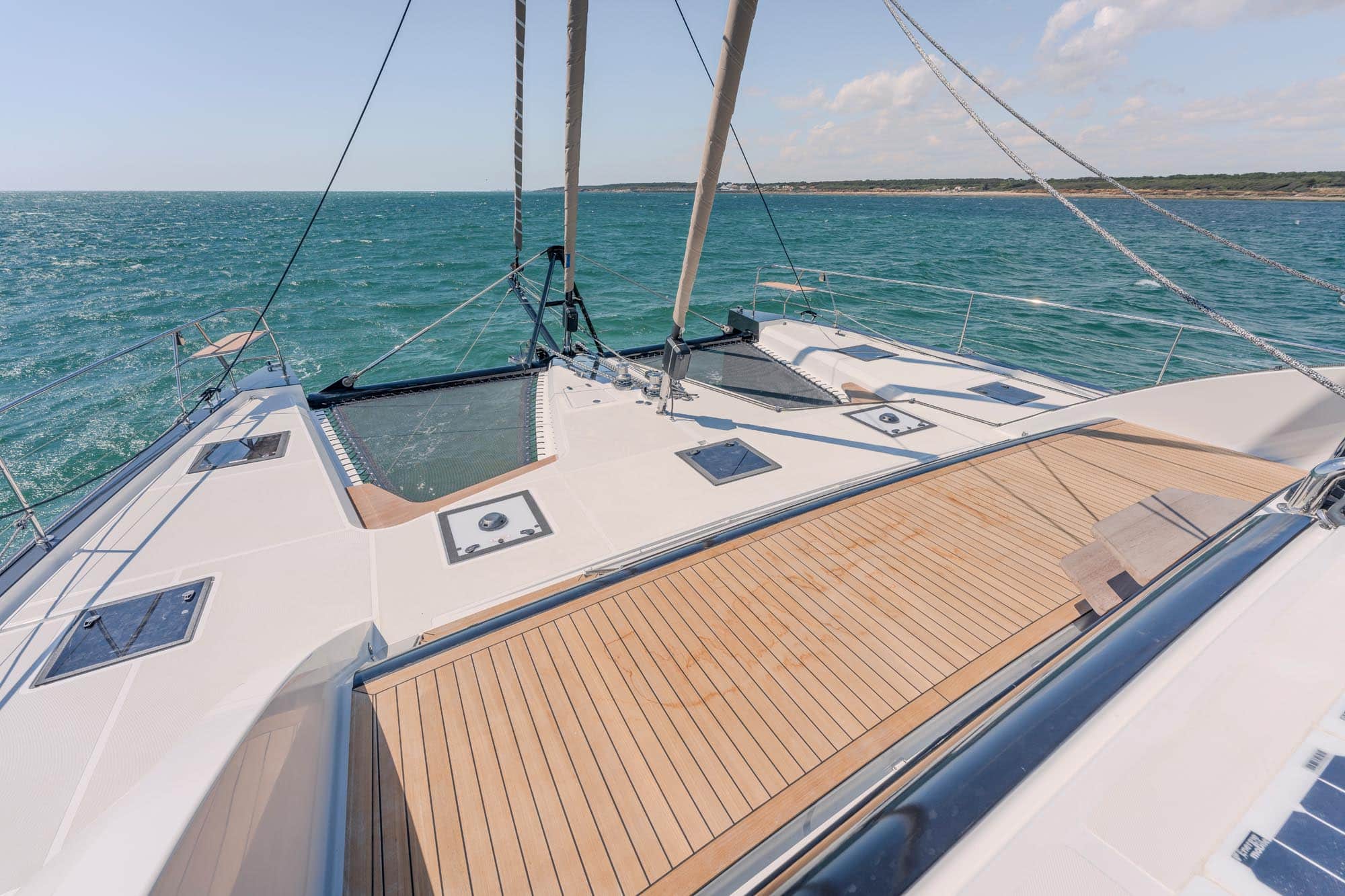
There is space for tools and spare parts. Diving equipment can have a dedicated place. Water toys need not occupy the saloon. Provisions for weeks at sea can be stored properly. A work area can remain a work area rather than becoming a dining table every evening.
For owners spending months aboard, storage capacity is not a luxury feature. It is part of autonomy.
The Boat Eventually Becomes a Home Rather Than a Weekend Machine
The strongest reason to move towards a catamaran often appears after the sailing day has ended.
A cruising yacht spends an extraordinary amount of its life anchored, moored or in port. The owner still lives aboard during those hours.
The catamaran then exploits its full width.
The saloon sits above the water between the hulls, creating panoramic views and a natural connection between cockpit and interior. Cabins can be separated from one another. Guests gain privacy. Ventilation can improve. The galley becomes part of the main living area rather than a space buried below decks.
Privilège pushes this architectural advantage further through its forward full-beam owner’s suite.
On the Signature 510, the owner is not simply allocated one of the hulls. The suite extends into the central nacelle. It creates a wider sleeping environment with forward views and greater separation from guest accommodation.
That matters because long-term owners gradually stop measuring a yacht by the number of cabins.
They begin measuring privacy, circulation, natural light, storage, noise and the distance between where they sleep and where everyone else lives.
The boat has become a home.
The Safety Case Becomes About Exposure, Stability and Redundancy
Catamaran safety requires precision because simplistic claims are misleading.
A catamaran possesses very high initial stability and does not normally heel deeply under sail. That reduces the likelihood of crew losing balance and makes movement around the vessel easier.
It also changes the yacht’s warning signs.
A ballasted monohull heels progressively as aerodynamic load increases. The crew feels the boat becoming overpowered. The sails move away from the vertical and shed some of their effective force.
A catamaran remains relatively upright. High loads can therefore build without the dramatic heel that warns a monohull sailor to react.
Reefing early is essential.
The relationship between wind speed and aerodynamic force makes this particularly important: approximately speaking, aerodynamic pressure rises with the square of wind speed. Doubling wind speed can create roughly four times the aerodynamic pressure.
There is another fundamental distinction. A ballasted monohull can possess substantial self-righting ability following a knockdown. An inverted cruising catamaran should not be expected to right itself in the same way.
Modern standards explicitly recognise this issue. ISO 12217-2 includes specific provisions for habitable multihulls covering susceptibility to inversion, escape arrangements and flotation when inverted.
Catamaran safety therefore comes from design and seamanship working together.
Every current Privilège is certified in European Design Category A, the category applicable to recreational craft designed for conditions where wind may exceed Beaufort Force 8 and significant wave heights may reach 4 metres and above, excluding abnormal conditions such as hurricanes, violent storms and rogue waves.
Certification provides a technical baseline. Offshore preparation goes further.
The Twin-Hull Architecture Creates Useful Redundancy
The second hull also changes the machinery architecture.
Every current Privilège uses two diesel engines, one in each hull. The Signature 510, for example, carries two engines rated at approximately 58.8 kW each (80 hp).
The practical benefit extends beyond additional power.
If one propulsion system becomes unavailable, another remains. Two engines also provide differential thrust during harbour manoeuvres, allowing the skipper to apply ahead thrust on one side and astern thrust on the other.
Privilège extends this principle through system redundancy.
Depending on specification, this can include segregated tanks, multiple bilge pumps, dual autopilot arrangements, alternative electrical generation, multiple navigation resources and more than one means of anchoring.
Redundancy does not mean duplicating every object aboard. It means ensuring that the loss of one critical function does not immediately create an emergency.
For owners planning long-distance sailing, this distinction can become more persuasive than another knot of theoretical boat speed.
The Privilège Formula Brings the Criteria Together
There is a risk in treating all catamarans as equivalent.
They are not.
Some are developed principally for charter utilisation. Some prioritise minimum displacement and maximum sailing performance. Others concentrate on interior volume. Each design brief creates compromises.
A genuine bluewater catamaran must resolve several objectives simultaneously.
It needs structural integrity. It needs sensible displacement and load capacity. It needs adequate bridgedeck geometry. It needs manageable sail handling. It needs secure circulation. It needs accessible machinery. It needs protected watchkeeping positions and enough storage to operate away from shore.
It must then provide a home that owners actually want to inhabit.
This has been central to Privilège since the brand’s origins in the offshore experience of Philippe Jeantot, twice winner of the BOC Challenge and founder of the Vendée Globe.
The current Signature 510 demonstrates the philosophy particularly clearly. Its balanced rig and deck layout are designed for short-handed operation. Its protected helm station remains connected with the cockpit while providing visibility around the yacht. Its storage and tankage support extended cruising. Its owner’s suite gives the private accommodation the importance it deserves.
Safety technology has also evolved. Since 2026, SEA.AI optical and thermal machine-vision technology has been fitted as standard across the Privilège range to help identify objects that conventional AIS or radar may fail to show clearly.
The objective is coherent rather than spectacular: create a yacht in which offshore capability and residential comfort reinforce one another.
The Moment to Change Comes When the Boat Must Serve Your Life
The monohull remains one of sailing’s great machines. Its balance, feedback and ability to work to windward explain why generations of sailors remain deeply attached to it.
Yet yacht ownership evolves.
At some point, an experienced sailor may realise that he is choosing routes partly to avoid uncomfortable sea states. His partner may no longer enjoy passages at 20 degrees of heel. Guests may tolerate the boat rather than enjoy it. Storage may have consumed every cabin. Moving around the boat may require more effort than the sailing itself.
These are meaningful signals.
The transition from monohull to catamaran often occurs when the owner stops asking which boat produces the purest sailing sensation and starts asking which boat will allow him to sail farther, stay aboard longer and bring the people he loves with him.
That is precisely where Privilège positions its yachts.
The promise is larger than two hulls. It is a floating home capable of crossing oceans: stable enough to make daily life natural, robust enough to take distance seriously, spacious enough for long-term ownership and engineered so that comfort does not have to end when the passage begins.
For many lifelong monohull sailors, that is ultimately the criterion that matters.