


Catamarans carry heavy wind loads at anchor. Privilège Marine explains why two anchors, and often two windlasses, belong on a bluewater bow.
A cruising catamaran spends far more of its life at anchor than under sail. Its wide platform and high topsides catch more wind than a monohull of the same length, and the load on the anchor quadruples each time the wind speed doubles. For that reason, Privilège Marine fits every Signature catamaran with two independent anchoring systems as standard: a 70-kilogram (154-pound) galvanized Rocna on 75 meters of 12-millimeter grade 70 chain, and a 50-kilogram (110-pound) Rocna Mk II on 100 meters of lead-core rope from a second bow roller. Owners can add a second windlass, duplex stainless steel chain, Ultra anchors, a riding weight and stern shore-line reels. The logic is redundancy. A lost anchor, a fouled chain or a dead windlass motor is an inconvenience in a marina. In a remote anchorage at night, with the wind rising, it becomes an emergency. A second system turns that emergency back into a manageable task.
The Catamaran That Spends Its Life at Anchor
Ocean crossings make the headlines. Anchorages fill the logbook. A crew sailing around the world spends far more nights on the hook than at sea, often far from any marina or boatyard.
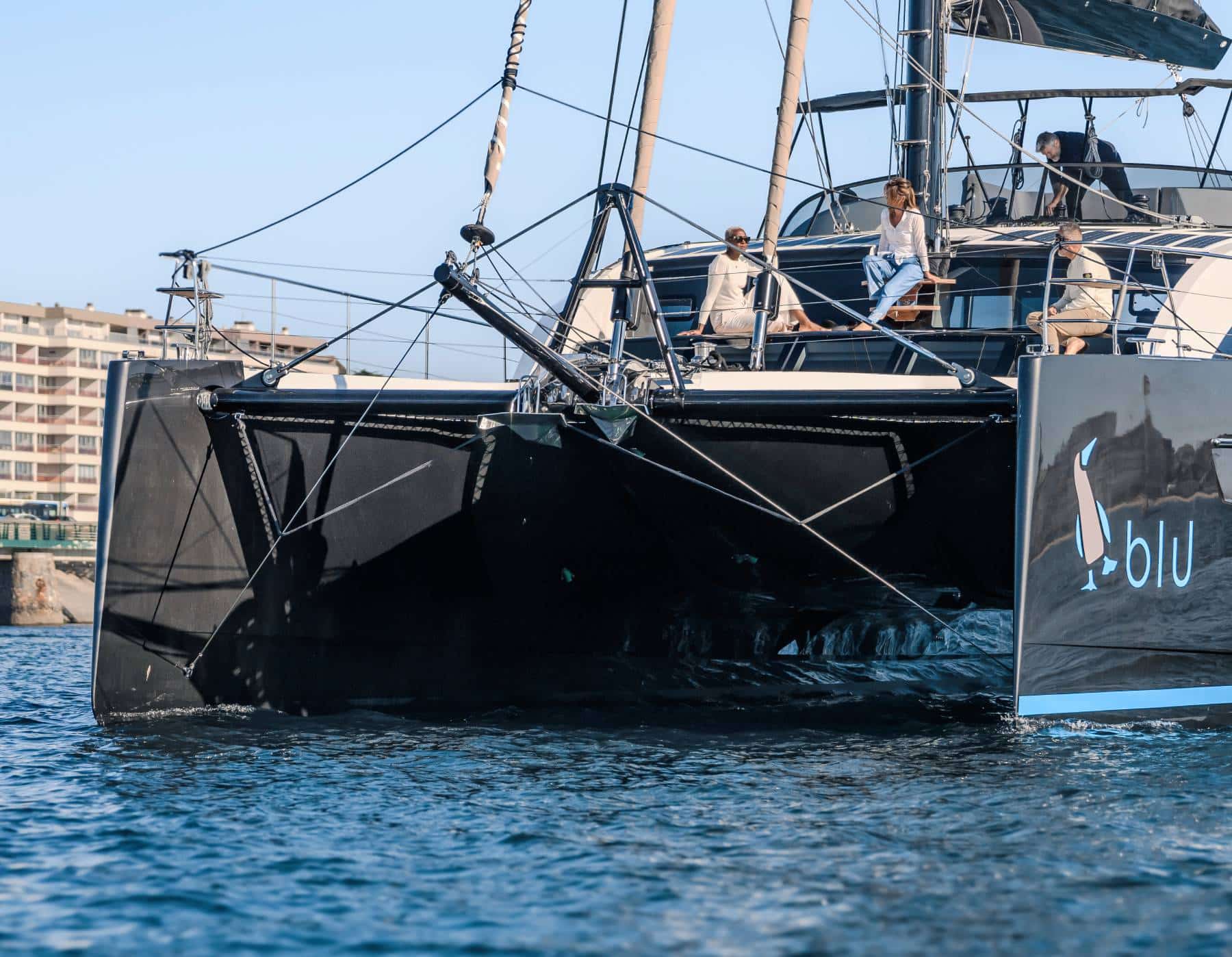
A catamaran asks more of its ground tackle than a monohull of the same length. The Privilège Signature 650 measures 19.5 meters (64 feet), with a beam of 9.2 meters (30 feet 2 inches) and a light displacement of 29 tonnes (63,950 pounds). Its two hulls, bridgedeck saloon and flybridge present a broad face to the wind. When Practical Sailor measured anchor loads, its testers found that a 38-foot (11.6-meter) catamaran carried roughly the same windage as a Bavaria 45 monohull. They concluded that overall length alone is a poor guide to anchor size.
Physics sharpens the point. Wind load rises with the square of wind speed, so a gust that climbs from 20 to 40 knots quadruples the force on the rode. PassageMaker magazine estimates that multihulls and other high-windage boats can see ground tackle loads up to 150 percent higher than those of a typical sailboat. Catamarans also tend to “sail” at anchor, sheering from side to side, and each swing ends with a jerk on the chain.
The Primary System Built for a Gale
The Rocna and the logic of oversizing
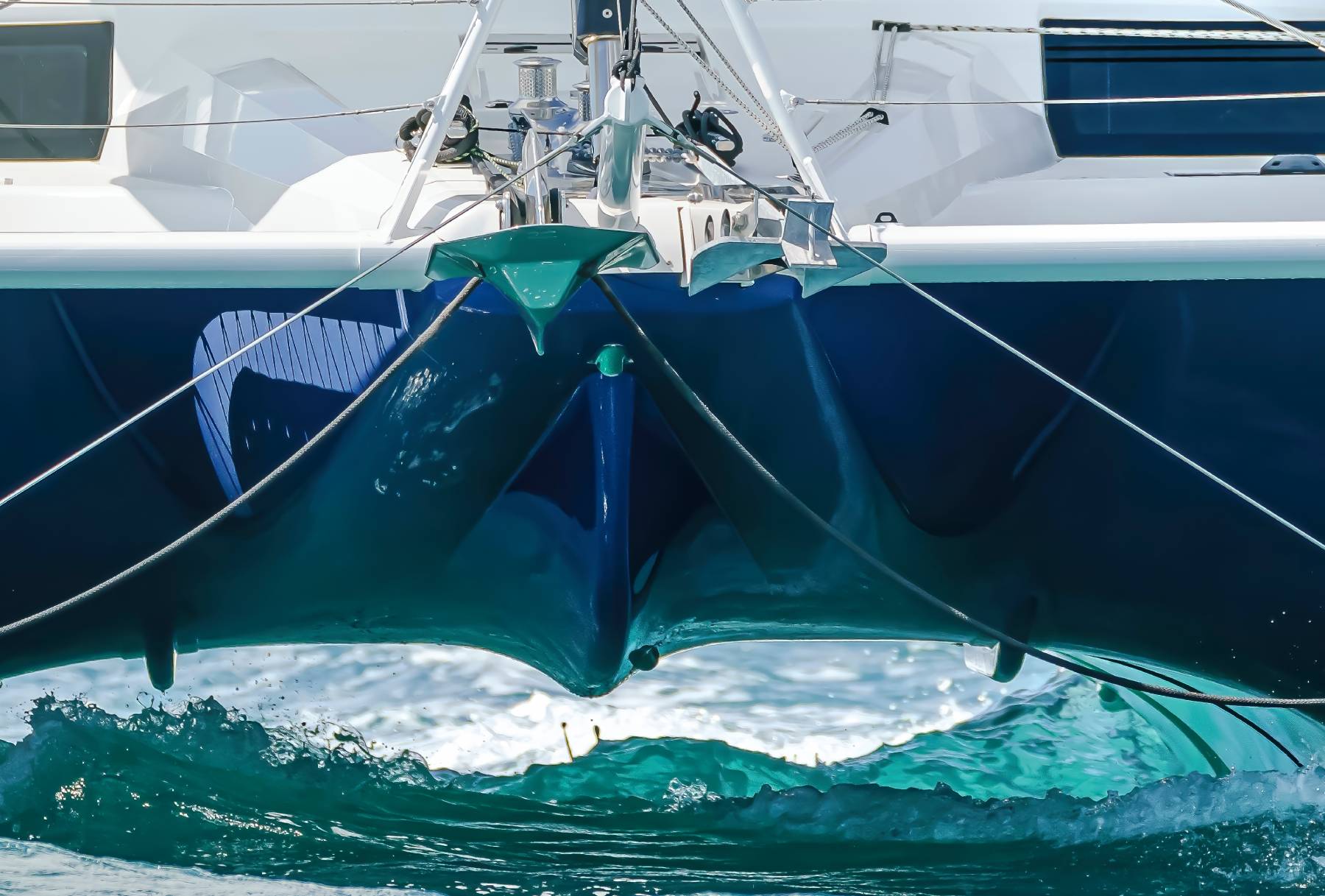
Every Signature 510, 580 and 650 leaves our yard in Les Sables-d’Olonne with a galvanized Rocna Original of 70 kilograms (154 pounds) as its main anchor. Rocna, designed in New Zealand by Peter Smith and produced by Canada’s CMP Group, bases its sizing chart on 50 knots of wind, the surge that comes with it and a poor-holding seabed. The company then tells multihull owners to choose one size larger. Our specification follows that rule. A sharp, weighted toe digs into hard sand, and the roll bar turns the anchor right side up as it lands.
The chain, the windlass and the bridle
The anchor rides on 75 meters (246 feet) of 12-millimeter grade 70 galvanized chain, followed by 25 meters (82 feet) of rope. The grade refers to the tensile strength of the steel. Under American industry ratings, a half-inch (12.7-millimeter) grade 70 chain carries a working load limit of 11,300 pounds, about 5.1 tonnes, and a breaking strength of 45,200 pounds, about 20.5 tonnes. At roughly 3.1 kilograms per meter, our 75 meters of chain weigh about 230 kilograms (510 pounds). On the seabed, that weight forms a curve, the catenary, which absorbs shocks before they reach the anchor. A flip swivel joins chain and anchor, lets the anchor rotate freely and helps it seat correctly on the bow roller.
A 2,000-watt electric windlass handles the chain through a 12-millimeter gypsy, the toothed wheel that grips each link, and carries a drum for warping lines. Beside the deck switches, two remote controls display a chain counter, one at the chain locker and one at the main helm station. The skipper knows exactly how much chain is out. Scope, the ratio of rode length to water depth plus bow height, determines how flat the pull on the anchor is, and therefore how well it holds.
Once the anchor is set, the anchor bridle takes over. Its two legs run from the chain to a cleat on each bow. They split the load between the hulls, keep the boat centered and take the strain off the windlass, a machine designed to lift and never meant to serve as a mooring post. A stainless steel plate protects the bow structure from chain chafe.
The Second Anchor as Insurance and as a Tool
The Rocna Mk II on lead-core rope
The standard specification includes a second, fully independent system. A 50-kilogram (110-pound) galvanized Rocna Mk II sits on its own bow roller with a dedicated 500-millimeter cleat. Rocna launched the Mk II in 2023. It adds a reshaped roll bar the company calls a “roll-foil,” a reinforced shank, a weighted tip and an attachment point for tandem anchoring.
Its rode is 100 meters (328 feet) of lead-core rope. The lead sinks the line to the seabed, away from propellers and neighboring keels. Rope also keeps weight off the bows, where every extra kilogram increases pitching at sea.
The situations that justify two anchors
PassageMaker lists the moments when a second anchor becomes critical: the primary is lost, it is fouled and cannot be recovered, or it is dragging with all its chain out and the windlass has quit. These failures tend to arrive at night, in rising wind.
The second anchor also widens the tactical options. A Bahamian moor sets two anchors from the bow roughly 180 degrees apart, so the boat pivots in place when a tidal stream reverses. A V deployment, with the two anchors spread at an angle, curbs a catamaran’s sheering in a blow and reduces peak loads. In soft mud, a tandem rig can add holding power.
Rocna’s engineers strongly advise against routinely using two anchors to compensate for an undersized primary. We agree. The main anchor must hold alone. The second exists for failures and for specific techniques.
The Case for a Second Windlass
A 50-kilogram anchor on rope is manageable in calm weather. Recovering it by hand from 15 meters (49 feet) of water, with the boat pitching and gusts at 30 knots, is a different task. The crew must haul the anchor, the rope and part of the boat’s own resistance.
We therefore offer a second windlass for the secondary anchor, with a wired remote control and a 25-meter (82-foot) leader of 12-millimeter grade 70 chain. The chain leader resists abrasion on rock and coral, adds catenary and allows the windlass to recover the anchor under power. The boat then carries two complete systems, each able to deploy and recover its anchor without muscle.
A windlass has several weak points: the motor, the solenoid, the gearbox, the wiring and the battery bank. A second unit removes the single point of failure. It also adds weight forward, power demand and cost. For Mediterranean cruising between well-equipped ports, the standard specification is sufficient. For owners bound for Patagonia, the South Pacific or the Indian Ocean, where spare parts can take weeks to arrive, we recommend it.
The Stainless Steel Upgrade and Its Trade-offs
Owners can replace the galvanized gear with stainless steel. The main anchor becomes an 80-kilogram (176-pound) Ultra and the secondary a 60-kilogram (132-pound) Ultra. Ultra Marine builds these anchors in 316L stainless steel with a hollow shank and a lead-filled tip, which lowers the center of gravity and keeps the point down. Hollow sections cannot survive hot-dip galvanizing, so the design exists only in stainless. It pairs with the Ultra Flip Swivel, a one-piece, RINA-certified fitting that removes the need for shackles.
The chain changes too: 75 or 100 meters of 12-millimeter duplex stainless steel chain in AISI 318LN, grade 60 Plus, made by the German specialist Cromox. Duplex steel combines two metallurgical structures and resists saltwater corrosion better than standard 316L. It suits boats that spend long periods near the equator. Galvanized chain eventually needs re-galvanizing. Stainless chain avoids that job and runs more freely in the locker. On the secondary rode, the stainless option uses a 25-meter duplex leader and 75 meters (246 feet) of rope.
The trade-off is cost. At one American retailer, a 70-kilogram stainless Rocna lists at about $10,056, against $4,078 for the galvanized version. Grade 60 Plus also carries a lower nominal grade than grade 70. Stainless buys longevity and appearance, at a price.
The Accessories That Change How a Catamaran Anchors
The Ultra Marine riding weight, a 15-kilogram (33-pound) ring that slides down the chain, lowers the angle of pull on the anchor and damps the snatching that wakes a crew at night. It can also help free an anchor wedged under rock. For safety, the crew must install it from the dinghy.
The Ultra Line stern reels, in 60-meter (197-foot) and 100-meter (328-foot) versions, hold flat webbing for tying the stern to a rock or a tree ashore. The technique is standard in Croatia, Greece, Turkey and Scandinavia, where anchorages are deep and swinging room is scarce. With the bow anchored and the stern secured, a catamaran occupies a fraction of the space.
Precision also has a regulatory side. Since 2020, France has banned yachts over 24 meters (79 feet) from anchoring on protected Posidonia seagrass in designated Mediterranean zones, with fines of up to €150,000. Signature catamarans sit below that threshold, but the direction is clear: authorities want boats anchored on sand, with a controlled swing.
The deck hardware completes the system: eight 500-millimeter cleats with stainless chafe guards, two 360-millimeter transom cleats, two 420-millimeter bow roller fairleads for picking up mooring buoys, four dock lines and ten fenders with an air compressor.
The Seamanship That Gives Hardware Its Value
A crew with one anchoring system has one plan. A crew with two can lay a Bahamian moor before the tide turns, drop a second anchor within seconds when the first drags, or buoy a fouled chain and still spend a secure night.
That advantage depends on practice. Crews should rehearse deploying the second anchor from the dinghy in daylight and service both windlasses before every season. The most reliable ground tackle is the one the crew has already used.
For a future owner, the real question concerns the voyage. Where will the boat spend its nights, how far from help, and in what winds? At Privilège, we build each catamaran as a home and as an ocean-going vessel. Its anchoring system should match the most remote anchorage on its owners’ chart.