


From solo laps of the planet to foiling sprints, the 15 sailing races that define the sport: their history, their records and the sailors who win them.
Fifteen competitions shape modern sailing. They range from solo laps of the planet to short sprints on foiling catamarans. The Vendée Globe remains the summit of solo racing, and Charlie Dalin’s 2025 victory cut its record to 64 days. The America’s Cup, first sailed in 1851, moves to Naples in July 2027. SailGP has turned inshore racing into a global league. The Route du Rhum, won on 8 November 2026 by Tom Laperche in record time, keeps the solo transatlantic tradition alive. The Fastnet, Sydney Hobart and Middle Sea races put amateurs and professionals on the same course, and in 2025 the French navigator Alexis Loison won the first two on small double-handed boats. The Golden Globe Race takes sailors back to sextants. The ARC lets cruising crews cross the Atlantic in company. Together, these events show how ocean sailing evolves, and why their lessons reach the boats owners sail every day.
The Language Behind the Results
Two titles matter in offshore racing. Line honours go to the first boat to finish. The overall title goes to the boat with the best corrected time under a handicap rule, usually IRC, which rates each yacht by its size, sail area and design. A 30-meter (100-foot) maxi can therefore take line honours while a 10-meter (33-foot) yacht wins the race.
Boat classes matter too. The IMOCA is an 18.28-meter (60-foot) monohull. The Ultim is a trimaran up to 32 meters (105 feet) long and 23 meters (75 feet) wide. Both now use foils, curved appendages that lift the hulls out of the water and multiply speed.
The Round-the-World Races That Measure Endurance
The Vendée Globe
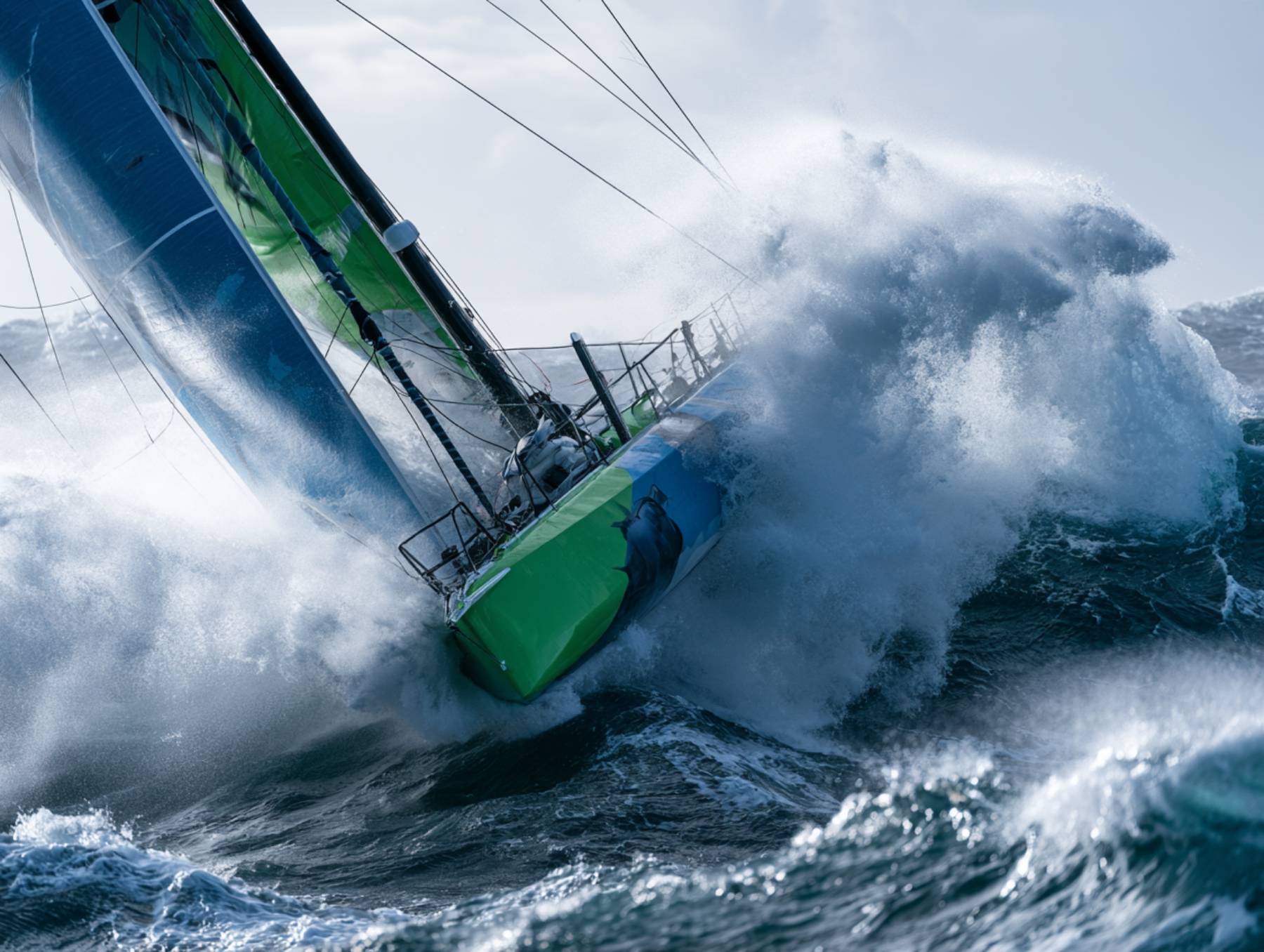
The Vendée Globe is a solo, non-stop, unassisted race around the world in IMOCAs. It starts and finishes in Les Sables-d’Olonne every four years. Philippe Jeantot, who founded our shipyard in 1985, created the race in 1989. That link remains at the heart of our offshore racing heritage. The tenth edition started on 10 November 2024 with 40 skippers. Charlie Dalin won on 14 January 2025 in 64 days, 19 hours and 22 minutes, more than nine days faster than Armel Le Cléac’h’s record from 2017. He sailed 27,667 nautical miles at an average of 17.79 knots. The next edition starts in 2028.
The Golden Globe Race
The Golden Globe Race recreates the 1968 race won by Sir Robin Knox-Johnston, the first person to sail solo and non-stop around the world. Skippers sail small production boats designed before 1988, with paper charts and sextants. GPS and modern electronics are banned. Sixteen skippers left Les Sables-d’Olonne on 6 September 2026 for about 30,000 nautical miles and seven to eight months at sea. The attrition is brutal: across the three previous editions, 43 sailors started and only nine finished. South Africa’s Kirsten Neuschäfer won in 2023, the first woman to win a solo round-the-world race.
The Arkéa Ultim Challenge
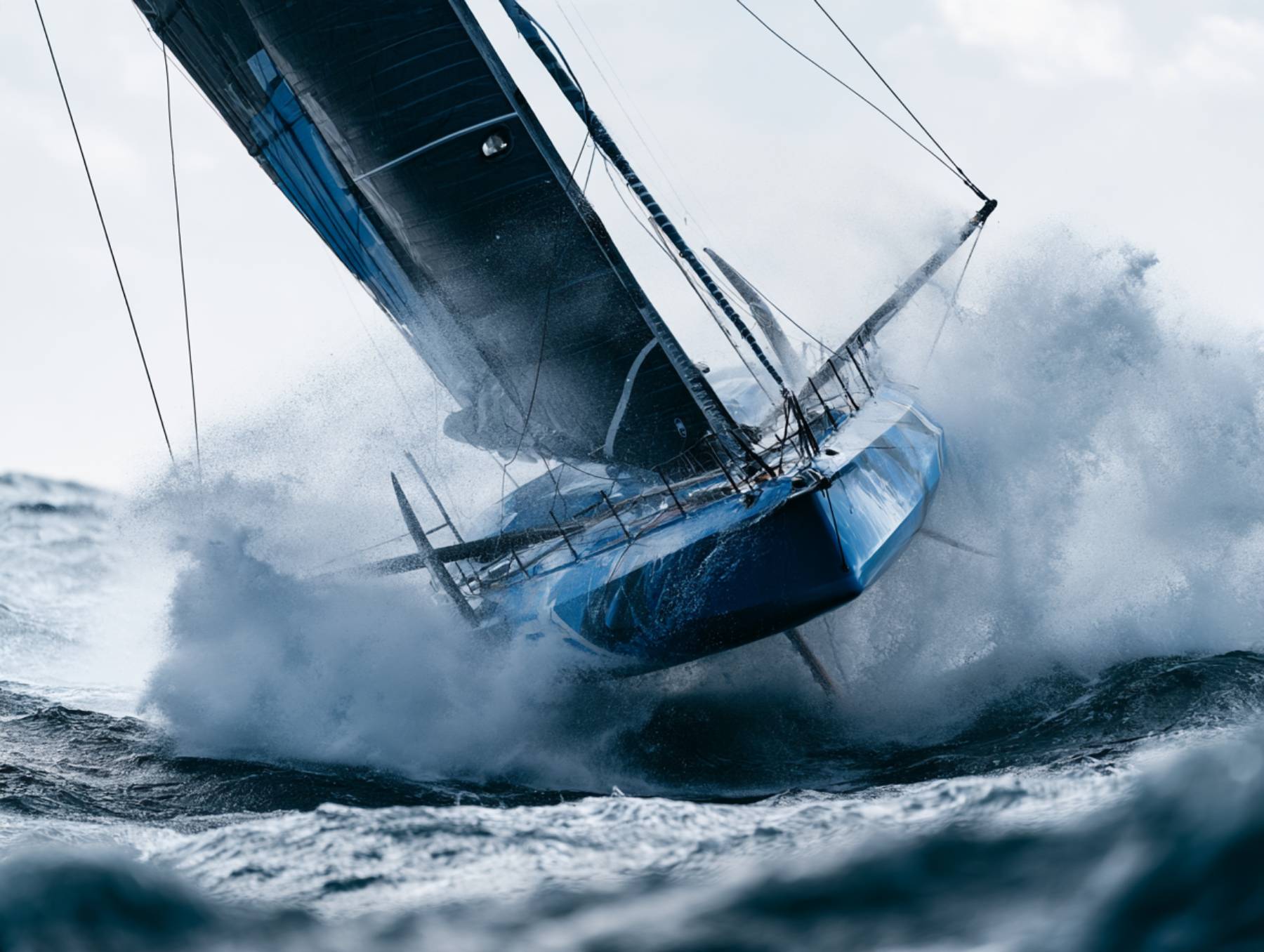
The Arkéa Ultim Challenge-Brest is the first solo round-the-world race for Ultim trimarans. Its first edition started from Brest on 7 January 2024 with six skippers. Charles Caudrelier won aboard Maxi Edmond de Rothschild in 50 days, 19 hours and 7 minutes. He was the only competitor who completed the course without stopping for repairs. That detail says much about the fragility of these 32-meter machines at sustained high speed. The second edition is planned for the winter of 2027-2028.
The Jules Verne Trophy
The Jules Verne Trophy rewards a record rather than a race. Crews choose their own weather window and sail non-stop around the world from a line between Ushant and the Lizard. In January 2026, Thomas Coville and six crew on Sodebo Ultim 3 set a new time of 40 days, 10 hours and 45 minutes, beating the mark IDEC Sport had held since 2017. They averaged about 29 knots over more than 28,000 miles. The first holders, aboard Enza New Zealand in 1994, needed almost 75 days.
The Ocean Race
The Ocean Race, born as the Whitbread Round the World Race in 1973, is the fully crewed counterpart. 11th Hour Racing Team won the 2022-2023 edition. The 15th edition starts from Alicante on 17 January 2027, in IMOCAs crewed by four sailors, including at least one woman. Its first leg, 14,000 nautical miles to Auckland, will be the longest in the race’s history. The finish is set for AMAALA, on Saudi Arabia’s Red Sea coast.
The Inshore Contests Where Technology Rules
The America’s Cup
The America’s Cup is the oldest trophy in international sport. The schooner America won it around the Isle of Wight in 1851. Teams now race AC75 foiling monohulls capable of more than 55 knots, or about 100 kilometers per hour (62 mph). Emirates Team New Zealand beat INEOS Britannia 7-2 in Barcelona in 2024 to win a third consecutive Cup. The 38th Match starts in Naples on 10 July 2027, the first time Italy has hosted the event. The Cup rewards design budgets as much as sailing skill, and the best-funded team usually holds the edge.
The SailGP Championship
SailGP, founded by Larry Ellison and Sir Russell Coutts, pits national teams against each other in identical F50 foiling catamarans that reach about 100 kilometers per hour. Because the boats are one-design, crew skill decides results. Emirates Great Britain, with Dylan Fletcher as driver, won Season 5 at the Abu Dhabi Grand Final on 30 November 2025. Season 6 opened in Perth in January 2026 with 13 teams, including Sweden’s new Artemis Racing.
The Olympic Regatta
Sailing has featured at nearly every Summer Games since 1900. The Paris 2024 regatta took place in Marseille, where kitefoiling and the iQFOiL windsurfer made their Olympic debut. The format favors short, intense races in dinghies, skiffs and boards, and it produces many of the sailors who later lead America’s Cup and SailGP teams. The next Olympic regatta will be held in Long Beach, California, in 2028.
The Transatlantic Classics
The Route du Rhum
Created in 1978, the Route du Rhum-Destination Guadeloupe runs solo from Saint-Malo to Pointe-à-Pitre every four years, about 3,542 nautical miles. The 13th edition started on 1 November 2026. Tom Laperche, 29, won the Ultim class on SVR-Lazartigue in 6 days, 13 hours and 27 minutes, a race record, at his first attempt. Thomas Coville finished second and Louis Burton third. The defending champion, Charles Caudrelier, retired with the new Gitana 18. The race mixes professional Ultims and IMOCAs with amateurs in the Rhum categories, which explains its popularity in France.
The Transat Café L’Or
Formerly the Transat Jacques Vabre, this double-handed race follows the historic coffee route from Le Havre to the Caribbean every two years. Its 17th edition finished in Fort-de-France, Martinique, in November 2025. Of 74 starters, 63 finished. Tom Laperche and Franck Cammas won the Ultim class in 10 days, 13 hours and 3 minutes over 6,670 nautical miles. Jérémie Beyou and Morgan Lagravière won the IMOCA class on Charal 2.
The Mini Transat
The Mini Transat is the training school of ocean racing. Skippers cross the Atlantic alone on 6.5-meter (21-foot) boats, without satellite communication or outside routing. In 2025, organizers cancelled the first leg because of the weather, and the race ran as a single leg from La Palma, in the Canary Islands, to Saint-François, Guadeloupe. Mathis Bourgnon won the prototype class in 13 days, 18 hours and 24 minutes, 30 years to the day after his father, Yvan, won the race. Paul Cousin won the production class. Many Vendée Globe skippers began their careers here.
The Offshore Classics Open to Amateurs
The Rolex Fastnet Race
The Royal Ocean Racing Club’s biennial race covers 695 nautical miles from Cowes, around the Fastnet Rock off south-west Ireland, to Cherbourg. The centenary edition in July 2025 drew a record 444 boats. SVR-Lazartigue took overall line honours, and Black Jack 100 took the monohull title in 2 days, 12 hours and 31 minutes. The overall winner was Léon, a 10.4-meter (34-foot) JPK 1050 sailed double-handed by Alexis Loison and Jean-Pierre Kelbert. The race still carries the memory of 1979, when a storm killed 15 competitors and reshaped offshore safety rules.
The Rolex Sydney Hobart Yacht Race
The Cruising Yacht Club of Australia’s 628-nautical-mile race starts on Boxing Day and crosses the Bass Strait, known for violent southerly fronts. In 1998, a storm there killed six sailors. In the 80th edition, in December 2025, Master Lock Comanche took line honours in 2 days, 5 hours and 3 minutes. After a protest, the double-handed JPK 10.30 Min River won overall. Its owner, Jiang Lin, became the first woman to win the race, with Alexis Loison as co-skipper. Loison won both the Fastnet and the Sydney Hobart in the same year, a clear sign of how competitive small double-handed boats have become.
The Rolex Middle Sea Race
The Royal Malta Yacht Club’s 606-nautical-mile race starts in Valletta and circles Sicily anticlockwise, passing the Strait of Messina and the active volcano of Stromboli. The 47th edition started on 17 October 2026. Black Jack 100 took monohull line honours on 19 October, and Django 7x won overall under IRC. Light patches, sudden squalls and island wind shadows make it one of the most tactical offshore races on the calendar.
The Rally That Opens the Ocean to Cruisers
The Atlantic Rally for Cruisers
The ARC is a rally with racing divisions. Since 1986, it has taken cruising yachts 2,700 nautical miles from Las Palmas de Gran Canaria to Rodney Bay, Saint Lucia. More than 7,000 boats have taken part. The 40th edition, in 2025, counted 145 boats, including 30 catamarans. The 2026 fleet starts on 22 November, and most boats will take 18 to 21 days. Rambler 88 holds the record of 8 days and 6 hours, set in 2016. For many owners, the ARC is their first Atlantic crossing, and its safety inspections and weather briefings reduce the risks of a first ocean passage.
The Lessons Racing Hands to Cruising Sailors
Racing is the laboratory of sailing. Foils, carbon structures, powerful autopilots and weather routing were tested in the Vendée Globe and the Route du Rhum long before they reached cruising yachts. Failures teach as much as records. Caudrelier won the first solo Ultim race around the world because his boat held together while every rival stopped for repairs.
The 2025 season also overturned an old assumption. Small, well-prepared boats sailed by two people won two of the hardest offshore classics. Preparation, reliability and seamanship counted for more than length.
Our shipyard stands close to the Vendée Globe pontoons in Les Sables-d’Olonne. We build bluewater catamarans for owners who want to cross oceans in comfort, at their own pace. The races remind us every four years of a simple truth: at sea, the winner is often the boat built to last.