


From the schooner America to 103 km/h foiling AC75s, the America’s Cup has transformed yacht design and influenced modern offshore cruising.
The America’s Cup began in 1851 as a test of naval architecture. It remains one. The difference is speed. The schooner America won through efficient hull lines and a disciplined sail plan. Later defenders exploited rating rules with immense yachts such as Reliance. The J Class introduced systematic tank testing. The 12-Metre era made small gains decisive and produced Australia II’s winged keel. The International America’s Cup Class brought carbon construction, advanced sailmaking and industrial-scale simulation. Multihulls then broke the displacement barrier. Hydrofoils removed most of the hull from the water. In 2024, INEOS Britannia recorded 55.6 knots, or 103 km/h, during official racing. Yet the Cup’s most useful legacy is not raw speed. Modern cruising yachts benefit from lighter composite structures, moulded sails, computational design, load monitoring and better control systems. At Privilège Marine, the lesson is clear: transfer the science, not the fragility. Offshore yachts must remain efficient, understandable and dependable far from shore.
The Race That Began as a Design Competition
The America’s Cup is the oldest international sporting trophy. It is also the longest-running experiment in competitive yacht design.
In August 1851, the schooner America joined a fleet race around the Isle of Wight. Fifteen yachts started. America was not the largest boat in the fleet. Her advantage came from a different design philosophy.
George Steers gave the schooner efficient hull lines and a clean rig. America did not carry every available sail throughout the race. She carried the right sails for the conditions. From the start, the Cup rewarded the relationship between hull resistance, aerodynamic efficiency and crew execution.
That formula still defines the event. The hardware has changed beyond recognition. The objective has not.
The Rating Rules That Encouraged Extreme Yachts
Early America’s Cup yachts were displacement boats. Their speed was constrained by waterline length, wave-making resistance and stability. Designers therefore searched for ways to create a longer effective sailing length without paying the full rating penalty.
The most extreme expression was Reliance, Nathanael Herreshoff’s 1903 defender. Reliance measured about 43.8 metres in hull length, or 143 feet 8 inches, and carried roughly 1,580 square metres of sail, or 17,000 square feet. Her main boom alone was about 35.1 metres long, or 115 feet.
When the yacht heeled, her long overhangs immersed and extended the effective waterline length. This increased speed potential while exploiting the measurement rule.
It was brilliant engineering. It was also a dead end. Reliance required a huge crew, generated severe loads and had a narrow operating envelope. The Cup had discovered a recurring problem: an open rule can create extraordinary performance, but also extraordinary cost and fragility.
The J Class That Turned Testing into a Competitive Weapon
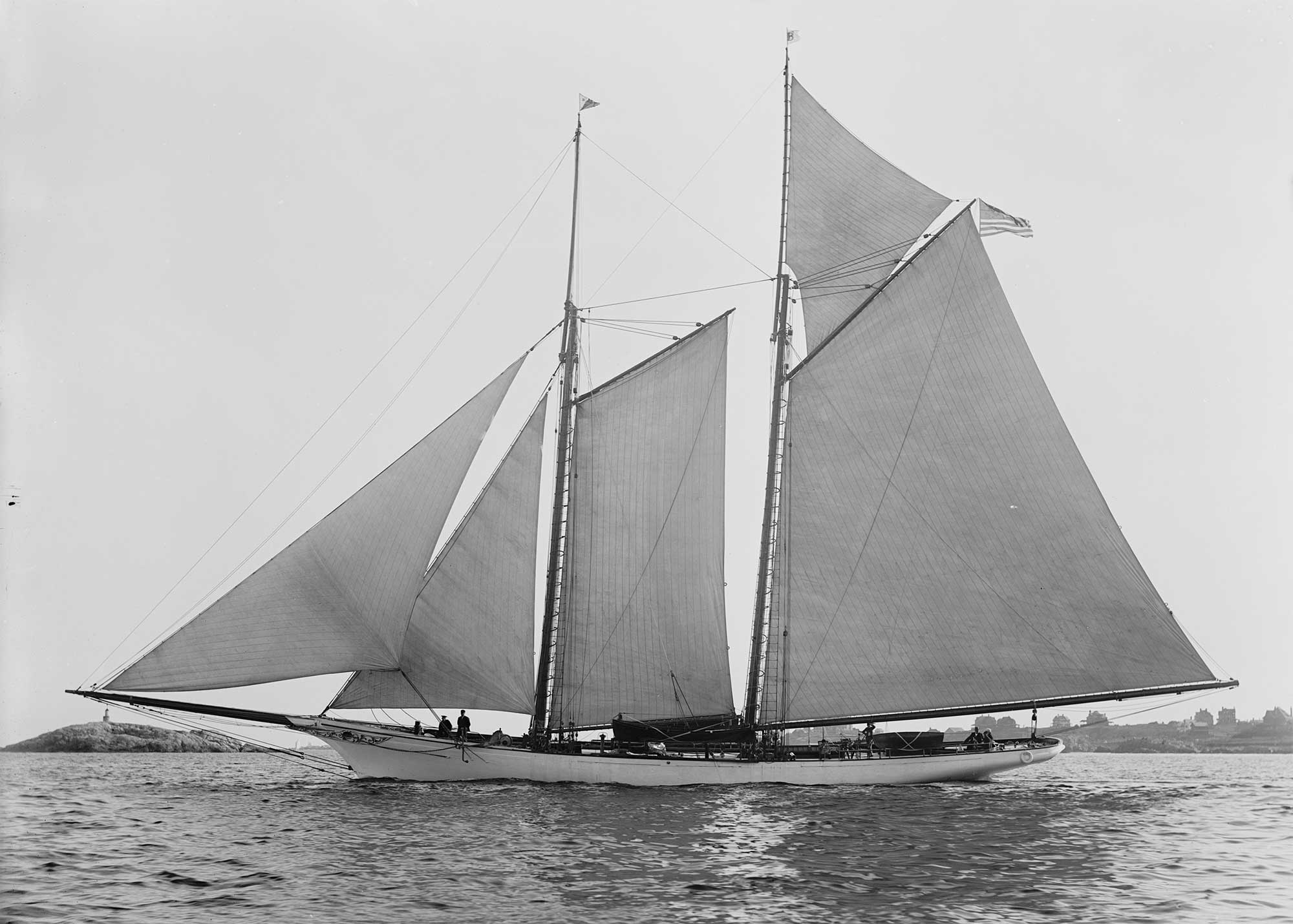
The Universal Rule brought the J Class to the America’s Cup between 1930 and 1937. These yachts remain among the most elegant racing machines ever built. They were also scientific instruments.
Ranger, the dominant American defender of 1937, used the maximum permitted waterline of 26.5 metres, or 87 feet. She displaced about 166 tonnes and carried approximately 701 square metres of sail.
Her development process mattered more than her size. Designers used model testing to study resistance, heel angle, side force and balance before committing to the full-size yacht. Olin Stephens and Starling Burgess treated the hull, keel, rig and sails as one system.
Ranger defeated Endeavour II four races to nil. One winning margin exceeded 18 minutes. The result confirmed that methodical testing could outperform intuition, however experienced the designer.
The 12-Metre Era That Made Small Gains Decisive
After the Second World War, J Class campaigns had become financially unrealistic. The America’s Cup returned in 1958 with the 12-Metre Class.
The name is misleading. A 12-Metre was not 12 metres long. It was designed to a rating formula. Typical Cup yachts measured about 19 to 21 metres overall and displaced roughly 24 to 30 tonnes.
These boats were slower than the J Class in absolute terms. They were also closer in performance. That made marginal gains decisive.
Designers refined hull shape, ballast distribution, rudders, keels and sail inventories. Aluminium replaced wood in many campaigns. Wind-tunnel work, tank testing and two-boat comparison became standard. Professional crews trained for thousands of hours.
The defining breakthrough came in 1983. Australia II used Ben Lexcen’s winged keel, developed with extensive model testing in the Netherlands. The inverted profile placed ballast low. Its horizontal wings reduced induced drag and helped control leeway.
The keel was not magic. Australia II also had strong sails, a disciplined crew and an effective campaign. But the appendage changed the competitive balance. Australia II defeated Liberty four races to three and ended the New York Yacht Club’s 132-year hold on the trophy.
The wider industry absorbed the principle. Winglets, bulbs and carefully shaped keel tips became familiar tools in racing and cruising design. Not every later keel was a copy. The conceptual transfer was clear: appendage geometry could create lift, reduce drag and improve stability without simply adding area.
The IACC Era That Industrialised Yacht Design
The controversial 1988 match placed a giant New Zealand monohull against the smaller hard-wing catamaran Stars & Stripes. The mismatch exposed the weakness of relying on the Deed of Gift alone to define a modern contest.
The International America’s Cup Class, or IACC, followed in 1992 and remained in use until 2007. These were long, narrow monohulls with deep keels, large sail plans and highly optimised structures.
Their design programmes increasingly resembled aerospace projects. Teams used computational fluid dynamics to study water and airflow. Finite-element analysis mapped structural loads. Velocity prediction programs compared performance across wind speeds and angles. Carbon fibre spread through hulls, masts, booms and appendages. Instrumentation produced large data sets from every sailing session.
Sailmaking changed as well. During the 1992 cycle, moulded 3DL sails emerged from America’s Cup development. Sailmakers could create a three-dimensional shape on a full-size mould and align fibres with predicted load paths.
That technology later evolved into 3Di composite sails. Related products are now used for offshore racing and cruising. The Cup helped turn the sail from stitched cloth into an engineered composite structure.
The Multihull Revolution That Broke the Displacement Barrier
The 2010 America’s Cup was another legal and technical confrontation. BMW Oracle Racing’s USA 17 was a 27.4-metre, or 90-foot, trimaran with a towering rigid wing. Alinghi 5 was a giant catamaran.
USA 17 won easily. In the first race, the American trimaran averaged about 20.2 knots. The result proved that a rigid wing could deliver exceptional lift-to-drag performance at full scale.
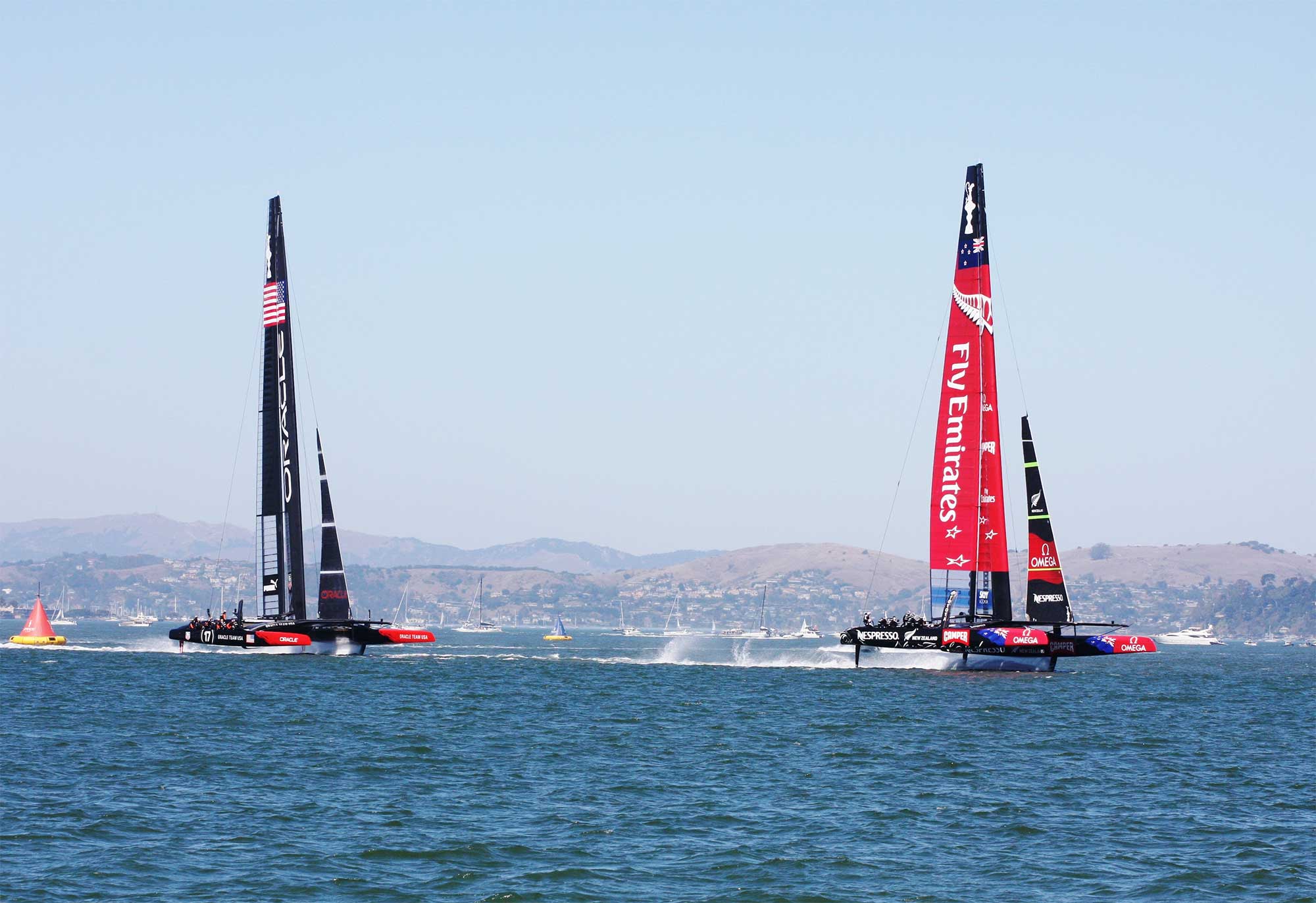
The next Cup adopted the 22-metre AC72 catamaran. These boats combined light carbon structures, rigid wings and hydrofoils. Emirates Team New Zealand developed a configuration that allowed the catamaran to rise clear of the water and remain supported by its appendages.
This was the decisive break with the past. A conventional yacht pushes its hull through water. A foiling catamaran lifts its hulls above the surface. Wetted area falls sharply. Speed rises until aerodynamic drag, foil drag, cavitation risk and control limits become the main constraints.
The AC72s exceeded 40 knots. They were spectacular and dangerous. The death of Artemis Racing sailor Andrew Simpson during training in 2013 was a brutal reminder that innovation had moved faster than the sport’s safety margin.
For 2017, the Cup moved to smaller AC50 catamarans. Emirates Team New Zealand introduced cyclists, or cyclors, to generate hydraulic power more efficiently than conventional arm grinders. Its boat exceeded 46 knots and defeated Oracle Team USA seven races to one.
The AC75 That Made Controlled Flight the New Normal
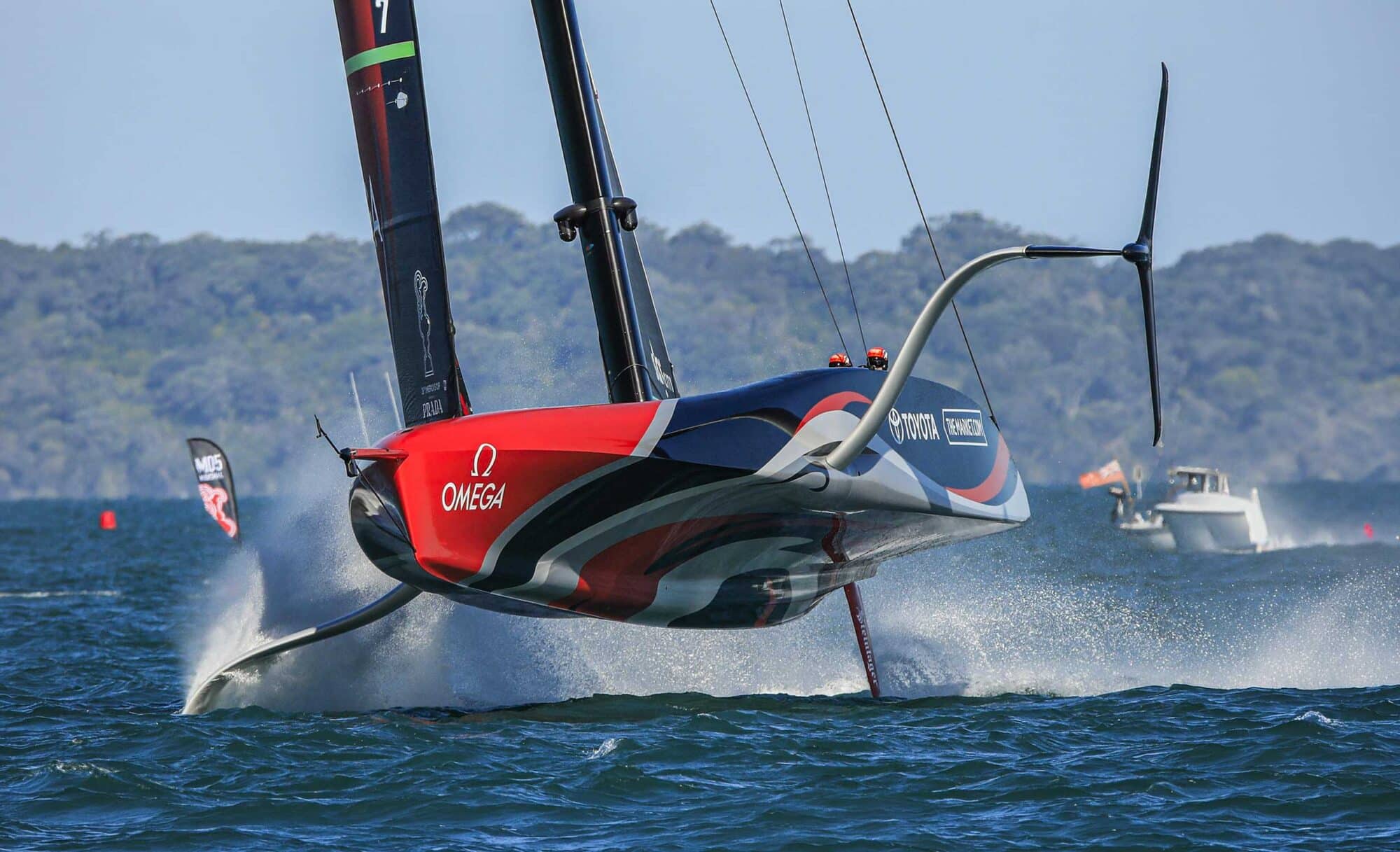
After winning in Bermuda, Emirates Team New Zealand replaced the catamaran with a radical concept: a 20.7-metre foiling monohull.
The AC75 has no conventional ballast keel. It uses two canting foil arms. One foil is lowered to provide lift and lateral resistance. The windward foil is raised and acts partly as movable ballast. A rudder elevator controls pitch. Flaps on the submerged foil regulate lift.
Above deck, a twin-skin mainsail forms a soft wing around the mast. It offers much of the aerodynamic logic of a rigid wing, but can be hoisted, lowered and reshaped.
The second-generation AC75s raced in Barcelona in 2024 weighed about 6,200 kilograms without crew and carried eight sailors. They combined carbon structures, hydraulics, electronic flight controls, advanced software and hundreds of sensors.
INEOS Britannia reported 120,000 components, more than 700 sensors and channels, and over 30,000 data channels on its 2024 boat. During Race 8 of the Louis Vuitton Cup Final, the British team recorded 55.6 knots, equal to 103 km/h.
This performance did not come from one invention. It came from control. At 50 knots, a small error in pitch can cause a crash within seconds. The crew must manage ride height, foil loading, sail shape, energy, course position and tactics at the same time.
The 38th America’s Cup is scheduled for Naples in 2027. It will retain the AC75 and AC40 platforms. Existing teams must reuse their previous AC75 hulls where available. The crew will fall to five sailors. Battery power will replace much of the human-generated hydraulic energy. A €75 million team cost cap is intended to contain escalation without ending development.
The Technologies That Reached Cruising Yachts
The Cup does not transfer complete boats into the cruising market. An AC75 would be an absurd offshore cruiser. It has extreme systems, limited practical payload and no tolerance for neglected maintenance.
The transfer happens in layers.
The Composite Structures That Reduce Weight and Fatigue
Carbon fibre, structural foams, bonded components and engineered load paths are now common in premium yacht construction. Racing accelerated their adoption and improved manufacturing discipline.
For a cruising yacht, lower structural weight can support more payload, a stronger safety margin or better light-wind performance. Stiffness also helps preserve rig geometry and sail shape.
The specification must be different. A race boat is optimised for a short competitive life. A bluewater yacht must withstand repeated slamming, ultraviolet exposure, thermal cycles and imperfect maintenance. The correct goal is not minimum weight. It is minimum unnecessary weight.
The Sail Technology That Preserves Shape
Moulded composite sails, fibre mapping and aerodynamic simulation have moved directly into high-end cruising.
A sail that holds its shape generates less drag and more drive. It also reduces heel and rudder load. On passage, that can improve average speed without pushing the boat harder. It can also reduce autopilot effort and electrical consumption.
This transfer is particularly valuable because it improves both performance and control. A stable sail shape makes the yacht more predictable. That matters more offshore than a brief increase in peak speed.
The Digital Tools That Predict Behaviour Before Launch
Modern designers routinely use computational fluid dynamics, finite-element analysis and velocity prediction programs. These tools were not invented by the America’s Cup. The Cup accelerated their marine use and created a culture of validation.
For an offshore catamaran, simulation can examine bridge-deck clearance, wave impact, structural fatigue, appendage loads and aerodynamic balance under realistic loading.
Digital models reduce guesswork. They do not replace sea trials. They allow naval architects to arrive at the testing stage with better questions and fewer fundamental uncertainties.
The Foil Research That Improved Appendages
Most cruising yachts do not need to fly. Full foiling creates draft, complexity, impact risk and maintenance demands that conflict with remote cruising.
Yet America’s Cup foil research has improved rudders, daggerboards, centreboards and keel profiles. Designers now understand ventilation, cavitation, section shape and load distribution more precisely.
Some performance cruising multihulls use foil-assisted appendages to reduce effective displacement or control pitching. The concept can work. It must be judged honestly.
A small speed gain is worthless if the system becomes vulnerable to collision, marine growth or hydraulic failure far from support. Offshore engineering must consider the consequences of failure, not merely the benefits of correct operation.
The Control Systems That Reduce Crew Workload
Load sensors, hydraulic controls, electric winches, integrated displays and advanced autopilots have roots across racing, aerospace and industrial engineering. The Cup has forced them to become faster, lighter and more accurate.
For cruising, the purpose is different. The goal is not to complete a tack in seconds. It is to let a small crew manage a large yacht safely.
Automation is useful when it supports judgement. It becomes dangerous when it hides failure modes. Offshore systems should remain diagnosable. Critical functions should have manual or redundant alternatives.
The best cruising control system is not necessarily the most sophisticated one. It is the system that remains understandable at 03:00, in poor weather, when the nearest technician is thousands of kilometres away.
The Offshore Lesson That Matters More Than Speed
At Privilège Marine, we do not believe a bluewater catamaran should imitate an America’s Cup boat. The missions are opposite.
A Cup boat must be fastest for a few races. An offshore yacht must remain capable after weeks at sea. It carries water, fuel, tenders, tools, food, personal equipment and safety systems. It must sail in waves that would stop Cup racing. It must remain manageable by an owner and a small crew.
The relevant America’s Cup legacy is therefore methodological.
Measure loads. Reduce drag. Control weight. Preserve sail shape. Validate structures. Improve ergonomics. Collect useful data. Design systems as parts of one coherent platform. Then apply reliability before spectacle.
The best cruising innovation is rarely the most visible. It may be a lighter structure that allows more equipment without overloading the boat. It may be a sail that keeps its shape for thousands of hours. It may be an autopilot that uses less energy because the hull and rig are balanced.
It may also be a machinery space that allows a pump, filter or electrical component to be reached and replaced at sea. Access is not glamorous. Offshore, it is a performance feature.
This distinction is essential. Racing technology asks how far performance can be pushed. Bluewater engineering asks how much useful performance can be preserved without compromising safety, comfort or independence.
The Future That Will Be Faster but More Selective
The America’s Cup has moved from carved wooden hulls to aircraft-like control systems in less than two centuries. Its boats became faster because designers attacked every source of resistance and uncertainty.
The next advance may not be another great jump in peak speed. Beyond 100 km/h, control, reliability, cost and safety matter as much as acceleration. The 2027 rules already reflect that reality through hull reuse, a cost cap and stored electrical power.
The Cup will continue to produce ideas that appear excessive. That is its function. It provides a place where designers can test the outer edge of possibility.
The cruising industry should watch closely, but copy selectively. The enduring achievement of the America’s Cup is not the flying yacht itself. It is the discipline behind it: understand the forces, remove waste, manage energy and build the boat as a coherent system.
That discipline belongs on every serious ocean-going yacht.