


The Golden Globe Race sends solo sailors around the world with sextants, paper charts and classic yachts. Here is why the challenge remains unique.
The Golden Globe Race is sailing’s most deliberate return to first principles. Competitors sail roughly 55,600 km (30,000 nautical miles) around the world alone, non-stop and without outside assistance, using yachts and navigation methods rooted in the late 1960s. GPS, electronic navigation instruments and autopilots are removed from the competitive equation. Skippers navigate with sextants, paper charts, compasses and chronometers, interpret weather from traditional sources and keep small boats functioning for around eight months. The yachts are conservative production monohulls of 9.75 to 10.97 m (32 to 36 ft), designed before 1988, with long keels and protected rudders. Since the original 1968 event, finishing has remained exceptional. The Golden Globe therefore rewards something technology can sometimes obscure: judgement, endurance, repair skills and the ability to remain effective when the nearest help is thousands of kilometres away.
The race deliberately removes technology from the equation
Calling the Golden Globe a race for “real sailors” is provocative. Modern IMOCA racing requires another formidable skill set. The Golden Globe makes a different choice. It strips away much of the technology supporting contemporary ocean racing and makes traditional seamanship decisive.
The 2026 edition is scheduled to leave Les Sables-d’Olonne on 6 September. The eastabout course runs through the Southern Ocean and back to the same port, via the Cape of Good Hope, Cape Leeuwin and Cape Horn, with prescribed islands, latitude limits and rendezvous gates. Organisers expect many sailors to spend about 250 days at sea.
The race is solo, non-stop and unassisted. A skipper may shelter or anchor to repair the boat, but entering a port or receiving material assistance removes him from the main classification. Opening the sealed emergency GPS equipment also moves a competitor into the Chichester Class.
The navigator must create his own position and weather picture
A Golden Globe skipper cannot simply read latitude and longitude from a chartplotter. With sextant and paper charts, the sailor measures the altitude of the Sun or stars above the horizon. A chronometer, nautical almanac and sight-reduction tables turn that observation into a line of position. Dead reckoning fills the gaps between celestial fixes.
Weather requires the same discipline. Personalised routing and services such as PredictWind or Windy are prohibited. Permitted sources include World Meteorological Organization high-seas text, HF radio weatherfax and national forecasts. The skipper still interprets the barometer, cloud structure, swell and wind shifts.
Electric autopilots are banned. Competitors rely heavily on windvane self-steering, a mechanical system that responds to apparent wind direction and controls the helm. When it fails, the sailor must repair it, improvise or hand-steer.
The boats are old-fashioned because reliability matters more than speed
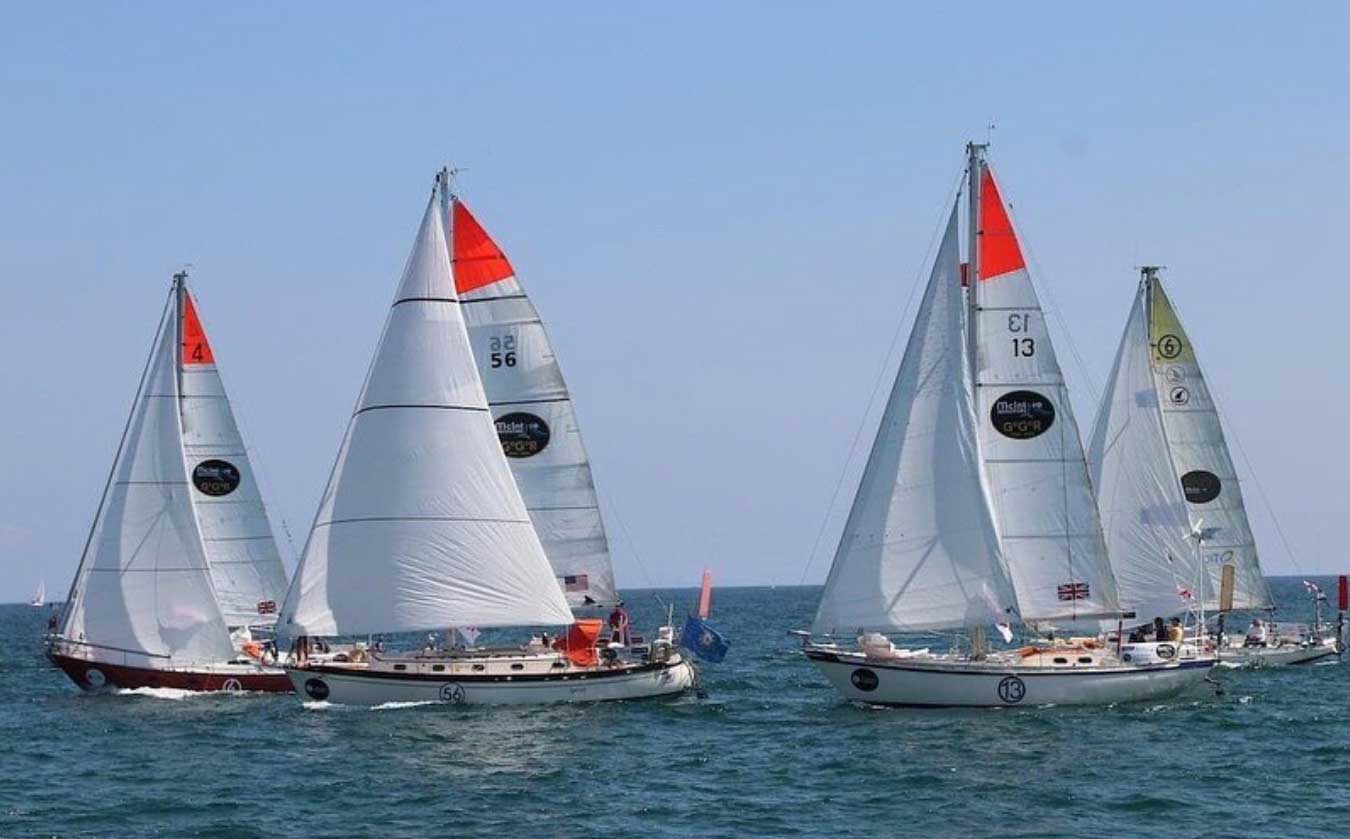
The rules restrict competitors to traditional production designs. The yachts must generally be fibre-reinforced plastic boats designed before 1988, built in series of at least 20, between 9.75 and 10.97 m (32 and 36 ft), with full-length keels, rudders attached to the keel’s trailing edge and a minimum design displacement of about 6,200 kg.
These long-keel production yachts favour directional stability, simplicity and robust rudder protection. They are also heavy and much slower than modern offshore racers.
The Rustler 36 has become emblematic. Jean-Luc Van Den Heede won the 2018 race in the Rustler 36 Matmut. That same yacht returns in 2026 under Ertan Beskardes as Miss Beagle. Damien Guillou’s Rustler 36 Solarem measures 10.77 m (35.3 ft) and displaces about 7,623 kg.
Every boat still requires a major refit plan and surveys of the hull, deck, rig and critical systems. The rules leave seaworthiness with the entrant. The governing principle is simple: finish before trying to win.
Crédit Photo: The Golden Globe Race
The original race turned survival into sailing history
The Sunday Times Golden Globe Race began in 1968. Nine men set out at different times. Only Robin Knox-Johnston finished, returning to Falmouth aboard the 9.75 m (32 ft) ketch Suhaili after 312 days and becoming the first person to sail solo and non-stop around the world.
Bernard Moitessier rounded Cape Horn aboard Joshua while still capable of winning, then continued east and eventually sailed to Tahiti rather than return to Europe. Donald Crowhurst fabricated position reports while remaining in the Atlantic. His trimaran was later found abandoned after he disappeared at sea.
The first edition established the race’s central truth. Speed only matters once survival, judgement and reliability are secured.
The 2018 edition showed that the danger had not changed
Eighteen sailors started the revived 2018 Golden Globe. Five finished.
Jean-Luc Van Den Heede won in 211 days, 23 hours, 12 minutes and 19 seconds, a record that still stands. In the southern Indian Ocean, a storm with winds around 130 km/h (70 knots) and seas reported at 14 m dismasted Abhilash Tomy and Gregor McGuckin. Tomy suffered a severe spinal injury and required an international rescue.
Susie Goodall was later pitchpoled and dismasted roughly 3,700 km (2,000 nautical miles) west of Cape Horn before being rescued by a bulk carrier.
The 2022 edition produced a victory defined by seamanship
Sixteen sailors started in 2022. Only three completed the race in the main classification.
South African Kirsten Neuschäfer won aboard the Cape George 36 Minnehaha in an official corrected time of 233 days, 18 hours, 43 minutes and 47 seconds. She became the first woman to win a round-the-world race via the three great capes.
Her defining moment came earlier. Finnish skipper Tapio Lehtinen’s Asteria flooded and sank rapidly in the southern Indian Ocean. Neuschäfer diverted, found his liferaft and took him aboard before transferring him to a merchant ship. Officials awarded her a 35-hour time credit.
Abhilash Tomy finished second, four years after the spinal injury that ended his 2018 race. Michael Guggenberger finished third. Simon Curwen reached Les Sables-d’Olonne first physically, but a repair stop in Chile had moved him into the Chichester Class.
The 2026 fleet combines professionals, veterans and outsiders
As of late August 2026, 16 skippers remain. Damien Guillou is among the performance references. The former French Olympic-squad 49er sailor, Figaro competitor and IMOCA boat captain was near the front in 2022 before a windvane failure ended his race. He won the 2026 SITraN Challenge prologue.
Ertan Beskardes returns for a third campaign in Van Den Heede’s former winning Rustler 36. Pat Lawless, a former Irish commercial fisherman, returns after self-steering failure forced him out in 2022. Guy deBoer is back after grounding Spirit on Fuerteventura in that same edition.
The remaining fleet includes Guido Cantini, Andrea Lodolo, Matt Woodside, Isa Rosli, Henry Wootton, Gunnar Christensen, Louis Kerdelhué, Helga Marie “Mara” Løvenskiold Kveseth, Etienne Messikommer, Selim Yalcin, Pär Nyman and Daniel Pinsky.
Qualification is demanding. The current Notice of Race requires at least 8,000 nautical miles of previous ocean sailing, another 2,000 nautical miles solo and, for most entrants, a further 4,000-nautical-mile solo non-stop qualifying voyage in the entered yacht.
The real contest is between the sailor and uncertainty
The Golden Globe remains compelling because it removes precision from a world accustomed to it. The public can follow satellite positions, and the 2026 edition adds a one-way Starlink-based Live Window on selected boats. The skipper receives no internet, weather data or navigational assistance through it. For the audience, it is 2026. For the sailor, much of the voyage still feels like 1968.
From Privilège Marine’s home in Les Sables-d’Olonne, the lesson is familiar. A true bluewater yacht ultimately depends on one sailor, one boat and an ocean that does not adjust its standards.
Comfort and electronics can transform life at sea. They remain tools. When systems fail, sound construction, preparation, judgement and self-reliance are what bring a boat home.