


Carbon and aluminium masts offer different gains in weight, stiffness, cost and offshore serviceability. Privilège Marine explains the trade-off.
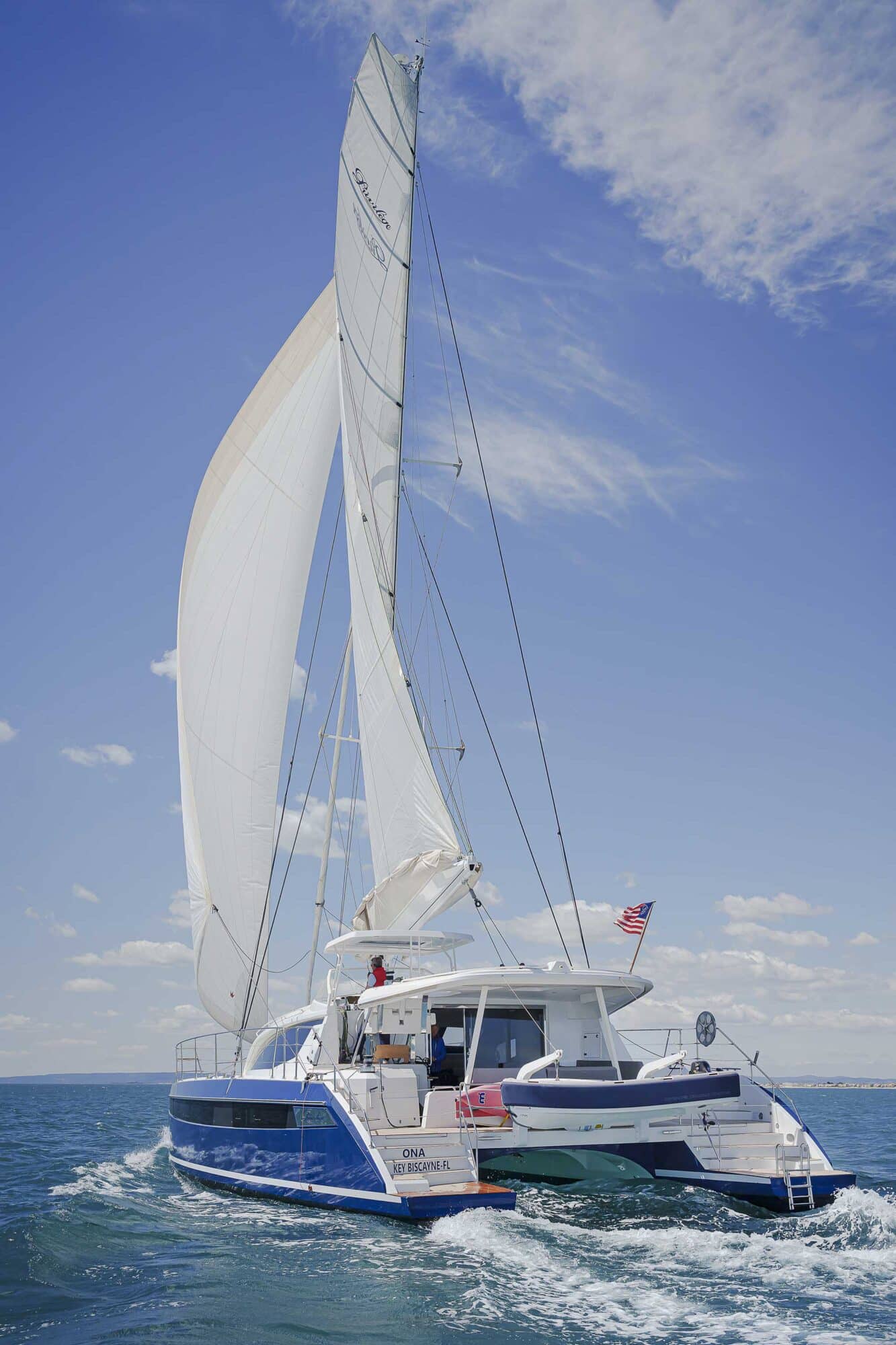
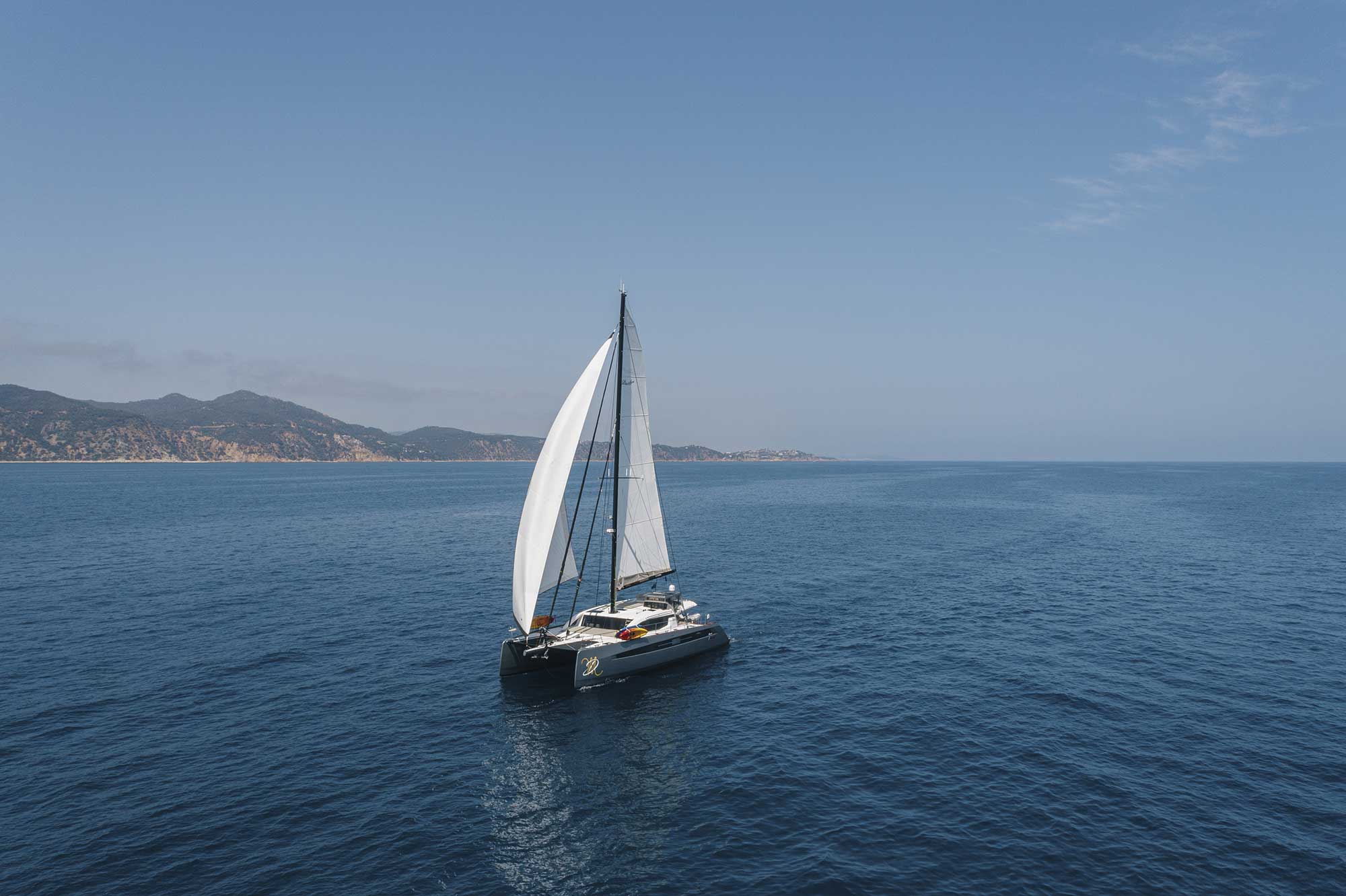
The choice between a carbon mast and an aluminium mast is not simply a contest between modern and traditional materials. It is an engineering decision involving weight, stiffness, sail control, durability, maintenance and cost. Aluminium remains the rational standard for most cruising yachts. It is proven, relatively affordable and supported by a worldwide service network. Carbon fibre offers a higher stiffness-to-weight ratio. It can reduce weight aloft by around 20% to 30% in a typical cruising application, although the exact saving depends on the mast design and equipment. This improves stability, reduces pitching and allows more precise sail trim. A carbon boom also lowers inertia during gybes. At Privilège Marine, aluminium masts and booms are fitted as standard because they provide a strong and dependable offshore solution. Carbon masts and booms are available as an option for owners seeking better weight control and stronger sailing performance from a fully equipped blue-water catamaran.
The Material Choice That Shapes the Entire Yacht
A mast appears simple. It is a vertical structure holding the sails. In engineering terms, it is far more demanding.
A yacht mast must resist compression from the standing rigging. It must absorb lateral bending from the sails. It must withstand torsion, shock loads, pumping and thousands of load cycles. Those forces change with wind speed, sea state, sail configuration and the movement of the yacht.
The mast must also control sail shape. A structure that bends too much allows the forestay to sag and changes the profile of the mainsail. A structure that is excessively rigid may transfer higher peak loads into the rigging, chainplates and hull. The correct mast is therefore not the stiffest possible mast. It is a mast with the correct bend characteristics for the complete yacht.
Carbon fibre and aluminium achieve this balance in very different ways.
An aluminium mast is normally made from an extruded marine-grade alloy section. The profile is anodised or painted. It can be tapered towards the masthead and reinforced around high-load areas such as the gooseneck, spreaders and rigging attachments.
A carbon mast is a laminated composite. Its fibres can be placed in specific directions and quantities. More material can be added where loads are highest. Less can be used where the structure requires less reinforcement. This allows the designer to control longitudinal stiffness, lateral stiffness and torsional resistance with much greater precision.
That design freedom is the central advantage of carbon. Its black finish is merely the visible result.
The Weight Difference That Matters Most Above the Deck
Raw material density provides a useful starting point.
A typical aluminium mast alloy has a density of about 2.70 grams per cubic centimetre. Carbon fibre itself is closer to 1.79 grams per cubic centimetre. A finished carbon laminate also contains resin, coatings, inserts and local reinforcements, so those figures cannot be translated directly into a complete mast weight.
The finished result nevertheless remains significant. A properly engineered carbon fibre mast may weigh around 20% to 30% less than its aluminium equivalent. Rustler Yachts, which offers both materials on offshore cruising yachts, cites an average reduction of approximately 25% in mast weight.
The percentage is only part of the story. The location of the saved weight matters more.
Removing 100 kilograms from a yacht’s interior is useful. Removing 100 kilograms from a mast, with much of that mass positioned 10 to 25 metres above the water, has a greater dynamic effect.
The yacht’s vertical centre of gravity moves lower. Pitching and rolling inertia decrease. The boat becomes more responsive to changes in wind pressure. It may recover more quickly after passing through a wave. It also wastes less energy accelerating a heavy rig from side to side.
This matters on a catamaran. A modern blue-water catamaran carries a substantial operational load. It may have large fuel and water capacities, lithium batteries, refrigeration, air conditioning, a tender, domestic equipment, safety systems, tools, stores and personal belongings.
A carbon mast does not make that payload disappear. Nor does it transform a luxury cruising catamaran into a racing machine. Carbon is not magic. It simply removes mass from one of the least desirable places to carry it.
At Privilège Marine, this is one of the main reasons for offering a carbon mast and boom. It helps preserve sailing performance on a yacht designed to carry its owners, their equipment and their ambitions across oceans.
The Stiffness Advantage That Improves Sail Control
Stiffness is often discussed badly.
Carbon fibre is not automatically stiffer than aluminium in every direction. Carbon is anisotropic. Its properties depend on the orientation of its fibres. An aluminium alloy behaves more uniformly in different directions.
The relevant engineering value is not simply the material’s modulus. Mast stiffness also depends on the dimensions and geometry of the section. Naval architects describe bending stiffness as the product of the material’s elastic modulus and the section’s second moment of area.
In simple terms, both the material and the shape matter.
The elastic modulus of common aluminium mast alloys is about 70 gigapascals. Individual carbon fibres may exceed 230 gigapascals and can reach more than 300 gigapascals in intermediate-modulus products. A finished laminate has lower values than the bare fibres because it includes resin and fibres in several orientations. Yet its stiffness relative to its mass remains substantially higher.
This allows a carbon mast to be lighter while retaining equal or greater stiffness in the directions that matter.
The result is better control of mast bend. The mainsail can maintain a more consistent designed shape. The rig can also support greater forestay tension, provided the entire rig and yacht structure have been engineered for it.
Forestay tension is critical when sailing upwind. Wind pressure pushes the headsail and forestay to leeward. This creates forestay sag. Excessive sag makes the headsail fuller, increases aerodynamic drag and reduces pointing ability.
A stiffer mast does not eliminate sag. Nothing does. It makes the rig more stable and predictable, which allows more precise rig tuning.
This can produce a cleaner headsail entry, a more controlled mainsail profile and less distortion as wind pressure changes. The yacht may sail closer to the wind. More importantly for offshore cruising, it may maintain speed through waves with fewer large changes in heel, heading and sail shape.
The Performance Gain That Extends Beyond Maximum Speed
Owners often ask how many knots a carbon mast will add. There is no responsible universal answer.
The gain depends on displacement, sail area, hull form, sea state, wind strength, rig configuration and the weight difference between the two mast packages. It also depends on whether the owner uses the additional performance effectively.
A carbon rig can improve light-wind acceleration because the yacht has less mass and rotational inertia. In moderate conditions, reduced pitching can help the sails and appendages work more consistently. Upwind, greater rig stability can improve sail shape and pointing.
In stronger wind, a lighter rig may allow the yacht to carry its working sail plan for longer before reefing. This does not mean that reefing decisions should become aggressive. Offshore seamanship still requires conservative margins. It means the yacht may remain balanced and controlled over a wider operating range.
The real benefit is often found in average passage speed rather than peak speed.
An additional fraction of a knot sustained for several days is valuable. At an average of 8 knots, a yacht covers about 356 kilometres, or 192 nautical miles, in 24 hours. Raising that average to 8.5 knots adds roughly 22 nautical miles per day. Over a ten-day passage, the difference exceeds 400 kilometres, or 216 nautical miles.
A carbon mast alone cannot guarantee that gain. Weather routing, sail choice, hull cleanliness and crew decisions remain decisive. The carbon rig gives the yacht a better platform from which to use the available wind.
The Carbon Boom That Reduces Loads During Manoeuvres
The boom deserves separate attention.
Seldén states that its carbon booms can provide a weight saving of up to 35% to 40% compared with an aluminium equivalent. On one published example for a 10.7-metre yacht, or 35 feet, the boom weight falls from approximately 30 kilograms to 20 kilograms.
The absolute saving will differ on a large catamaran, but the mechanical principle remains the same.
A lighter boom has less momentum during a gybe. This reduces the energy that must be controlled by the mainsheet, traveller, preventer and boom fittings. Accidental gybes remain dangerous, but the forces generated by a lighter spar can be lower.
The crew also benefits during reefing and sail handling. A lighter boom places less static load on the topping lift or rigid vang. It may reduce rolling influence when sailing downwind. The boom can also be made stiffer for its weight, helping to maintain mainsail foot tension and sail shape.
The carbon boom is therefore not merely a visual companion to a carbon mast. It produces its own operational and structural benefits.
The Strength Question That Requires a More Honest Answer
People often ask which mast is stronger. The question is incomplete.
A carbon mast can offer exceptional tensile strength and compression resistance for its weight. The laminate can be reinforced locally around spreader roots, halyard exits, goosenecks and standing-rigging attachments. It also has strong resistance to conventional metal fatigue and does not corrode in the same way as aluminium.
Aluminium has different advantages. It is ductile. It can deform before complete failure. Dents, cracks, oxidation and corrosion around fittings are often visible during inspection. Its behaviour is familiar to surveyors and riggers around the world.
Carbon damage can be less obvious. A local impact may produce internal delamination, matrix cracking or fibre damage without creating a dramatic mark on the surface. A serious impact therefore requires professional assessment. Visual inspection alone may not establish the full extent of the damage.
Carbon is also electrically conductive. Carbon structures and metallic fittings must be carefully isolated to limit galvanic corrosion. Stainless-steel and aluminium fittings still require inspection, even when the main tube itself cannot corrode.
A carbon mast is repairable. A specialist can remove damaged laminate and rebuild the structure with correctly oriented fibres. A good repair can restore the required load path. But it is not an improvised job for an unqualified technician in an isolated harbour.
An aluminium mast may be easier to inspect and service through the conventional marine network. Major structural repairs can still be difficult. Welding heat-treated aluminium may alter local material properties and create hard points or weakened zones. Some damage requires replacement rather than repair.
Neither material removes the need for scheduled rig inspections.
The Aluminium Standard That Remains Technically Rational
Aluminium continues to dominate cruising yacht masts for sound reasons.
It delivers a proven balance of strength, weight and price. Extrusion produces consistent sections. Anodising provides effective surface protection. Components and replacement fittings are widely available. Most professional riggers understand aluminium spars.
It is also easier to control project cost. The production process is industrialised. Standard sections can be adapted to many yacht designs. Lead times are usually more predictable than those for a fully customised carbon laminate.
For an offshore yacht, serviceability matters. A yacht may cruise far from its original shipyard. Owners need a system that can be inspected, maintained and supported in different countries.
This is why Privilège Marine installs aluminium masts and booms as standard. The choice is not a concession. It is a robust technical specification for safe and reliable blue-water cruising.
A well-designed aluminium rig can deliver excellent performance. The mast can be correctly tapered, tuned and paired with high-quality standing rigging and sails. For many owners, it provides the best balance between purchase cost, operational simplicity and long-term ownership.
The Carbon Price That Reflects More Than Raw Material
A carbon mast costs more because the product is more complex.
The manufacturer must calculate the laminate for a specific yacht. Engineers determine fibre type, fibre orientation, wall thickness and local reinforcement. The mast may be filament-wound or built from pre-impregnated materials. It then requires controlled curing, finishing, machining, bonding and detailed quality assurance.
The tooling and production volume also matter. Aluminium mast sections are extruded in repeatable profiles. Carbon yacht masts are produced in much smaller numbers and may be highly customised.
There is no reliable universal multiplier. The difference depends on mast height, section size, spreaders, standing rigging, mainsail track, paint system, fittings, shipping and commissioning.
A published options list for the 14-metre Eagle 46 priced a package including a carbon mast, carbon boom, Rodkicker vang and rod rigging at €42,750 excluding VAT. That figure is not directly transferable to a larger Privilège catamaran. It demonstrates the scale of the premium and the importance of comparing complete rig packages rather than raw mast tubes.
On a large yacht, the option must be assessed against its operational value. The buyer is not paying only for carbon fibre. The buyer is paying for engineering, custom manufacturing, reduced weight aloft, improved sail control and potentially better passage performance.
The Privilège Approach That Keeps the Choice Practical
At Privilège Marine, the standard aluminium mast and boom remain the logical solution for most cruising programmes. They are strong, proven and maintainable. They also allow owners to allocate budget to other equipment that may be more important to their specific voyage, such as energy generation, communications, additional refrigeration or safety systems.
The carbon mast and boom form a genuine performance option. They are particularly relevant for owners who want to control the weight of a comprehensively equipped yacht. They can also suit owners who place a high value on sailing response, reduced pitching and more precise sail trim.
The decision must be made early. Changing mast material affects rig engineering, weight calculations, stability, wiring, fittings, standing rigging and commissioning. It is not simply a cosmetic substitution at the end of construction.
The owner must also consider the yacht’s real loading condition. A carbon mast cannot compensate indefinitely for oversized tenders, excessive equipment or several tonnes of optional payload. Weight management must remain coherent across the entire yacht.
This is the frank answer. Carbon improves performance, but engineering discipline creates the performance.
The Better Rig Is the One That Matches the Voyage
The aluminium mast offers value, familiarity and worldwide serviceability. The carbon mast offers lower weight, greater design freedom and a more stable aerodynamic platform.
Neither material is universally superior.
For an owner planning relaxed coastal cruising, aluminium may be the sensible choice. For an owner seeking the best possible sailing response from a fully equipped ocean-going catamaran, the carbon option becomes more compelling.
The difference is not measured only at the masthead. It is felt in the yacht’s motion, its acceleration, its sail shape and the way it carries its equipment across an ocean.
A successful offshore yacht does not pursue minimum weight at any cost. It places weight intelligently. Few kilograms are more valuable to remove than those carried high above the water.