Close
Lang selector black

Category: Catamaran Ownership

  • The Smarter Way to Think About Financing a Catamaran

    The Smarter Way to Think About Financing a Catamaran

    A practical guide to catamaran finance, marine loans, cash purchases, credit costs, and the key differences between US and European structures.

    Buying a catamaran is a financial decision before it becomes a sailing decision. The purchase price is only the first line. The real question is how the boat will be funded, how much the credit will cost over time, and how the financing structure will affect liquidity, ownership, tax exposure, insurance, flag choice and future resale. A buyer may pay cash, use a marine loan, arrange a yacht mortgage, structure a lease, or combine personal capital with asset-backed lending. Each route changes the economics of ownership.

    For a Privilège owner, this question deserves the same level of care as layout, equipment and autonomy. A yacht built for ocean passages, private life and long-distance comfort is a long-term asset. Financing it should be approached with the same discipline: clear numbers, verified assumptions and professional advice. This article explains the main options without recommending one. It is information, not financial advice.

    The first question is whether capital or credit serves the project

    A catamaran purchase begins with a simple choice: pay cash or finance boat. The answer looks personal, but it is also technical. Cash removes interest charges. It simplifies closing. It can strengthen the buyer’s position during negotiation and reduce lender conditions. It also locks a large amount of capital into a depreciating, operating asset.

    Financing does the opposite. It preserves liquidity. It allows the owner to keep capital invested elsewhere, maintain reserves for refit, crew, insurance, cruising and unexpected maintenance, or align payments with personal cash flow. It also introduces interest, fees, paperwork, lender rights and sometimes restrictions on use.

    For a serious cruising catamaran, the financial plan should not stop at the monthly payment. The owner must calculate the total cost of credit. This includes the interest paid over the term, origination fees, mortgage registration, legal costs, survey costs, documentation costs, insurance requirements and possible foreign-exchange exposure.

    A simple example is useful. On a €1,000,000 financed amount over 15 years, a 6% annual rate produces a monthly payment of about €8,439 and total interest of about €518,942. At 8%, the payment rises to about €9,557 and total interest to about €720,174. At 8.95%, close to some long-term US public marine-loan benchmarks in 2026, the payment reaches about €10,113 and the interest cost rises to about €820,330. The boat is the same. The credit structure is not.

    This is why the interest rate is only one number. The term, deposit, residual value, currency, fees and tax treatment can change the real cost more than the headline rate suggests.

    The marine loan treats the catamaran as a financed asset

    A marine loan catamaran structure is usually secured against the boat. The lender evaluates the borrower and the vessel. The borrower is assessed through income, assets, liabilities, credit history, liquidity and residence. The vessel is assessed through value, age, builder reputation, documentation, survey, insurability and resale liquidity.

    In the United States, marine lending is relatively visible. Some lenders publish rates, terms and minimum amounts. Publicly available US examples in June 2026 show boat-loan APRs starting around 6.95% for short new-boat terms and rising toward 8.95% or more for longer terms, with used-boat rates often higher. Terms may reach 180 months, or 15 years, with some specialist lenders discussing longer terms for larger loans and strong borrowers.

    For a high-value sailing catamaran, the lender may require a substantial down payment. In practice, 10% to 30% is common in many marine-finance discussions, while larger deposits may be requested for bespoke yachts, older vessels, complex ownership structures or cross-border use. The logic is blunt. A yacht is mobile, expensive to recover, exposed to weather, and sensitive to maintenance quality. The lender wants the owner to have meaningful equity in the boat.

    The loan file also tends to include the Hull Identification Number, valuation, builder information, flag or documentation details, insurance binder, purchase contract and sometimes a marine survey. On used vessels, the survey becomes central. On a new build, the yard contract and payment schedule matter because funds may be drawn in stages before delivery.

    For a Privilège, the financing discussion should reflect the reality of the yacht itself. These are not commodity boats. They are bluewater catamarans built around offshore safety, comfort, craftsmanship and the owner’s life on board. That strengthens the need for proper documentation. A lender will want to understand not only the purchase price, but also the specification, equipment, construction stage, delivery timing and intended registration.

    The catamaran mortgage rate is only the visible part of the price

    The search term catamaran mortgage rates often leads buyers to one number. That number matters. It is also incomplete.

    A marine mortgage works by giving the lender a registered security interest in the vessel. The term “mortgage” sounds close to real estate, but a yacht is not a house. It moves across jurisdictions. It can be flagged in one country, insured in another, berthed in a third and cruised across several customs areas in one season. This mobility affects enforcement risk. Enforcement risk affects pricing.

    The total price of credit has five main layers.

    First, there is the interest rate. This may be fixed or variable. Fixed rates provide visibility. Variable rates may begin lower, but expose the owner to central-bank movements and lender margins.

    Second, there is amortisation. A fully amortising loan repays principal and interest over the term. A loan with a balloon payment keeps monthly payments lower, then requires a large final amount. That may suit some cash-flow profiles, but it creates refinancing or resale risk at maturity.

    Third, there is the deposit. A larger deposit reduces the financed amount. It can reduce risk for the lender and may improve terms. It also uses more cash immediately.

    Fourth, there are fees. These may include arrangement fees, legal fees, documentation fees, registration costs, bank charges, valuation and survey costs. They can look small beside the yacht price, but they are part of the real cost.

    Fifth, there are lender conditions. The lender may require comprehensive hull insurance, navigation-area approval, professional maintenance, restrictions on charter, restrictions on flag, or approval before moving the yacht to certain regions.

    A buyer should ask for the amortisation schedule, not only the monthly amount. The schedule shows how much interest is paid each year, how fast equity builds, and what remains outstanding if the yacht is sold after five, seven or ten years.

    The European model relies more heavily on leasing and private banking

    Europe has a different culture of yacht finance. The product often appears as a lease, a loan with a ship mortgage, or a private-bank structure secured by several assets. The documentation can be less public than in the United States. Negotiation is often more individual.

    In several European markets, yacht leasing has historically been common for new boats. A leasing company buys the yacht and leases it to the user, often with an option to purchase at the end. Public European examples indicate lease terms for sailing yachts and motor yachts of about 5 to 15 years, with down payments that can range from 10% to 50%, depending on country, lender, borrower profile and yacht status.

    A ship mortgage is closer to a secured loan. The boat is registered, and the lender’s interest is recorded. European yacht brokers and finance providers often describe financing ranges of 50% to 80% of the purchase price, with terms around 10 to 15 years. The exact structure depends heavily on the flag, borrower residence, VAT position and bank appetite.

    The European discussion also has a strong tax and customs dimension. A yacht used in the European Union by an EU resident normally requires a clear VAT-paid status or another lawful basis for relief. A non-EU resident using a non-EU boat privately may rely on Temporary Admission, usually allowing up to 18 months in EU waters without paying import VAT or customs duty, provided the conditions are met. Overstaying can make VAT and duty due.

    This is not a minor detail. On a yacht worth €2,000,000, VAT at 20% represents €400,000 before any penalties, interest or professional costs. The financing structure cannot be separated from the VAT and customs strategy.
    financing catamaran

    The United States is more standardised but still demanding

    The US market is often more transparent for consumer marine finance. Lenders publish APR ranges. Loan calculators are widely available. Borrowers may compare fixed-rate offers more easily. There is also a mature system for Coast Guard documentation, preferred ship mortgages and recreational boat lending.

    For larger documented vessels, a lender may ask for a First Preferred Ship Mortgage. This gives the lender a strong security interest. The process can involve the US Coast Guard Certificate of Documentation, title evidence, lien recording and proof of insurance. Used boats usually require a marine survey. These steps create structure and lender confidence.

    US borrowers may also consider tax treatment. Under IRS rules, a boat can qualify as a home if it has sleeping, cooking and toilet facilities. In some cases, interest on a secured loan for a qualifying primary or second home may be deductible, subject to limits and personal tax circumstances. This point should be handled by a tax adviser. It should never be assumed.

    US financing may be more accessible on paper, but it is not automatic. Credit history, debt-to-income ratio, liquidity, employment or business income, loan size, boat age and intended use all matter. A new, well-documented cruising catamaran may be easier to underwrite than an older, heavily modified yacht with uncertain maintenance records. A buyer planning private use may face different conditions from one planning charter activity.

    The cash buyer still carries a financial cost

    Cash looks clean. It avoids lender scrutiny and interest. It can speed the transaction. It also creates opportunity cost.

    If an owner uses €2,000,000 in cash to buy the catamaran, that money cannot be used elsewhere. It cannot generate portfolio income. It cannot remain available for business needs. It cannot serve as a liquidity reserve during market stress. The true cost of cash is the return the capital might have earned elsewhere, adjusted for risk and tax.

    Cash also does not remove ownership costs. Insurance, berth, maintenance, haul-out, antifouling, sails, electronics, batteries, safety equipment, professional crew, wintering and long-distance logistics remain. For bluewater cruising, an owner should also maintain a serious reserve. Offshore reliability depends on disciplined maintenance. A beautiful yacht with weak cash reserves can become a source of pressure.

    That said, cash preserves freedom. The owner can choose the flag, cruising programme and refit calendar without lender consent, subject to law and insurance. There is no amortisation schedule. There is no refinancing risk. There is no lender approval before sale. For some owners, that freedom is worth more than the potential investment return on retained capital.

    The financed buyer buys liquidity and accepts constraints

    Financing can be intelligent when it is used deliberately. Leverage has a price, but it may preserve flexibility. A buyer who finances 60% of the yacht and keeps substantial liquidity may be better prepared for refit, cruising, family needs or business volatility than a buyer who pays cash and keeps too little reserve.

    The danger is monthly-payment thinking. A lower payment does not always mean a better structure. Longer terms increase total interest. Balloon payments postpone risk. Variable rates can rise. Foreign-currency loans can become expensive if income and debt are not in the same currency.

    Currency is especially important for international owners. A euro-denominated yacht financed in dollars may expose the owner to exchange-rate risk if income, investments or resale proceeds are in another currency. The same applies to sterling, Swiss francs or other currencies. A one-point movement in the interest rate is visible. A 10% currency movement on a seven-figure balance is more painful.

    The buyer should also examine early repayment rules. Some loans allow prepayment without penalty. Others charge fees. If the owner expects to sell the boat within five years, the early-exit cost matters as much as the entry rate.

    The charter question changes the underwriting

    Some owners consider charter income to offset finance costs. This should be treated with caution. A yacht designed for private long-distance life is not the same financial object as a charter platform.

    Charter may create revenue, but it also increases wear, management complexity, insurance requirements, commercial coding, crew obligations, local tax exposure and scheduling constraints. It can affect VAT treatment, lender consent and resale condition. A lender may underwrite a private-use yacht differently from a commercial or mixed-use yacht.

    For Privilège owners, the decision is also philosophical. Many choose a yacht because it is personal. The layout, materials, systems and storage are shaped around their life at sea. Turning that yacht into a revenue asset may conflict with the original purpose. It may still be possible. It simply requires a different financial model and professional advice from the beginning.

    The honest calculation should include management commission, cleaning, maintenance acceleration, consumables, insurance uplift, crew, marketing, downtime and tax. Gross charter revenue is not net cash flow.

    The practical checklist before signing a finance offer

    A buyer should request clear answers before signing any marine finance offer.

    The first question is the financed amount. Is VAT included? Are options included? Are delivery, commissioning and registration costs included? Are tenders, solar upgrades, watermakers, lithium batteries, navigation equipment and safety systems part of the financed asset?

    The second question is the rate. Is it fixed or variable? What benchmark is used? How often can it change? What margin is added?

    The third question is the term. Is the loan fully amortising? Is there a residual value? Is there a residual value guarantee? What is the final payment?

    The fourth question is the security. Is the lender taking a marine mortgage, a personal guarantee, a corporate guarantee, a pledge over investments, or several forms of security?

    The fifth question is use. Can the yacht cross the Atlantic? Can it remain in the Caribbean? Can it enter the European Union? Is charter allowed? Is professional delivery allowed? Does the navigation area match the insurance policy?

    The sixth question is exit. What happens if the yacht is sold early? Can the loan be transferred? Is refinancing possible? What documents will be required to release the mortgage?

    The seventh question is professional review. A marine lawyer, tax adviser, insurance broker and finance specialist should review the structure. This is not bureaucracy. It is risk control.

    The financing should respect the way the owner will live at sea

    At Privilège Marine, we build catamarans around owners, not around abstract market categories. The same thinking should apply to finance. A yacht intended for family circumnavigation, Mediterranean residence, Atlantic crossings or seasonal Caribbean cruising will not produce the same financial constraints.

    A bluewater catamaran is a private world with engines, rigging, structure, autonomy systems, electronics, domestic comfort and offshore safety. Financing that yacht requires more than comparing interest rates. It requires a coherent plan for capital, liquidity, tax, insurance, flag, customs, cruising area and exit value.

    The most sensible owner is not the one who always pays cash. It is not the one who always finances. It is the one who understands the real cost of each route before signing.

    The final test is simple. The financing should support the life the yacht was built for. It should not quietly reshape it. A Privilège is designed for distance, comfort and personal freedom. The financial structure should preserve those three things with the same care that goes into the yacht itself.
  • The New Luxury at Sea Is Relevance Over Standardization

    The New Luxury at Sea Is Relevance Over Standardization

    True yacht luxury now lies in relevance: a bespoke sailing yacht shaped around ownership, life on board and long-distance cruising.

    The definition of luxury in yachting is changing. Finish quality still matters, but it no longer explains the real premium paid by serious owners. A yacht becomes valuable when it fits the way an owner lives, sails, rests, works, hosts and crosses oceans. That is the difference between a polished object and a relevant home at sea.

    For Privilège Marine, this distinction is central. From its shipyard in Les Sables d’Olonne, the company builds bluewater sailing catamarans around each owner’s real requirements. Layout, circulation, autonomy, storage, safety systems, materials, technical configuration and interior atmosphere must form one coherent whole. The result is a bespoke sailing yacht with purpose, not a standardized luxury product with expensive finishes. In a market where high-end buyers are asking for deeper personal relevance, the future of yachtbuilding belongs to yards able to listen, interpret and build around a precise way of life.

    The market is moving from visible luxury to useful luxury

    Luxury yachting has long been judged through visible signs. Glossy joinery, rare materials, large cabins, bigger glazing and impressive entertainment areas have carried much of the conversation. These elements still count. They are part of the physical experience of a yacht. Yet they do not answer the most important question an owner eventually asks at sea: does this yacht make my life easier, safer and more meaningful?

    That question is now reshaping the premium yacht market. Deloitte and Confindustria Nautica estimated the global new-build yachting market at €34.8 billion in 2023, up 7.3% year on year. The market then entered a more selective phase, with pressure on smaller boats and stronger resilience in premium and large-yacht segments. In that environment, buyers become more demanding. They are less impressed by generic luxury. They expect a yacht to solve their own life at sea.

    The superyacht data points in the same direction. The Monaco Yacht Show Market Report 2025 by SuperYacht Times counted 6,174 superyachts over 30 metres (98 feet) in operation by early August 2025. Only 915 were sailing yachts. Among the 588 new superyachts in build, only 40 were sailing yachts, equal to 7% of the construction book. Sailing yachts occupy a narrower, more intentional segment. Owners who choose sail often want more than space and prestige. They want range, silence, seamanship, autonomy and a closer relationship with the sea.

    This is why relevance has become a stronger marker of luxury than finish level alone. A surface can be expensive and still irrelevant. A layout can be impressive at a boat show and tiring after three weeks offshore. A cabin can be beautiful and poorly suited to the owner’s actual rhythm. True luxury begins when the yacht reflects use, not display.

    The owner’s lifestyle is the real specification

    The serious owner does not buy a yacht as a neutral object. He buys a way of living. That life may involve crossing the Atlantic as a couple, spending months in the Mediterranean with children, working remotely from anchorages, welcoming guests for short periods, storing equipment for diving or kitesurfing, or sailing with a reduced crew. Each scenario changes the yacht.

    This is where standardization reaches its limit. A fixed layout can be efficient for production. It can make comparisons easier. It can also ignore the real use of the boat. An owner who sails with family needs different privacy, storage and watchkeeping logic from an owner who uses professional crew. An owner who works on board needs acoustic privacy, lighting, power management and connectivity. An owner who spends months in remote anchorages needs autonomy, refrigeration, water capacity, spare-parts storage and technical access. An owner who values wellness may want a gym, a meditation area or a larger owner’s suite rather than another conventional guest cabin.

    A yacht is a system. Every choice has consequences. Moving storage affects weight distribution. Adding equipment affects electrical load. Expanding refrigeration affects energy management. Creating a media room requires ventilation, sound control and power planning. A larger wardrobe changes circulation and storage logic. A better office needs more than a desk. It needs daylight, privacy, connectivity, seating position and protection from heat.

    That is why Privilège Marine treats personalisation as an engineering and design discipline. It is not cosmetic. It begins with dialogue. How does the owner sail? Who is on board? How long are the passages? Which areas will be used every day? Which spaces must remain quiet? Where should technical systems be accessible? Which details will still matter after five years of ownership?

    The answer defines the yacht.

    The Privilège approach starts with the owner before the layout

    Privilège Marine has been building ocean-going catamarans for more than 40 years in Les Sables d’Olonne, on the French Atlantic coast. This location matters. The shipyard is based in a port shaped by offshore sailing culture, close to the world of the Vendée Globe and long-distance seamanship. The product is not conceived as a floating apartment. It is conceived as a bluewater sailing catamaran for owners who expect comfort and confidence over distance.

    The company’s range reflects that positioning. The Signature 510 is a 17.09-metre (56-foot) catamaran designed for autonomous bluewater sailing, with 165 square metres (1,775 square feet) of sail area, 800 litres (211 gallons) of fuel and 600 litres (158 gallons) of fresh water. Its full-beam owner’s suite, protected helm station and large storage capacity speak to long voyages rather than short-term appearance.

    The Signature 600 moves the concept further. At 18.28 metres (60 feet), with 259 square metres (2,787 square feet) of sail area, two 110 hp engines, two 485-litre fuel tanks and two 450-litre fresh-water tanks, it is built for long-distance cruising and extended use. Yet its most revealing feature is not only technical. It is the aft portside cabin, treated as a flexible space. Depending on the owner, it may become a home cinema, gym, office, storage room, artist’s studio or large walk-in wardrobe.

    That decision captures the Privilège philosophy. The same area of the boat can answer several lifestyles. The value lies in choosing the right answer for the owner, not in forcing every owner into the same solution.

    The Signature 650 extends the same thinking at a larger scale. With an overall length of 21.25 metres (70 feet), 264 square metres (2,840 square feet) of total sail area and fuel capacity of two 1,000-litre tanks, it is built for owners who want to explore with greater volume, comfort and autonomy. Its central owner’s suite, protected cockpit and secure circulation support long periods at sea. The yacht is still a sailing machine. It is also a private retreat.

    luxury catamaran

    The interior becomes valuable when it supports life at sea

    Interior luxury is often reduced to materials. That is too narrow. Materials matter because they create atmosphere, durability and sensory comfort. Yet the real question is how the interior behaves after the first impression.

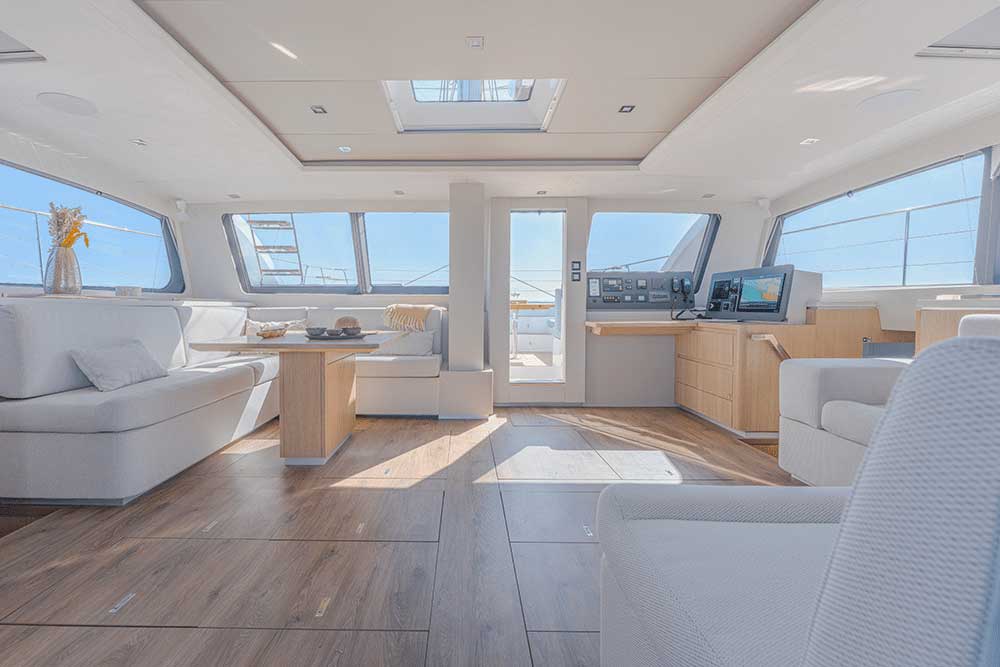
    On a long-range sailing catamaran, the interior must support movement, sleep, storage, social life, privacy and recovery. A saloon must work at anchor and underway. A galley must be practical in real use, not only photogenic. A cabin must provide comfort without becoming a cave. Lighting must be calm at night and useful during maintenance. Ventilation matters. Handles, edges and circulation routes matter. The distance between the helm, cockpit, saloon and cabins matters because fatigue is part of sailing.

    This is the difference between standard luxury and relevant luxury. Standard luxury asks whether a space looks expensive. Relevant luxury asks whether the space works for the people who will inhabit it.

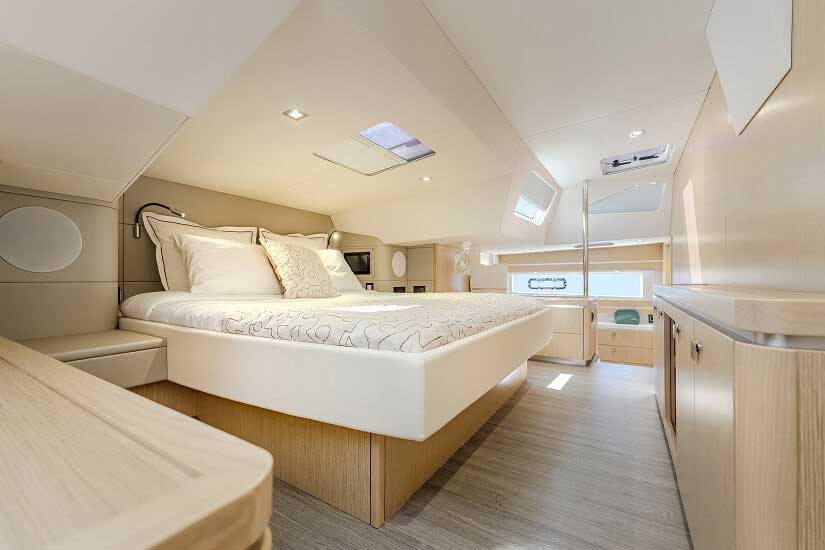
    For Privilège Marine, this is why the owner’s suite has always carried importance. The owner is not a guest on his own yacht. He should have privacy, volume and a sense of permanence. The forward or central owner’s suite found across the range is not a decorative signature. It changes the emotional balance of the yacht. It tells the owner that the boat has been organised around long-term life on board.

    The technical choices are part of the luxury experience

    The yachting industry sometimes separates luxury from engineering. Owners know this is false. Comfort at sea depends on structure, weight, sail handling, protection, visibility, noise, autonomy and safety. A beautiful yacht that is stressful to sail does not remain luxurious for long.

    Privilège Marine’s design logic places safety and usability at the centre. The Signature 510 is designed to be handled without a crew, thanks to a balanced rig and intuitive deck plan. The Signature 580 and Signature 600 use a helm position conceived to combine visibility, protection and connection with life on board. The Signature 650 adds scale without abandoning secure circulation and protected spaces.

    The integration of SEA.AI as standard equipment across the range also shows how technology can be relevant rather than ornamental. The system uses optical and thermal cameras with artificial intelligence to detect unidentified floating objects and other risks around the boat, including targets that radar or AIS may not always identify. For owners sailing at night, in reduced visibility, in busy anchorages or with a small crew, this is not a gadget. It supports vigilance. It reduces cognitive load. It adds another layer to serenity at sea.

    That is luxury in a practical form. It is not louder. It is more useful.

    The bespoke yacht is a coherent object, not a list of options

    The word bespoke is often overused in luxury markets. In yachtbuilding, it should mean something precise. A bespoke yacht is not simply a standard platform with more options. It is a coherent object shaped through decisions that fit together.

    A custom office must make sense with power, lighting, ventilation and acoustic comfort. A gym must make sense with structure, storage, air flow and movement. Extra storage must make sense with weight and access. A larger guest area must make sense with privacy and service. A media room must make sense with sound, heat and electricity. The role of the shipyard is to protect coherence.

    This is where Privilège Marine’s position is distinct. The company builds tailor-made luxury yachts with the discipline required for ocean use. The process cannot be reduced to aesthetic choice. It must reconcile the owner’s wishes with naval architecture, structure, ergonomics and long-term reliability.

    That balance is especially important on a sailing catamaran. A catamaran offers volume, stability and living space, but it also demands discipline around weight and systems. Relevance cannot become excess. A well-designed yacht must carry what the owner truly needs and avoid what will become unused complexity.

    The premium is therefore not only in choosing. It is in choosing wisely.

    The new luxury owner expects recognition without theatricality

    Across the wider luxury market, the most valuable clients are moving away from massified signals. BCG and Altagamma’s 2025 True-Luxury Global Consumer Insights describe a top-tier luxury clientele that values intimacy, recognition, excellence and personal connection. This applies directly to yachting.

    A yacht owner does not need theatrical attention. He needs to be understood. He needs a shipyard capable of translating personal use into technical and spatial decisions. The relationship should be direct, serious and precise. Good questions are more valuable than generic promises.

    This is also why editorially serious yacht luxury should be discussed with more rigour. Finish level remains part of the story, but it is no longer enough. The owner who spends years with a yacht will judge the shipyard on daily relevance: how the yacht behaves at 02:00 during a night watch, how calm the saloon feels after a rough passage, how easily guests move through the cockpit, how well the systems can be monitored, how naturally the family lives together without losing privacy.

    The best luxury disappears into use. It does not need to announce itself every minute.

    The future belongs to yachts that feel necessary

    The next phase of yacht luxury will be less about adding features and more about sharper relevance. Owners will still demand beauty. They will still expect fine materials, refined craftsmanship and technical excellence. Yet the strongest premium will go to yachts that feel inevitable once they are used.

    That is the standard Privilège Marine seeks to meet. A Privilège is not conceived as a universal answer. It is built around a particular owner, a particular rhythm and a particular ambition at sea. The yacht must cross oceans with confidence. It must feel calm. It must support autonomy. It must protect those on board. It must carry the owner’s personal way of living without compromising the fundamentals of seamanship.

    This is a frank definition of modern yacht luxury: the most valuable yacht is the one that makes the owner’s life at sea more coherent.

    For Privilège Marine, relevance is not a marketing layer. It is the reason to build differently. It is why each yacht begins with dialogue. It is why layouts remain open to interpretation. It is why engineering, craftsmanship and personalisation must be considered together. And it is why a true luxury catamaran is never only finished to a high standard. It is built to belong to one owner.

  • The Flag That Quietly Defines Life Aboard a Yacht

    The Flag That Quietly Defines Life Aboard a Yacht

    Choosing a yacht flag shapes ownership, compliance, tax, charter use, insurance and cruising freedom. It is never just paperwork.

    Choosing a yacht flag is one of the least visible decisions in yacht ownership. It is also one of the most consequential. The flag gives a boat its legal nationality. It determines the flag state, the registration authority, the safety framework, the inspection regime, the radio licence, the ownership rules and, in many cases, the way the yacht can be used. A private pleasure yacht, a commercially operated yacht and a liveaboard yacht may look similar at anchor, but they do not raise the same legal questions. Nationality, residence, tax position, cruising area, charter plans, financing, insurance, crew status and future resale all matter. At Privilège Marine, we build catamarans around their owners’ real sailing projects. The flag must be chosen with the same seriousness. It should fit the yacht, the owner and the intended life aboard, not just the fastest registration route.

    The boat flag is the yacht’s legal nationality

    A yacht flag is not simply a piece of fabric at the stern. It is the visible sign of the yacht’s legal nationality.

    Under the United Nations Convention on the Law of the Sea, every state sets the conditions under which a ship may receive its nationality and fly its flag. The ship then has the nationality of that state. The same convention also says that ships should sail under the flag of one state only and, on the high seas, are generally subject to the exclusive jurisdiction of that flag state.

    This is the foundation of yacht flag registration. The flag determines which administration has primary responsibility for the yacht. It also determines which documents must be carried, which surveys may apply, which safety rules are relevant, how radio equipment is licensed and which authority can issue or validate key certificates.

    For an owner, this matters from the first day. A yacht without a proper flag is not simply incomplete. It may be unable to clear customs, obtain insurance, enter a marina, receive an MMSI number, register a mortgage or sail internationally with confidence.

    The mistake is to see the flag as a late administrative decision. It is better treated as part of the yacht project. On a bluewater catamaran built to cross oceans, the flag must support the way the yacht will actually be used.

    The private yacht and the commercial yacht are not the same legal object

    The same catamaran can be a private yacht, a commercial yacht or, in some cases, move between different modes under strict conditions. The physical boat may be identical. The legal consequences are not.

    A private pleasure yacht is normally used by the owner, family and guests without payment. The owner is not carrying passengers for hire. The yacht is not marketed for charter. The regulatory burden is usually lighter, although this does not mean informal. Safety, radio, navigation, environmental and registration rules still apply.

    A commercial yacht is different. It is used for sport or pleasure but in trade. Charter is the obvious example. Once guests pay, the yacht enters a more demanding world: coding, surveys, manning requirements, crew qualifications, safety equipment, insurance terms, operational limits and sometimes different tax treatment.

    The Red Ensign Group Yacht Code gives a useful benchmark. Part A applies to yachts of 24 m (78 ft 9 in) and over in load line length, in commercial use for sport or pleasure, carrying no cargo and no more than 12 passengers. Part B concerns pleasure yachts of any size, in private use or engaged in trade, carrying more than 12 but not more than 36 passengers. Malta’s Commercial Yacht Code also distinguishes between yachts below 24 m, certified under a Small Commercial Yacht Code, and yachts over 24 m, certified under the Commercial Yacht Code. Its Commercial Yacht Certificate is renewable every five years.

    These thresholds are important because many owners underestimate the consequences of chartering. A yacht that is perfectly suitable as a private liveaboard may need additional equipment, surveys and documentation before commercial operation. The flag state will decide how that transition can be done.

    The liveaboard yacht creates a third layer of complexity

    A liveaboard yacht is not always a separate legal category. In many jurisdictions, the yacht remains private or commercial depending on use. But living aboard changes the analysis.

    A liveaboard owner may spend months in one country, move between customs zones, use the yacht as a residence, work remotely, host family, employ crew, or keep the yacht in European waters for extended periods. Each point can affect customs, tax, immigration, marina contracts, insurance and local reporting.

    This is where the choice of a boat flag becomes difficult. A European resident sailing an EU VAT-paid yacht does not face the same issues as a non-EU resident using a non-EU flagged yacht under temporary admission. Under EU customs guidance, private means of sea transport may normally stay under temporary admission for 18 months. That figure matters. It can shape cruising plans, winter storage, exit-and-re-entry strategy and the evidence an owner should keep on board.

    The flag does not decide everything. Residence, beneficial ownership, VAT status and the place where the yacht is used also matter. But the flag interacts with all of them.

    At Privilège Marine, many owners are not buying a catamaran for a short season. They are buying a platform for life aboard. Some plan a Mediterranean programme. Others want Atlantic crossings, Caribbean seasons, Pacific cruising or a family sabbatical. The correct flag for one programme may be unsuitable for another.

    The owner’s nationality and residence can narrow the options

    A common question is simple: can an owner choose any flag?

    The honest answer is no. Not always.

    Some registers require a link between the owner and the flag state. That link may be nationality, residence, company incorporation, local representation or an approved ownership structure. Some flags accept private individuals from many jurisdictions. Others require a local company or representative. Some are practical for EU residents. Others are more common for international owners, financed yachts or yachts with future charter plans.

    This is why nationality and residence matter. A French resident, a British resident, a Swiss resident, a US citizen, a non-EU resident based in Dubai and a company-owned yacht in Malta may all face different choices. The same physical yacht may produce different answers depending on who owns it, where the owner lives, how the yacht is financed and where it will cruise.

    There is also the question of perception. A recognized flag with strong administration can make port formalities easier. A poorly perceived flag can invite more questions, especially under port state control regimes. The Paris MoU White, Grey and Black List, valid for the 2025–2026 period, ranks flag performance using inspection and detention data over a three-year rolling period for flags with at least 30 inspections. France ranked first on the White List for that period, with 297 inspections and one detention between 2022 and 2024. Cayman Islands was also on the White List, ranked sixth, with 318 inspections and three detentions.

    This does not mean a private yacht should select a flag only by ranking. It does mean the reputation of the flag state is not abstract. It can affect how the yacht is viewed by authorities, insurers, financiers and maritime professionals.

    The flag affects safety rules, surveys and equipment

    Owners often ask about taxes first. They should also ask about safety.

    The flag state sets or applies the framework for construction standards, equipment, surveys, certification and operational compliance. On a private yacht, these rules may be lighter than on a commercial vessel. But they are still real. For example, UK guidance for pleasure vessels explains that the term “pleasure vessel” refers to the way the vessel is used at the time of operation, not merely what it was designed to do. The same guidance notes that UK Class XII regulations concern pleasure vessels of 13.7 m (44 ft 11 in) and over, with specific exemptions allowing small craft equipment instead of large commercial ship standards in defined cases.

    The technical message is clear. The legal status of the yacht depends on use. A yacht built for private use cannot automatically be operated commercially because the owner has found a charter client. A pleasure yacht may be treated differently if it is used for reward. A commercial yacht may require coding, inspections, life-saving appliances, fire-fighting equipment, crew certificates and a safety management approach that exceeds private use.

    This is not bureaucracy for its own sake. A charter guest is not the same legal person as an invited friend. A paying passenger creates a different duty of care. The flag state must recognize that difference.

    For a Privilège catamaran, which may be built for ocean passages, family living and long-distance autonomy, the right safety framework must be planned early. It affects lockers, equipment placement, fire systems, liferafts, alarms, radio equipment and documentation.

    boat flag

    The flag also shapes radio, identity and navigation formalities

    A yacht flag is connected to practical identity. Registration usually leads to an official number, port of registry, call sign and the ability to obtain a radio licence. The MMSI number used by VHF DSC, AIS and EPIRB is tied to the flag administration.

    This matters when a yacht changes flag. A reflagging may require a new radio licence, new MMSI, updated AIS programming, revised EPIRB registration and new marking. It may also affect insurance, mortgage registration and the yacht’s official documents.

    The process is not always dramatic, but it is not casual. A yacht is a legal object. Its identity must be coherent across registration papers, insurance documents, builder’s certificate, bill of sale, radio licence, equipment records and customs evidence.

    The International Maritime Organization has been paying greater attention to transparency in ship registration. In April 2026, the IMO Legal Committee approved new guidelines intended to improve due diligence, ownership records and oversight of registration procedures. The fact that this is now a formal international concern should tell owners something important: flag registration is no longer a quiet back-office issue. Authorities want cleaner records and clearer responsibility.

    The tax question cannot be separated from use

    Tax is often the reason owners first ask about flags. It is also where bad advice can become expensive.

    The flag may influence customs treatment, but it does not replace a full tax analysis. VAT status, importation, the owner’s residence, beneficial ownership, the place of use, charter activity and temporary admission rules all matter.

    For example, a non-EU flagged yacht used privately by a non-EU resident may be able to enter EU waters under temporary admission for a defined period, often 18 months. But that does not make it an EU VAT-paid yacht. It does not automatically allow commercial charter. It does not solve residence issues. It does not make every Mediterranean cruising plan simple.

    Similarly, an EU flag does not by itself prove that VAT has been paid. Customs officers may ask for supporting documentation. Owners should keep purchase invoices, VAT evidence, import documents, registration papers, insurance certificates, crew documents and proof of movements in a clear onboard file.

    The hard truth is that the flag is sometimes oversold as a tax solution. It should be understood as one part of a wider ownership structure. The right question is not “Which flag is cheapest?” The better question is: which flag matches the yacht, the owner, the tax position, the cruising area and the intended use?

    The financing and insurance markets care about the flag

    A yacht flag also affects finance and insurance.

    Lenders often prefer recognized registries where mortgages can be properly recorded and enforced. Insurers look at flag, use, cruising limits, crew qualifications, surveys, class where applicable, and whether the yacht is private or commercial. A yacht that is insured as private but used for paid charter can create serious problems after an incident.

    Some flags are well understood by banks, insurers, managers and surveyors. Others may be legal but less convenient. The difference can appear when financing is arranged, when the yacht is sold, when a claim is made or when a buyer’s lawyer checks title.

    This is why a flag decision should be made with the future in mind. A private owner may not plan to sell for years. But resale still matters. A clear flag history, strong documentation and recognized registration can make a future transaction smoother. Confused paperwork can reduce confidence and delay a sale.

    A Privilège is a long-term yacht. It deserves a flag structure that can support long-term ownership.

    The charter option must be decided before it becomes tempting

    Many private owners say they do not plan to charter. Some later change their mind.

    That change can be sensible. It can also be complicated. If the yacht was registered, equipped and insured only for private use, occasional charter may not be easy. The flag state may require coding. The insurer may require revised terms. Crew qualifications may change. Local charter rules may apply in the cruising area. VAT and tax reporting may become more complex.

    The Mediterranean is especially sensitive. France, Italy, Spain, Greece, Croatia and other jurisdictions can apply their own charter rules, VAT treatment and local requirements. A flag that works well for private cruising may not be the most efficient for commercial use. A flag that works for charter may impose obligations the owner would not want for purely private life.

    This is why the charter question should be answered early, even if the answer is “probably not.” A yacht can be designed with flexibility, but legal flexibility must be planned. The build specification, safety equipment, documentation and ownership structure may need to anticipate future use.

    The best flag choice begins with the sailing programme

    The right flag cannot be chosen in isolation. It starts with the sailing programme.

    Will the yacht be kept mainly in France, Spain, Italy or Greece? Will it cross the Atlantic each year? Will it remain in the Caribbean? Will it cruise outside the EU? Will the owner live aboard? Will there be crew? Will the yacht charter? Will the yacht be financed? Will the owner be resident in the EU? Will the owner want a private ownership structure or a company-owned structure? Will there be a future plan to sell into a specific market?

    Only after these questions are answered does the list of suitable flags become meaningful.

    At Privilège Marine, we build catamarans around the owner’s real life aboard. The flag should follow the same logic. It should be chosen because it supports the yacht’s mission, not because it appeared convenient in a conversation at the end of the sale.

    The Privilège view is that paperwork is part of seamanship

    Privilège Marine designs and builds bluewater luxury catamarans in Les Sables d’Olonne, with models such as the Signature 510, Signature 580, Signature 600 and Signature 650 conceived around ocean capability, comfort and owner-led personalization. Our work is technical, but it is also practical. A yacht that is beautifully built but poorly structured administratively creates avoidable stress.

    Choosing a yacht flag is therefore not a decorative decision. It is part of seamanship. It affects how the yacht is recognized, how it is controlled, how it is insured, how it may be used and how freely it can move.

    The right approach is calm and methodical. Start with the owner’s nationality and residence. Define private, commercial or mixed use. Clarify the cruising area. Confirm VAT and customs status. Check eligibility. Speak to a maritime lawyer, tax adviser, insurer and, where relevant, a yacht manager. Then select the flag that supports the whole project.

    A boat flag should never be chosen only because it is fashionable, cheap or fast. At sea, weak decisions travel with the yacht. Strong decisions disappear into the background and allow the owner to enjoy the voyage.

    The best flag is the one that lets the yacht live as intended.

  • How Privilège Turns a Catamaran Into a Home at Sea

    How Privilège Turns a Catamaran Into a Home at Sea

    Why upgrading to a Privilège Marine means moving from catamaran ownership to a tailored bluewater home built for distance, comfort and value.

    The move from a standard cruising catamaran to a Privilège Marine is not just an upgrade in size. It is a change in philosophy. A typical catamaran asks owners to adapt their habits to an existing layout. A Privilège is built around the owner’s life, route, crew, guests and private routines. That distinction matters once a yacht becomes more than a holiday platform. On a bluewater catamaran 50 feet plus, space, systems, privacy, storage, autonomy and after-sales support become part of the ownership experience. Privilège Marine’s strength lies in combining French craftsmanship, offshore engineering, large owner suites, robust construction and deep personalization. The result is a yacht that behaves less like a production object and more like a long-term private residence. That is also why Privilège catamarans have a credible argument on value retention: they are not merely bought. They are commissioned, lived in and kept.

    The real upgrade is not length, but the way the boat fits your life

    For many owners, the first catamaran is bought around a dream: more space, easier anchoring, shallow draft, stability at rest, and enough comfort to stay aboard for several weeks. That dream is real. It is also incomplete.

    The turning point usually comes later. The owner begins to ask sharper questions. Can the boat cross oceans without feeling improvised? Can it support months at sea without turning every passage into a logistics exercise? Can the interior work for a couple, children, guests, crew, remote work and privacy at the same time? Can the yacht remain elegant after years of salt, sunlight and hard use?

    That is where the concept of an upgrade catamaran becomes too narrow. The real question is not whether an owner moves from 43 feet to 49 feet, or from 49 feet to 59 feet. The issue is moving from a boat that accommodates life on board to a boat designed as a life on board.

    A Privilège Marine sits in that category. The company builds in Les Sables-d’Olonne, on France’s Atlantic coast, a place shaped by offshore sailing rather than marina theatre. The brand’s origin goes back to Philippe Jeantot, the French solo sailor who created the Vendée Globe and imagined a family cruising catamaran with serious ocean credentials. That history matters because it explains the yard’s bias: comfort is not treated as the opposite of seamanship. It is treated as something that must survive the sea.

    This is the central promise of the premium catamaran upgrade: your next boat should fit your life, not the other way around.

    The owner suite changes the meaning of privacy at sea

    On many catamarans, the owner cabin is a larger version of a guest cabin. It may have more storage, a bigger bathroom and a private desk. It is pleasant, but it remains constrained by a production layout.

    Privilège takes a different approach. Its best-known architectural signature is the central owner’s suite positioned forward in the nacelle. On the Signature 510, the full-beam owner’s suite is presented as the largest in its category. On the Signature 650, the central suite offers panoramic forward-facing views, natural light and the kind of volume rarely found in a sailing catamaran of this size.

    That is not a cosmetic detail. It changes daily life.

    A proper owner suite gives the owner separation from guests without isolation from the boat. It allows a couple to live aboard for long periods without feeling that the most private space has been sacrificed to maximize charter-style cabin count. It also makes the yacht more emotionally convincing. Owners of large bluewater catamarans do not only buy performance ratios and tankage figures. They buy the feeling of waking up in a private apartment facing the horizon.

    This is where Privilège’s customization becomes commercially powerful. A client can choose between fewer cabins with more private volume, or more accommodation for family and guests. On the Signature 510, the layouts include a master suite with two guest cabins, a master suite with three guest cabins, or four double cabins. On the Signature 580, the options include galley-up and galley-down arrangements, with different combinations of master, guest and crew spaces. On the Signature 650, the yacht can be configured with three to five cabins.

    This is not decoration. It is architecture around ownership.

    The 50-foot-plus catamaran becomes a systems platform

    A bluewater catamaran 50 feet plus is not simply a larger leisure boat. It is a small, mobile infrastructure system. It must generate power, manage water, preserve food, support communications, protect navigation equipment, ventilate cabins, store spare parts, handle black water, and remain maintainable far from the shipyard.

    The numbers show the shift. The Privilège Signature 510 has a length overall of 17.09 metres (56 ft), a beam of 7.98 metres (26 ft), light displacement of 16.8 tonnes, fuel capacity of 2 x 400 litres and fresh-water capacity of 2 x 300 litres. The Signature 580 moves to 19.10 metres (62.66 ft), 9.18 metres of beam, 29 tonnes light displacement, 2 x 485 litres of fuel and 2 x 450 litres of fresh water. The Signature 650 reaches 21.25 metres (70 ft), with 9.20 metres of beam, 29 tonnes light displacement, 2 x 1,000 litres of fuel and 2 x 650 litres of fresh water.

    These figures are not marketing ornaments. They define autonomy, comfort and operational seriousness. Fuel capacity affects motoring range, generator use and safety margins. Fresh-water capacity affects life at anchor, even when a watermaker is fitted. Displacement affects motion, payload and the relationship between luxury materials and sailing performance. Beam affects stability, living volume and deck circulation.

    The practical lesson is direct: the larger Privilège models are not just more spacious. They give the owner more room to specify the systems that make long-distance cruising realistic. Solar panels, lithium battery banks, inverters, watermakers, air conditioning, refrigeration, navigation electronics, satellite communication and domestic appliances all require proper integration. A yacht built for the owner must consider not only the list of equipment, but how the owner will actually use it.

    A Mediterranean summer yacht, a family circumnavigation yacht and a semi-crewed Caribbean-Pacific yacht do not need the same systems philosophy. Privilège’s value is that these differences can be discussed before the boat exists.

    The construction logic matters because luxury must survive movement

    The most honest test of a luxury catamaran is not the first boat show visit. It is year five.

    Glossy surfaces are easy to admire at delivery. The harder question is whether cabinets stay quiet, doors align, fabrics resist UV, cabins remain acoustically comfortable, and structural elements feel solid after thousands of nautical miles. In yachting, luxury without durability is just decoration with a short warranty.

    Privilège’s construction philosophy is built around this problem. The yard’s material describes infusion as part of its composite process, used to balance resin and fibre ratio for strength and weight control. It also states that structural bulkheads are installed, bonded and laminated in the hulls before demoulding, reinforcing the overall structure.

    That detail is important. A bluewater catamaran works constantly. The platform twists, lands, accelerates, slows, loads rigging, unloads rigging, and absorbs impact from waves across two hulls and a bridge deck. The owner may experience this as comfort or noise. The boat experiences it as force.

    This is why construction, joinery and systems integration cannot be separated. The best interior in the world loses value if it rattles, swells, cracks or becomes impossible to service. Privilège’s approach of hand-fitting cabinets, selecting durable marine fabrics, integrating soundproofing materials and using high-end mattresses is not only about aesthetics. It is about making a yacht that remains livable when the weather is no longer decorative.

    That is the difference between a catamaran that looks luxurious and a bluewater home that can stay luxurious.

    The CE Category A certificate is a technical signal, not a slogan

    The Privilège Signature 510, 580 and 650 are listed with CE Category A-12 certification. This deserves explanation because the term is often used loosely.

    Under the European recreational craft framework, Design Category A refers to craft designed for conditions where wind may exceed Beaufort Force 8 and significant wave height may exceed 4 metres, excluding abnormal conditions such as storms, hurricanes, tornadoes, extreme sea states and rogue waves. It is not a licence to behave carelessly. It is not a guarantee against weather. It is a design classification connected to stability, buoyancy, handling and structural requirements.

    For an owner considering a premium catamaran upgrade, the relevance is clear. Bluewater ownership is about margin. It is about the ability to leave later, arrive safely, manage fatigue, and cope with the unplanned. A well-designed yacht cannot remove risk. It can make risk more manageable.

    Privilège’s design choices follow that logic: protected helm positions, standard staysails across the range, balanced rigs, intuitive deck plans, strong visibility, and layouts that connect the helm to social areas rather than isolating the person on watch. These are not small matters. On passage, the person handling the boat must be protected, informed and connected.

    A home at sea is still a vessel. Comfort has to be earned through naval architecture.

    The upgrade changes the relationship between owner and shipyard

    Production boat buying is usually transactional. The owner selects a model, chooses from a list of options, accepts the compromises and waits for delivery. That model works well for many buyers. It is efficient. It can also be limiting.

    Privilège Marine operates closer to a commission-based relationship. The yacht begins with the owner’s sailing programme, lifestyle and expectations. The question is not simply “Which model?” but “What life must this boat support?”

    That question can lead to major decisions. Will the yacht be sailed by a couple, by family, or with crew? Will the galley be central to family life or separated for service? Does the owner need a work area with proper connectivity? Is the forward cockpit a quiet retreat, a guest space, or part of the watch system? Should the boat prioritize long-term autonomy, warm-weather living, charter flexibility, private cruising or resale liquidity?

    The best customization is not excess. It is discipline. A badly customized yacht can become personal in ways that harm future resale. A well-customized yacht improves use while keeping the boat coherent for the next owner. This is where an experienced yard matters. The role of Privilège is not to say yes to everything. It is to translate personal requirements into a yacht that remains seaworthy, elegant, serviceable and commercially understandable.

    That is why the claim that Privilège is among the strongest builders in customization is credible. The customization is not limited to cushions and veneers. It reaches layout, systems, materials, storage, service access, owner privacy and long-range use.

    The resale argument is really a durability argument

    No serious buyer should accept vague promises about resale value. Yacht markets move. Currency changes. Interest rates matter. New-build waiting times matter. Brokerage presentation matters. Maintenance records matter even more.

    Still, Privilège has a stronger resale story than most because its value proposition ages well. A yacht built for ocean cruising, with a recognizable brand, serious construction, owner-focused layouts and a limited production profile, is less exposed to the commodity logic of high-volume charter platforms. It may not be immune to depreciation, but it is harder to reduce to a generic used catamaran.

    Brokerage listings support the point, though they should be read carefully because asking prices are not final transaction prices. Older Privilège models from the 1990s and 2000s still appear in international listings, including Privilège 37, 465, 495 and 615 models. More recent listings show high-value Signature models, including a 2022 Privilège 510 advertised in the Caribbean and a 2025 Signature 580 advertised at multimillion-euro levels. The important signal is not one price. It is the continued market presence of boats across several generations.

    The reason is simple. A Privilège does not rely only on trend. It relies on trust. Buyers of used bluewater catamarans look for structural reputation, maintenance access, ocean capability, comfortable owner spaces and evidence that the yacht was not built down to a price. Privilège’s low-volume, semi-custom positioning gives it an advantage here.

    The best resale strategy is not speculation. It is building a boat that another serious owner will still want in ten or fifteen years.

    The support network becomes part of the ownership product

    A premium yacht is only as reassuring as the support behind it. This is especially true for owners moving beyond coastal cruising. Once a boat is in the Caribbean, the Pacific, the Indian Ocean or the Mediterranean, after-sales support becomes part of the boat’s real value.

    We state that its ownership experience includes support from design to handover and beyond, with 24/7 after-sales availability. For a bluewater owner, that matters. A yacht is a complex object. Even the best-built vessels need assistance, parts, remote diagnosis, upgrades, maintenance planning and sometimes urgent technical advice.

    This is one of the differences between owning a boat and owning a bluewater home. A home has continuity. It has records, upgrades, service history and known systems. The stronger the relationship between owner, shipyard and service partners, the more confidence the owner has to keep sailing.

    That confidence is commercially valuable. It reduces friction. It supports future resale. It makes ownership less intimidating for clients upgrading from smaller catamarans. It also gives brokers and future buyers a clearer story: the yacht is not an isolated object, but part of a builder ecosystem.

    The Privilège step is for owners who know what they want next

    The Privilège Marine buyer is not always a first-time dreamer. Often, the buyer has already owned or chartered catamarans. They know what annoys them. They know what they would change. They know the difference between space and usable space. They know that a beautiful saloon is not enough if storage is poor, systems are inaccessible, or the owner cabin feels like a compromise.

    That is why the step up to Privilège is persuasive. It gives experienced owners a chance to correct the boat around their life. It also gives future owners a more mature entry into bluewater sailing: not through fantasy, but through design.

    The central idea is frank. If a yacht is going to carry your family, your guests, your possessions, your work habits, your sleep, your privacy and your ambitions across oceans, it should not be treated like a product pulled from a shelf. It should be treated like a home that can sail.

    A Privilège Marine is not the cheapest way to own a catamaran. That is not the point. It is a way to own a yacht that has been built around the owner, with the structural, technical and interior seriousness required for distance. For the right buyer, the premium is not just in the materials. It is in the freedom to stop adapting your life to the boat, and start building the boat around your life.