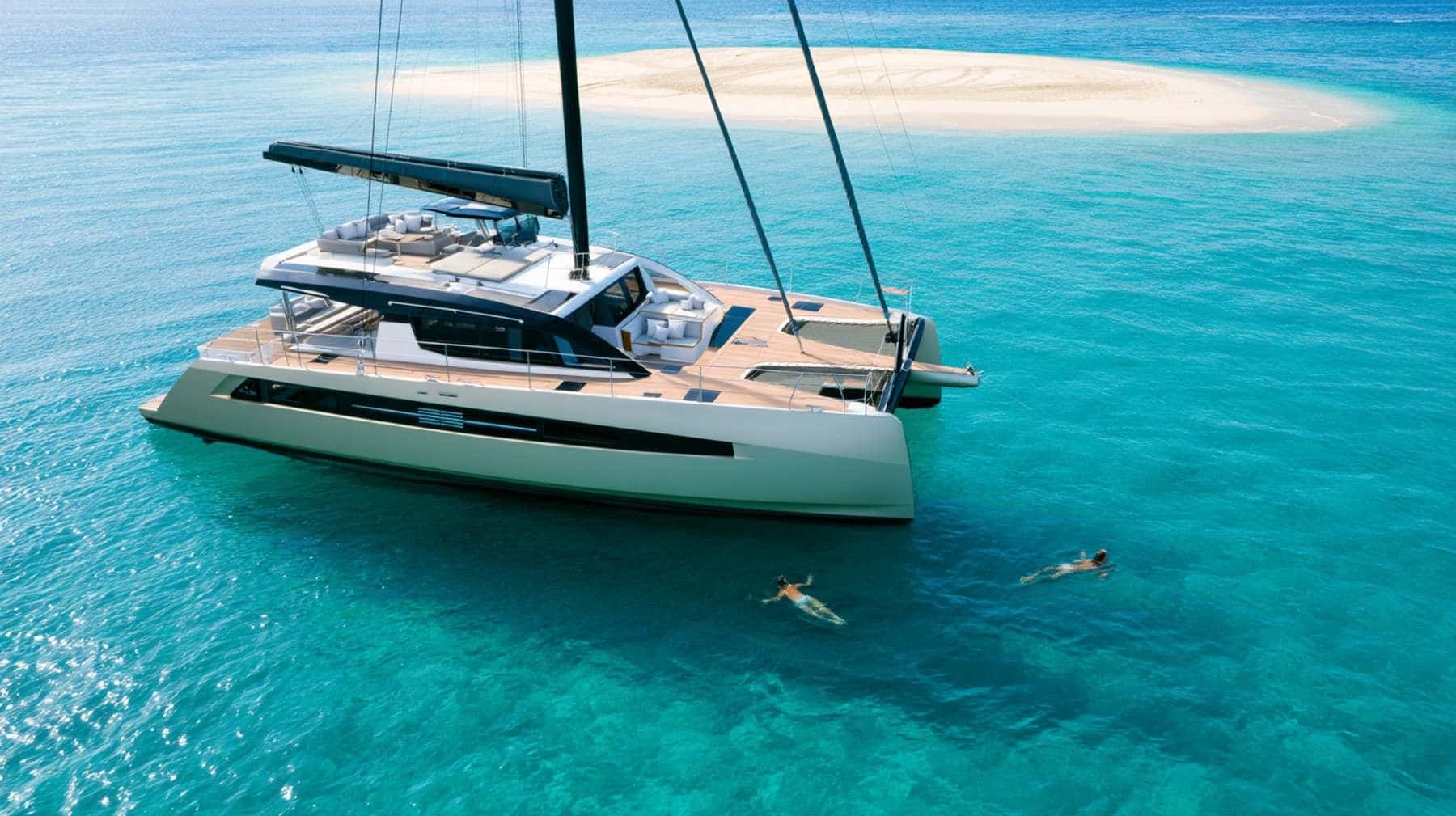
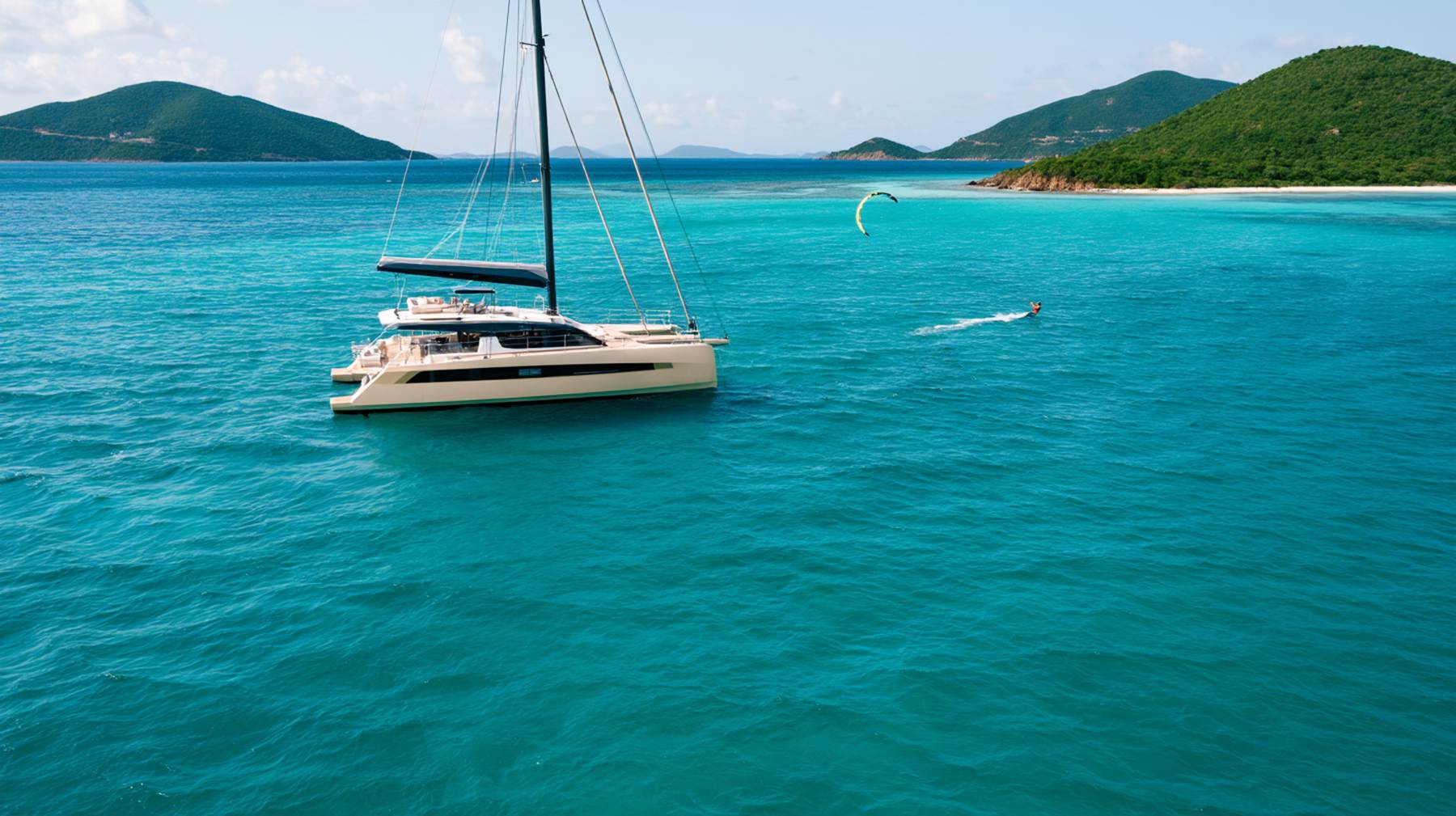
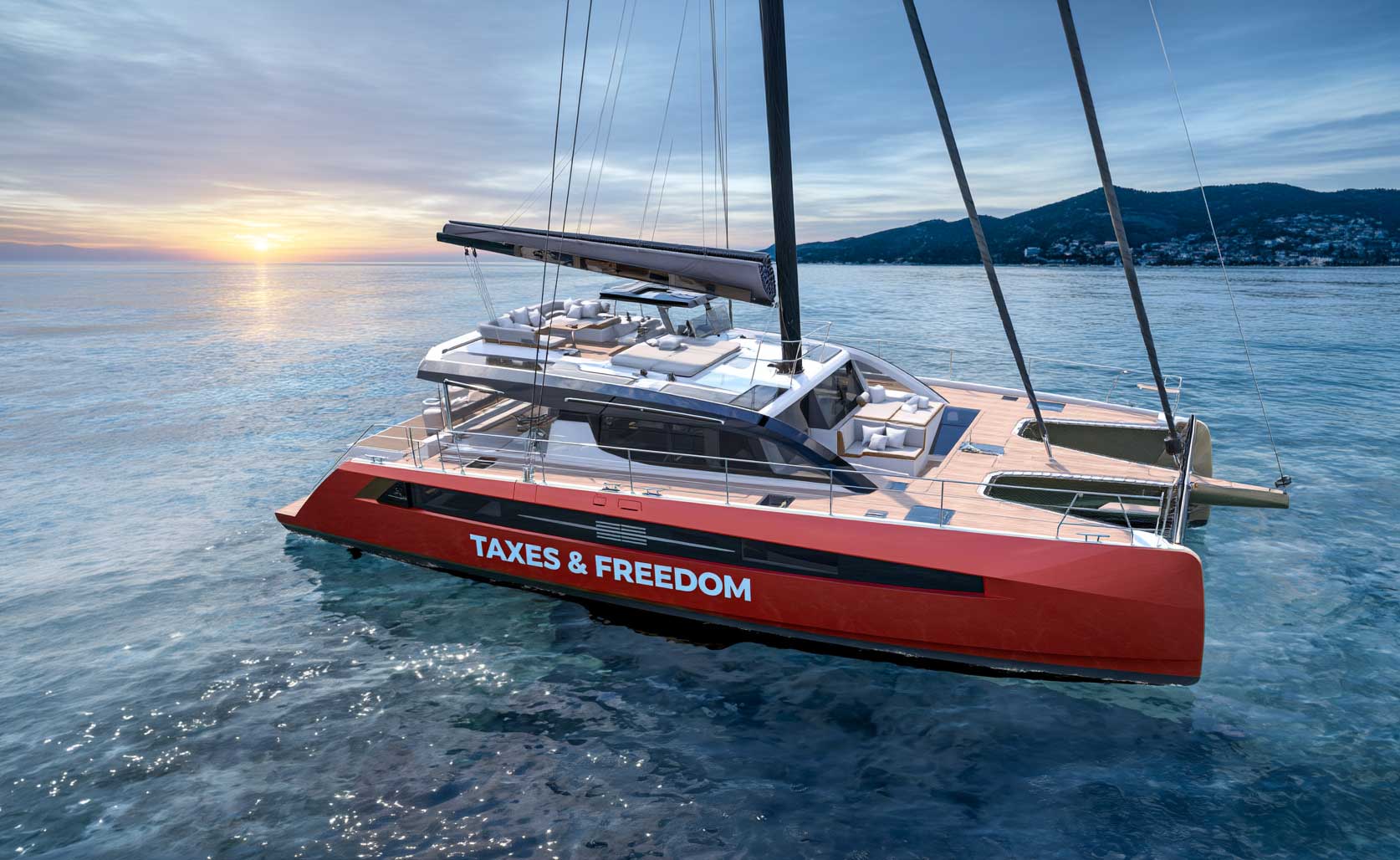
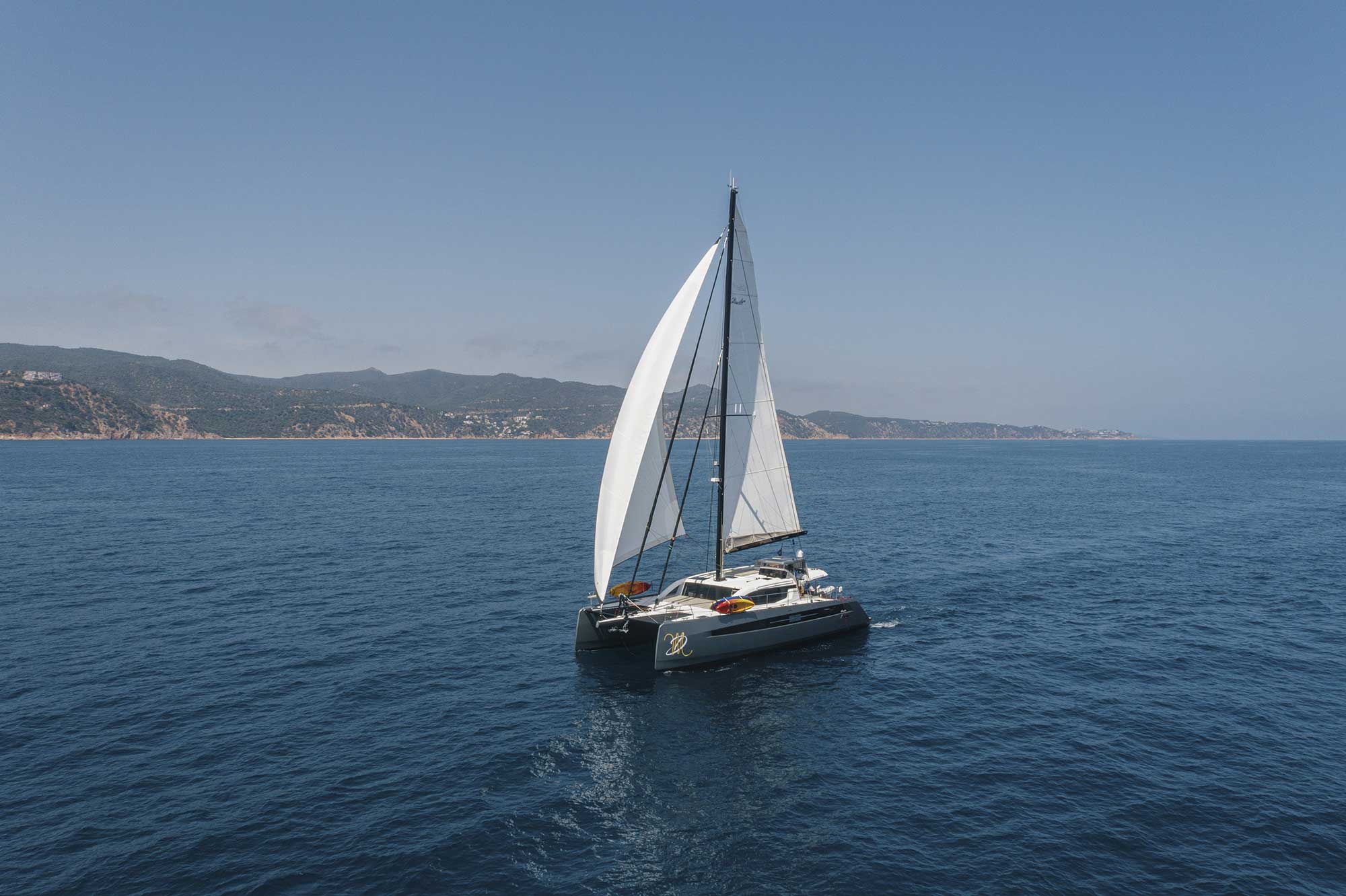
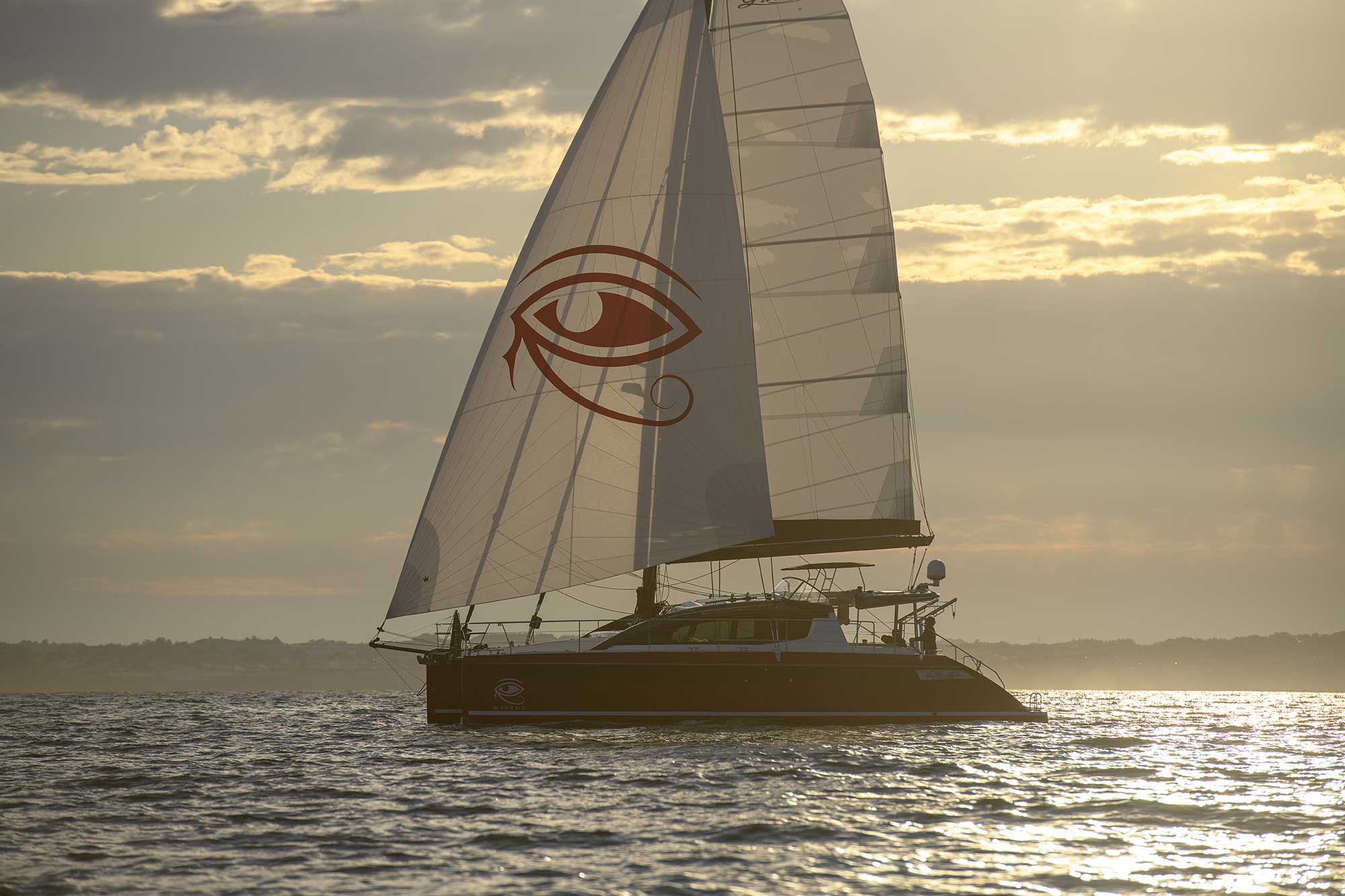
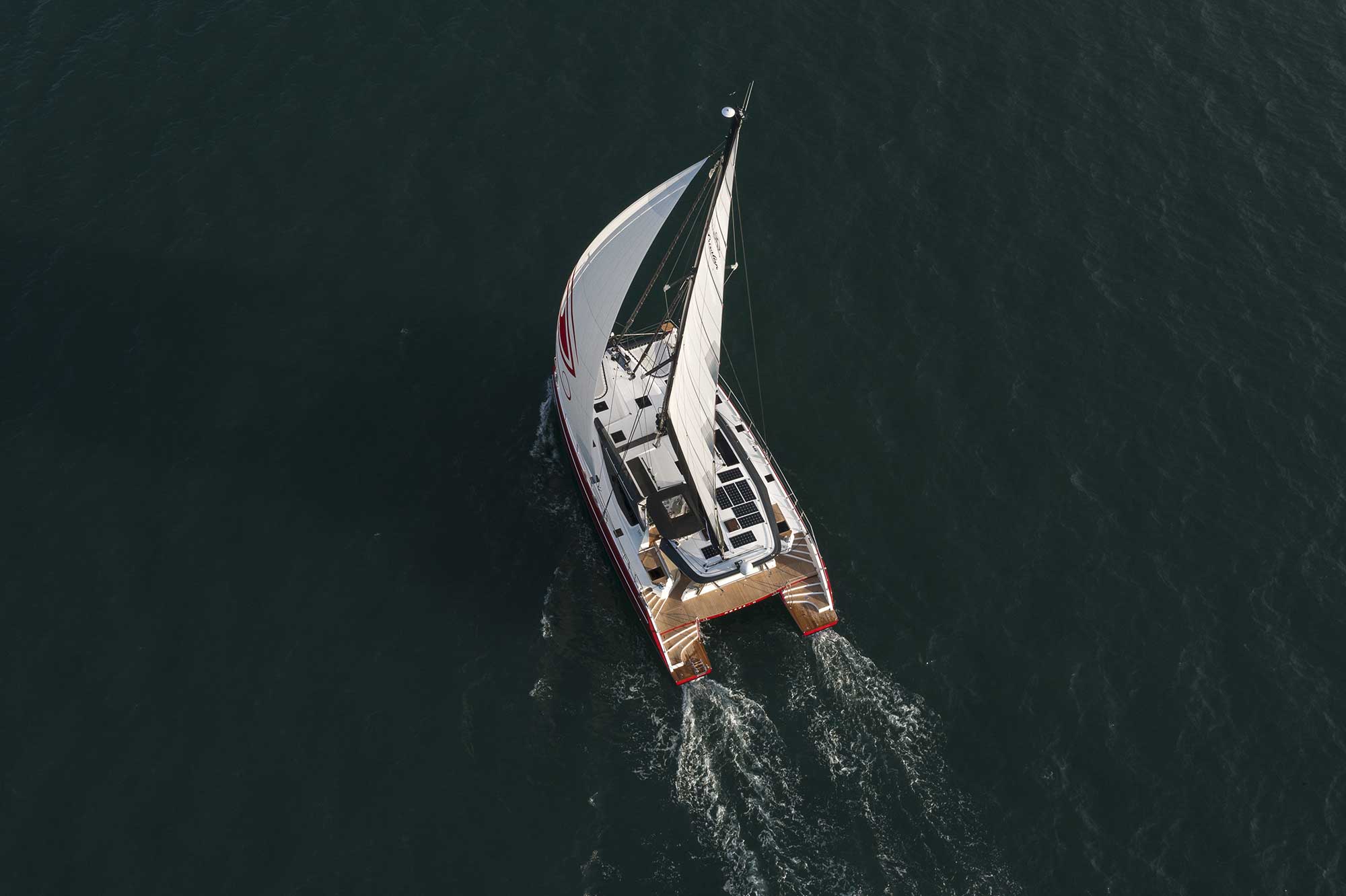
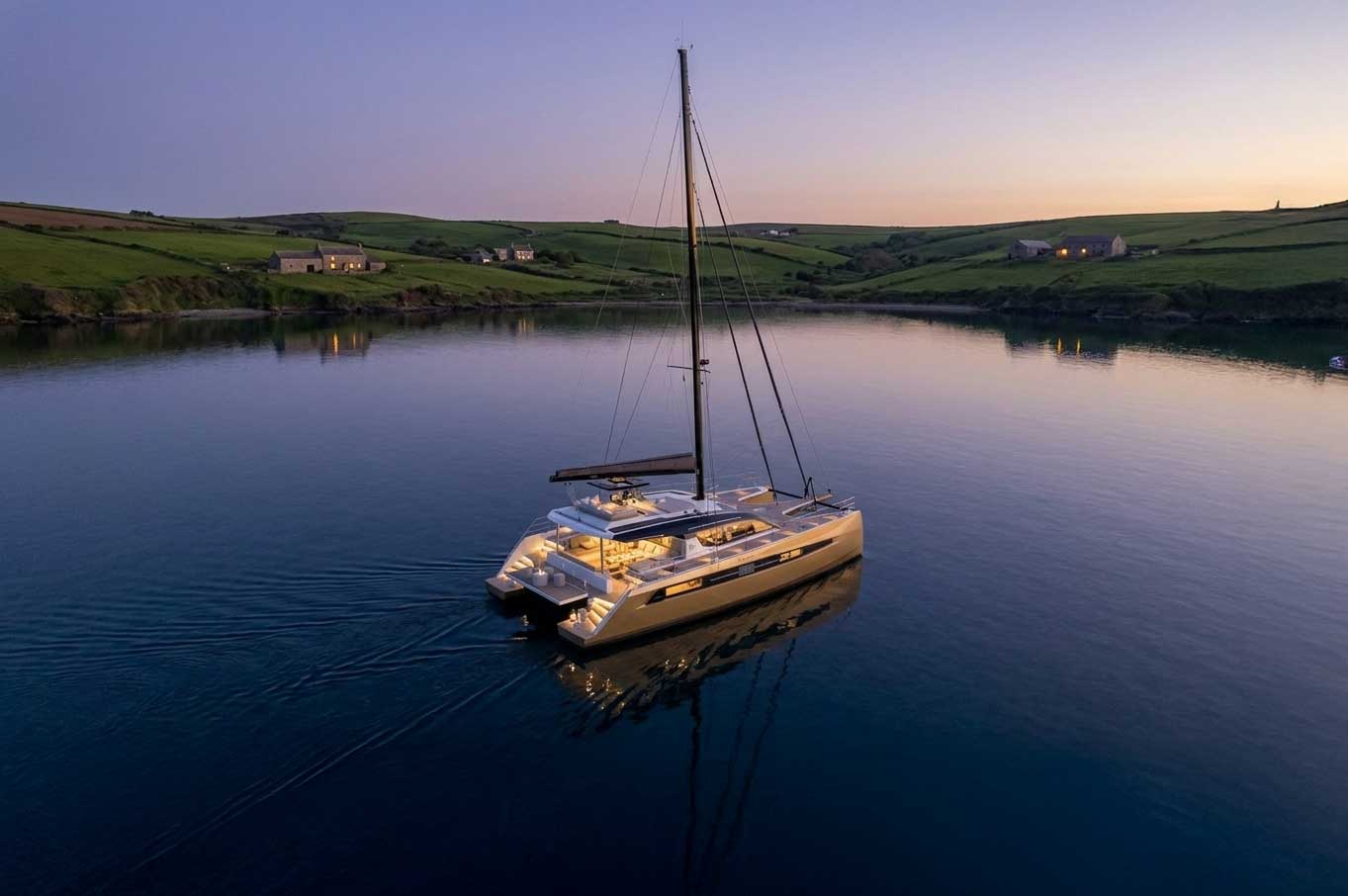
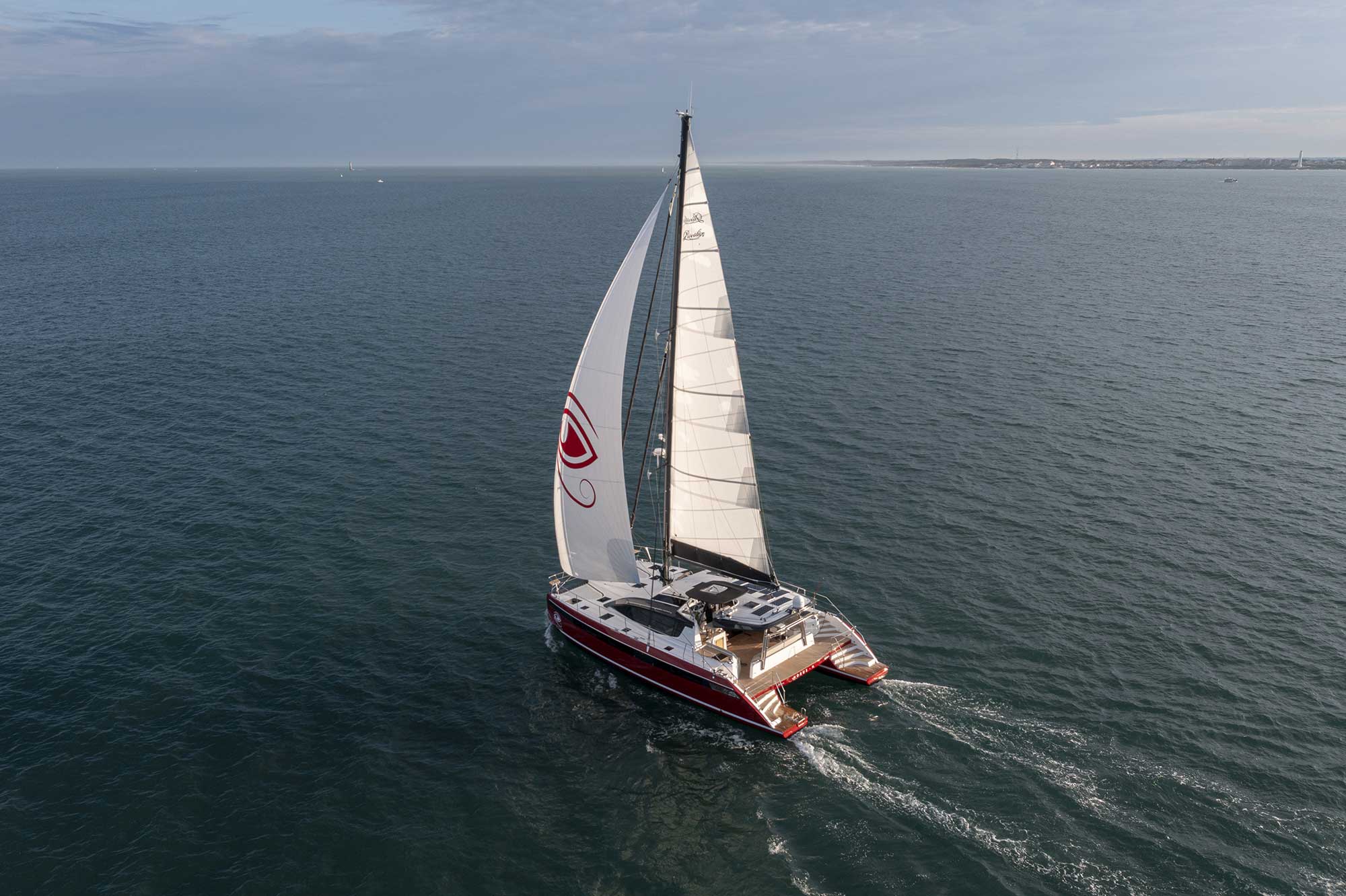
The Privilège P600 brings BVI charter readiness to an ocean-going luxury catamaran, with premium earning potential and a long-term ownership strategy.
The Privilège P600 brings together two ambitions: owning a personalised ocean-going home and operating a premium crewed charter yacht. Its BVI-compliant specification allows owners pursuing British Virgin Islands commercial registration to avoid additional structural alterations or accommodation changes for the agreed operating profile. Individual certification, qualified crew, insurance and operating permissions remain essential.
Privilège Marine’s intended charter positioning is US$40,000–70,000 per week, depending on season, specification, service and experiences. Achieving those rates requires a complete hospitality operation, supported by the yacht’s comfort and craftsmanship. Stronger weekly earnings can help recover the initial investment faster, provided occupancy and operating margins justify the purchase premium.
Long-term value also depends on maintenance, sensible customisation and documented care. Commercial certification can support deployment in other destinations, subject to local authorisation. The opportunity is a carefully managed yacht business built around a vessel that remains desirable for private ownership.
The BVI-ready specification removes a costly conversion stage
At Privilège Marine, we build yachts for ocean passages and extended life aboard. The P600 applies that philosophy to a commercially useful proposition: a luxury sailing catamaran whose agreed BVI-compliant specification accommodates charter requirements from the outset.
For an owner choosing BVI commercial registration, the practical benefit is no additional structural or accommodation conversion within that specification and operating profile. Decisions affecting construction, escape arrangements and interior configuration can be addressed during the build.
This matters because converting a completed private yacht can involve engineering work, disrupted interiors and lost operating time. Integrating the requirements early makes the delivery budget and commissioning schedule more predictable.
The agreement must identify the applicable code, approved layout, passenger capacity and intended operating area. Changes to these parameters can require further assessment.
The commercial certificate turns readiness into permission to operate
The British Virgin Islands maintain a small-commercial-vessel framework covering yachts of this size. Their maritime authority publishes several relevant codes, including MGN 280 and the Caribbean Small Commercial Vessel Code. The applicable certification route must be confirmed for the individual vessel.
Examination addresses matters including stability, watertight integrity, fire protection, lifesaving equipment and safe operation. These requirements protect guests and crew while establishing the conditions under which the yacht may trade.
BVI registration, commercial certification and charter licensing perform different functions. Registration establishes nationality. Certification establishes technical compliance. Local licensing authorises the commercial activity.
An owner must also arrange appropriate insurance, recognised crew qualifications, inspections and applicable permits. Avoiding structural conversion therefore removes one category of expenditure; survey, equipment, licensing and operating costs remain.
The luxury premium comes from the experience guests receive
The P600 has a beam of 9.18 metres, approximately 30 feet, and a draft of 1.85 metres, approximately 6.07 feet. Its tank capacities include 1,000 litres of fuel and 900 litres of freshwater.
These dimensions and capacities provide a substantial platform for living aboard. Commercial success depends on how that platform serves guests.
Privacy, comfortable sleeping arrangements, attractive communal spaces and careful interior craftsmanship shape the experience throughout the week. Crew need equally practical working arrangements: provisioning space, accessible equipment and an efficient service routine.
The Signature 600 also allows the aft port cabin to become a gym, office, cinema or another owner-defined space. For charter use, that choice deserves commercial scrutiny. A distinctive amenity may attract a particular clientele, while retaining the cabin may suit a broader group market.
US$40,000–70,000 per week is the commercial positioning we envisage for suitably specified and professionally operated programmes. Rates will depend on dates, guest numbers, crew, inclusions and the experiences delivered.
A private chef, carefully planned menus, guided marine activities and well-organised shore excursions can strengthen the proposition. Every advertised service must be supported by the appropriate people, equipment and permissions.
The weekly rate needs a credible market position
Premium charter guests purchase a complete holiday. A yacht with limited privacy, ordinary accommodation or insufficient service infrastructure will struggle to sustain the same price as a carefully managed luxury programme.
Other premium builders also operate in this market with pices from €42,000 per Week for smaller units and from US$72,000 for larger boats.
They establish that a substantial luxury-catamaran market exists. They do not establish achieved P600 revenues or guaranteed demand.
The upper end of our proposed range therefore requires a compelling package and a proven booking strategy. Brokers need precise specifications, excellent photography, clear inclusions and confidence in the crew.
Pricing must distinguish the charter fee from taxes, gratuities and any Advance Provisioning Allowance, the deposit used to meet specified voyage expenses. An inclusive package and a fee quoted plus expenses represent different financial propositions.
The investment case rests on net contribution
A higher purchase price can be recovered faster when the yacht generates enough additional operating contribution.
Consider an illustrative season of 12 booked weeks at an average US$50,000. Gross charter receipts would reach US$600,000. This is an arithmetic scenario, rather than a booking forecast.
If those receipts were 20% higher, at US$60,000 per week, the same calendar would produce US$720,000. The additional US$120,000 would improve returns only after allowing for any extra delivery costs.
Brokerage and management commissions, crew, provisioning, insurance, maintenance, berthing and replacement reserves all affect the result. Financing and tax must then be considered.
A useful comparison isolates the purchase premium. If a yacht costs US$500,000 more and produces US$100,000 more annual net operating contribution, the incremental investment has a simple five-year payback before financing, tax and resale differences. Both figures are illustrative assumptions.
The resale advantage must be maintained throughout ownership
Privilège’s approach gives owners a credible basis for protecting value: enduring accommodation, offshore capability, craftsmanship and a recognisable specialist brand.
Our guide to catamaran resale value explains the importance of configuration, maintenance and scarcity.
A commercial yacht must earn its condition premium. Engine hours, service records, rig inspections, interior wear and equipment replacement history influence what a buyer will pay.
A professionally maintained P600 may remain attractive to both private owners and charter operators. That broader usefulness supports the ownership case.
The opportunity extends beyond the British Virgin Islands
BVI commercial certification can provide a useful technical foundation for operating elsewhere. Each destination retains control over local charter permissions, taxation, customs treatment and crew requirements.
The Bahamas, for example, has a Foreign Yacht Charter Licence procedure. Mediterranean deployment likewise requires country-specific assessment before bookings are accepted.
Seasonal relocation can increase access to demand, but passage costs, crew time, insurance conditions and maintenance windows must enter the budget.
The strongest P600 programme connects these decisions from the beginning: specification, certification, guest experience, operating calendar and eventual resale. The result is an ocean-going home with a considered commercial purpose—and an ownership strategy that can evolve with its owner.
Explore how the Privilège 510, 600 and 650 combine ocean-going construction, owner-focused accommodation and three distinct approaches to life aboard.
The Privilège collection offers three approaches to long-distance sailing and life aboard. The Signature 510 concentrates on owner-operated cruising, with a central owner’s suite and accommodation suited to couples travelling with occasional guests. The Signature 600 introduces more space and flexibility, including the possibility of turning a guest cabin into an office, studio or exercise room. The Signature 650 provides a larger residential setting, with arrangements that accommodate professional crew and separate domestic work from guest areas.
Their competitive strengths follow a consistent principle: devote space and engineering to the people who will actually live aboard. Across the luxury sailing catamaran market, buyers can find greater cabin capacity, performance-focused construction or different propulsion technologies. Privilège’s proposition centres on ocean-going capability, personal accommodation and the practical requirements of extended ownership. Choosing between the three models means deciding how much space, operational support and freedom of arrangement a cruising programme requires.
The collection puts residential comfort within an offshore structure
At Privilège Marine, we build bluewater cruising catamarans in Les Sables-d’Olonne. The Signature 510, 600 and 650 share naval architecture by Cabinet Marc Lombard and interiors by Darnet Design. Their purpose combines offshore sailing with the routines of a permanent home.
The construction specifications include infused foam-core structures and laminated structural bulkheads. A sandwich structure separates two laminate skins with a lightweight core, providing stiffness while controlling weight. Bonded connections between structural elements distribute loads through the yacht.
These methods support the offshore brief, although construction terminology alone cannot establish superiority over another builder. The more useful distinction is how structure, accommodation and equipment work together around an owner’s intended use.
Our competitive position rests on that combination: a sailing yacht designed for extended passages, with living spaces that owners can shape around their needs.
The Signature 510 makes owner-operated cruising its priority
The Signature 510 measures 15.24 metres overall (50 feet), with a beam of 7.98 metres (approximately 26 feet 2 inches) and a draught of 1.57 metres (5 feet 2 inches). It is the most compact model in the collection and the natural starting point for couples planning to sail without permanent crew.
Its standard accommodation comprises an owner’s suite and two guest cabins. The owner’s double bed, measuring 1.80 by 2.00 metres, occupies the central pod between the hulls.
This arrangement gives the 510 a clear advantage for buyers who place a high value on their own accommodation. Compared with layouts configured for more guests, it concentrates space on the people spending the most time aboard.
The distinction matters commercially. A couple planning several seasons afloat has different priorities from an operator seeking maximum cabin capacity. Storage, bedroom access and everyday comfort become purchasing criteria in their own right.
The 510’s appeal is therefore residential space at an owner-operated scale. Its suitability still depends on sailing experience, physical capability and equipment choices. Powered sail handling assists the crew; passage planning and sound seamanship remain essential.
The Signature 600 gives owners greater control over their space
The Signature 600, introduced in April 2026, develops the Signature 580 platform. Its evolution concentrates on interior architecture, lighting, materials and the relationship between living areas.
At 19.70 metres overall (approximately 64 feet 8 inches), with a beam of 9.18 metres (30 feet 1 inch), it offers a substantial increase in scale over the 510. Its most distinctive accommodation feature is the adaptable aft port cabin. Owners can configure this space as an office, studio, exercise room or additional storage.
That flexibility has practical value. Someone working remotely may use a separate office daily. A family preparing for extended cruising may prefer organised equipment storage. Either choice can contribute more to life aboard than an additional guest bedroom.
The standard arrangement combines an owner’s suite, three guest cabins and a galley in the saloon. An alternative places the galley below and provides crew accommodation with two guest cabins.
The competitive advantage is personalisation beyond finishes. Many luxury catamarans offer choices of upholstery, timber and cabin arrangements. The 600’s proposition explicitly extends to changing a room’s function.
Within the collection, it suits owners seeking greater separation between activities: sailing, entertaining, working and resting. The additional space also brings larger equipment and more extensive systems to manage.
The Signature 650 creates a private home with room for crew
The Signature 650 measures 21.62 metres overall (approximately 70 feet 11 inches), with a beam of 9.21 metres (30 feet 3 inches). Its central owner’s suite occupies the nacelle and benefits from forward-facing views.
The standard arrangement includes that suite, two guest cabins, crew accommodation and a galley below the main living level. This supports a household travelling with professional assistance while preserving distinct spaces for owners, guests and domestic work.
Against competing layouts that allocate more space to additional cabins, the 650’s advantage is its emphasis on private residential use. A smaller guest complement can make sense when the owners value generous personal accommodation and extended stays aboard.
The galley’s location also changes daily routines. Food preparation can continue separately from conversation, entertaining or quiet time in the saloon.
The 650 consequently addresses a different ownership model from the 510. Crew arrangements, maintenance responsibilities and operating expenditure should form part of the purchasing brief from the outset.
The strongest choice follows the way owners intend to live
The collection offers a progression in use as well as size. The 510 supports couples taking an active role in sailing and maintenance. The 600 provides greater freedom to organise family life. The 650 accommodates a more extensive residential programme with crew.
Across all three, equipment choices require discipline. Batteries, tenders, appliances and additional stores consume carrying capacity. Electrical demand determines how effectively solar generation, storage and a generator can support life aboard.
The decisive question is how each yacht will function during an ordinary month at sea. A well-chosen Privilège gives its owners the accommodation, working space and sailing arrangements that make that month possible.
A yacht’s flag shapes registration, tax exposure, cruising rights, insurance and charter rules. Here is what owners should check before choosing one.
Choosing a yacht flag is a legal and operational decision, not a matter of aesthetics. The flag gives the yacht its nationality and determines which administration regulates its registration, safety requirements, surveys and, in many cases, crewing rules. It can also influence financing, insurance, charter activity and access to certain administrative privileges.
Tax requires a separate analysis. The flag does not determine VAT by itself. In the European Union, a yacht can have Union status while flying a non-EU flag. Conversely, a non-EU yacht may operate under Temporary Admission for up to 18 months if the relevant conditions are met. Owner residence, place of use and ownership structure are often more important than the flag.
Individual and corporate owners also face different questions. A company can simplify financing or succession, but it introduces accounting, beneficial-ownership and tax issues. The correct flag is therefore the one that fits the yacht’s complete ownership and cruising programme.
The first question concerns how the yacht will actually be used
At Privilège Marine, we build bluewater catamarans to cross oceans and to serve as genuine homes for their owners. That makes flag selection particularly important.
A yacht that spends its life between France, Italy and Greece presents a different legal profile from one crossing between Europe, the Caribbean and the United States. A privately used yacht also requires a different structure from one offered occasionally for charter.
Before choosing a yacht flag, define four things: the owner, the cruising area, whether the yacht will generate revenue, and where it will normally be based.
Those answers should drive the registration decision.
The flag gives the yacht its legal nationality
Under the United Nations Convention on the Law of the Sea, ships have the nationality of the state whose flag they are entitled to fly. The flag state exercises jurisdiction over administrative, technical and social matters concerning the vessel.
This has practical consequences.
The flag administration can determine registration requirements, mandatory equipment, survey obligations, radio documentation, skipper qualifications and other operating rules.
Eligibility also differs significantly between registries.
France generally requires at least 50 per cent qualifying EU or EEA ownership, whether directly or through qualifying companies, together with other registration requirements. Malta permits vessels to be owned by qualifying corporate bodies irrespective of nationality, subject in some cases to the appointment of a Maltese resident agent. The Marshall Islands requires yacht ownership through an eligible Marshall Islands entity or a qualified foreign maritime entity.
The first item on any yacht registration checklist is therefore simple: can the proposed owner legally use the flag?
The tax question begins with residence rather than the flag
This is where yacht owners make some of their most expensive mistakes.
Putting a yacht under a foreign flag does not automatically move it outside the tax system of the country where the owner lives or where the boat is used.
France provides a clear example. A French resident who owns or uses a qualifying foreign-flagged recreational vessel can remain liable for the French annual tax on personal maritime craft, known as TAEMUP.
A foreign flag therefore does not make a French-resident owner invisible to French taxation.
Tax residence and flag state are different concepts.
The same principle should guide wealth taxes, benefit-in-kind rules, personal-use taxation, inheritance planning and local cruising taxes. Each must be checked separately.
The EU VAT rules deserve particular attention
The European Commission issued updated guidance on pleasure craft in May 2026. Its position is particularly useful because it corrects a common misconception.
The nationality of the owner and the yacht’s flag generally do not determine whether a vessel has Union customs status or whether VAT has been paid.
A Cayman-, British- or Marshall Islands-flagged yacht can therefore have legitimate EU Union status.
A non-EU flag does not mean “VAT unpaid”.
The opposite is equally important.
A yacht owned by a person established outside the EU can, subject to the conditions, enter the Union under Temporary Admission without paying import VAT and customs duty. For a privately used sea-going yacht, the normal period is 18 months.
For full relief under the standard private-yacht regime, the European Commission states that the boat must be registered outside the EU and owned by a person established outside the EU.
This is one of the situations where flag choice genuinely affects the VAT structure.
An EU resident should therefore be particularly careful. EU guidance states that a boat being used in the Union by an EU resident must usually have Union status.
The ownership structure changes the calculation
The individual owner should start with personal residence
Direct private ownership is often the simplest structure.
The owner should check nationality and residency eligibility for the chosen flag, personal taxation in the country of residence, VAT or customs status, inheritance consequences and local taxes where the yacht will be kept.
Succession should not be ignored. A yacht is a valuable movable asset. Different jurisdictions can treat ownership transfer after death very differently.
The owner should also ask a practical question: will changing residence in five years make the chosen registration difficult to maintain?
A bluewater yacht can remain in service for decades. The ownership structure should survive changes in lifestyle.
The company-owned yacht creates another legal layer
Corporate ownership can make sense. It can facilitate financing, joint ownership, succession planning and sometimes charter operations.
It is not automatically tax-efficient.
A company does not make private use commercial use.
Where a company seeks VAT recovery, tax authorities can examine whether it is carrying on a genuine economic activity. Private use by shareholders or directors may create VAT adjustments, taxable benefits or other consequences depending on the jurisdiction.
The owner must therefore identify the company’s jurisdiction, tax residence, beneficial owner, accounting obligations, VAT position and actual business activity.
Registries increasingly conduct deeper ownership checks. In April 2026, the International Maritime Organization approved new international guidelines aimed at improving due diligence, ownership verification and transparency in ship registration.
Opaque structures are becoming less attractive, not more.
The cruising programme can eliminate otherwise attractive flags
Most cruising rights depend primarily on coastal-state immigration, customs and navigation laws. The flag can nevertheless create practical advantages or restrictions.
The United States, for example, operates a cruising-licence regime for eligible foreign pleasure vessels based partly on reciprocal arrangements. A cruising licence can significantly simplify repeated movements between US ports.
An owner planning several seasons in American waters should check eligibility before selecting a registry.
The same logic applies elsewhere. Ask where the yacht will spend most of its time, whether local cruising permits exist, how often customs clearance is required, and whether a particular flag receives specific treatment.
Choose the flag for the itinerary you will actually sail.
The private-versus-commercial decision can change everything
An owner who says, “I may charter the boat occasionally,” has already introduced a major registration issue.
Private yacht registration and commercial yacht registration are not interchangeable.
Commercial operation can introduce safety coding, inspections, crew qualifications, employment requirements, insurance conditions and local charter licensing.
The differences between flags can be substantial.
Malta’s commercial yacht framework covers yachts from 15 metres (49 ft). Yachts below 24 metres (79 ft) operate under its Small Commercial Yacht Code.
The Marshall Islands standard Commercial Yacht category, by contrast, applies to yachts of 24 metres and above.
For an owner considering a 15 to 21 metre (50 to 70 ft) bluewater catamaran, this distinction is fundamental.
A flag that works perfectly for private cruising may therefore become unsuitable when commercial charter is added later.
For larger commercial yachts, the Maritime Labour Convention and flag-state crewing requirements can add another layer of obligations.
The quality of the registry matters beyond paperwork
The cheapest registry is rarely the smartest criterion.
Owners should examine the reputation of the administration, availability of technical support, survey network, responsiveness during emergencies, mortgage registration system and acceptance by banks and insurers.
Port State Control data can provide one indicator of wider flag performance. In the Paris MoU’s 2025 White List, the Cayman Islands ranked first, France seventh and Luxembourg tenth.
Those rankings primarily concern vessels subject to Port State Control and should not be treated as a league table for private yachts. They nevertheless illustrate how flag administrations develop reputations within the maritime industry.
A serious bank financing a yacht may also want a registry where its mortgage can be properly recorded and enforced. The UK Ship Register, for example, explicitly identifies the ability to register a marine mortgage as an advantage of Part I registration.
Ask the lender before selecting the flag.
The same applies to the insurer.
The technical rules follow the vessel after registration
Registration does not only produce a certificate and a flag for the stern.
Flag administrations may require surveys, tonnage measurement, safety equipment, radio licences, MMSI registration and documentation covering ownership and previous registration.
For yachts built in Europe, another distinction matters.
CE conformity under the EU Recreational Craft Directive concerns the design and manufacture of recreational craft from 2.5 to 24 metres (8.2 to 79 ft). It is separate from vessel registration.
CE certification and flag registration are not the same thing.
An EU-built bluewater catamaran can therefore be CE-certified while being registered under a non-EU flag. Both sets of rules must be respected where applicable.
The owner’s flag-selection checklist should come before delivery
Before deciding on the best flag for a yacht, the owner should be able to answer every question below:
Ownership eligibility: Can an individual owner qualify, or is a company required?
Owner residence: Where is the beneficial owner tax-resident?
VAT and customs: Is the yacht VAT-paid, Union status, exported or using Temporary Admission?
Cruising area: Which countries will the yacht realistically visit during the next five years?
Home base: Where will it spend most of the year?
Private or commercial use: Will any charter revenue be generated?
Local taxation: Are annual yacht taxes, cruising taxes or resident-owner taxes triggered?
Insurance: Has the insurer confirmed acceptance of the proposed flag and cruising area?
Financing: Can the lender register an acceptable marine mortgage?
Administration: What are the survey, radio, crewing, renewal and reporting obligations?
One unanswered question can change the entire structure.
The right flag should survive the complete ownership cycle
A yacht flag should work on the day of delivery, during an Atlantic crossing, after several years in the Mediterranean, during a future resale and, if required, through a change in ownership structure.
That is the real test.
At Privilège Marine, our owners buy boats capable of travelling far beyond their home waters. The administrative structure deserves the same long-term thinking as the yacht itself.
There is no universal “best yacht flag”. There is only a flag that fits a particular owner, tax residence, cruising programme, financing structure and use of the yacht.
The correct flag is a consequence of the plan.
Choosing it before the plan is understood is working backwards.
A practical guide to yacht flags, EU VAT, U.S. import duty and charter rules for Americans cruising the Mediterranean and Caribbean.
For most American owners buying a new Privilège catamaran for private cruising, the strongest default is a U.S. flag with a recreational Certificate of Documentation. It provides clear proof of nationality, supports recognized marine financing and avoids the administrative burden of a foreign ownership company.
The Mediterranean tax strategy must then be addressed separately. A non-European resident may use EU Temporary Admission to cruise in European Union waters for up to 18 months, provided the yacht is registered outside the EU and remains eligible for the regime. Alternatively, the owner can import the yacht permanently and pay EU VAT.
A Cayman Islands, Marshall Islands or British Virgin Islands flag can make sense for commercial charter, international crewing, complex ownership or specific financing arrangements. An EU flag such as Malta is more suitable for a permanently European yacht than for temporary admission.
The correct answer depends on residence, ownership, cruising duration, charter activity and the yacht’s eventual return to the United States.
The flag decision begins with the yacht’s real operating plan
A yacht flag establishes nationality. It determines which maritime administration supervises registration, ownership, safety certification and certain crewing requirements. It can also affect financing, insurance, charter licensing and the legal remedies available to lenders.
The flag does not, by itself, determine where tax is payable.
For an American buying a new Privilège catamaran, five questions come first:
Will the yacht remain strictly private?
Is the owner resident in the United States or Europe?
How long will the yacht remain in the Mediterranean?
Will it carry paying guests?
Will it eventually enter the United States?
These choices should be made before delivery. They may influence the purchasing entity, the delivery location, the export procedure, the insurance contract and, in a commercial project, the yacht’s technical specification.
This is particularly important for a Privilège. These catamarans are designed in Les Sables-d’Olonne as long-range homes at sea. Their systems, storage, autonomy and interior arrangements are developed around each owner’s route, family and operating expectations. The legal structure should follow the same owner-led approach.
The U.S. flag is the strongest default for private cruising
A recreational yacht of at least five net tons can generally qualify for United States Coast Guard documentation when it is wholly owned by an eligible U.S. citizen or qualifying U.S. entity. A yacht built in France can therefore be documented in the United States for recreational use.
The recreational endorsement authorizes pleasure use. It does not authorize ordinary passenger charter operations. It nevertheless provides a nationally recognized title and nationality framework. U.S. documentation can also support the registration of a preferred ship mortgage, which matters when a yacht is financed.
For a private owner cruising between the Mediterranean, the Caribbean and the United States, the principal advantages are clear:
A direct connection with the owner’s home jurisdiction
Familiar documentation for American lenders and advisers
Straightforward proof of nationality abroad
No requirement to maintain a foreign yacht-owning company
Easier administrative continuity when returning to U.S. waters
The ownership structure still requires care. A U.S. corporation must satisfy specific citizenship rules concerning its incorporation, chief executive and board leadership. An LLC should be reviewed against the Coast Guard’s ownership and citizenship requirements before the purchase contract is signed.
The U.S. flag also carries practical restrictions
A French-built yacht cannot normally qualify for a U.S. coastwise endorsement. It therefore cannot simply enter the domestic American passenger trade. This is a major restriction for an owner considering charters between U.S. ports.
The choice of captain also requires attention. U.S. documentation rules can create difficulties when a documented vessel is formally placed under the command of a non-U.S. citizen. An owner intending to employ a permanent European, British, Australian or South African captain should obtain a written crewing opinion before selecting the flag.
For an owner-operated, private Privilège, these restrictions are usually manageable. For a professionally crewed charter yacht, they can change the answer.
The Mediterranean tax question is about customs status
The European Union distinguishes the yacht’s flag from its customs status.
A U.S.-flagged yacht may become a Union-status yacht after lawful importation and payment of VAT. It can then remain in the European Union without the 18-month temporary admission limit.
Conversely, an EU flag does not prove that VAT has been paid. Registration documents and tax documents serve different purposes. European Commission guidance states that the owner’s nationality and the yacht’s flag are generally irrelevant to Union customs status, except where a yacht is using temporary admission.
The export route from France requires precise documentation
A new Privilège is built and delivered in France. France applies a standard VAT rate of 20 percent.
On a yacht valued at €4 million, that represents €800,000. The tax treatment must therefore be designed before the yacht is handed over.
A sale may qualify as a French VAT-free export when the yacht is genuinely exported outside the European Union and the seller retains the required customs evidence. The contract, transfer of risk, delivery protocol, departure itinerary and export declaration must all tell the same story.
An owner should avoid accepting unrestricted delivery in France and then attempting to reconstruct an export transaction afterwards. Sea trials, commissioning, warranty work and owner use must be clearly separated in the documentation.
The temporary admission route suits mobile non-EU owners
A person established outside the European Union may temporarily bring a privately used yacht into EU customs territory without paying import duty or VAT.
The yacht must be registered outside the European Union. It must normally be owned or used by a person established outside the EU. It must leave the customs territory within 18 months.
During that period, the yacht can move between participating EU countries without opening a new temporary admission procedure at every border. A Privilège could therefore cruise from France to Spain, Italy, Greece and Croatia within the same admission period.
The owner should retain:
Registration and ownership documents
Proof of non-EU residence
The original entry record
Marina invoices and fuel receipts
Crew and guest records
Evidence of departure from EU customs territory
A new 18-month period can generally begin after the yacht has genuinely left and later re-entered. European legislation does not establish a universal minimum time outside the EU. Repeated short exits designed only to create artificial compliance may still attract customs scrutiny.
An American citizen living permanently in France, Spain or Italy should not assume that a U.S. passport creates temporary admission eligibility. Residence matters more than citizenship for this purpose.
The permanent import route suits a European home port
An owner intending to keep the yacht in the Mediterranean throughout the year may prefer permanent importation.
Import VAT is generally due in the country where the yacht enters the relevant import procedure. France currently applies 20 percent. Malta applies 18 percent. Italy, Spain, Greece and other countries apply their own standard rates.
The lowest published rate should never be the only reason for choosing an import country. Customs authorities will consider where the import genuinely occurred, where the yacht was released for free circulation and whether the declared transaction had economic substance.
After lawful importation, a non-EU resident can own a Union-status yacht indefinitely. The yacht can retain a U.S. flag. Paying European VAT does not require adopting a European flag.
This is often the cleanest solution for an owner who wants a permanent berth in Palma, Antibes, Porto Cervo or Athens and expects to spend most seasons within the European Union.
The foreign flag earns its cost only when it solves a problem
The Cayman Islands, Marshall Islands and British Virgin Islands are established yacht registries. They are commonly considered when a yacht has international financing, professional management, non-American crew, multiple beneficial owners or a commercial charter programme.
Their value comes from maritime administration and operational flexibility. Their value does not come from making tax disappear.
Operating situation
Most practical starting point
Principal advantage
Principal concern
Private Mediterranean and Caribbean cruising by a U.S. resident
U.S. recreational documentation
Simple ownership and strong home-jurisdiction connection
U.S. crewing and commercial-use restrictions
Private yacht with international captain or complex ownership
Cayman Islands, Marshall Islands or British Virgin Islands
Yacht-focused registry and flexible corporate structuring
Annual administration and U.S. reporting
Permanent EU-based yacht
U.S. or EU flag after permanent importation
Long-term European use without the 18-month limit
Import VAT becomes payable
Commercial Mediterranean or Caribbean charter
Commercial Cayman or Marshall Islands structure, or another approved commercial registry
Purpose-built commercial framework
Coding, manning, VAT and local charter licences
Intended charter between U.S. ports
Specialist U.S. maritime analysis required
Potential access to the U.S. market
A French-built yacht normally lacks coastwise eligibility
The Marshall Islands generally requires ownership through an eligible citizen, national or qualified foreign maritime entity. The British Virgin Islands also applies qualified ownership rules, which often lead an American owner to use a local company. Cayman provides both private and commercial registration pathways.
A foreign ownership company can also create American tax-reporting obligations. Depending on control and ownership, a U.S. person may have to file IRS Form 5471 and disclose foreign financial interests. The basic penalty for failing to file a complete Form 5471 can begin at $10,000, with further penalties for continued failure.
A foreign flag should therefore be selected because it improves the yacht’s operation, financing or commercial structure. A foreign flag does not erase U.S. tax. American citizens remain subject to U.S. taxation on worldwide income.
The Malta flag belongs to a different strategy
Malta offers a respected European registry and a developed commercial-yacht framework. A nonresident owner can register through an appropriate structure and local representative.
Its main limitation for this specific profile is decisive. EU temporary admission requires the yacht to be registered outside the European Union. A Malta-flagged yacht therefore does not fit the standard temporary admission strategy.
Malta is better suited to a yacht that will operate permanently within Europe, particularly when commercial activity and EU compliance are central to the plan.
The charter decision must be made before construction
Private use and commercial charter are different legal activities.
A U.S. recreational endorsement restricts the yacht to pleasure use. Cayman and Marshall Islands structures may offer clearer pathways for switching between private and commercial operation, subject to their respective certification requirements.
The flag still represents only one part of the charter analysis. The yacht may also need:
Commercial safety certification
Stability and load-line documentation
Additional lifesaving and firefighting equipment
Qualified and medically certified crew
Commercial liability insurance
Local charter licences
VAT registration and invoicing procedures
Compliance with local cabotage rules
These requirements can affect the layout, crew accommodation, technical spaces, escape routes, fire protection and operating manuals. Commercial use should be decided before construction. Retrofitting a private yacht for regulated charter after delivery can be expensive and operationally disruptive.
The Caribbean rewards a simple and defensible structure
The Caribbean is a collection of separate customs, immigration and tax jurisdictions. Each national arrival may require clearance, regardless of the yacht’s flag.
For private cruising, a U.S. flag is widely understood and generally practical. The larger tax issue arises when the yacht enters the United States.
A foreign-flagged yacht owned by a U.S. resident can become dutiable when imported into the United States. Sailing yachts have historically been classified at a federal duty rate of approximately 1.5 percent, although the current tariff classification and customs value should always be confirmed before arrival.
A qualifying foreign yacht may receive a U.S. cruising licence for up to one year when its flag state benefits from reciprocal treatment. The licence simplifies port formalities. It does not eliminate arrival reporting, import duty or state use tax.
State taxation must also be reviewed. Florida, for example, caps the sales and use tax imposed on a boat at $18,000 under its current rules. Eligibility, timing and prior tax credits still require a transaction-specific analysis.
The best answer follows the owner’s life at sea
For a U.S.-resident owner buying a new Privilège for private Mediterranean and Caribbean cruising, the most coherent structure will usually be:
U.S. recreational documentation, a properly documented export from France and European temporary admission during Mediterranean seasons.
A permanent Mediterranean owner should consider paying EU import VAT and obtaining Union status. The yacht can still remain under the U.S. flag.
A foreign registry deserves serious consideration when the yacht will employ a non-American captain, operate commercially, use international financing or sit within a multi-owner or estate-planning structure.
Before delivery, the owner should obtain one coordinated written plan covering French export VAT, yacht ownership and registration, EU customs treatment, U.S. import exposure, insurance and intended commercial use. Each element affects the others.
A Privilège is designed to cross oceans and become a genuine home for its owner. Its flag should provide the same qualities as the yacht itself: security, clarity and the freedom to follow the intended route.
Why Privilège catamarans take an early value reset, then resist depreciation through owner layouts, offshore engineering, scarcity and care.
Luxury catamaran depreciation follows two different curves. The first is driven by the loss of the new-yacht premium. The second is driven by configuration, brand, condition and supply. A well-specified Privilège may lose about 20% during its first two years as the market discounts personal options, commissioning costs and the difference between a new build and a pre-owned yacht. After that reset, age becomes less important. Buyers focus on the owner’s layout, private-use history, maintenance records, equipment age and replacement cost. This is where Privilège has structural advantages. The yachts are conceived around their owners, built for long-distance cruising and produced in limited numbers. Public brokerage data checked on July 16, 2026, showed only two used Privilège 510s, one used Signature 580 and no used Signature 650 on YachtWorld. That scarcity supports demand. An 80% residual value remains a market outcome rather than a promise, yet it is credible for the strongest examples when measured correctly.
The First Two Years Create a Market Reset
Every new yacht carries a premium that disappears when the first owner becomes the seller. The market calls this depreciation. A more accurate term is the first-owner reset.
The original invoice includes the right to define the yacht. The owner chooses materials, cabin functions, electronics, sails, energy systems, tender arrangements and hundreds of details. These choices create personal value. The next buyer rarely values every choice at its full cost.
A €100,000 package of upgrades may add only part of that amount to the resale price. Commissioning costs follow the same logic. Delivery, setup, owner training and initial corrections improve the yacht, yet the brokerage market does not reimburse them euro for euro.
A new yacht also offers factory selection, full warranty coverage and the emotional value of first ownership. A two-year-old yacht offers immediate availability and a proven operating record. Those advantages reduce the discount, but they rarely erase the new-build premium.
YATCO places typical first-year yacht depreciation at 10% to 20%. A privately used, well-documented luxury sailing catamaran belongs at the stronger end of the market. A target of roughly 20% cumulative depreciation over the first two years is therefore defensible for a carefully specified Privilège. It remains a benchmark rather than a contractual floor.
The arithmetic is simple. A yacht with an ex-tax market value of €2 million would reset toward €1.6 million at 80%. The next stage depends far less on the calendar. It depends on the individual boat.
The Eighty Percent Figure Needs a Precise Denominator
The phrase 80% residual value often compares different numbers.
Residual value may be measured against the original base price, the final invoice, the original tax-paid price or the current replacement cost. These figures can diverge by hundreds of thousands of euros. Currency movements and changes in standard equipment create further distortions.
The Privilège Signature 580 shows the problem. A published 2020 specification listed a base price of €1.69 million excluding tax. A 2021 Signature 580 was advertised in 2026 at €2.15 million. A later independent test placed the basic price of a new Signature 580 at just under €4 million in 2024.
These figures refer to different specifications and tax positions. They also represent asking prices rather than completed transactions. They still reveal an important truth. A used yacht can retain more than its original nominal base price while representing a much lower percentage of current replacement cost.
The Signature 510 market shows the same variation. A new 2025 Signature 510 was advertised at €2.09 million excluding tax. On July 16, 2026, two used examples were publicly listed at $1.749 million for a 2023 yacht and $1.399 million for a 2022 yacht. Currency, location, specification, tax status and condition prevent a clean percentage comparison.
For serious analysis, 80% should refer to the yacht’s original ex-tax purchase value, with taxes, financing costs and highly personal consumables removed. The yacht must also remain comparable in specification and condition. That definition produces a useful measure of yacht residual value.
The Owner’s Version Sits at the Top of Demand
The strongest driver of catamaran resale value is configuration.
A specialist multihull brokerage ranks a private owner’s version that has never entered bareboat charter at the top of the demand hierarchy. Its analysis estimates that an owner layout can command $40,000 to $80,000 more than a charter-layout sister of the same age.
The premium comes from utility. Private buyers want privacy, storage, circulation and long-term comfort. They do not want the maximum number of revenue-producing cabins. A dedicated owner’s suite often replaces two smaller cabins and compact bathrooms. The lost berths create value for the person who lives aboard.
Privilège has built its identity around this logic. The Signature 510 places a full-beam owner’s suite forward in the nacelle. The yacht can be configured with three or four cabins. Its storage and protected helm are designed for extended private cruising.
The Signature 600 develops the principle further. Its aft port cabin can become an office, cinema, gym, studio, dressing room or additional storage space. This protects resale because the yacht remains centred on owner use.
A mass-market four-cabin layout faces a harder resale equation. Every fleet phase-out adds similar boats to the market. An owner-specified Privilège competes with a much smaller pool.
The Charter Pipeline Repeats the Same Price Pressure
A bareboat charter yacht works harder and enters a predictable resale channel.
Sail Magazine has estimated that a catamaran leaving charter after four to five years may have depreciated by about 40%. The same analysis cited annual engine use of roughly 800 to 1,000 hours for some charter cats, against about 100 to 400 hours for a private yacht.
Charter maintenance can be professional and documented. The market still prices use, cabin layout and future supply. Four-cabin, four-head models compete against newer fleet releases every season. This creates recurring inventory pressure.
The private yacht follows a different pattern. Its interior usually reflects one owner’s habits. Its use history is easier to understand. Buyers still require a survey, yet they begin with a stronger assumption.
Privilège yachts are conceived as private bluewater catamarans and floating homes. Their resale market therefore avoids much of the structural oversupply that affects ex-charter catamarans.
The Brand Converts Confidence Into Liquidity
Resale value depends on price and time. A yacht that takes two years to sell has weaker liquidity than a yacht that finds a credible buyer in six months.
Brand recognition reduces uncertainty. A buyer can research the model, speak with specialists, obtain technical history and compare other examples. An unknown one-off demands more work. The seller pays through a lower offer or a longer sales period.
This is brand liquidity.
Privilège has built ocean-going catamarans in Les Sables-d’Olonne since 1985. Its current partner page lists at least 13 specialist organisations across Europe, the United States, the United Arab Emirates, Tahiti and Scandinavia.
That network supports technical interpretation and after-sales confidence. It also helps older yachts remain legible to the market. A buyer understands that the name refers to a continuing shipyard, a defined design philosophy and a community of technical knowledge.
The Condition Becomes the Balance Sheet
Depreciation slows with age. Deferred maintenance then becomes the decisive discount.
On a young yacht, buyers ask how old it is. On an older yacht, they ask what has been replaced. The survey becomes a balance sheet. Engines, saildrives, standing rigging, sails, generator, batteries, watermaker, air-conditioning, pumps, electronics and teak are assessed separately.
A large maintenance backlog can remove more value in one survey than several years of normal ageing. The discount includes the repair cost, the uncertainty margin and the buyer’s time.
A yacht with invoices, oil analysis, rig inspection reports and recent replacements can outperform its age. A 2009 Privilège 615 currently marketed in the United States highlights a substantial 2020 refit and new Yanmar engines. Its seller presents maintenance quality as the central value argument.
The 2022 Privilège 510 Sisu provides a younger example. Its listing describes professional management, upgraded standing rigging, a premium sail inventory, six electric Harken winches and about 2.8 kW of solar generation. The winch upgrade alone is stated at about €60,000.
This equipment does not recover its full invoice value. It reduces the buyer’s future expenditure and uncertainty. That difference protects the sale price.
The Offshore Platform Preserves Long-Term Utility
A boat holds value when its original purpose remains useful.
Privilège builds bluewater luxury catamarans for ocean passages and extended life aboard. The Signature 510 carries CE Category A certification for 12 people. It has a light displacement of 16.8 tonnes (37,000 lb) and a full-load displacement of 22.8 tonnes (50,700 lb).
The Signature 600 is listed at 29 tonnes (63,934 lb) empty and 35 tonnes (77,162 lb) fully loaded. The Signature 650 reaches 37 tonnes (81,600 lb) at full load.
These figures describe substantial offshore platforms. They also explain why a Privilège can remain relevant after fashion changes. The yacht offers secure circulation, protected helm positions, large tankage, storage, private accommodation and the capacity to carry cruising equipment.
This enduring structural utility matters more than a fashionable finish. Upholstery can be changed. Electronics can be upgraded. The core naval architecture and load-carrying capacity are far harder to reproduce.
Rising replacement cost reinforces this effect. Materials, skilled labour, equipment and compliance costs have increased. A current new build may cost far more than a comparable yacht did five years earlier. The used yacht gains a price umbrella, especially when delivery slots are limited.
The Scarcity Supports Price Without Creating a Guarantee
Scarcity works when demand remains active.
YachtWorld showed 1,894 used sailing catamarans on July 16, 2026. A separate brand search showed about 20 used Privilège sailing catamarans across all ages and models. That is close to 1% of the platform’s used sailing-catamaran inventory.
The Signature series was rarer still. The platform displayed two used Privilège 510s, one used 580 Signature and no used Signature 650. Most Signature listings were new yachts or future delivery positions.
This creates a genuine scarcity premium. Buyers searching for a used Privilège catamaran have few recent alternatives. A strong example can therefore resist broad market averages.
Scarcity alone cannot rescue a poor boat. An unrealistic price, weak documentation or major deferred work will still stop a sale. Rarity increases leverage only when the yacht is credible.
The Resale Strategy Begins With the Original Specification
Owners protect value before delivery.
The strongest specification supports private long-distance use. It avoids highly personal choices that narrow the future audience. It invests in equipment that serious cruisers understand.
A practical resale specification includes an owner-focused layout, robust energy generation, sensible battery capacity, reliable water production, protected watchkeeping, practical sail handling, accessible machinery and generous storage. Buyers also reward recognised equipment brands and installations that can be serviced globally.
Documentation should begin on day one. Every service invoice, software update, oil change, rig inspection and equipment replacement should remain in one digital file. Engine and generator hours should be tracked.
Cosmetic care matters because it signals deeper care. Clean bilges, dry lockers, intact sealant, protected joinery and orderly wiring make the yacht easier to trust.
The strongest principle is simple: resale starts at specification.
The Market Rewards Boats That Remain Coherent
A Privilège can lose about 20% during its first two years because the market removes the premium attached to newness, factory choice and personal commissioning. The curve then changes.
Configuration moves to the front. Brand recognition reduces transaction risk. Condition determines the refit budget. Offshore capability preserves utility. Scarcity limits direct competition. Rising replacement cost supports the ceiling.
This combination explains why strong Privilège examples can retain around 80% of their original value after the initial reset. The result depends on the denominator, the specification, the ownership history and the survey. Public asking prices provide evidence of positioning. Completed private transactions determine the final truth.
A yacht retains value when the second owner can understand it, trust it and use it without rebuilding its purpose. Privilège begins with that purpose: a safe ocean-going catamaran that also works as a real home. The resale market recognises the difference.
Choosing a yacht flag early prevents costly changes to a new catamaran’s certification, ownership, financing, crewing and delivery.
A yacht’s flag is not decorative. It determines the vessel’s nationality and places it under the authority of a flag state. For a new-build catamaran, that decision can affect ownership eligibility, private or commercial use, safety equipment, surveys, crew qualifications, radio licensing, financing and resale. It does not, by itself, determine VAT status or grant an automatic right to cruise indefinitely in another customs territory. The correct time to begin is before the build contract is signed. The intended use and likely registry should then be confirmed before the technical specification is frozen. At Privilège Marine, the flag discussion belongs beside the ownership structure, cruising programme and delivery plan. Waiting until launch can force equipment changes, delay registration and complicate insurance or mortgage documents. A strong registry is not simply inexpensive. It must be legally suitable, operationally credible and responsive throughout ownership.
The Flag Is the Yacht’s Legal Nationality
Under international law, a vessel has the nationality of the state whose flag it flies. That state must exercise jurisdiction and control over administrative, technical and social matters. The flag administration therefore becomes one of the yacht’s permanent authorities.
It may set registration conditions, approve surveys, issue certificates and regulate radio licensing. It may also define requirements for commercially operated yachts, professional crew and safety equipment.
This is why choosing a yacht flag is different from selecting an attractive home port. The flag creates a legal operating framework.
For a Privilège catamaran intended for bluewater cruising, several reputable registers may be possible. The correct choice depends on the owner, ownership entity, financing, cruising grounds and future use. There is no universally best yacht flag.
The Decision Must Begin Before the Contract
The flag should be considered before the build contract is finalised. At that stage, the owner should define who will legally own the yacht and whether it will be used privately or offered for charter.
Some registers accept direct ownership only from specified nationalities. Others permit qualifying companies or require a local representative. A lender may prefer a registry in which a maritime mortgage can be recorded clearly.
Several major registries permit registration during construction. The Cayman Islands allows a vessel and related mortgage to be registered once the keel is laid. The Republic of the Marshall Islands can issue a construction certificate during the build. This can matter when staged payments are financed.
Ownership, finance and flag must be designed together. Changing the owner entity late can affect contracts, insurance and delivery documents.
The Private-or-Commercial Question Changes the Build
The most consequential question is whether the yacht will remain private.
Private use generally means that the yacht is used for the owner’s pleasure and does not carry guests for payment. Once it is chartered or used for reward, another regulatory regime may apply.
For yachts below 24 metres (78.7 feet), commercial codes can require additional lifesaving equipment, fire protection, alarms, surveys and crew certification. The United Kingdom’s Sport or Pleasure Vessel Code applies to commercial vessels below 24 metres carrying no more than 12 passengers. Malta also applies a Small Commercial Yacht Code below 24 metres.
These are not post-delivery paperwork differences. Equipment locations, escape routes, fire systems and accommodation standards may need review during design.
An owner who may charter later is not describing a minor possibility. Future charter use should be engineered from the start.
The Flag Does Not Decide VAT by Itself
A common mistake is to treat a non-European flag as a VAT solution. It is not.
VAT and customs status depend on the owner’s residence, ownership structure, delivery location, importation and actual use. The flag may be relevant evidence, but it is not the sole test.
The European Union’s temporary admission procedure can, subject to conditions, allow a non-Union pleasure craft to circulate within the EU customs territory for up to 18 months. That benefit is not automatic merely because the yacht flies a non-EU flag.
An EU flag also does not prove that EU VAT has been paid. Owners should retain purchase invoices, import documents and evidence of Union status where applicable.
Flag registration and tax status are separate files. They should be coordinated before delivery.
The Technical Specification Must Match the Registry
A recreational catamaran between 2.5 and 24 metres (8.2 and 78.7 feet) placed on the European market generally falls within the scope of the European Recreational Craft Directive. CE compliance and flag compliance are related but distinct.
The CE mark addresses European product requirements. The flag state determines registration and operational obligations. Commercial operation may add coding and survey requirements.
Before the specification is frozen, the owner, shipyard and adviser should confirm the navigation area, maximum number of people aboard, private or commercial status, lifesaving appliances, fire equipment and radio installation.
This is also the moment to decide whether classification is required by the flag, lender or insurer. Classification is not the same as registration. A classification society may review construction against its rules and act for the flag during certain surveys.
The Final Months Are for Execution, Not Strategy
Several months before delivery, the registration application should be active. The yacht’s name may need to be reserved. Ownership records, proof of title and financing documents must be assembled.
The builder’s certificate is central to new-build yacht registration. A tonnage measurement may also be required. The United Kingdom’s Part I process, for example, requires evidence of title and a tonnage survey.
The flag also affects the ship station licence, call sign and Maritime Mobile Service Identity. An MMSI contains a three-digit code linked to the issuing administration. If the yacht changes flag, the MMSI must change. AIS equipment, radios and emergency beacons may therefore need reprogramming.
Do not commission communications equipment under a temporary assumption.
Before handover, the owner should have the certificate of registry or provisional certificate, radio licence, insurance confirmation, ownership evidence, CE documentation and any required commercial certificates.
The New-Build Flag Checklist
The intended use: Will the catamaran be used for private cruising, charter, corporate hospitality or a future combination?
The legal owner: Will ownership be personal, corporate or financed, and is that owner eligible for the selected registry?
The cruising plan: Where will the yacht operate, enter customs territory and potentially conduct charter activity?
The tax position: Where will delivery occur, and how will VAT or importation be documented?
The technical regime: Does the flag require additional surveys, commercial coding, classification or safety equipment?
The crew model: Will the yacht be owner-operated or professionally crewed, and which qualifications will the flag accept?
The lender and insurer: Can a mortgage be recorded, and do both parties accept the flag and cruising programme?
The registry service: Does the administration provide efficient technical support, provisional registration and document processing?
The radio identity: When will the call sign, MMSI, EPIRB registration and AIS data be issued?
The exit plan: Can the yacht be sold, deleted, refinanced or converted to commercial use without unnecessary friction?
The Best Flag Is the One That Fits the Yacht’s Real Life
The wrong flag is rarely wrong because of its colour or reputation. It is wrong because it was selected for one attractive feature while ignoring the yacht’s operation.
A low registration fee cannot compensate for unsuitable ownership rules. A prestigious register cannot rescue a yacht designed as private when its owner later expects charter activity. A tax assumption cannot replace customs advice.
At Privilège Marine, the sensible sequence is direct. Define the owner, use, cruising programme and financing first. Shortlist the appropriate flags next. Confirm the technical consequences before design freeze. Complete registration, radio and insurance work before handover.
The flag at the stern may occupy less than one square metre (10.8 square feet). Its consequences extend through the yacht’s entire working life.
Series production sells a proven specification. Privilège owner-first construction shapes an offshore catamaran around the people who will live aboard.
The difference between a series-production catamaran and an owner-first yacht is not simply the number of options on a price list. It is the order in which decisions are made. Series production begins with factory efficiency, repeatable layouts and a specification designed for a broad market. The owner then selects from what the production system can accommodate. Owner-first construction reverses that sequence. It starts with the owner’s cruising program, privacy needs, crew structure and autonomy requirements, while retaining proven naval architecture. At Privilège Marine, that distinction appears in the full-beam owner’s suite, meaningful interior flexibility, offshore engineering and an after-sales relationship that continues beyond delivery. Series production has legitimate advantages, including speed, familiarity and cost control. But an owner planning years of bluewater cruising is not buying only a platform. The owner is commissioning a long-term operating environment.
The Series-Production Model Is Built Around Repetition
Series production is not inherently inferior. It is an efficient answer to a clear market need. A production catamaran builder reduces variation, repeats manufacturing processes and uses common layouts, joinery modules, wiring plans and option packages across many hulls.
That model improves predictability. It can shorten delivery times, simplify staff training and make parts easier to identify. It also suits owners seeking a familiar layout, controlled pricing or a yacht intended partly for charter.
The compromise is equally clear. The production system defines the limits of the yacht. Layout changes disrupt workflow. Bespoke cabinetry affects drawings and weight estimates. Unusual equipment can alter electrical loads, ventilation and commissioning.
This is why many production ranges offer an “owner’s version” and a “charter version.” The difference often concerns cabin count. One hull becomes a larger private area, while the platform remains largely fixed. That is personalization, but it is not owner-first construction.
The Owner-First Model Begins With the Cruising Program
Privilège Marine works from a proven range rather than designing every yacht from a blank sheet. Repeatable naval architecture, validated structures and established engineering reduce technical risk.
But the first question is different: What must this yacht allow its owner to do?
A couple preparing for a circumnavigation may require extensive stores, redundant communications and easy machinery access. A family may prioritize separate living zones, school space and privacy. An owner using professional crew may need different circulation between service and private areas.
Those choices influence refrigeration, battery capacity, solar generation, water production, ventilation, furniture, technical access and weight distribution. Personalization therefore involves design and engineering, not merely decoration.
Privilège states a typical delivery horizon of about 12 to 18 months, depending on the model and degree of personalization. That timetable reflects limited-production construction to order. The yacht is not treated as stock.
The Owner’s Suite Reveals the Yacht’s Real Priority
The clearest architectural difference is often found in the most private space aboard.
On many catamarans, the owner’s cabin occupies one hull. It can be comfortable, but its proportions remain governed by hull width and a platform designed to support several cabin configurations.
Privilège takes a more structural approach. The Signature 510 uses the forward central nacelle to create a full-beam owner’s suite. The owner is not given a slightly larger cabin inside a guest-oriented plan. The private suite becomes part of the yacht’s architecture.
The Signature 510 is 17.09 meters (56 feet) long and 7.98 meters (26 feet) wide. Its central suite uses that beam to create panoramic views, lateral volume and separation from guest accommodation.
This is the point often missed in comparisons between a production catamaran and a semi-custom catamaran. Usable privacy matters more than nominal cabin count.
The Personalization Must Remain Technically Coherent
Owner-first construction does not mean accepting every request. A serious custom catamaran builder must sometimes say no.
Every appliance consumes power. Larger battery banks add weight. Additional refrigeration creates heat. New furniture can obstruct wiring, plumbing or structural access. Heavy equipment can alter trim and motion.
The shipyard’s role is not to accumulate options. It is to translate a lifestyle into a coherent vessel.
The Signature 600 illustrates this approach through its aft portside cabin. Instead of fixing the space as another guest cabin, Privilège can configure it as an office, gym, cinema, studio, enlarged wardrobe or additional storage area.
The surrounding platform remains controlled. The Signature 600 measures 18.28 meters (60 feet), carries 259 square meters (2,787 square feet) of sail and displaces 35 tonnes (77,162 pounds) at full load. Freedom remains subject to balance, access and reliability.
The Offshore Capability Appears in the Numbers
The phrase “bluewater cruising catamaran” should describe measurable design intent.
The Signature 510 carries 800 liters (211 US gallons) of fuel and 600 liters (158 US gallons) of fresh water. It has a full-load displacement of 22.8 tonnes (50,700 pounds), twin 80-horsepower diesel engines and CE A-12 certification.
The Signature 600 carries 970 liters (256 US gallons) of fuel and 900 liters (237 US gallons) of fresh water. These figures matter because offshore autonomy depends on capacity, access, reliability and load-carrying margin.
European Category A is intended for extended voyages in conditions that may exceed Beaufort Force 8 and significant wave heights of 4 meters (13 feet), excluding abnormal conditions. Certification is not a guarantee against extreme weather. It is a technical baseline.
A series yacht can also be ocean-capable. The honest distinction is that owner-first construction allocates more decisions to the intended voyage, rather than to the broadest possible market.
The After-Sales Philosophy Extends the Build
The difference continues after handover.
In a conventional sales model, support may move progressively from the shipyard to dealers, equipment suppliers and local contractors. That structure can work well when many identical boats create broad technical familiarity.
Privilège treats catamaran after-sales service as part of the ownership product. Owners remain connected through dedicated contacts and WhatsApp assistance groups. The after-sales manager can coordinate the shipyard, captains, marinas, subcontractors and manufacturers. When an important issue requires builder knowledge, a technician can travel to the yacht.
This matters because personalized yachts contain decisions that may not be obvious to an unrelated technician. The builder retains the design history and reasoning behind installations. Continuity reduces diagnostic uncertainty.
Feedback also returns to production. Recurrent failures, difficult access points or supplier weaknesses can be corrected in future yachts.
The Better Choice Depends on Who Should Adapt
A series-production catamaran is often the rational choice for an owner who values quicker availability, established specifications, broad familiarity and disciplined pricing. There is no virtue in paying for customization that will not be used.
Owner-first construction becomes relevant when the yacht will serve as a home, offshore sailing platform and private environment for years. In that case, compromises made for factory repetition can become daily irritations. Poor storage, unsuitable circulation or insufficient technical capacity do not remain small details after several ocean passages.
The divide is straightforward. In series production, the owner adapts to a carefully defined product. At Privilège Marine, a proven offshore platform is adapted, within sound technical limits, to the owner.
That does not mean every yacht should be bespoke. It means serious long-range ownership demands a different order of priorities. The boat must begin with the life it will carry.
A premium yacht offers choice. A bespoke Privilège is shaped around its owner, creating a rare bluewater home with lasting personal and market value.
The luxury yacht market often uses “premium”, “custom” and “bespoke” as if they described the same thing. They do not. A premium yacht usually offers a high standard of design, equipment and finish, supported by a structured options list. A bespoke yacht begins with the owner’s life. It asks how the yacht will be sailed, who will live aboard, where it will travel and what must work every day. Layout, materials, energy, water, navigation systems, storage and service are then considered as one coherent project. At Privilège Marine, this dialogue takes place within proven bluewater platforms designed for ocean passages. The result is not a decorative variation of a standard boat. It is a personal home at sea, built in France around a particular owner and a particular programme. No two Privilège yachts are alike. That rarity has meaning because it is rooted in use, engineering and craftsmanship rather than fashion alone.
The Premium Product Offers Choice Within a Finished Idea
A premium yacht can be exceptionally well designed. It may use fine materials, respected equipment brands and advanced manufacturing methods. It may also offer several cabin plans, timber finishes, upholstery collections and electronics packages. The owner receives meaningful choice.
The central idea, however, has already been settled. The shipyard has defined the circulation, principal volumes, technical architecture and intended pattern of use. The buyer enters that system and selects the version that comes closest to his needs.
This approach has clear industrial advantages. It simplifies engineering, certification and production. It can also protect quality because the same solutions are repeated, tested and refined across a series.
The limit appears when the yacht becomes a long-term residence rather than a leisure product.
A family preparing for a circumnavigation does not have the same priorities as an owner cruising the Mediterranean with professional crew. A couple living aboard for six months each year needs different storage, refrigeration, energy generation and working space from an owner using the yacht for short holidays.
The difference becomes even clearer when personal activities enter the equation. An owner who dives regularly needs compressors, bottle storage, equipment-drying areas and safe access to the water. A remote-working entrepreneur needs reliable communications, a proper office and enough electrical autonomy to operate far from a marina. A keen cook may value a larger galley and additional refrigeration more than another guest cabin.
A premium product asks which available version the owner prefers. A bespoke yacht asks what the owner’s life requires.
The Bespoke Yacht Starts With the Owner Rather Than the Catalogue
Bespoke does not mean changing everything without restraint. Naval architecture is governed by weight, balance, structure, stability, access, ventilation, safety and certification. A responsible shipyard protects those fundamentals.
True bespoke work combines freedom with discipline. The hull platform, structural engineering and offshore purpose may be proven, while the yacht’s internal organisation, technical configuration and visual character are developed around the owner.
This is more serious than selecting decorative options from a catalogue. It is also different from the fully custom superyacht model, where the naval platform may be created from a blank sheet. In the world of bluewater sailing catamarans, a proven platform is an asset. It allows the owner to benefit from established naval architecture while shaping the elements that determine life aboard.
At Privilège Marine, every project begins with owner dialogue.
Will the yacht be sailed by a couple, a family or a permanent crew? Will it cross the Atlantic, remain in the Caribbean, spend several months in the Mediterranean or undertake a circumnavigation? How many guests will stay for several weeks rather than several nights? Does the owner cook personally? Is a separate crew route required? Will the yacht carry diving equipment, bicycles, spare sails, tools or specialist medical supplies?
These questions shape the brief. They also expose contradictions.
An owner may request more cabins, larger domestic appliances, additional batteries, a gym and extensive equipment storage while also expecting low displacement and strong sailing performance. Every addition has a cost in weight, volume, complexity, energy consumption or maintenance.
The shipyard’s role is not to approve every request. Its role is to interpret the owner’s priorities and turn them into a safe, coherent and buildable yacht. That sometimes requires saying that one idea should be modified, simplified or rejected.
Such frankness is part of genuine yacht customisation. A bespoke yacht should reflect its owner without sacrificing the qualities that allow it to cross oceans.
The Layout Becomes the Architecture of Daily Life
Layout is the clearest difference between a configured yacht and a genuinely tailored one. Cabin count alone says little about the quality of life aboard. Privacy, movement, noise, natural light, storage and the separation of functions matter more over time.
Many production catamarans are derived from charter requirements. Their interiors are designed to maximise the number of equivalent cabins and private bathrooms. This makes commercial sense for weekly rental operations, but it can create compromises for a private owner.
Privilège follows a different logic. The yacht is conceived primarily as an owner’s yacht.
The shipyard is known for placing the owner’s suite forward in the central nacelle or rostrum. On the Signature 510, the yacht measures 17.09 metres overall (56 feet) and 7.98 metres in beam (26 feet). Its full-beam owner’s suite uses the width of the central structure rather than confining the owner to one hull.
This arrangement changes the experience of the yacht. The cabin becomes a genuine private room rather than a widened corridor. It can provide greater visual openness, more natural light and a clearer separation between the owners and their guests.
The Signature 580 extends this residential logic. It measures 19.10 metres overall (62 feet 8 inches), with a beam of 9.18 metres (30 feet 1 inch). It can be arranged with four or five cabins, while the galley, guest spaces and crew accommodation can be considered according to the owner’s programme.
The yacht also links the saloon with a protected forward cockpit. This connection changes the circulation between interior and exterior spaces. It creates another private living area while allowing the forward part of the yacht to become part of daily life rather than an occasional deck space.
The new Signature 600 makes the principle even more explicit. Its aft portside cabin is treated as an open brief. The owner may turn it into a private cinema, gym, office, artist’s studio, enlarged wardrobe or serious storage room for long-distance cruising.
That decision changes the yacht’s function, not merely its appearance.
This is the architecture of daily life. A true owner’s yacht may deliberately carry fewer cabins than the available volume could accommodate. The apparent sacrifice creates privacy, order, comfort and usable storage. For an owner who intends to live aboard, that can be worth far more than another double berth.
The Materials Must Remain Convincing After Years at Sea
Premium materials are often judged under exhibition lighting. Bespoke materials must also be judged after heat, salt, ultraviolet exposure, humidity and thousands of miles of movement.
A yacht interior is not a static apartment. Furniture forms part of a moving structure. Doors, drawers, stone surfaces, timber panels, fabrics and fittings must tolerate repeated acceleration, vibration and changes in temperature.
Weight also matters. A material that works perfectly in a house may be unsuitable aboard a sailing catamaran because it is too heavy, too brittle or difficult to repair internationally.
Privilège selects real wood, engineered surfaces and composite structures according to durability, balance and tactile quality. The owner can influence timber tones, fabrics, leathers, coverings, hardware and colour relationships, but these choices must remain compatible with offshore use.
This separates decoration from yacht design.
A visually dramatic surface may age badly in tropical sunlight. A delicate fabric may be inappropriate beside an exterior access point. A fashionable finish may prove difficult to replace five years later. Certain natural stones may require lightweight backing or careful positioning. Timber must be selected, treated and assembled to remain stable in a marine environment.
A bespoke material palette should reflect the owner while remaining calm, maintainable and technically credible.
The strongest interiors rarely rely on obvious displays of expense. Their quality appears in the accuracy of the joinery, the feel of the surfaces, the quiet operation of drawers, the alignment of panels and the absence of unwanted noise at sea.
The best result feels personal without looking theatrical. It also allows the yacht to mature with dignity.
The Systems Decide Whether the Yacht Can Become a Home
A yacht becomes a home when its systems support ordinary life reliably. This is where superficial customisation ends and serious bespoke work begins.
Energy demand depends on behaviour. Air conditioning, cooking, refrigeration, water heating, communications, navigation electronics, entertainment and water production all compete for power.
Battery capacity, solar generation, inverters, generators and engine charging must therefore be specified as an integrated system rather than a collection of individual options. The correct solution depends on where the yacht will sail, how often it will use marinas and how the owner expects to live at anchor.
Water planning follows the same logic.
The Signature 510 carries 800 litres of fuel (211 US gallons) and 600 litres of fresh water (158 US gallons). The Signature 580 carries two 485-litre fuel tanks, for a total of 970 litres (256 US gallons), and two 450-litre fresh-water tanks, for a total of 900 litres (237 US gallons).
These figures provide the base. The owner’s route and habits then determine watermaker capacity, filtration, redundancy, tank monitoring and maintenance access.
A couple crossing the Atlantic may prioritise simplicity and the ability to repair equipment independently. A family living aboard in tropical climates may require greater refrigeration capacity, more air conditioning and a higher daily volume of fresh water. An owner remaining connected to a business may need satellite communications, protected network equipment and dedicated power reserves.
Technical choices also vary by region. Electrical standards, shore-power arrangements and regulatory expectations differ between Europe, the United States and Australia. Equipment must be selected with future cruising areas and international servicing in mind.
Privilège integrates mechanical, hydraulic, electrical, plumbing and climate systems with maintenance access as a core requirement. This point is critical. A beautifully finished yacht that requires major furniture removal for routine maintenance has been designed poorly.
The technical specification determines silence at anchor, confidence during a night passage and the ability to remain away from shore infrastructure. It also determines how easily the owner, crew or local technician can understand and service the yacht years after delivery.
The Offshore Platform Places Limits That Protect the Owner
Bespoke work has value because it is built on engineering that should not be compromised. Privilège catamarans are conceived as bluewater yachts, and the current range carries CE Category A certification with model-specific person limits.
Under European rules, Category A applies to craft designed for winds that may exceed Beaufort force 8 and significant wave heights of 4 metres and above, excluding abnormal conditions such as hurricanes, extreme seas and rogue waves.
The classification is not a promise that any owner can sail into any weather. It is a design framework covering stability, buoyancy, structural requirements and handling characteristics.
The Signature 580 and Signature 600 are certified CE A-12. Their published full-load displacement is 35 tonnes, compared with 29 tonnes in light-ship condition. That six-tonne difference illustrates why specification control matters.
Fuel, water, equipment, personal possessions, tenders, spare parts and custom features all consume payload. They can also affect trim, sailing performance and motion at sea.
A bespoke shipyard must therefore protect the weight estimate throughout the project. Marble, larger battery banks, additional refrigeration, exercise equipment and extensive spare parts may all be possible, but their combined effect must be understood.
The same principle applies to structural alterations. Moving a bulkhead, enlarging an opening or repositioning heavy machinery can affect more than the room where the change is made. Engineers must consider load paths, ventilation, cable routes, pipework, fire protection and future access.
This discipline strengthens the final yacht. The owner gains freedom where freedom creates value, while the naval platform retains the integrity needed for ocean passages.
The Service Continues After the Yacht Leaves the Workshop
A premium transaction often reaches its commercial conclusion at delivery. A bespoke yacht relationship should continue because the first months of use reveal how systems, habits and expectations meet in real conditions.
Privilège launches and commissions its yachts at Les Sables-d’Olonne, where direct access to the Atlantic supports sea trials and final technical adjustments. The owner receives a personalised handover rather than a simple transfer of keys.
The purpose of commissioning is to test the yacht as a complete system. Engines, sails, steering, electronics, plumbing, climate control and domestic equipment must work together. The crew or owner must also understand how those systems operate.
After-sales support is part of the build philosophy. A dedicated contact can coordinate with the owner, captain, marina, supplier or subcontractor. Feedback returns to engineering and production. This creates a useful cycle: service corrects individual issues and improves future yachts.
The dialogue matters because a yacht is a complex operating environment. Owners may need support after changing cruising region, captain or equipment. They may also wish to improve a system after gaining practical experience aboard.
Over ten years of ownership, clear documentation, system knowledge and responsive technical support can be as important as the initial interior design.
The Rarity Comes From Purpose Rather Than Artificial Scarcity
Luxury brands often manufacture scarcity through limited editions, waiting lists or controlled distribution. A bespoke Privilège is rare for a more substantial reason. It reflects a particular owner’s decisions.
No two projects combine the same route, family structure, cabin plan, materials, energy profile, storage needs and equipment.
Even yachts built on the same platform develop different identities. One may be configured for a couple crossing oceans without permanent crew. Another may support a family, an office and extended periods at anchor. A third may include professional crew circulation and formal guest accommodation.
This is rarity with purpose. It cannot be reproduced by changing upholstery or adding a numbered plaque.
Rarity alone does not guarantee resale value. Highly personal choices can narrow the future market when they reduce flexibility, compromise performance or create difficult maintenance.
Good bespoke design avoids that trap. It expresses the first owner’s life while preserving spatial logic, technical clarity and qualities that another serious sailor can understand.
A coherent owner’s yacht can remain desirable because its originality is functional. Buyers recognise proper storage, comfortable circulation, reliable systems, durable joinery and an offshore platform. These qualities age more slowly than fashion.
A boat built around a clear cruising programme may also have a more convincing history. Its equipment, layout and maintenance records tell a coherent story. This can matter when a future buyer compares it with a generic yacht whose specification was assembled largely from a standard options list.
The Most Valuable Yacht Is the One That Remains Relevant
The real difference between premium and bespoke appears after delivery. A premium yacht can impress immediately. A bespoke yacht should continue to make sense after seasons of use, long passages and changing circumstances.
Privilège Marine builds within this longer horizon. The yacht begins as a proven bluewater catamaran, then becomes a personal project through architecture, materials, systems and sustained conversation.
It is conceived as a home at sea, with the strength to cross oceans and the refinement to support daily life.
That approach creates emotional value because the owner recognises his decisions throughout the yacht. It creates practical value because spaces and systems respond to real behaviour. It can also support long-term value when personalisation remains coherent, durable and technically sound.
The strongest bespoke projects balance individuality with restraint. They give the owner exactly what matters while avoiding changes that would weaken performance, reliability or future relevance.
A truly bespoke yacht does not need to announce its exclusivity. Its distinction is visible in the way people move through it, the way equipment has been integrated and the way the yacht continues to serve its owner far from land.
The result is rare because it belongs to one life. It is valuable because it was designed to remain useful, safe and meaningful for years.
From an owner-operated 50-footer to a crewed 80-foot yacht, the right catamaran depends on experience, family, range and life aboard.
Choosing the right catamaran begins with the way the owner intends to sail. A 50-foot bluewater catamaran can provide a genuine ocean-going home while remaining manageable by an experienced couple. A 60-foot yacht creates more privacy, storage and residential flexibility, alongside substantially greater sail loads and displacement. Around 65 feet, the vessel becomes a private yacht in the fullest sense, with greater autonomy and a stronger case for professional support. At 80 feet, permanent crew and formal yacht management become the practical norm.
Length alone gives an incomplete answer. Beam, full-load displacement, sail area, draft, windage and technical complexity often matter more. Family structure, physical ability, guest expectations, preferred destinations and the willingness to manage maintenance must also shape the decision.
At Privilège Marine, we begin with the owner’s intended life at sea. The right catamaran size delivers sufficient space, autonomy and privacy while remaining genuinely usable.
The first decision concerns the owner rather than the yacht
Future owners often begin with a number. They ask whether they need 50, 60, 65 or 80 feet.
The more useful starting point concerns the operating model.
Who will sail the yacht? How many months will the owners spend aboard? Will children live on the boat? How often will guests join? Will the yacht cross oceans or remain within familiar cruising areas? Do the owners want to maintain direct control, or would they rather rely on a captain and crew?
These questions define the correct size more accurately than the number of cabins or the area of the saloon.
A retired couple planning a gradual circumnavigation has different needs from a family spending school years aboard. Owners who entertain regularly require more privacy and hospitality space. A couple who values independence may prefer a smaller yacht that they can handle and maintain themselves.
The right choice also depends on experience. A larger catamaran can feel calm and simple when conditions are favourable and every powered system works. The real test comes during a night approach, a squall, a technical failure or a difficult marina manoeuvre.
At Privilège Marine, we build bluewater catamarans as ocean-going homes. Size therefore has to serve two purposes. It must support the owner’s life aboard and preserve the ability to operate the yacht safely.
The dimensions that reveal the yacht’s real scale
Model names provide a useful reference. They do not always correspond directly to overall length.
The Privilège Signature 510 has a hull length of 15.24 metres (50 feet), while its overall length reaches 17.09 metres (56 feet). Its beam is 7.98 metres (26 feet 2 inches).
The Signature 600 measures 18.28 metres (60 feet) overall and 9.18 metres (30 feet 1 inch) across the beam.
The Signature 650 has a hull length of 19.60 metres (64 feet 4 inches). Its maximum overall dimension reaches 21.25 metres (69 feet 9 inches), while its beam measures 9.20 metres (30 feet 2 inches).
A marina, insurer or shipyard may use a different measurement depending on the service involved. Hull length, overall length, waterline length and load-line length describe different things. Buyers should always examine the full technical specification.
Displacement creates an even more important distinction.
The Signature 510 weighs 16.8 tonnes in light condition and 22.8 tonnes fully loaded. The Signature 600 weighs 29 tonnes light and 35 tonnes at full load.
The increase in nominal hull length from 50 to 60 feet appears moderate. Full-load displacement rises by approximately 54 percent. Working sail area increases from 165 square metres (1,776 square feet) to 259 square metres (2,788 square feet), an increase of about 57 percent.
A 60-foot catamaran is therefore much more than an extended 50-footer. It carries greater inertia, higher sheet loads, more domestic systems and a significantly larger wind profile.
The 50-foot catamaran keeps experienced owners in command
A well-designed 50-foot bluewater catamaran occupies an important position in the market. It provides enough volume for long-term cruising while preserving realistic owner operation.
The Signature 510 carries three or four cabins. It provides 800 litres (211 US gallons) of fuel and 600 litres (158 US gallons) of fresh water. Its twin 80-horsepower engines support close-quarters manoeuvring, while its working sail plan covers 165 square metres.
The protected helm remains connected to the cockpit. The principal sail controls are centralized. The arrangement reduces unnecessary movement around the deck and allows a trained couple to manage the yacht without permanent professional crew.
The owner profile suited to 50 feet
This category suits owners who enjoy sailing the yacht themselves. They want direct control over navigation, manoeuvres and maintenance. They may welcome guests, although the yacht remains primarily their own home rather than a hospitality platform.
A 50-foot catamaran can work well for a couple on a world cruise. It can also accommodate a family with children. Shared areas will serve several functions, and storage requires planning, yet the yacht can support genuine long-distance autonomy.
This category also preserves greater freedom in marinas and service yards. A beam approaching 8 metres already requires a suitable catamaran berth. The yacht still has access to more infrastructure than a boat measuring over 9 metres across.
Shorthanded sailing remains realistic at this size. Single-handed operation is technically possible for a highly experienced skipper on a yacht configured for it. A couple provides a safer and more credible operating model for most private owners.
The limits that still demand serious seamanship
A 50-foot catamaran remains a large yacht. At full load, the Signature 510 weighs more than 22 tonnes. Its mainsail measures 88 square metres (947 square feet).
Electric winches, furling systems and autopilots reduce physical effort. They do not remove the forces involved. A jammed sheet, failed windlass or damaged furler can expose the crew to the full mechanical load.
Owners need to understand reefing, engine manoeuvring, anchoring and emergency procedures. They should be able to control the yacht when a powered system stops working.
The advantage lies in relative manageability. Distances across the deck remain reasonable. Equipment can remain accessible to an owner who participates in maintenance. The sail plan stays within the range that a properly trained couple can operate.
For experienced sailors who value independence, a 50-foot catamaran often represents the most balanced choice.
The 60-foot catamaran adds a different quality of life
The transition from 50 to 60 feet produces one of the most significant changes in the range.
The Signature 600 measures 18.28 metres overall, with a beam of 9.18 metres. Its full-load displacement reaches 35 tonnes. It carries 259 square metres of working sail, 970 litres (256 US gallons) of fuel and 900 litres (238 US gallons) of fresh water.
The additional dimensions create much more than a larger saloon. They provide wider circulation routes, larger machinery spaces, greater storage and stronger separation between private and shared areas.
The aft portside space on the Signature 600 can become an office, studio, gym, cinema, dressing room or technical storage area. This flexibility reflects the changing role of the yacht. Owners may spend several months aboard. They may work remotely, welcome adult children or carry equipment for extended cruising.
The couple that can still operate the yacht
An experienced couple can operate a modern 60-foot catamaran when the deck plan and systems are designed for shorthanded use.
Powered winches, furling sails, reliable autopilots and centralized controls become central operating systems. Early reefing becomes essential. Every manoeuvre should be prepared before the yacht enters confined water.
A 35-tonne platform carries substantial momentum. Engine control must manage the approach and stop the yacht. Human strength on a mooring line cannot compensate for excessive speed or poor positioning.
Twin engines positioned far apart give a catamaran excellent turning authority. One engine ahead and the other astern can rotate the yacht within a limited area. Windage and current still influence the result. The high sides and deckhouse create a large aerodynamic surface.
A 60-footer can remain an owner-operated bluewater catamaran. The crew needs meaningful experience and a disciplined approach. Describing this category as an easy solo yacht would misrepresent the physical scale involved.
The family that benefits from the extra volume
The 60-foot category suits owners who live aboard for long periods and regularly welcome family or friends.
Children can have distinct spaces for school, sleep and privacy. Adults can work without occupying the main saloon. Guest cabins can remain available rather than becoming permanent storage rooms.
This separation matters during long voyages. Life aboard becomes tiring when every space serves several unrelated purposes. A larger platform allows work, rest and social life to occur simultaneously.
The yacht can also carry a larger tender, more provisions, additional refrigeration and greater technical redundancy. Each addition must remain part of a coherent weight and energy plan.
A couple moving from a smaller catamaran will usually understand these compromises. First-time catamaran owners should consider structured training and professional support during the first season. Experience on a smaller monohull does not fully prepare someone for manoeuvring a yacht more than 9 metres wide.
The 65-foot catamaran becomes a complete private yacht
Around 65 feet, the catamaran begins to function as a private yacht in the full sense. It can still be sailed directly by its owners. Professional support becomes increasingly valuable.
The Signature 650 has an overall hull length of 19.60 metres and a maximum overall dimension of 21.25 metres. Its beam is 9.20 metres, and its draft reaches 2.04 metres (6 feet 8 inches).
Full-load displacement rises to 37 tonnes. The working sail plan covers 264 square metres (2,841 square feet), including a 140-square-metre (1,507-square-foot) mainsail. Twin 150-horsepower engines provide the power required for a yacht of this mass.
Autonomy increases substantially. Fuel capacity reaches 2,000 litres (528 US gallons), while fresh-water capacity totals 1,300 litres (343 US gallons).
These figures support longer periods away from shore, larger domestic systems and more extensive equipment. They also create more maintenance and greater reliance on powered handling systems.
The experienced owners who want to retain control
A highly experienced couple can operate a 65-foot catamaran when the yacht has been configured around their abilities and intended programme.
The meaningful question concerns abnormal conditions.
Can either owner bring the yacht alongside after the other becomes injured? Can one person secure the mainsail after a powered system fails? Can the crew recover the anchor if the windlass stops? Can they manage an overnight approach after several days with interrupted sleep?
These scenarios define the practical limit more accurately than a calm-water sea trial.
At this size, experience matters more than confidence. Powered systems can make a large yacht feel deceptively simple. Their failure reveals the true loads.
A seasonal captain offers a useful compromise. Owners can sail privately in familiar regions and bring in professional support for ocean deliveries, difficult passages, intensive guest periods or maintenance seasons.
The guests and crew who require proper separation
A 65-foot yacht suits a multigenerational family, owners who entertain frequently or sailors who expect to spend much of the year aboard.
The yacht can provide adult-size guest accommodation, better acoustic separation and distinct circulation routes. The owner’s suite can retain privacy while guests use the cockpit, saloon or flybridge.
Crew accommodation also becomes a real design question. A professional skipper needs a proper cabin, ventilation, storage and access to a bathroom. An improvised berth in a sail locker does not support safe watchkeeping or long-term service.
The decision to use crew should be made before the interior is finalized. It influences the galley, laundry, refrigeration, technical access and storage. It also affects the relationship between owners and guests.
A 65-foot catamaran can function without permanent crew. It becomes easier to enjoy when the operating model includes professional help at the right moments.
The 80-foot category enters the world of superyachts
An 80-foot sailing catamaran belongs to a different class.
A current 80-foot yacht may measure slightly more than 24 metres overall. The Sunreef 80 Graya, for example, measures 24.4 metres (80 feet) and accommodates up to four professional crew members alongside its guests.
The increase in scale supports larger tenders, water toys, commercial-grade galleys, extensive refrigeration, formal crew quarters and several distinct exterior living areas.
The owner may still take the helm. The yacht itself operates through a professional structure.
The crew that becomes part of ownership
An 80-foot catamaran requires continuous preparation. Engineering systems need inspection. Decks and interiors require regular care. Provisions, fuel, water, waste and guest logistics need management.
A captain will normally oversee navigation, safety, compliance and maintenance. An engineer or technically skilled deckhand may be required depending on the machinery and propulsion systems. A chef or steward becomes relevant when the owners host several guests.
The architecture must support this organisation. Crew members need private accommodation, bathrooms, working routes and access to technical areas. The galley may become a professional workspace. Laundry and cold storage grow considerably.
At this level, crew privacy and owner privacy must be designed together. A poorly planned layout creates constant interaction between service routes and private spaces.
The threshold that carries regulatory consequences
The 80-foot category also sits close to a significant regulatory boundary.
The European Recreational Craft Directive covers recreational craft with hull lengths up to 24 metres. Large commercial yacht codes in several jurisdictions apply from 24 metres in load-line length.
Hull length, overall length and load-line length are separate measurements. The yacht’s flag, private or commercial status, passenger capacity and operating region also affect the applicable rules.
The Red Ensign Group Yacht Code, for example, covers commercial yachts measuring 24 metres or more in load-line length and carrying no more than 12 passengers.
An owner approaching this category needs advice from the naval architect, flag administration, insurer and maritime lawyer before the design is finalized. A seemingly small change in dimension can influence certification, crew qualifications and operating requirements.
The manoeuvres that become harder faster than length suggests
Twin engines give catamarans strong close-quarters control across every size category. The engines are separated by the full width of the yacht, creating substantial turning leverage.
Size introduces three further forces: windage, inertia and distance.
Windage increases as the hull sides, superstructure, mast and flybridge become larger. Aerodynamic force rises broadly with the square of wind speed. Under comparable conditions, a rise from 20 to 30 knots can produce approximately 2.25 times the force on the exposed surfaces.
Inertia increases with displacement. The Signature 510 reaches 22.8 tonnes at full load. The Signature 600 reaches 35 tonnes. Every approach has to begin more slowly and earlier on the larger boat.
Distance also matters. A crew member on the opposite bow of a 60- or 65-foot yacht may be several seconds away from the helm. Clear communication becomes essential. Headsets can be more effective than shouting across the deck.
Fenders and lines should be prepared before entering the harbour. A crew member should never attempt to stop a large yacht through physical force. The engines, rudders and planned approach must control the movement.
The larger yacht can feel easier offshore because it has space to move and often carries its momentum comfortably through waves. Marinas provide less margin. A crosswind, narrow fairway and fixed concrete quay expose every weakness in planning.
The anchor and sails that reveal the hidden loads
Anchoring equipment grows with displacement and windage. The anchor becomes heavier. Chain diameter and windlass capacity increase. Recovering the system manually becomes progressively less realistic.
The larger yacht also carries more sail.
The Signature 510 has an 88-square-metre mainsail. The Signature 600 carries 121 square metres. The Signature 650 reaches 140 square metres.
A 140-square-metre sail contains almost 60 percent more area than an 88-square-metre sail. Loads also rise with wind speed. The difference becomes critical when a sail jams, a batten catches or the powered system fails.
Owners should examine more than normal push-button operation. They should understand the backup procedure. They should know how the mainsail can be lowered, how a furler can be released and how the yacht can be stabilized while a problem is addressed.
Automation extends the practical operating range of a couple. It does not change the underlying physics.
The cruising programme that should determine the platform
A couple planning an Atlantic circuit may find a 50-foot catamaran entirely sufficient. It provides ocean capability, storage and privacy while preserving access to more marinas and service yards.
A family living aboard full time may benefit from 60 feet. Children need space for school, sleep and personal routines. Parents need areas for work and privacy. Longer water and fuel capacity can support extended time away from shore.
Owners planning world cruising with frequent guests may prefer 65 feet. The greater autonomy, guest separation and technical volume support several roles without forcing every space to perform multiple functions.
An 80-foot yacht suits owners seeking a floating residence with professional service. It provides extensive hospitality space, large tenders, water toys and clear separation between family, guests and crew.
The route also matters. Remote cruising favours storage, accessible systems, redundancy and fuel capacity. Mediterranean use brings greater attention to marina availability and stern-to mooring. High-latitude sailing requires heating, protected watchkeeping and space for equipment.
A yacht that suits the Caribbean may require a different specification for Norway, Patagonia or the South Pacific.
The family structure that changes the answer
Cabin count provides limited guidance without understanding who will use those cabins.
Young children often want to remain close to their parents. Teenagers value privacy. Adult children and their partners need proper double cabins and separate bathrooms. Older relatives may require wider steps, stable handholds and easy access between the cockpit and saloon.
Owners who frequently invite friends should also consider the rhythm of life aboard. Privacy depends on circulation, acoustic separation and the location of bathrooms, rather than cabin numbers alone.
A crewed yacht introduces another household. Crew members work, sleep and eat aboard. Their routes should allow them to provide service without crossing constantly through private areas.
The correct layout follows the real group that will spend time on the yacht. Designing around a theoretical maximum number of guests often creates compromises that affect the owners every day.
The physical profile that buyers should assess honestly
Age alone does not determine whether someone can operate a yacht. Mobility, balance, strength, reaction time and technical confidence provide a more useful picture.
Powered winches and furlers allow owners to sail larger yachts for longer. Cameras improve visibility. Bow and stern thrusters can assist certain manoeuvres. Electronic monitoring simplifies supervision of machinery and energy systems.
Every automated system still needs maintenance and an emergency procedure.
Prospective owners should walk the full yacht during a sea trial. They should move from the helm to the mast, bow, engine rooms and tender platform. They should imagine the same route at night, in rain and while the yacht is pitching.
They should also test technical access. Filters, pumps, sea cocks and electrical panels need to remain reachable without exceptional flexibility or strength.
The appropriate yacht remains manageable during an awkward day. Boat-show conditions reveal very little about this requirement.
The marina network that shrinks as the yacht grows
Beam creates one of the most practical limits on catamaran ownership.
The Signature 510 measures 7.98 metres across. The Signature 600 and Signature 650 exceed 9.18 metres. An 80-foot catamaran may approach or exceed 11 metres.
Many marinas cannot provide berths of this width. Others place catamarans on outer pontoons, alongside quays or across two conventional berths. Availability becomes more seasonal and expensive in popular destinations.
Haul-out capacity also matters. A marina may accept the yacht afloat while its travel lift lacks sufficient width or lifting capacity. The owner may need to travel to a specialist yard for antifouling, saildrive service or structural inspection.
Draft increases more gradually across the Privilège range. It rises from 1.57 metres on the Signature 510 to 1.85 metres on the Signature 600 and 2.04 metres on the Signature 650.
These remain moderate figures for yachts of their size. The difference can still affect shallow anchorages, tidal harbours and access to certain cruising grounds.
Owners should examine the infrastructure along their intended route before choosing the yacht. The freedom provided by additional onboard space can be reduced by limited access ashore.
The operating budget that grows through complexity
Purchase price represents only the beginning of the financial comparison.
A larger yacht requires more antifouling, heavier ground tackle, larger sails and more powerful machinery. Berthing and haul-out costs rise. Insurance reflects value, cruising region and crew arrangements.
Domestic systems also multiply. Additional cabins bring more toilets, pumps and air-conditioning outlets. Larger galleys require more refrigeration. Bigger tenders need stronger lifting equipment. Greater electrical demand may require larger generators, battery banks and charging systems.
Each system improves life aboard. Each system creates another inspection, service interval and potential failure point.
At 80 feet, professional crew adds salaries, travel, food, insurance, uniforms and training. Yacht management may become necessary for compliance, accounting and technical supervision.
The relevant measure is total ownership cost, considered over several years. Owners should model berthing, maintenance, haul-outs, sails, machinery replacement, crew and upgrades before deciding how much yacht their budget can support.
Buying the yacht and operating it comfortably are separate financial tests.
The final choice that should be tested on a difficult day
The strongest decision begins with an uncomfortable scenario.
The crew has sailed overnight. The wind increases during the marina approach. One engine develops a fault. Guests are tired. The available berth is narrow.
Can the owner remain in control?
For an experienced couple who values direct involvement, broad marina access and bluewater autonomy, the 50-foot category often provides the strongest balance.
For owners seeking more residential space, regular guest accommodation and long-term life aboard while retaining private operation, 60 feet offers a meaningful step forward.
For world cruising with extensive autonomy, adult guests and occasional or permanent professional support, 65 feet creates a complete private-yacht platform.
For owners who want superyacht space, service and clear separation between family and crew, 80 feet offers a different form of ownership. Professional operation forms part of the package.
At Privilège Marine, we begin with the owner’s experience, family, destinations and appetite for technical responsibility. The conversation then turns to length.
The largest yacht within budget is rarely the automatic answer. The best yacht remains fully usable by its owner. It should provide enough space for the intended life while preserving the freedom, confidence and pleasure that led to the purchase.
The right catamaran eventually disappears beneath the voyage. It fits its owners so well that they stop thinking about its size and begin thinking only about where it can take them.
A lower purchase price can hide commissioning, upgrades, warranty gaps, repairs and weaker resale. The real comparison begins over ten years.
The advertised price of a mass-production catamaran rarely represents the cost of the yacht its owner will actually use. Delivery, commissioning, navigation equipment, energy systems, safety gear, tenders and offshore upgrades can add 10 to 20 percent to the initial price. Later costs emerge through warranty exclusions, corrective work, difficult access, premature replacement and compromises that were accepted at the ordering stage.
A higher-quality semi-custom catamaran demands more capital at delivery. Its financial logic develops over a longer period. Systems can be integrated during construction. Materials and joinery can be selected for durability. The layout can reflect the owner’s real programme. A lower-volume yacht can also remain more distinctive on the brokerage market.
The calculation still requires discipline. Routine maintenance remains unavoidable, while excessive personalization can damage resale. For an owner planning eight to ten years aboard, however, the relevant measure is the ten-year cost of ownership, after resale, rather than the apparent discount printed on the first quotation.
The attractive base price that rarely survives commissioning
Mass production lowers manufacturing costs. Standard moulds, repeated layouts, bulk purchasing and a structured option list allow a shipyard to produce more yachts in less time. This creates a genuine economic advantage. It also produces an attractive starting price.
The problem begins with the meaning of that price.
A base specification may include the hulls, engines, rig, essential domestic equipment and a limited navigation package. The owner still needs a yacht capable of supporting the intended programme. An Atlantic crossing, family sabbatical or long-term life aboard requires much more than a boat-show specification.
The final list may include a watermaker, upgraded refrigeration, additional battery capacity, solar generation, an inverter, satellite communications, radar, AIS, safety equipment, a suitable tender, davit modifications, stronger ground tackle, spare parts, tools and additional storage.
Delivery and commissioning create another layer. The yacht may need to be transported or sailed from the factory. The mast, rig and sails require preparation. Electronics need calibration. Mechanical and electrical systems require testing. Local registration, flag requirements and safety rules may demand further work.
Excess Catamarans, itself a production builder, states that commissioning, delivery and additional equipment commonly add 10 to 20 percent to the price of a new catamaran. That range changes the comparison immediately.
Consider a hypothetical production catamaran advertised at €2 million. A 10 percent addition raises the effective acquisition cost to €2.2 million. A 20 percent addition takes it to €2.4 million. Taxes, financing and registration remain outside this illustration.
The apparent €400,000 difference between that boat and a more comprehensively specified €2.4 million yacht may therefore disappear before either yacht begins its first serious voyage.
The relevant figure is the sail-away price. It should include every system, installation and service required to make the yacht ready for its owner’s real use.
The option list that conceals a systems problem
An option list appears flexible because it contains many choices. Genuine customization asks a different question: how should the entire yacht function?
A production owner may select larger batteries, additional refrigeration and more powerful air conditioning as separate items. Each choice affects the others. Battery capacity influences charging equipment. Charging equipment affects alternators, generators and shore-power systems. Air conditioning changes electrical demand. Increased demand changes cable sizing, heat management, ventilation and machinery space.
A collection of options does not automatically form an integrated system.
This matters on a bluewater catamaran because failures often begin at the interfaces between components. A battery bank may be correctly installed while its ventilation remains inadequate. A watermaker may fit inside a locker while routine filter changes require dismantling surrounding equipment. Additional solar capacity may generate power that the existing charging architecture cannot use efficiently.
Post-delivery contractors can solve many of these problems. Their work carries three disadvantages.
The owner pays for new equipment. The owner may also pay to remove or modify equipment already installed. Finished joinery, headliners, flooring or cable routes may need to be opened and rebuilt. The yacht can then require further testing and documentation.
Labour has effectively been purchased twice.
A semi-custom project allows these decisions to be made before construction reaches the relevant stage. Cable runs, ventilation, access panels, mounting points and load calculations can be developed around the complete specification.
The financial value lies in avoiding duplication. A system designed once and installed once usually costs less over its working life than a standard installation followed by a major retrofit.
The compromise that becomes an invoice after delivery
Every series-built yacht contains compromises. Standardization depends on them.
A fixed galley position may serve most buyers. Standard freezer capacity may suit seasonal cruising. A conventional cabin arrangement may appeal to charter operators and large families. A common technical layout simplifies production.
The owner pays when those assumptions conflict with the actual programme.
A couple living aboard for six months each year may need a workshop instead of a fourth guest cabin. An owner working remotely may need a quiet office with dependable connectivity and dedicated cooling. A family crossing the Pacific may value food storage, spare-parts capacity and laundry systems more than an additional bathroom.
When the yacht cannot be adapted during construction, the owner adapts after delivery.
Cabins become storage rooms. Furniture is removed. Electrical panels are expanded. Additional freezers appear in passageways. Portable equipment fills spaces that were never designed for it. Weight accumulates without a coordinated plan.
These are series compromise costs. Some appear as direct expenditure. Others reduce comfort, access, reliability and future marketability.
The cost may also appear through lost use. A yacht undergoing a six-week retrofit during the Mediterranean season carries a financial cost beyond the yard invoice. Marina fees continue. Insurance continues. Financing continues. The owner loses time that cannot be recovered.
A well-planned custom catamaran avoids many of these corrections by defining the owner’s programme before the boat is built.
The warranty that covers less than owners assume
A new-yacht warranty provides useful protection. Its practical value depends on scope, exclusions, location and the division of responsibility between the shipyard and equipment suppliers.
Modern catamarans contain engines, generators, navigation electronics, pumps, refrigeration units, chargers, batteries, air-conditioning systems and domestic appliances from multiple manufacturers. Each supplier may apply separate terms, reporting procedures and service networks.
This creates warranty fragmentation.
A publicly available 2021 warranty document from Fountaine Pajot illustrates the issue. It provided a two-year contractual warranty, with five years for specified structural elements and underwater gelcoat. Engines and electronic equipment remained subject to their manufacturers’ own warranties. The terms excluded normal wear, third-party equipment, transport, towing, handling and storage costs.
These provisions are not unusual within the marine industry. They show why a valid warranty claim can still generate expenditure.
A defective component may be replaced free of charge while the owner pays for haul-out, freight, access work or transport to an authorised service centre. Labour may require prior approval. The nearest qualified technician may be several hundred kilometres away. The yacht may be outside the geographic area covered by the original dealer.
Warranty protection also ends long before ten-year ownership does.
The deeper issue concerns responsibility. When several contractors have modified the yacht after delivery, each party can attribute a problem to another installation. The battery supplier may question the charging system. The installer may blame ventilation. The shipyard may treat the system as a later modification.
Integrated construction creates a clearer chain of accountability. A shipyard that specifies, installs, documents and tests the complete system has fewer opportunities to divide responsibility.
The quality premium that changes the repair curve
Build quality cannot remove maintenance. Every yacht needs antifouling, engine servicing, rig inspections, sail care, pump replacement and corrosion control. Salt water, ultraviolet light, vibration and mechanical wear affect all vessels.
Higher construction quality changes a different category: corrective maintenance.
Corrective work addresses components that fail early, installations that move, poorly supported pipework, leaking deck fittings, misaligned furniture, inadequate access, electrical faults and systems that were never properly matched.
The cost of these faults includes labour and replacement parts. It also includes investigation. Technicians may spend hours locating a problem before beginning the repair.
Access strongly influences the bill. Replacing a pump takes little time when the pump sits behind a removable panel. The same task becomes expensive when a technician must empty a locker, remove joinery and work through a narrow opening.
Material selection also affects replacement cycles. Marine-grade hardware, suitable fabrics, properly protected wiring, durable hinges and correctly treated timber cost more during construction. They can remain serviceable for longer.
At Privilège Marine, structural bulkheads are installed, bonded and laminated into the hulls before demoulding. Cabinets are fitted by skilled teams rather than treated as removable domestic modules. Systems are considered in relation to service access, long-distance autonomy and the owner’s programme.
These choices do not produce a maintenance-free yacht. They aim to reduce movement, noise, premature deterioration and repeated intervention.
The distinction matters financially. Scheduled maintenance can be budgeted. Unexpected repairs create uncertainty, lost sailing time and emergency pricing.
The costs that premium construction cannot remove
A serious comparison should avoid pretending that a custom or semi-custom yacht always costs less to run.
A larger and more comprehensively equipped yacht may have higher annual expenditure. More refrigeration, air conditioning, hydraulics, electronics and domestic equipment create more service points. Premium materials can cost more to repair. Bespoke components may require specialist labour.
Insurance, mooring, haul-out and fuel depend heavily on the yacht’s size, location and use. Construction quality has limited influence on these expenses.
The premium yacht also carries a higher opportunity cost. Capital invested in a yacht cannot remain invested elsewhere. Financing charges rise with the purchase price.
These facts strengthen the need for an honest calculation. The financial case for a semi-custom catamaran rests on lower rework, better integration, longer material life, fewer unsuitable compromises and stronger resale positioning. It does not rest on the idea that an expensive yacht becomes inexpensive to own.
The depreciation curve that dominates the calculation
Depreciation often represents the largest ownership cost.
Brokerage estimates vary because yachts differ in age, condition, tax status, location, builder and specification. YATCO reported in 2025 that a new yacht may lose 10 to 20 percent of its value in the first year, with total depreciation reaching 40 to 50 percent over five years in some cases.
These are broad market estimates. They should never be applied mechanically to a specific yacht. They still reveal the scale of the issue.
On a €2.4 million yacht, every five percentage points of residual value equal €120,000. A ten-point difference equals €240,000.
That amount can exceed several years of routine mechanical servicing.
Resale value depends on more than the badge on the hull. Buyers examine condition, service history, equipment age, tax status, location and survey findings. The yacht also has to remain desirable as a product.
High-volume boats face a particular challenge. A seller may compete against many yachts of the same model, year and layout. Buyers can compare them directly and negotiate on price.
A June 2026 YachtFocus snapshot illustrated this dynamic. The marketplace showed 16 Lagoon 52 F catamarans for sale and two Privilège Serie 5 yachts. The figures fluctuate and do not constitute a valuation study. They show the difference between a high-volume secondary market and a limited-production one.
Scarcity alone cannot preserve value. A rare yacht with weak support or an impractical layout may be difficult to sell. A limited-production yacht from a recognised bluewater builder has a stronger position when condition, specification and maintenance remain convincing.
The customization that can protect or destroy resale
Personalization supports value when it makes the yacht better for serious use. It can reduce value when it makes the yacht understandable to only one person.
A bright interior finish can be changed. A highly unusual cabin arrangement may require major construction work. A professional workshop, office or flexible studio can appeal to future owners when designed with alternative uses in mind. A permanently specialised room may narrow the market.
The strongest approach is disciplined personalization.
The owner should receive a yacht tailored to the intended life aboard. The design should remain coherent enough for another experienced buyer to understand its value.
This requires a shipyard willing to challenge requests. Responsible customization involves more than saying yes. It considers weight, structure, access, electrical demand, ventilation, balance and eventual resale.
At Privilège Marine, the discussion begins with the sailing programme. Will the yacht be used by a couple, a family or professional crew? Will it cross oceans or remain largely in the Mediterranean? Does the owner need a large private suite, an office, additional cold storage or technical space?
The answer shapes the specification before the yacht enters service.
This limited-production semi-custom model occupies a financially useful position between two extremes. A mass-production yacht offers limited architectural flexibility. A fully one-off custom yacht carries substantial design costs and may present unique technical and resale risks. A proven platform with carefully controlled personalization can provide individuality without discarding established naval architecture and construction processes.
The ten-year calculation that exposes the false economy
The correct comparison can be expressed through a simple formula.
The net ownership cost equals the acquisition price, commissioning, financing, maintenance, repairs, upgrades and lost-use costs, minus the resale proceeds.
Each category should be calculated for the same use case.
Consider two hypothetical catamarans intended for ten years of private bluewater cruising.
The first carries an advertised price of €2 million. Delivery, commissioning and required equipment add 15 percent, or €300,000. Its effective starting cost reaches €2.3 million before taxes and financing.
The second costs €2.5 million with the owner’s required systems integrated during construction.
The real opening difference is €200,000 rather than €500,000.
A buyer should then model corrective work, refits and residual value. A ten-point difference in resale retention on €2.5 million represents €250,000. That single variable can reverse the original purchase-price advantage.
The result remains hypothetical. No builder can guarantee future resale, repair expenditure or market conditions. The exercise shows why the base quotation is insufficient.
The buyer should request a ten-year model containing at least five scenarios: expected commissioning, routine maintenance, corrective repairs, a mid-life technical refit and conservative resale.
The most important measure is the cost per year of useful ownership. A cheaper yacht that spends more time undergoing modifications or repairs may deliver fewer usable sailing months. The owner has purchased an asset and lost part of the experience the asset was meant to provide.
The buyer for whom mass production remains rational
A production catamaran can be the financially correct choice.
The model suits buyers seeking rapid delivery, conventional coastal use and a familiar layout. Standard parts may be easier to source. Large dealer networks can provide broad geographic support. A popular model may also attract a large pool of buyers at the right price.
Short ownership changes the calculation. A buyer planning to keep the yacht for three years may gain little from investing in deep personalization. A charter operator may prioritise cabin count, rapid repair and fleet consistency. An owner still discovering personal preferences may benefit from a standard first yacht.
The financial argument for Privilège becomes strongest when the owner already understands the intended use. Experienced sailors know which compromises became frustrating on previous boats. They can specify the next yacht with greater accuracy.
They also tend to keep the yacht longer. Durability, layout relevance and serviceability then have more time to repay the initial premium.
The decision that begins after the headline price
A yacht purchase should never be reduced to the first number on a quotation.
The lower-priced catamaran may remain the less expensive choice. It may also accumulate commissioning costs, duplicated labour, warranty logistics, corrective work and depreciation that exceed the original saving.
A higher-quality semi-custom yacht asks the owner to commit more capital earlier. In return, the yacht can be engineered around the real programme, fitted correctly during construction and positioned more distinctly when it returns to the market.
Privilège Marine follows this logic. We build a limited number of bluewater catamarans around the people who will live aboard them. The objective is not unlimited choice. It is a coherent yacht whose structure, systems, interior and sailing purpose support one another.
The most financially sound principle is also the simplest: build the right boat once.
Over ten years, value comes from the quality that remains, the modifications that were avoided, the sailing time that was preserved and the price another serious owner is prepared to pay.