Category: History

  • The Golden Globe Race: The Last Great Test of Pure Seamanship

    The Golden Globe Race: The Last Great Test of Pure Seamanship

    The Golden Globe Race sends solo sailors around the world with sextants, paper charts and classic yachts. Here is why the challenge remains unique.

    The Golden Globe Race is sailing’s most deliberate return to first principles. Competitors sail roughly 55,600 km (30,000 nautical miles) around the world alone, non-stop and without outside assistance, using yachts and navigation methods rooted in the late 1960s. GPS, electronic navigation instruments and autopilots are removed from the competitive equation. Skippers navigate with sextants, paper charts, compasses and chronometers, interpret weather from traditional sources and keep small boats functioning for around eight months. The yachts are conservative production monohulls of 9.75 to 10.97 m (32 to 36 ft), designed before 1988, with long keels and protected rudders. Since the original 1968 event, finishing has remained exceptional. The Golden Globe therefore rewards something technology can sometimes obscure: judgement, endurance, repair skills and the ability to remain effective when the nearest help is thousands of kilometres away.

    The race deliberately removes technology from the equation

    Calling the Golden Globe a race for “real sailors” is provocative. Modern IMOCA racing requires another formidable skill set. The Golden Globe makes a different choice. It strips away much of the technology supporting contemporary ocean racing and makes traditional seamanship decisive.

    The 2026 edition is scheduled to leave Les Sables-d’Olonne on 6 September. The eastabout course runs through the Southern Ocean and back to the same port, via the Cape of Good Hope, Cape Leeuwin and Cape Horn, with prescribed islands, latitude limits and rendezvous gates. Organisers expect many sailors to spend about 250 days at sea.

    The race is solo, non-stop and unassisted. A skipper may shelter or anchor to repair the boat, but entering a port or receiving material assistance removes him from the main classification. Opening the sealed emergency GPS equipment also moves a competitor into the Chichester Class.

    The navigator must create his own position and weather picture

    A Golden Globe skipper cannot simply read latitude and longitude from a chartplotter. With sextant and paper charts, the sailor measures the altitude of the Sun or stars above the horizon. A chronometer, nautical almanac and sight-reduction tables turn that observation into a line of position. Dead reckoning fills the gaps between celestial fixes.

    Weather requires the same discipline. Personalised routing and services such as PredictWind or Windy are prohibited. Permitted sources include World Meteorological Organization high-seas text, HF radio weatherfax and national forecasts. The skipper still interprets the barometer, cloud structure, swell and wind shifts.

    Electric autopilots are banned. Competitors rely heavily on windvane self-steering, a mechanical system that responds to apparent wind direction and controls the helm. When it fails, the sailor must repair it, improvise or hand-steer.

    The boats are old-fashioned because reliability matters more than speed

    The rules restrict competitors to traditional production designs. The yachts must generally be fibre-reinforced plastic boats designed before 1988, built in series of at least 20, between 9.75 and 10.97 m (32 and 36 ft), with full-length keels, rudders attached to the keel’s trailing edge and a minimum design displacement of about 6,200 kg.

    These long-keel production yachts favour directional stability, simplicity and robust rudder protection. They are also heavy and much slower than modern offshore racers.

    The Rustler 36 has become emblematic. Jean-Luc Van Den Heede won the 2018 race in the Rustler 36 Matmut. That same yacht returns in 2026 under Ertan Beskardes as Miss Beagle. Damien Guillou’s Rustler 36 Solarem measures 10.77 m (35.3 ft) and displaces about 7,623 kg.

    Every boat still requires a major refit plan and surveys of the hull, deck, rig and critical systems. The rules leave seaworthiness with the entrant. The governing principle is simple: finish before trying to win.
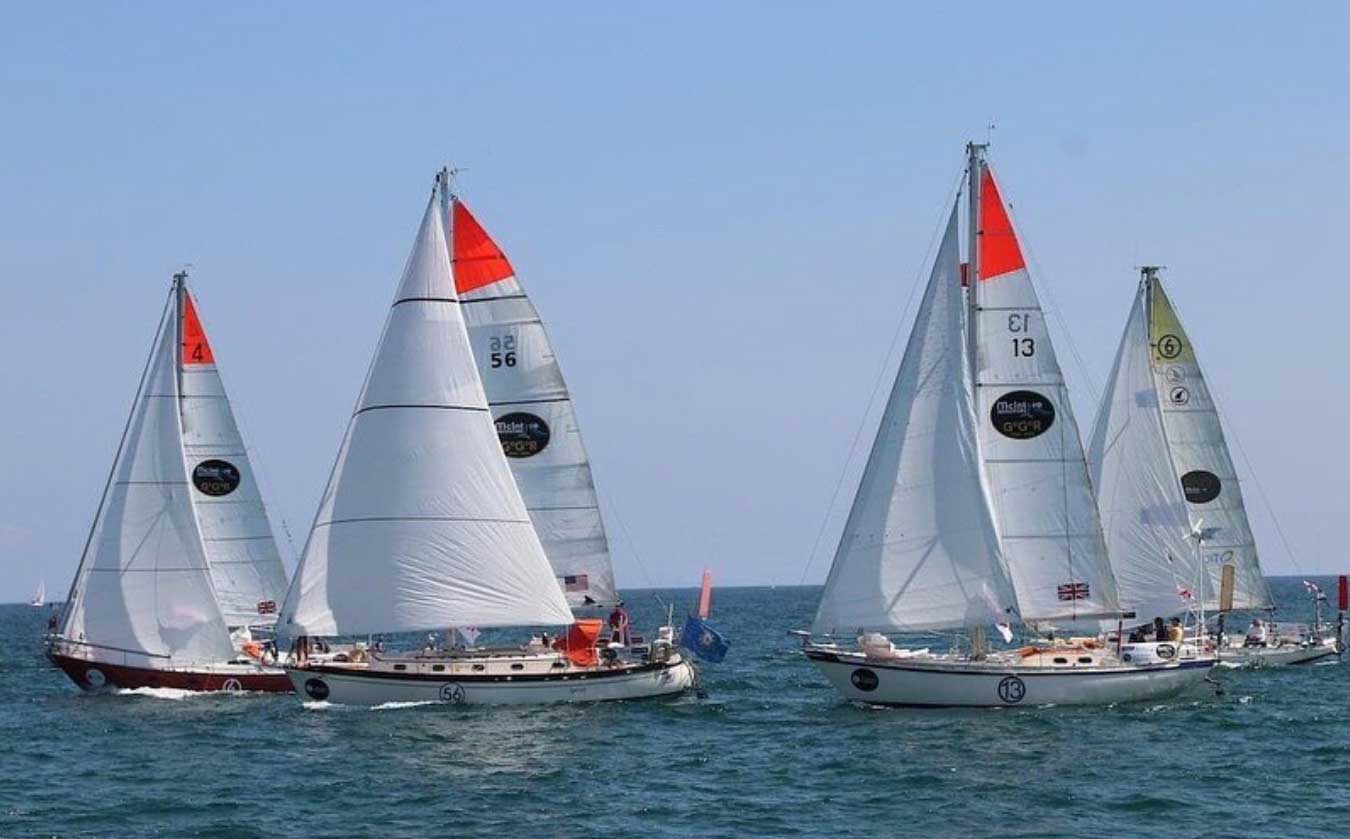
    golden globe race

    Crédit Photo: The Golden Globe Race

    The original race turned survival into sailing history

    The Sunday Times Golden Globe Race began in 1968. Nine men set out at different times. Only Robin Knox-Johnston finished, returning to Falmouth aboard the 9.75 m (32 ft) ketch Suhaili after 312 days and becoming the first person to sail solo and non-stop around the world.

    Bernard Moitessier rounded Cape Horn aboard Joshua while still capable of winning, then continued east and eventually sailed to Tahiti rather than return to Europe. Donald Crowhurst fabricated position reports while remaining in the Atlantic. His trimaran was later found abandoned after he disappeared at sea.

    The first edition established the race’s central truth. Speed only matters once survival, judgement and reliability are secured.

    The 2018 edition showed that the danger had not changed

    Eighteen sailors started the revived 2018 Golden Globe. Five finished.

    Jean-Luc Van Den Heede won in 211 days, 23 hours, 12 minutes and 19 seconds, a record that still stands. In the southern Indian Ocean, a storm with winds around 130 km/h (70 knots) and seas reported at 14 m dismasted Abhilash Tomy and Gregor McGuckin. Tomy suffered a severe spinal injury and required an international rescue.

    Susie Goodall was later pitchpoled and dismasted roughly 3,700 km (2,000 nautical miles) west of Cape Horn before being rescued by a bulk carrier.

    The 2022 edition produced a victory defined by seamanship

    Sixteen sailors started in 2022. Only three completed the race in the main classification.

    South African Kirsten Neuschäfer won aboard the Cape George 36 Minnehaha in an official corrected time of 233 days, 18 hours, 43 minutes and 47 seconds. She became the first woman to win a round-the-world race via the three great capes.

    Her defining moment came earlier. Finnish skipper Tapio Lehtinen’s Asteria flooded and sank rapidly in the southern Indian Ocean. Neuschäfer diverted, found his liferaft and took him aboard before transferring him to a merchant ship. Officials awarded her a 35-hour time credit.

    Abhilash Tomy finished second, four years after the spinal injury that ended his 2018 race. Michael Guggenberger finished third. Simon Curwen reached Les Sables-d’Olonne first physically, but a repair stop in Chile had moved him into the Chichester Class.

    The 2026 fleet combines professionals, veterans and outsiders

    As of late August 2026, 16 skippers remain. Damien Guillou is among the performance references. The former French Olympic-squad 49er sailor, Figaro competitor and IMOCA boat captain was near the front in 2022 before a windvane failure ended his race. He won the 2026 SITraN Challenge prologue.

    Ertan Beskardes returns for a third campaign in Van Den Heede’s former winning Rustler 36. Pat Lawless, a former Irish commercial fisherman, returns after self-steering failure forced him out in 2022. Guy deBoer is back after grounding Spirit on Fuerteventura in that same edition.

    The remaining fleet includes Guido Cantini, Andrea Lodolo, Matt Woodside, Isa Rosli, Henry Wootton, Gunnar Christensen, Louis Kerdelhué, Helga Marie “Mara” Løvenskiold Kveseth, Etienne Messikommer, Selim Yalcin, Pär Nyman and Daniel Pinsky.

    Qualification is demanding. The current Notice of Race requires at least 8,000 nautical miles of previous ocean sailing, another 2,000 nautical miles solo and, for most entrants, a further 4,000-nautical-mile solo non-stop qualifying voyage in the entered yacht.

    The real contest is between the sailor and uncertainty

    The Golden Globe remains compelling because it removes precision from a world accustomed to it. The public can follow satellite positions, and the 2026 edition adds a one-way Starlink-based Live Window on selected boats. The skipper receives no internet, weather data or navigational assistance through it. For the audience, it is 2026. For the sailor, much of the voyage still feels like 1968.

    From Privilège Marine’s home in Les Sables-d’Olonne, the lesson is familiar. A true bluewater yacht ultimately depends on one sailor, one boat and an ocean that does not adjust its standards.

    Comfort and electronics can transform life at sea. They remain tools. When systems fail, sound construction, preparation, judgement and self-reliance are what bring a boat home.
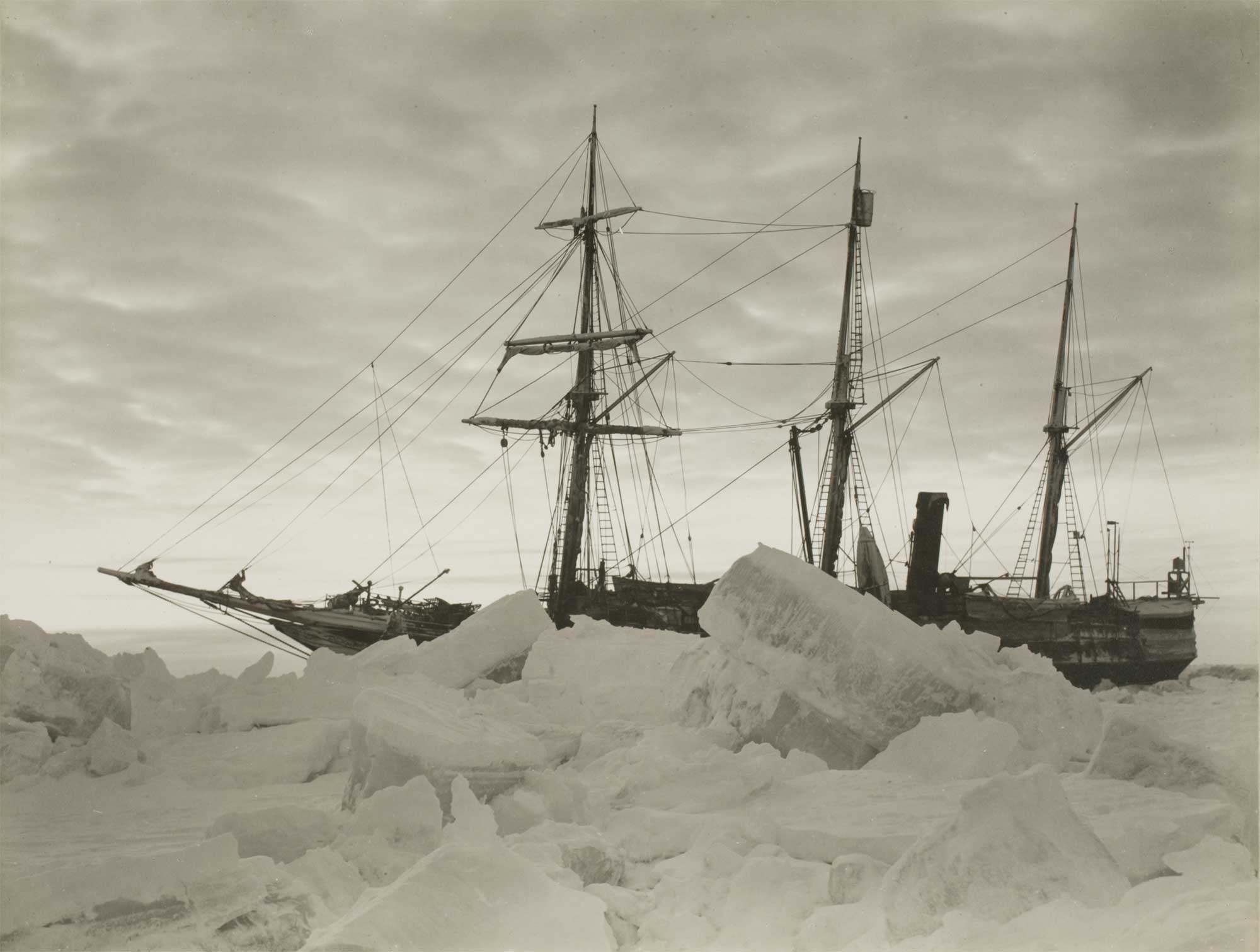
  • The Voyage That Made Ernest Shackleton an Enduring Legend

    The Voyage That Made Ernest Shackleton an Enduring Legend

    Shackleton’s failed Antarctic crossing became a masterclass in survival, seamanship and leadership after Endurance vanished beneath the ice.

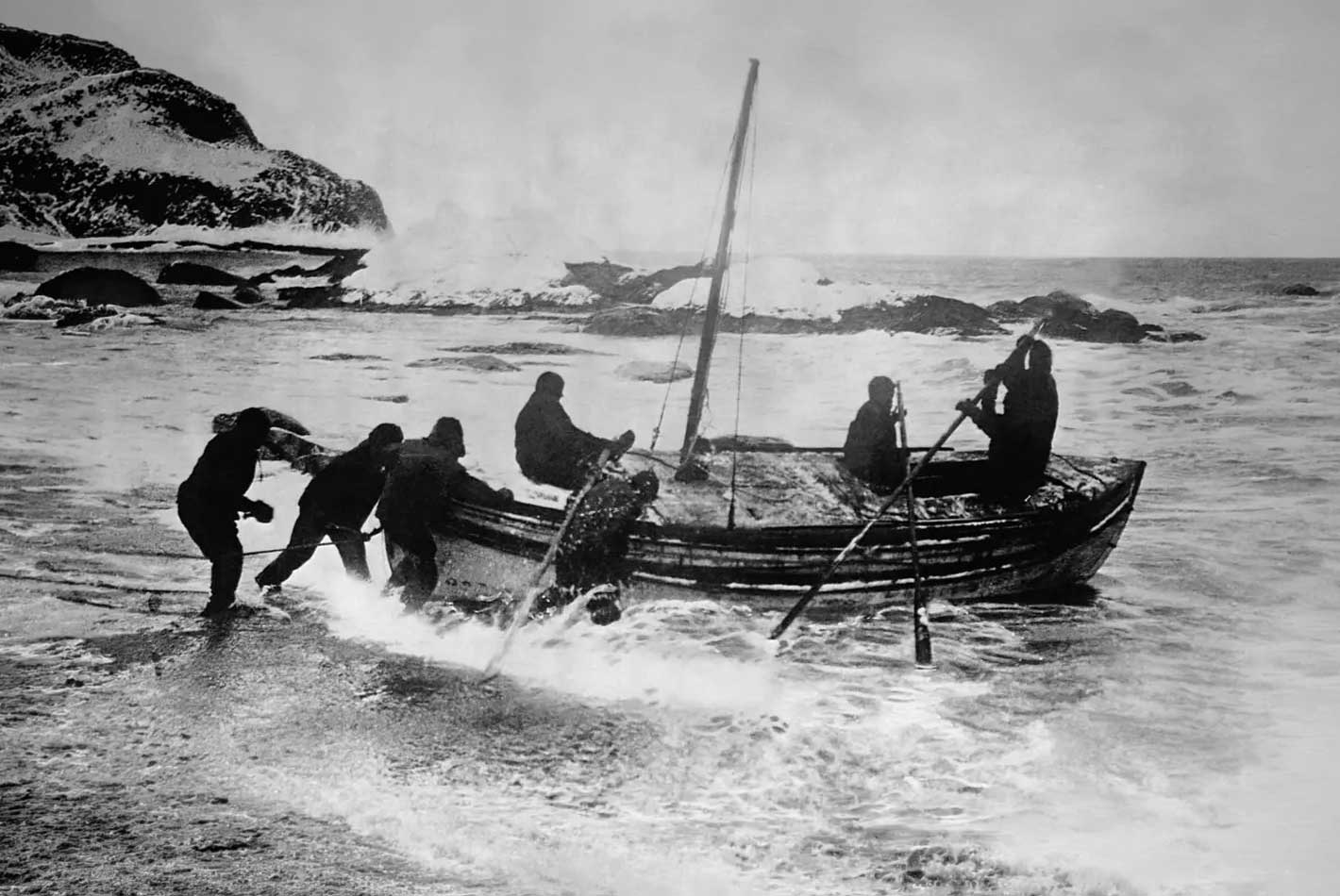
    Ernest Shackleton remains one of history’s most admired explorers because he turned a failed expedition into an extraordinary rescue operation. His 1914 Imperial Trans-Antarctic Expedition aimed to complete the first overland crossing of Antarctica. Endurance never reached the continent. The ship became trapped in the Weddell Sea, drifted with the pack for ten months and was eventually crushed. Shackleton then kept 28 men alive on the ice, led them to Elephant Island and sailed the 6.9-metre (22.5-foot) James Caird across approximately 1,450 kilometres (800 nautical miles) of the Southern Ocean. Captain Frank Worsley navigated with a sextant, a chronometer and only a few usable observations. Every member of the Endurance party survived. The wider expedition lost three men on the Ross Sea side. Shackleton’s reputation rests on courage, adaptability and loyalty. It also requires a frank assessment of his hurried planning, financial difficulties and willingness to accept extreme risk.

    The Sailor Who Learned Leadership Before Reaching Antarctica

    Ernest Henry Shackleton was born on 15 February 1874 in Kilkea, County Kildare, Ireland. His family later moved to London. At 16, he left school and joined the merchant navy.

    The decision gave him a practical education. Shackleton learned sail handling, cargo operations, watchkeeping, navigation and command aboard working ships. He qualified as a master mariner and gained experience on long ocean passages before entering polar exploration.

    In 1901, he joined Robert Falcon Scott’s Discovery Expedition. Shackleton, Scott and Edward Wilson travelled south by sledge to latitude 82°17′S, setting a new record. Hunger, cold and illness overwhelmed the party. Shackleton suffered a serious physical collapse and was sent home in 1903.

    The return damaged his pride. It also shaped his later leadership. He understood that exhaustion accumulates quietly. He had experienced how quickly ambitious plans could exceed a crew’s physical reserves.

    Shackleton returned to Antarctica as leader of the Nimrod Expedition in 1907. In January 1909, he and three companions reached 88°23′S, approximately 180 kilometres (112 miles) from the South Pole.

    Their food was running out. The men were weakening. Shackleton turned back.

    That decision denied him the Pole and probably saved four lives. It established one of the central principles of his leadership: survival took priority over the objective.

    The Expedition That Sought the Last Great Antarctic Prize

    Roald Amundsen reached the South Pole in December 1911. Robert Falcon Scott arrived weeks later and died during the return journey. Shackleton needed a new objective.

    He proposed the first complete crossing of Antarctica. His team would land beside the Weddell Sea, travel through the South Pole and continue to the Ross Sea. The journey across the continent would cover approximately 2,900 kilometres (1,800 miles).

    The Imperial Trans-Antarctic Expedition required two ships. Endurance would carry Shackleton’s Weddell Sea party. Aurora would place another group on the opposite side of the continent.

    The Ross Sea Party had to lay food and fuel depots along the final section of the proposed route. Shackleton’s crossing team would depend on those supplies after passing the Pole.

    The concept was bold and geographically coherent. Its margins were dangerously narrow. The two parties had no practical means of communicating. A failure on either side could threaten the entire expedition.

    Endurance departed Britain in August 1914 as Europe entered the First World War. After calling at Buenos Aires, the ship sailed to South Georgia. Experienced Norwegian whalers warned Shackleton that the Weddell Sea ice was unusually severe.

    He continued south on 5 December.

    The Polar Ship Built for Strength and Human Life

    Endurance had been launched in Norway in 1912 under the name Polaris. She was conceived as an ice-capable steam yacht for wealthy Arctic passengers before Shackleton bought her for £14,000.

    The vessel measured approximately 44 metres (144 feet) in length, with a beam of 7.6 metres (25 feet), and registered about 348 gross tons. She was a three-masted barquentine, combining sail power with a coal-fired steam engine of around 350 horsepower.

    Her rig placed square sails on the foremast and fore-and-aft sails on the other masts. This arrangement provided useful downwind power while requiring fewer sailors than a fully square-rigged ship.

    The auxiliary engine helped in confined waters and among broken ice. Its effectiveness depended on coal consumption, propeller access and the availability of open water. Once solid pack surrounded the hull, propulsion became irrelevant.

    Endurance was built with exceptional care. Her joints were heavily cross-braced. Her keel consisted of four solid oak members laid one above another. Dense greenheart protected vulnerable external areas. The structure was designed to absorb shocks while operating near ice.

    Strength still has limits. A ship can push aside broken floes. It cannot indefinitely resist the pressure generated when kilometres of moving pack converge around its hull. Ice pressure acts across the entire structure. It bends frames, twists the keel and opens seams.

    Endurance also offered unusually civilised accommodation for a polar vessel. She had cabins, a dining saloon, electric lighting, a galley and a darkroom used by photographer Frank Hurley.

    These features were more than luxuries. Warmth, light, food preparation and personal space helped maintain health and discipline during months of isolation.

    The Voyage That Made Ernest Shackleton an Enduring Legend

    The Ice That Turned a Voyage Into a Drifting Camp

    Endurance became trapped in the Weddell Sea on 19 January 1915, before reaching the intended landing point. The crew attempted to saw and break a channel. The pack closed faster than they could clear it.

    The ship drifted with the ice for ten months.

    Shackleton converted Endurance into a winter station. The crew maintained watches, cared for the dogs, took meteorological and scientific observations, repaired clothing and kept the ship operational. Lectures, games, music and Frank Hurley’s photography provided structure.

    Routine became a leadership instrument. Shackleton understood that idle men could become anxious, divided and fatalistic. He mixed social groups, controlled visible signs of fear and watched individuals whose morale concerned him.

    Food gradually changed. Stored provisions were supplemented and later replaced by seal and penguin meat. Fresh meat helped prevent scurvy, although nobody aboard fully understood the role of vitamin C.

    Living conditions deteriorated as the hull came under increasing pressure. Timbers groaned. Decks lifted. Water entered through damaged seams. Pumps had to be operated while carpenter Harry McNish constructed temporary barriers.

    On 27 October 1915, Shackleton ordered the men to abandon Endurance. The ship disappeared beneath the ice on 21 November.

    The expedition’s original purpose ended with it. Shackleton immediately gave the men a new objective: they would return home.

    The Camps That Drifted Across the Weddell Sea

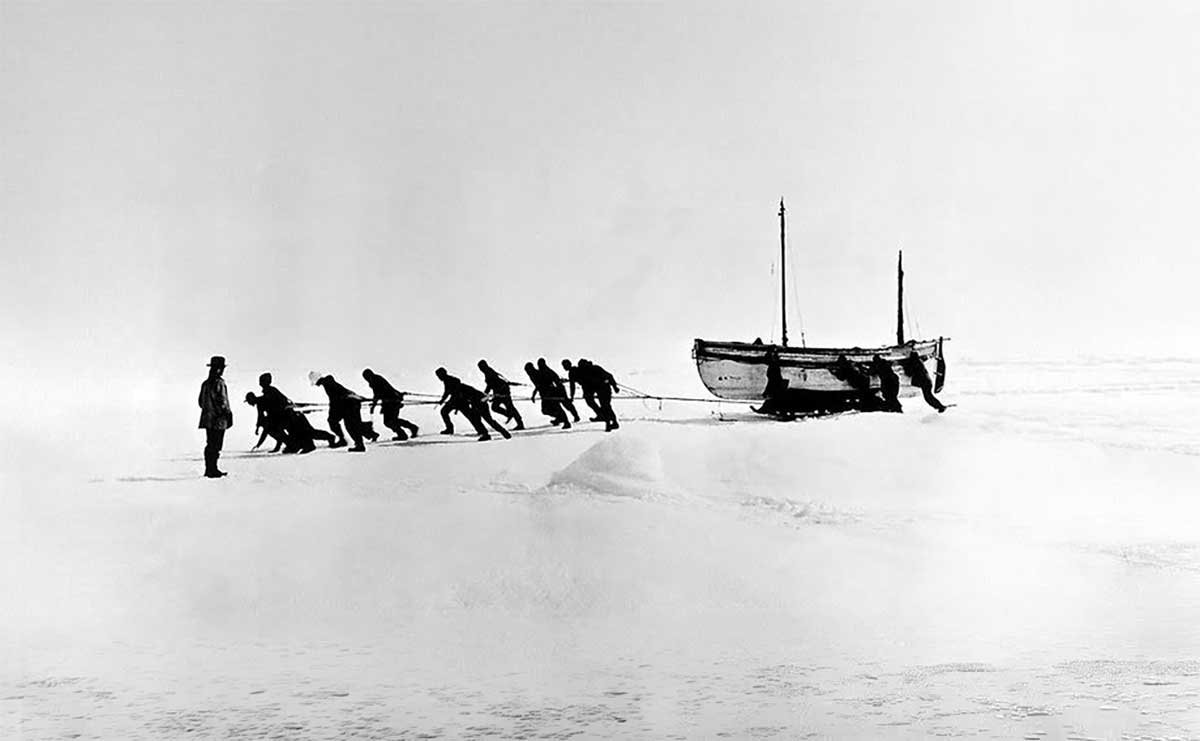
    The 28 men established camps on the pack ice with tents, supplies and three lifeboats: James Caird, Dudley Docker and Stancomb Wills.

    Shackleton ordered personal possessions reduced to about 0.9 kilograms (2 pounds) per man. The gesture showed that survival equipment and food now outweighed rank, sentiment and ownership.

    An early attempt to haul the boats across the ice failed. The uneven surface, pressure ridges and soft snow made progress exhausting. Shackleton stopped the march rather than consume the crew’s strength for little distance.

    They waited and drifted north.

    The danger was constant. Floes could split beneath tents. Leopard seals patrolled the edges. Killer whales surfaced near the boats. Food supplies depended increasingly on hunting. Clothing remained damp. Sleeping bags froze.

    Shackleton delegated carefully. Frank Wild maintained discipline. Frank Worsley managed navigation. McNish repaired equipment. Doctors Alexander Macklin and James McIlroy monitored health.

    Competence was distributed across the team. Shackleton’s strength lay partly in recognising who could solve each problem.

    When the ice finally broke apart in April 1916, the men launched the three lifeboats. After a brutal open-boat passage, they reached Elephant Island on 15 April. It was their first solid ground in 497 days.

    The island offered no realistic prospect of rescue.

    The James Caird That Became a Minimal Ocean-Going Vessel

    Shackleton decided to sail for South Georgia, where whaling stations offered the nearest practical help. The route crossed approximately 1,450 kilometres (800 nautical miles) of the Southern Ocean.

    James Caird was only 6.9 metres (22.5 feet) long. She was a double-ended, carvel-built lifeboat, designed primarily for emergency evacuation rather than a prolonged offshore passage.

    McNish transformed her with the materials available. He strengthened the structure, raised the sides and installed a makeshift deck using timber and canvas. Lamp wick, paint and seal blood helped seal gaps. Stones and sand provided ballast.

    The modifications improved protection and stability. They also left six men inside a wet, low and heavily loaded hull with almost no room to move.

    The crew consisted of Shackleton, Worsley, Tom Crean, Timothy McCarthy, John Vincent and McNish. They departed Elephant Island on 24 April 1916.

    The boat faced freezing spray, breaking seas and powerful westerly winds. Ice accumulated on the hull and rigging, raising the centre of gravity. The men had to break it away to prevent capsize. Their clothes and sleeping bags remained wet. Drinking water became contaminated.

    A sea anchor helped control the bow in heavy weather. Ballast limited violent movement. Sail had to be reduced early because a knockdown could fill the small cockpit and end the voyage within minutes.

    The James Caird survived because its crew treated every decision as a question of energy, stability and structural preservation.

    The Navigation That Found an Island in an Empty Ocean

    Frank Worsley carried a sextant, nautical almanac, chronometer and charts. His challenge was severe. Accurate celestial navigation requires a visible horizon and a clear Sun or star. The Southern Ocean provided cloud, spray and a violently moving platform.

    Worsley reportedly secured only four useful celestial observations during the passage. He supported them with dead reckoning, estimating course, speed, current and leeway.

    A sextant measures the angle between a celestial body and the horizon. The observation, combined with precise time and astronomical tables, gives a line of position. A chronometer error of four seconds can produce a longitude error of roughly 1.9 kilometres (1.2 miles) near the equator.

    Worsley had to perform these calculations while balancing in a 6.9-metre boat. Missing South Georgia meant entering the open South Atlantic with declining water, exhausted men and no second landfall.

    He deliberately aimed toward the island’s western side to account for uncertainty and prevailing conditions.

    The James Caird reached King Haakon Bay on 10 May after 16 days at sea. Navigation had reduced an ocean to one landfall.

    The Mountain Crossing That Completed the Rescue

    The boat landed on the uninhabited southern coast of South Georgia. The whaling stations lay across an unmapped interior of glaciers, mountains and crevasses.

    Shackleton, Worsley and Crean began the crossing on 19 May. They had basic clothing, a rope, a carpenter’s adze and screws fitted into their boots for grip. They travelled continuously because stopping risked hypothermia.

    After roughly 36 hours, they reached Stromness.

    Shackleton then organised repeated attempts to rescue the 22 men on Elephant Island. Ice defeated the first three vessels. The Chilean steam tug Yelcho, commanded by Luis Pardo, finally reached them on 30 August 1916.

    Every member of the Endurance party survived.

    The wider expedition had a darker outcome. Aurora had been torn from its Ross Sea moorings, leaving ten men ashore. The party completed its depot-laying work despite inadequate clothing and supplies. Arnold Spencer-Smith died from illness and exhaustion. Aeneas Mackintosh and Victor Hayward disappeared while crossing unstable sea ice.

    The statement that Shackleton “saved all his men” therefore needs precision. He saved all 27 companions who sailed with him aboard Endurance. Three members of the wider expedition died.

    The Leader Whose Failures Form Part of His Legacy

    Shackleton’s leadership deserves admiration without mythology.

    He made excellent decisions during the crisis. He abandoned unproductive marches. He protected weaker men without publicly humiliating them. He placed difficult personalities close to him. He maintained routines and presented confidence when the outcome was uncertain.

    He also created some of the risks he later managed. Preparations were hurried. Financing remained unstable. The expedition relied on optimistic assumptions about sea ice and coordination between two distant parties. Some experienced voices had warned of severe conditions in the Weddell Sea.

    Shackleton’s objective failed completely. His response to that failure made him famous.

    After returning, he served during the First World War and struggled with business ventures, debts and declining health. He sailed south again aboard Quest in 1921. On 5 January 1922, aged 47, he died in his cabin while the ship was anchored at South Georgia.

    He was buried at Grytviken at the request of his wife, Emily.

    The Lessons That Still Define Serious Ocean Voyages

    The Endurance expedition established lessons that remain relevant to offshore sailing, polar operations and expedition leadership.

    Structural strength must match the actual environment. A robust vessel still needs an escape strategy when external forces exceed its design assumptions.

    Repairability matters. McNish’s tools and practical knowledge turned a lifeboat into an ocean-going survival craft. Complex systems offer little value when they cannot be repaired far from assistance.

    Navigation requires redundancy. Worsley combined celestial observations, timekeeping, dead reckoning and judgement. He never depended on a single source of information.

    Habitability also affects safety. Warmth, sleep, food, light and protected working areas preserve judgement. A yacht designed for long-distance sailing must function as both a vessel and a home.

    This principle stands at the heart of Privilège Marine. Offshore capability comes from robust construction, reliable systems, protected navigation and interiors designed around the people who live aboard. Comfort supports endurance when it reduces fatigue and keeps a crew physically and mentally effective.

    Endurance was located in 2022 at a depth of 3,008 metres (9,869 feet). The wreck remains remarkably well preserved in the cold Weddell Sea.

    Its survival beneath the ice offers a final image of Shackleton’s story. The ship was lost, the mission failed and the men faced conditions beyond the original plan. Leadership began when the plan ceased to matter.

  • The Magellan Voyage That Changed Navigation and Redrew the World

    The Magellan Voyage That Changed Navigation and Redrew the World

    Magellan’s life, five ships and brutal voyage reveal how the first circumnavigation transformed navigation, geography and ocean sailing.

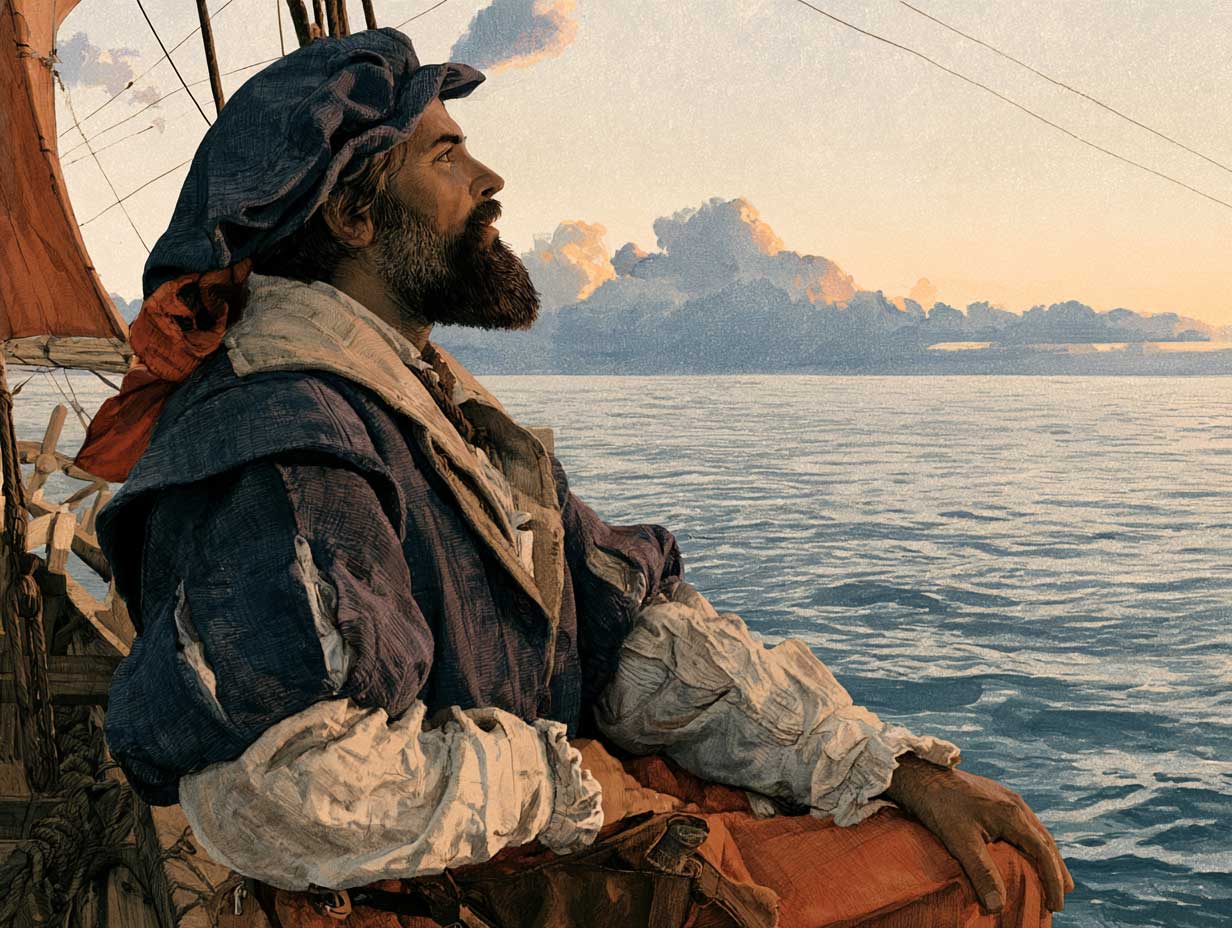
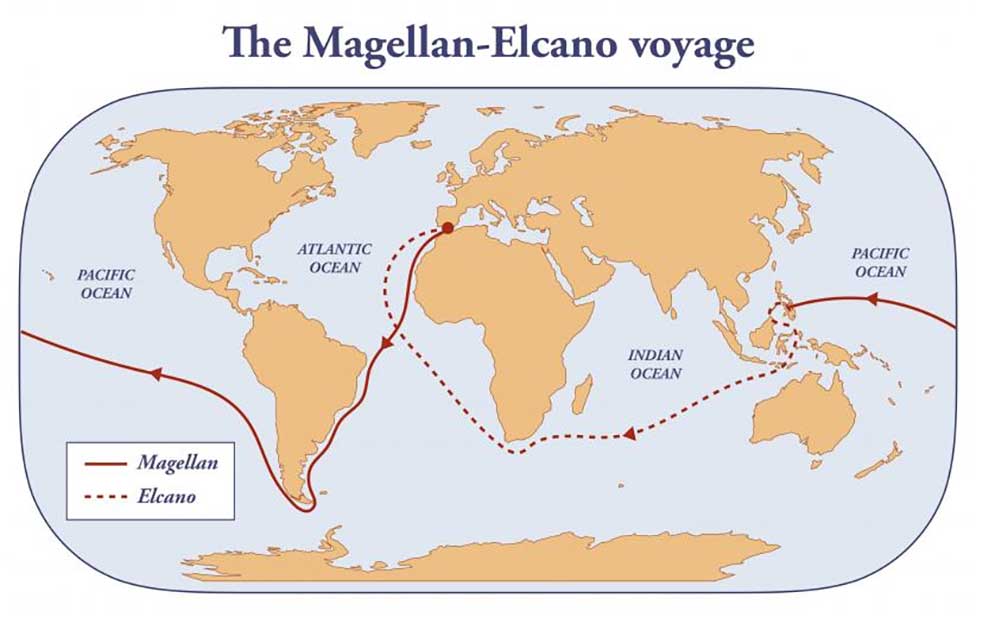
    Ferdinand Magellan entered history as the commander who launched the expedition that achieved the first recorded circumnavigation, although he never completed the voyage himself. A Portuguese sailor in Spanish service, he left Sanlúcar de Barrameda in 1519 with five ships and 239 men to find a westward passage to the Moluccas. The expedition survived mutiny, shipwreck, starvation, scurvy, desertion and armed conflict. It found the channel now known as the Strait of Magellan, crossed the Pacific in 99 days without fresh provisions and reached the Philippines, where Magellan was killed at Mactan in 1521. Juan Sebastián Elcano then brought Victoria home in 1522 with 18 survivors. The voyage demonstrated the practical continuity of the world’s oceans and exposed the true scale of the Pacific. It also showed that successful ocean exploration depends on more than courage. Ship strength, navigation, provisions, leadership and judgement decide whether a crew reaches the other side.

    The Portuguese Mariner Who Chose a Spanish Crown

    Fernão de Magalhães was born in Portugal around 1480. He sailed during the Portuguese expansion into the Indian Ocean, fought at Diu and reached Malacca. He gained direct knowledge of Asian trade routes and of the Moluccas, the Indonesian islands whose cloves commanded exceptional prices in Europe.

    Portugal already controlled the eastern route around the Cape of Good Hope. Magellan proposed reaching the same market by sailing west. King Manuel I rejected him. Magellan moved to Seville, entered Spanish service as Fernando de Magallanes and presented his plan to Charles I.

    Spain wanted access to the spice trade without entering the Portuguese sphere established by the Treaty of Tordesillas. Magellan believed that a passage existed through or around South America. He also argued that the Moluccas might lie within Spain’s half of the divided world. The voyage began as a commercial expedition, rather than as a planned circumnavigation.

    The company was multinational. It included Spanish and Portuguese sailors, the Venetian chronicler Antonio Pigafetta, the Basque mariner Juan Sebastián Elcano, the pilot Francisco Albo and Enrique de Malacca, Magellan’s Malay interpreter.

    The Five Ships Built for Cargo Rather Than Comfort

    The Armada de Molucca left Seville on 10 August 1519 and sailed from Sanlúcar de Barrameda on 20 September. Its five vessels were Trinidad, San Antonio, Concepción, Victoria and Santiago. Trinidad was Magellan’s flagship.

    They were naos, Iberian ocean-going cargo ships related to the carrack. Their capacities ranged from 75 to 120 toneles, a measure of carrying volume rather than modern displacement. San Antonio was the largest at 120 toneles. Trinidad was rated at 110, Concepción at 90, Victoria at 85 and Santiago at 75.

    No original construction plans survive. Naval historians estimate that Victoria measured about 28 metres long and 7.5 metres in beam. She carried approximately 45 men when she departed. Her timber hull was caulked with oakum and pitch. High sides and a deep hold provided cargo capacity and useful freeboard, but also created windage and slow handling.

    The rig used a bowsprit and three masts. Square sails on the foremast and mainmast delivered power when the wind came from behind the beam. A triangular lateen sail on the mizzen helped balance the ship. Additional bonnet sails could enlarge the working sail area in favourable conditions. Steering came from an axial stern rudder operated through a long tiller.

    The design was strong and practical for carrying provisions and commercial cargo. It was also heavy, crowded and inefficient to windward. Sail handling required men to work on exposed decks and aloft. The hull was the crew’s entire margin of survival.

    Maintenance was continuous. Carpenters, caulkers, coopers, sailmakers and smiths were as important as the pilots. A leaking hull could be beached and careened so that its underwater planking could be scraped, repaired and resealed. Every operation depended on hand tools, local materials, tides and physical labour.

    The Search for a Passage Through an Unknown Coast

    The fleet crossed the Atlantic, reached Brazil and worked south along an incompletely charted coast. Every major inlet demanded investigation because it might lead to the Pacific. Exploration consumed time, provisions and morale.

    At Puerto San Julián in Patagonia, several Spanish officers mutinied. Magellan suppressed the revolt with speed and severity. Luis de Mendoza was killed, Gaspar de Quesada was executed and Juan de Cartagena was later abandoned. Magellan preserved command, but fear became part of his authority.

    Santiago was subsequently wrecked while scouting farther south, although its crew survived. On 21 October 1520, the remaining ships found the entrance to the Strait of Magellan. The passage extends for roughly 560 kilometres through narrow channels, islands, strong tidal streams, hidden shallows and sudden squalls.

    San Antonio deserted inside the strait and returned to Spain with valuable provisions. Three ships entered the Pacific on 28 November. Magellan had found the passage he had promised. He had also entered an ocean whose scale he had badly underestimated.

    The Navigation System That Mixed Astronomy and Judgement

    The expedition’s pilots could calculate latitude with reasonable accuracy. They measured the altitude of the Sun or known stars with instruments such as the mariner’s astrolabe and quadrant. Astronomical tables supplied the Sun’s declination for each day. A magnetic compass gave heading, while charts recorded coastlines, bearings and known hazards.

    Longitude remained the central weakness. Accurate marine chronometers were still more than two centuries away. The pilots therefore relied on dead reckoning. They estimated speed, recorded heading and calculated the distance travelled over time.

    Sandglasses measured the watches. Speed could be judged by timing a floating object over a known length of hull or by using an early log line. A lead line measured depth near land and could sometimes recover samples of the seabed.

    Currents, leeway and storms made navigational errors accumulate. Francisco Albo’s log and Antonio Pigafetta’s narrative show disciplined observation, but also the limitations of the instruments. Experienced pilots corrected their calculations against landfalls, soundings, celestial observations and the behaviour of the sea.

    Navigation was therefore both technical and intuitive. Instruments produced figures. Survival depended on knowing when those figures were wrong.

    The Pacific Crossing That Destroyed the Crew’s Health

    The ocean first appeared calm, which explains the name Pacific. The crossing was still catastrophic. The ships spent 99 days at sea before reaching Guam and found almost nowhere to replenish their supplies.

    Food included ship’s biscuit, salted meat and fish, cheese, pulses, oil, wine and water stored in wooden casks. Heat, damp, bilge water and vermin damaged everything. Pigafetta described biscuit reduced to foul powder, putrid water and men eating ox hide that had been softened in seawater. Rats became valuable food.

    Scurvy followed the long absence of fresh produce. Swollen gums, weakness, bleeding and infection killed men who had survived storms and combat. The cause, vitamin C deficiency, would not be scientifically understood for centuries.

    Most sailors slept on mats, bundles or bare planking. Senior officers had limited protected accommodation. The rest found space beneath the forecastle, between cargo or on deck. Privacy barely existed. Personal chests served as seats, tables and storage.

    Fire was tightly controlled because a cooking flame or lantern could destroy a wooden ship within minutes. Drinking water could become contaminated. Wounds healed poorly in the damp and unhygienic environment. Vermin consumed food and spread disease.

    The lesson remains direct: habitability is a safety system. Exhausted and malnourished sailors make poorer decisions, handle sails more slowly and repair damage less effectively.

    The Death at Mactan and the Voyage Elcano Finished

    The expedition reached the Philippines in March 1521. Magellan allied himself with Rajah Humabon of Cebu and entered local political and religious conflicts. On 27 April, he attacked the forces of Lapulapu on Mactan.

    The decision was reckless. Shallow water kept the European boats and their heavier weapons away from the shore. Magellan’s men had to wade across the reef. They were outnumbered, exposed and unable to withdraw in good order. Magellan was killed while covering their retreat.

    Magellan did not complete the circumnavigation. After further deaths, the survivors burned Concepción because too few men remained to operate three ships. Trinidad and Victoria eventually reached the Moluccas and loaded cloves.

    Trinidad attempted to return east across the Pacific and failed. Victoria sailed west under Juan Sebastián Elcano. Elcano crossed the Indian Ocean, rounded the Cape of Good Hope and avoided Portuguese authorities wherever possible.

    Victoria reached Sanlúcar on 6 September 1522 and Seville two days later with 18 survivors. She had travelled more than 37,500 nautical miles, approximately 69,450 kilometres. One vessel out of five had returned. Fewer than one man in twelve from the original company stood on her deck.

    The Lessons That Changed Ocean Navigation

    The Magellan expedition revealed that the Pacific was far larger than many European geographers had assumed. It demonstrated that the world’s oceans formed a connected navigable system. It also produced practical knowledge of winds, currents, coastlines, provisioning and the southern passage between the Atlantic and Pacific.

    The records mattered almost as much as the route. Pigafetta preserved geographical, linguistic and ethnographic observations. Albo supplied navigational data. Later expeditions could study their landfalls, errors and survival decisions.

    The voyage also exposed the limits of command by force. Magellan defeated mutiny, yet his confidence became overreach at Mactan. Elcano succeeded by reducing the mission to one objective: bringing one damaged ship and its remaining crew home.

    The circumnavigation accelerated cartography and oceanic navigation. It also advanced European imperial competition and brought violence, forced conversion and commercial exploitation to the communities encountered along the route. Its importance should be recognised without turning conquest into romance.

    For modern ocean sailors, the enduring lesson lies in redundancy, maintainability, protected watchkeeping and humane living conditions. At Privilège Marine, those principles shape the bluewater yacht as both a safe offshore platform and a genuine home at sea. Five centuries of technology separate today’s yachts from Victoria. The ocean still rewards preparation and punishes illusion.

  • Philippe Jeantot Built More Than a Race Around the World

    Philippe Jeantot Built More Than a Race Around the World

    How Philippe Jeantot turned solo ocean racing into the Vendée Globe and helped shape Privilège Marine’s bluewater catamaran DNA.

    Philippe Jeantot’s legacy cannot be reduced to one race, one shipyard, or one line in sailing history. He belongs to the generation that turned French offshore sailing into a serious technical, sporting and industrial culture. A former deep-sea diver, he came to sailing through endurance, risk and self-reliance rather than through yacht-club tradition. He won the BOC Challenge twice, helped redefine what solo ocean racing could mean, then created the Vendée Globe in 1989 as a harder, purer version of the round-the-world race: one skipper, one boat, no stopovers and no assistance. At the same time, he channelled his experience into Jeantot Marine, later associated with the Privilège catamaran line. The result was not a marketing story invented after the fact. It was a direct transfer from offshore hardship into bluewater catamaran design: safety, autonomy, comfort and long-distance capability.

    The diver who became a sailor through discipline, not romance

    Philippe Jeantot was born in Antananarivo, Madagascar, in 1952. Before he became one of the defining figures of French offshore sailing, he was a professional deep-sea diver. That detail matters. It explains much of his later approach to boats, risk and endurance.

    Deep-sea diving is not an aesthetic relationship with the sea. It is technical, physical and unforgiving. Jeantot worked in a world where equipment, preparation and discipline could decide whether a man came back alive. In 1977, he took part in the Janus IV dive programme run by COMEX, during which divers reached a depth of 501 metres. That background placed him far from the romantic image of the solitary yachtsman guided only by instinct.

    His route into sailing was similarly direct. Jeantot was influenced by Bernard Moitessier’s book The Long Way, one of the great texts of solo ocean sailing. But he did not simply buy into the myth of escape. He built himself a 13.5-metre steel ketch, equivalent to about 44 feet, and prepared for single-handed ocean sailing. The boat was heavy, strong and practical. It was not an object of leisure. It was a machine for survival.

    That distinction is central to the Philippe Jeantot legacy. He approached sailing as a system. The sailor, the hull, the rig, the deck layout, the repair strategy and the mental reserve had to function together. Later, this same thinking would influence both the Vendée Globe and the early Privilège catamarans.

    The BOC Challenge turned Jeantot into a global offshore figure

    Jeantot’s sporting reputation was built in the BOC Challenge, the solo round-the-world race with stopovers that later became known under other names, including Around Alone and Velux 5 Oceans. In 1982-1983, he entered the first edition and won. Contemporary accounts describe a race of more than 27,000 nautical miles, or roughly 50,000 kilometres, through calms, storms, high-latitude depressions and repeated damage.

    The race format was already brutal. It was solo. It crossed the Southern Ocean. It demanded that one person manage navigation, sleep, repairs, weather analysis, sail changes and fear. But it was not yet the Vendée Globe. The BOC Challenge allowed stopovers. Skippers could rest, repair and restart from major ports around the world.

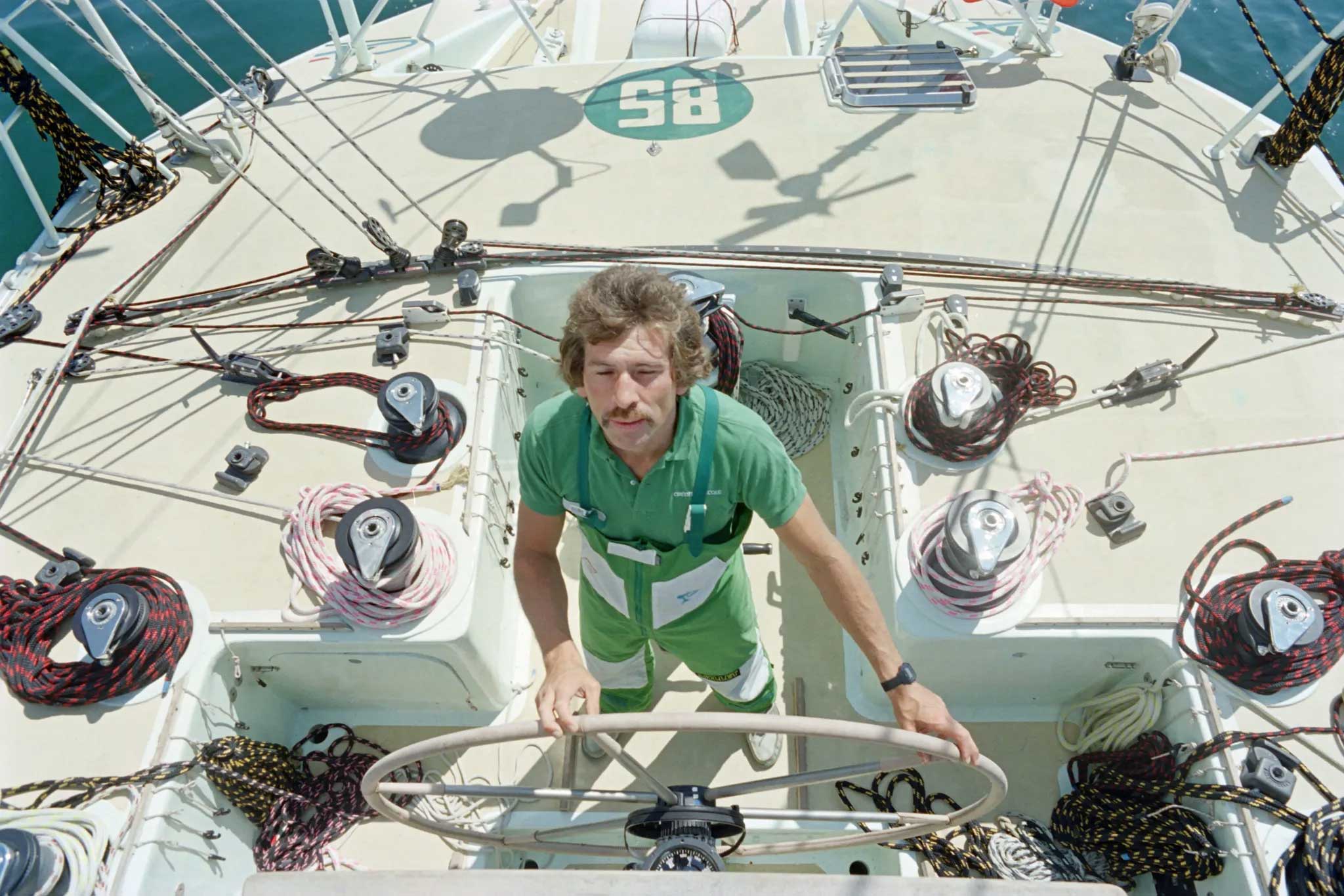
    Jeantot mastered that format. He won the 1982-1983 edition and then returned to win again in 1986-1987 aboard Crédit Agricole III. Winning once could be called a breakthrough. Winning twice made him a reference point. He was no longer just a French adventurer. He had become a sailor whose experience carried technical weight.

    The numbers are important because they separate fact from legend. The first BOC Challenge was not a coastal race inflated by storytelling. It was a full circumnavigation. Jeantot’s victory required months of isolation, weather management and mechanical resilience. His second win confirmed that the first was not an accident.

    This period also connected him to a broader French offshore movement. France was developing a particular culture of ocean racing: pragmatic, inventive, sponsor-backed and technically ambitious. Jeantot’s sponsor, Crédit Agricole, became part of that story. His boats, named Crédit Agricole, helped bring professional structure to a sport that still carried traces of amateur adventure.

    The Vendée Globe was born from dissatisfaction with compromise

    The Vendée Globe did not appear as a comfortable evolution of existing racing. It was born from dissatisfaction. Jeantot had won the BOC Challenge twice, but the stopover format left a question unresolved. If a sailor could stop, repair and recover, was the race truly the purest test of one person and one boat around the world?

    Jeantot’s answer was blunt: no.

    In 1989, he created a new race from Les Sables-d’Olonne. The principle was simple and severe: solo, non-stop, round the world, without assistance. The theoretical distance was around 24,000 nautical miles, or about 44,000 kilometres. The route sent skippers down the Atlantic, around the Cape of Good Hope, across the Indian and Pacific Oceans, around Cape Horn, then back up the Atlantic to Vendée.

    The first edition started on 26 November 1989. Thirteen skippers took the start. Only seven finished. Titouan Lamazou won in 109 days, 8 hours and 48 minutes. Jeantot himself finished fourth aboard Crédit Agricole IV, in 113 days, 23 hours and 47 minutes.

    Those figures still carry force. The first Vendée Globe was not a polished sporting product. It was an experiment conducted at full scale, in public, with real consequences. Boats broke. Skippers withdrew. Philippe Poupon’s capsize and rescue by Loïck Peyron became one of the defining images of the first edition. The race immediately proved both its power and its danger.

    This is why the Vendée Globe founder label matters. Jeantot did not merely create another event on the sailing calendar. He created a format that changed offshore racing. The Vendée Globe turned individual endurance into a global sporting narrative. It also forced boat design to advance. Autopilots, rigging, hull structures, energy systems, weather routing and onboard ergonomics all became matters of survival.

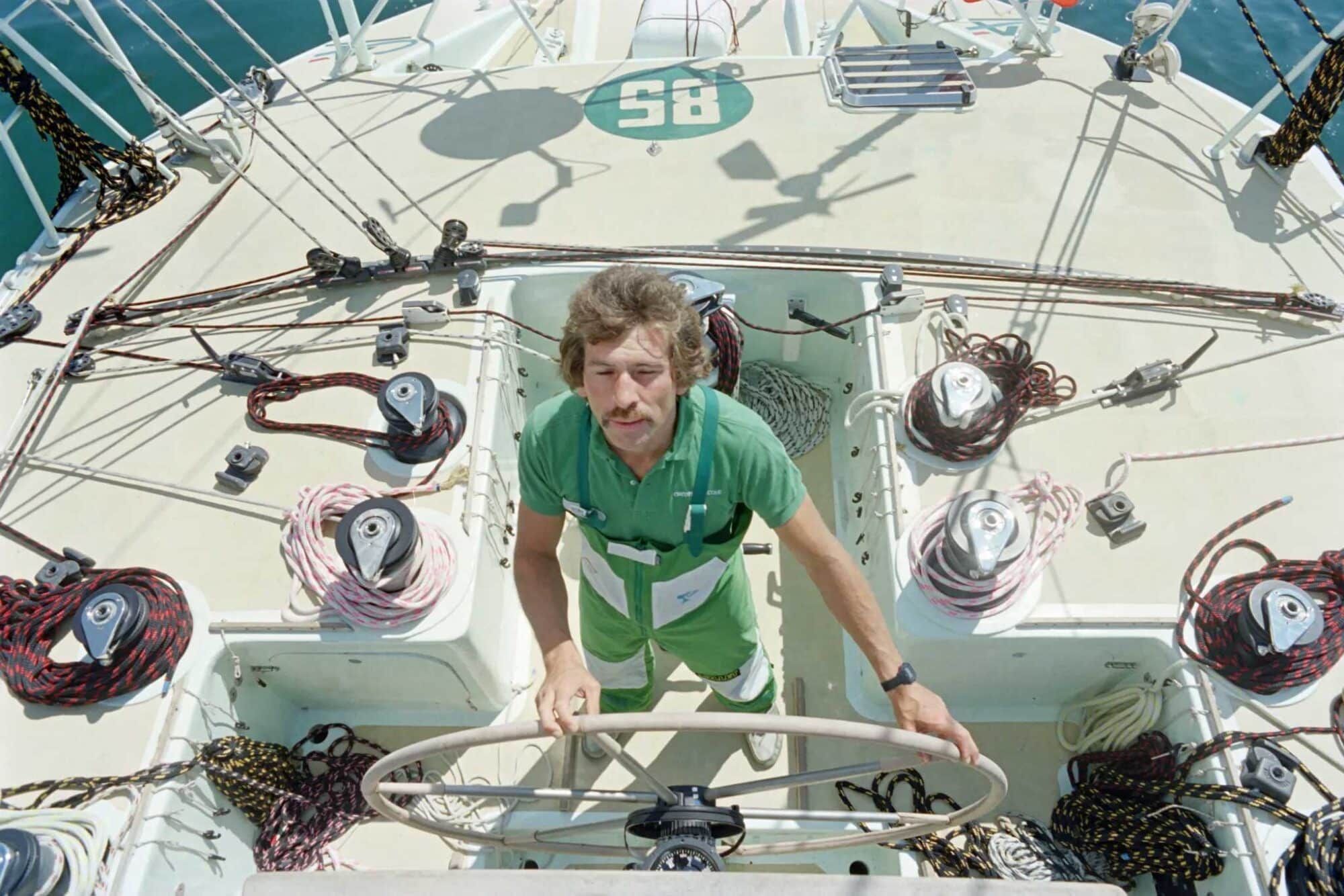
    Philippe Jeantot Privilege Marine
    Crédit Photo: Marcel Mochet

    The race made Les Sables-d’Olonne a capital of ocean endurance

    The choice of Les Sables-d’Olonne was not incidental. The port gave the race a fixed emotional geography. The Vendée Globe starts and finishes in the same place. That loop matters. It gives the event a ritual structure: departure, disappearance, danger, return.

    For the region, the race created an identity that went beyond tourism. Les Sables-d’Olonne became linked to the hardest form of solo ocean racing. Every four years, the town became a stage for technology, courage and national attention. The relationship between place and race helped turn the Vendée Globe into something more durable than a one-off challenge.

    The long-term effect is measurable. From 13 starters in 1989-1990, the race grew into a major international offshore event. The 2024-2025 edition had 40 starters, reflecting both the globalisation of the IMOCA class and the continuing appeal of the race format Jeantot created. The event remains rare in sport because its rule is easy to understand and almost impossible to execute: sail around the world alone, without stopping, without outside help.

    That clarity is part of Jeantot’s genius. Great sporting properties often have simple grammar. The Vendée Globe has one of the simplest. It is a human being, an 18-metre IMOCA, the oceans and time.

    The shipyard translated offshore experience into cruising design

    Jeantot’s other major legacy is industrial. In 1985, before the Vendée Globe began, he founded Jeantot Marine with René Bernard in Les Sables-d’Olonne. The company would become associated with the Privilège range of catamarans. Early models included boats such as the Privilège 47, followed by other designs that helped establish the brand’s reputation in long-distance multihull cruising.

    The link between racing and cruising is often exaggerated in the yacht industry. In this case, it is real. Jeantot had spent years learning what breaks offshore and what sailors need when land is far away. That experience did not lead him to design minimalist racing machines for private owners. It pushed him toward a different idea: a cruising catamaran that could cross oceans with stability, space, redundancy and confidence.

    A bluewater cruising catamaran is not simply a wide yacht with two hulls. It is a long-range platform. It must carry water, fuel, batteries, food, spare parts, safety equipment and people for extended passages. Its structure must cope with torsional loads between hulls. Its deck layout must allow watchkeeping and sail handling without exposing the crew unnecessarily. Its interior must remain livable at sea, not just impressive at anchor.

    That is where Jeantot’s offshore background mattered. The early Privilège philosophy was not built around marina glamour. It was built around ocean-crossing capability. Comfort was important, but not as a substitute for seriousness. Space had to serve life offshore. Volume had to be balanced against strength. The boat had to feel like a home without forgetting that the sea is indifferent to comfort.

    The first Privilège boats helped define a serious multihull niche

    The Privilège story began in a market that was very different from today’s catamaran sector. In the mid-1980s, cruising multihulls were still fighting for credibility. Many sailors associated serious ocean passagemaking with monohulls. Catamarans were often seen as charter boats, coastal platforms or experimental alternatives.

    Jeantot Marine entered that environment with a different claim. A catamaran could be comfortable and serious. It could offer privacy, stability and volume without abandoning offshore ambition. It could appeal to private owners who wanted to cross oceans rather than merely entertain guests in protected waters.

    This positioning proved important. The Privilège 47 and later models helped build a brand identity around strength, liveability and long-range cruising. The company was not the largest builder. It did not become a mass-production machine. Its place was narrower and more demanding: the premium end of the bluewater catamaran market.

    That niche still matters today. The modern catamaran market is crowded. Some brands focus on charter volume. Others focus on speed. Others push extreme luxury. Privilège Marine’s strongest argument remains the one rooted in its origin story: a boat shaped by offshore experience, designed for owners who care about the difference between coastal comfort and real bluewater confidence.

    The legacy is also complicated, and should be treated honestly

    A serious account of Philippe Jeantot cannot read like a brochure. His sporting and industrial contributions are substantial. They are also not the whole record. Jeantot later faced legal troubles in France, including convictions connected with financial and tax matters. Those facts do not erase the Vendée Globe. They do not cancel the technical influence he had on Privilège. But they do complicate the portrait.

    That distinction is important for credibility. Legacy is not sainthood. It is consequence. Jeantot’s consequence in sailing is clear. He helped professionalise French solo offshore racing. He founded the Vendée Globe, now one of the world’s most demanding ocean races. He helped create a shipyard whose identity was built around long-distance multihull cruising. These achievements stand because they produced institutions, boats and a culture that outlasted the man’s direct control.

    For Privilège Marine, the right lesson is not to mythologise Jeantot. It is to understand what made the origin powerful. The brand was born from a sailor who knew the cost of poor preparation. That is a stronger story than nostalgia. It gives the yard a technical inheritance: build boats for owners who may one day be far from rescue, far from shipyards and far from excuses.

    The real inheritance is a design ethic, not a name

    The phrase Philippe Jeantot legacy should not be treated as a decorative keyword. It describes a chain of cause and effect. Deep-sea diving taught discipline. Solo racing taught autonomy. The BOC Challenge taught the value of stopover repair and the limits of that format. The Vendée Globe removed the stopover and created the purest version of the test. Jeantot Marine then translated ocean experience into cruising catamarans designed for real passages.

    That is the story’s value for modern readers and serious yacht buyers. The sea does not care about branding. It tests structure, systems, crews and decisions. A convincing bluewater authority is not built by saying the word “bluewater” often. It is built by proving that design choices come from hard experience.

    Privilège Marine’s early story has that advantage. It begins with a man who had been deep under the sea, then alone across it, then ambitious enough to create a race that still defines the outer edge of solo sailing. The first Privilège boats emerged from that world. They were part of a broader French moment when offshore sailing, design and industry began to reinforce one another.

    The cleanest reading of Jeantot’s legacy is therefore not sentimental. It is practical. He helped make the ocean a stricter judge of sailors and boats. The Vendée Globe did that in sport. Privilège Marine carried part of the same logic into cruising. For a shipyard that still wants to speak credibly about safe ocean passages, private ownership and long-range autonomy, that origin remains more than history. It is a standard to meet.