Close
Lang selector black

Category: Performance & Tech

  • From Vendée Globe to America’s Cup: 15 Sailing Races That Matter

    From Vendée Globe to America’s Cup: 15 Sailing Races That Matter

    From solo laps of the planet to foiling sprints, the 15 sailing races that define the sport: their history, their records and the sailors who win them.

    Fifteen competitions shape modern sailing. They range from solo laps of the planet to short sprints on foiling catamarans. The Vendée Globe remains the summit of solo racing, and Charlie Dalin’s 2025 victory cut its record to 64 days. The America’s Cup, first sailed in 1851, moves to Naples in July 2027. SailGP has turned inshore racing into a global league. The Route du Rhum, won on 8 November 2026 by Tom Laperche in record time, keeps the solo transatlantic tradition alive. The Fastnet, Sydney Hobart and Middle Sea races put amateurs and professionals on the same course, and in 2025 the French navigator Alexis Loison won the first two on small double-handed boats. The Golden Globe Race takes sailors back to sextants. The ARC lets cruising crews cross the Atlantic in company. Together, these events show how ocean sailing evolves, and why their lessons reach the boats owners sail every day.

    The Language Behind the Results

    Two titles matter in offshore racing. Line honours go to the first boat to finish. The overall title goes to the boat with the best corrected time under a handicap rule, usually IRC, which rates each yacht by its size, sail area and design. A 30-meter (100-foot) maxi can therefore take line honours while a 10-meter (33-foot) yacht wins the race.

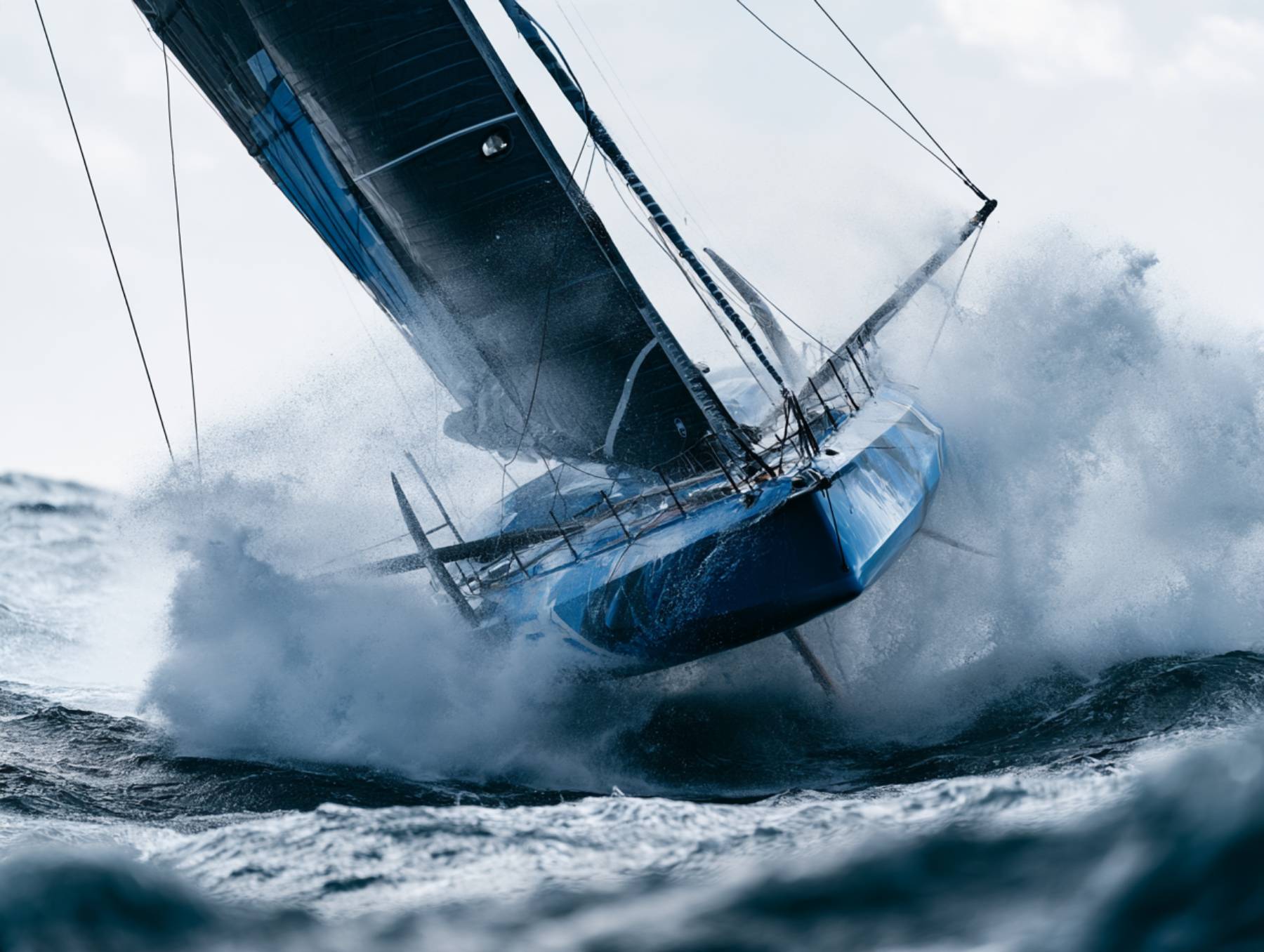
    Boat classes matter too. The IMOCA is an 18.28-meter (60-foot) monohull. The Ultim is a trimaran up to 32 meters (105 feet) long and 23 meters (75 feet) wide. Both now use foils, curved appendages that lift the hulls out of the water and multiply speed.

    The Round-the-World Races That Measure Endurance

    The Vendée Globe

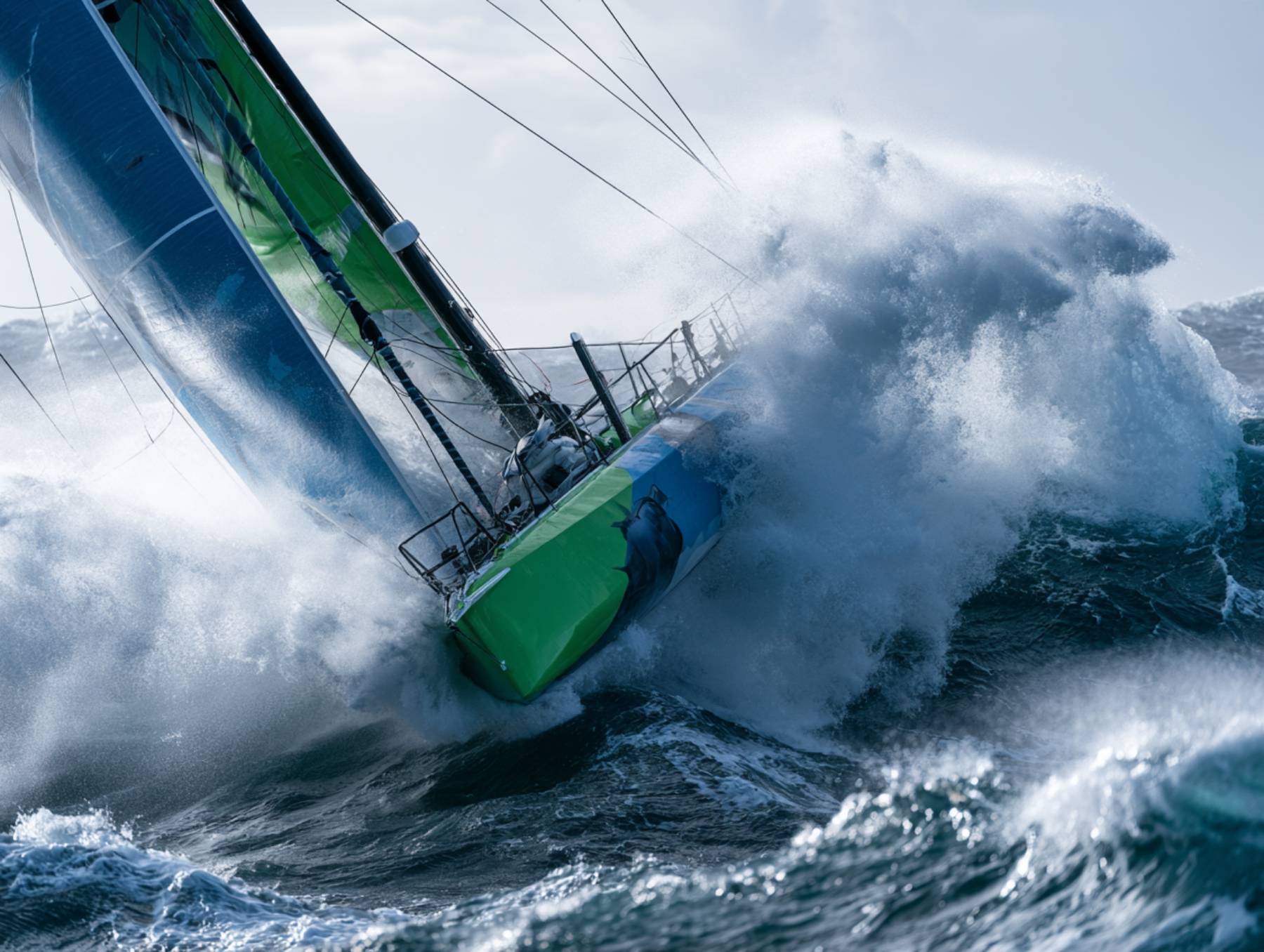
    The Vendée Globe is a solo, non-stop, unassisted race around the world in IMOCAs. It starts and finishes in Les Sables-d’Olonne every four years. Philippe Jeantot, who founded our shipyard in 1985, created the race in 1989. That link remains at the heart of our offshore racing heritage. The tenth edition started on 10 November 2024 with 40 skippers. Charlie Dalin won on 14 January 2025 in 64 days, 19 hours and 22 minutes, more than nine days faster than Armel Le Cléac’h’s record from 2017. He sailed 27,667 nautical miles at an average of 17.79 knots. The next edition starts in 2028.

    The Golden Globe Race

    The Golden Globe Race recreates the 1968 race won by Sir Robin Knox-Johnston, the first person to sail solo and non-stop around the world. Skippers sail small production boats designed before 1988, with paper charts and sextants. GPS and modern electronics are banned. Sixteen skippers left Les Sables-d’Olonne on 6 September 2026 for about 30,000 nautical miles and seven to eight months at sea. The attrition is brutal: across the three previous editions, 43 sailors started and only nine finished. South Africa’s Kirsten Neuschäfer won in 2023, the first woman to win a solo round-the-world race.

    The Arkéa Ultim Challenge

    The Arkéa Ultim Challenge-Brest is the first solo round-the-world race for Ultim trimarans. Its first edition started from Brest on 7 January 2024 with six skippers. Charles Caudrelier won aboard Maxi Edmond de Rothschild in 50 days, 19 hours and 7 minutes. He was the only competitor who completed the course without stopping for repairs. That detail says much about the fragility of these 32-meter machines at sustained high speed. The second edition is planned for the winter of 2027-2028.

    The Jules Verne Trophy

    The Jules Verne Trophy rewards a record rather than a race. Crews choose their own weather window and sail non-stop around the world from a line between Ushant and the Lizard. In January 2026, Thomas Coville and six crew on Sodebo Ultim 3 set a new time of 40 days, 10 hours and 45 minutes, beating the mark IDEC Sport had held since 2017. They averaged about 29 knots over more than 28,000 miles. The first holders, aboard Enza New Zealand in 1994, needed almost 75 days.

    The Ocean Race

    The Ocean Race, born as the Whitbread Round the World Race in 1973, is the fully crewed counterpart. 11th Hour Racing Team won the 2022-2023 edition. The 15th edition starts from Alicante on 17 January 2027, in IMOCAs crewed by four sailors, including at least one woman. Its first leg, 14,000 nautical miles to Auckland, will be the longest in the race’s history. The finish is set for AMAALA, on Saudi Arabia’s Red Sea coast.
    The Inshore Contests Where Technology Rules

    The America’s Cup

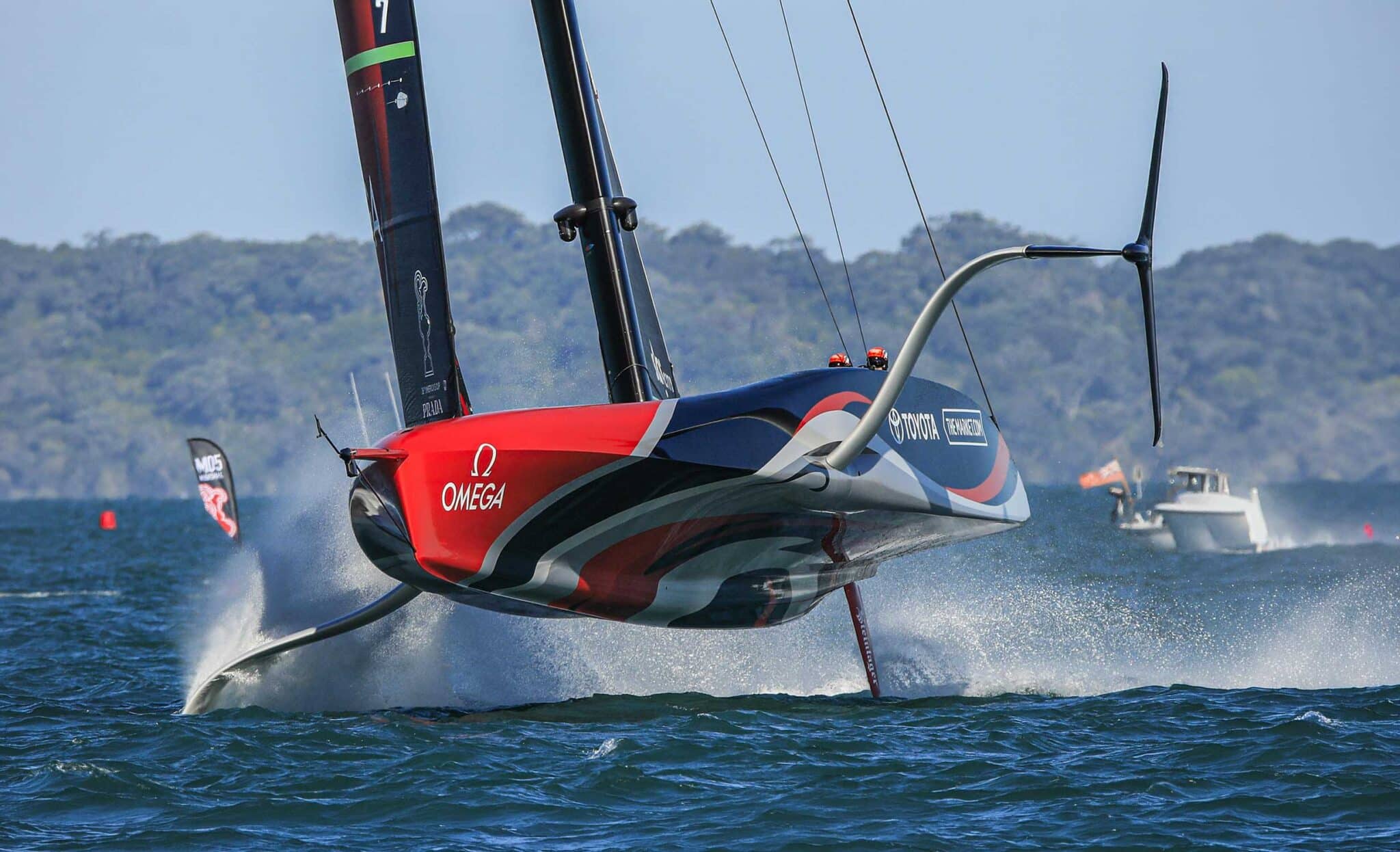
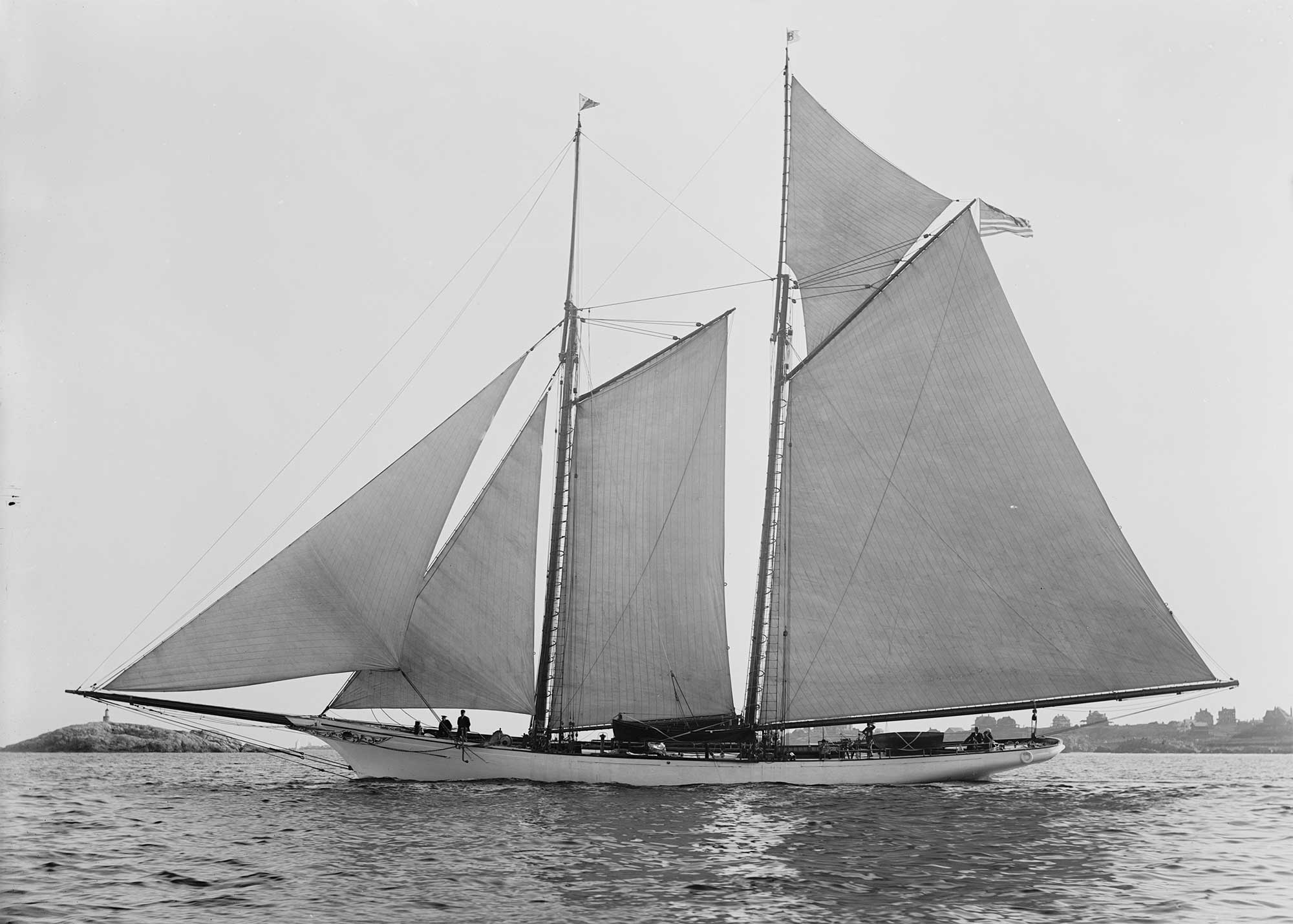
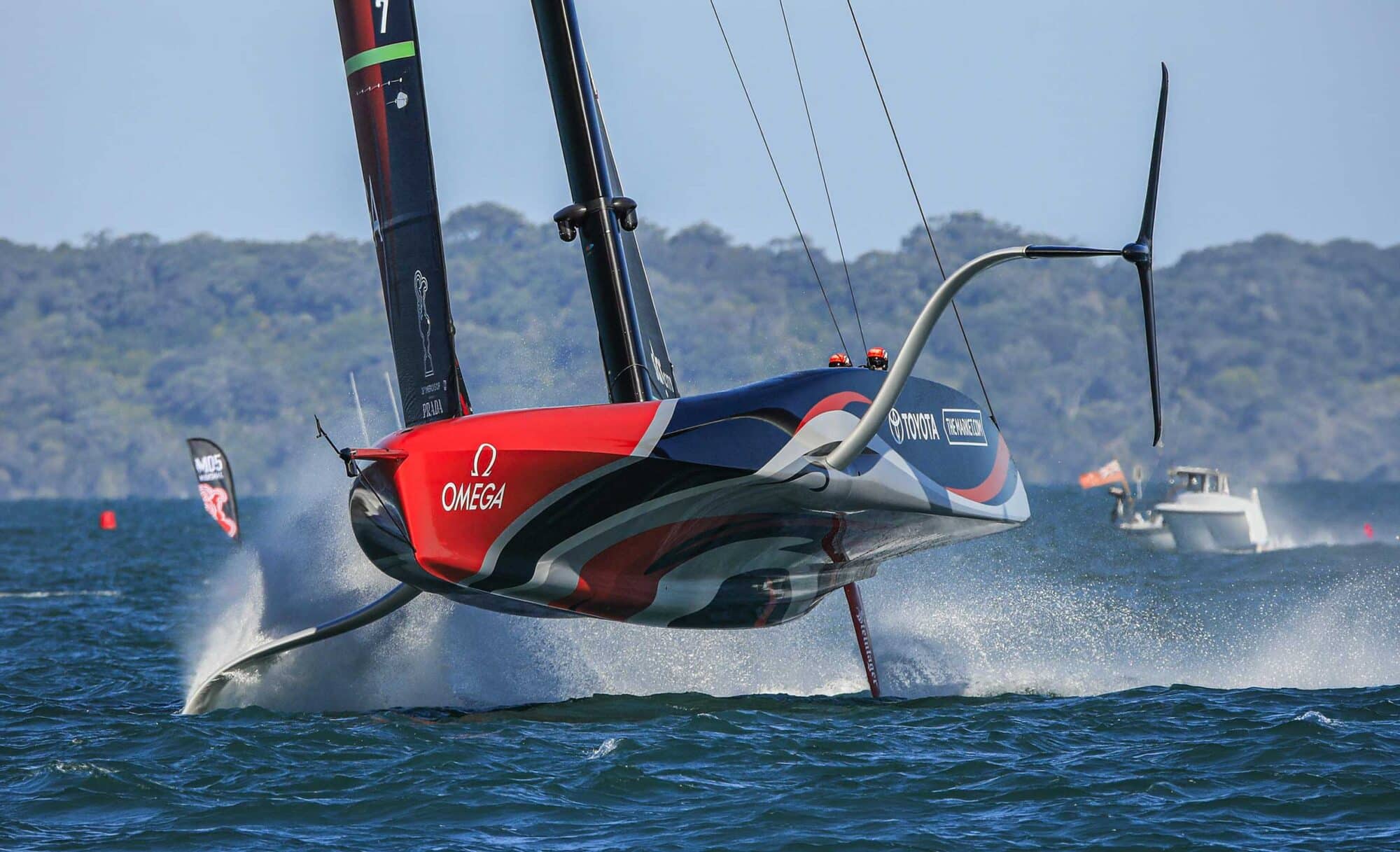
    The America’s Cup is the oldest trophy in international sport. The schooner America won it around the Isle of Wight in 1851. Teams now race AC75 foiling monohulls capable of more than 55 knots, or about 100 kilometers per hour (62 mph). Emirates Team New Zealand beat INEOS Britannia 7-2 in Barcelona in 2024 to win a third consecutive Cup. The 38th Match starts in Naples on 10 July 2027, the first time Italy has hosted the event. The Cup rewards design budgets as much as sailing skill, and the best-funded team usually holds the edge.

    The SailGP Championship

    SailGP, founded by Larry Ellison and Sir Russell Coutts, pits national teams against each other in identical F50 foiling catamarans that reach about 100 kilometers per hour. Because the boats are one-design, crew skill decides results. Emirates Great Britain, with Dylan Fletcher as driver, won Season 5 at the Abu Dhabi Grand Final on 30 November 2025. Season 6 opened in Perth in January 2026 with 13 teams, including Sweden’s new Artemis Racing.

    The Olympic Regatta

    Sailing has featured at nearly every Summer Games since 1900. The Paris 2024 regatta took place in Marseille, where kitefoiling and the iQFOiL windsurfer made their Olympic debut. The format favors short, intense races in dinghies, skiffs and boards, and it produces many of the sailors who later lead America’s Cup and SailGP teams. The next Olympic regatta will be held in Long Beach, California, in 2028.

    The Transatlantic Classics

    The Route du Rhum

    Created in 1978, the Route du Rhum-Destination Guadeloupe runs solo from Saint-Malo to Pointe-à-Pitre every four years, about 3,542 nautical miles. The 13th edition started on 1 November 2026. Tom Laperche, 29, won the Ultim class on SVR-Lazartigue in 6 days, 13 hours and 27 minutes, a race record, at his first attempt. Thomas Coville finished second and Louis Burton third. The defending champion, Charles Caudrelier, retired with the new Gitana 18. The race mixes professional Ultims and IMOCAs with amateurs in the Rhum categories, which explains its popularity in France.

    The Transat Café L’Or

    Formerly the Transat Jacques Vabre, this double-handed race follows the historic coffee route from Le Havre to the Caribbean every two years. Its 17th edition finished in Fort-de-France, Martinique, in November 2025. Of 74 starters, 63 finished. Tom Laperche and Franck Cammas won the Ultim class in 10 days, 13 hours and 3 minutes over 6,670 nautical miles. Jérémie Beyou and Morgan Lagravière won the IMOCA class on Charal 2.

    The Mini Transat

    The Mini Transat is the training school of ocean racing. Skippers cross the Atlantic alone on 6.5-meter (21-foot) boats, without satellite communication or outside routing. In 2025, organizers cancelled the first leg because of the weather, and the race ran as a single leg from La Palma, in the Canary Islands, to Saint-François, Guadeloupe. Mathis Bourgnon won the prototype class in 13 days, 18 hours and 24 minutes, 30 years to the day after his father, Yvan, won the race. Paul Cousin won the production class. Many Vendée Globe skippers began their careers here.

    The Offshore Classics Open to Amateurs

    The Rolex Fastnet Race

    The Royal Ocean Racing Club’s biennial race covers 695 nautical miles from Cowes, around the Fastnet Rock off south-west Ireland, to Cherbourg. The centenary edition in July 2025 drew a record 444 boats. SVR-Lazartigue took overall line honours, and Black Jack 100 took the monohull title in 2 days, 12 hours and 31 minutes. The overall winner was Léon, a 10.4-meter (34-foot) JPK 1050 sailed double-handed by Alexis Loison and Jean-Pierre Kelbert. The race still carries the memory of 1979, when a storm killed 15 competitors and reshaped offshore safety rules.

    The Rolex Sydney Hobart Yacht Race

    The Cruising Yacht Club of Australia’s 628-nautical-mile race starts on Boxing Day and crosses the Bass Strait, known for violent southerly fronts. In 1998, a storm there killed six sailors. In the 80th edition, in December 2025, Master Lock Comanche took line honours in 2 days, 5 hours and 3 minutes. After a protest, the double-handed JPK 10.30 Min River won overall. Its owner, Jiang Lin, became the first woman to win the race, with Alexis Loison as co-skipper. Loison won both the Fastnet and the Sydney Hobart in the same year, a clear sign of how competitive small double-handed boats have become.

    The Rolex Middle Sea Race

    The Royal Malta Yacht Club’s 606-nautical-mile race starts in Valletta and circles Sicily anticlockwise, passing the Strait of Messina and the active volcano of Stromboli. The 47th edition started on 17 October 2026. Black Jack 100 took monohull line honours on 19 October, and Django 7x won overall under IRC. Light patches, sudden squalls and island wind shadows make it one of the most tactical offshore races on the calendar.

    The Rally That Opens the Ocean to Cruisers

    The Atlantic Rally for Cruisers

    The ARC is a rally with racing divisions. Since 1986, it has taken cruising yachts 2,700 nautical miles from Las Palmas de Gran Canaria to Rodney Bay, Saint Lucia. More than 7,000 boats have taken part. The 40th edition, in 2025, counted 145 boats, including 30 catamarans. The 2026 fleet starts on 22 November, and most boats will take 18 to 21 days. Rambler 88 holds the record of 8 days and 6 hours, set in 2016. For many owners, the ARC is their first Atlantic crossing, and its safety inspections and weather briefings reduce the risks of a first ocean passage.

    The Lessons Racing Hands to Cruising Sailors

    Racing is the laboratory of sailing. Foils, carbon structures, powerful autopilots and weather routing were tested in the Vendée Globe and the Route du Rhum long before they reached cruising yachts. Failures teach as much as records. Caudrelier won the first solo Ultim race around the world because his boat held together while every rival stopped for repairs.

    The 2025 season also overturned an old assumption. Small, well-prepared boats sailed by two people won two of the hardest offshore classics. Preparation, reliability and seamanship counted for more than length.

    Our shipyard stands close to the Vendée Globe pontoons in Les Sables-d’Olonne. We build bluewater catamarans for owners who want to cross oceans in comfort, at their own pace. The races remind us every four years of a simple truth: at sea, the winner is often the boat built to last.
  • The Real Differences Between Carbon and Aluminium Masts

    The Real Differences Between Carbon and Aluminium Masts

    Carbon and aluminium masts offer different gains in weight, stiffness, cost and offshore serviceability. Privilège Marine explains the trade-off.

    The choice between a carbon mast and an aluminium mast is not simply a contest between modern and traditional materials. It is an engineering decision involving weight, stiffness, sail control, durability, maintenance and cost. Aluminium remains the rational standard for most cruising yachts. It is proven, relatively affordable and supported by a worldwide service network. Carbon fibre offers a higher stiffness-to-weight ratio. It can reduce weight aloft by around 20% to 30% in a typical cruising application, although the exact saving depends on the mast design and equipment. This improves stability, reduces pitching and allows more precise sail trim. A carbon boom also lowers inertia during gybes. At Privilège Marine, aluminium masts and booms are fitted as standard because they provide a strong and dependable offshore solution. Carbon masts and booms are available as an option for owners seeking better weight control and stronger sailing performance from a fully equipped blue-water catamaran.

    The Material Choice That Shapes the Entire Yacht

    A mast appears simple. It is a vertical structure holding the sails. In engineering terms, it is far more demanding.

    A yacht mast must resist compression from the standing rigging. It must absorb lateral bending from the sails. It must withstand torsion, shock loads, pumping and thousands of load cycles. Those forces change with wind speed, sea state, sail configuration and the movement of the yacht.

    The mast must also control sail shape. A structure that bends too much allows the forestay to sag and changes the profile of the mainsail. A structure that is excessively rigid may transfer higher peak loads into the rigging, chainplates and hull. The correct mast is therefore not the stiffest possible mast. It is a mast with the correct bend characteristics for the complete yacht.

    Carbon fibre and aluminium achieve this balance in very different ways.

    An aluminium mast is normally made from an extruded marine-grade alloy section. The profile is anodised or painted. It can be tapered towards the masthead and reinforced around high-load areas such as the gooseneck, spreaders and rigging attachments.

    A carbon mast is a laminated composite. Its fibres can be placed in specific directions and quantities. More material can be added where loads are highest. Less can be used where the structure requires less reinforcement. This allows the designer to control longitudinal stiffness, lateral stiffness and torsional resistance with much greater precision.

    That design freedom is the central advantage of carbon. Its black finish is merely the visible result.

    The Weight Difference That Matters Most Above the Deck

    Raw material density provides a useful starting point.

    A typical aluminium mast alloy has a density of about 2.70 grams per cubic centimetre. Carbon fibre itself is closer to 1.79 grams per cubic centimetre. A finished carbon laminate also contains resin, coatings, inserts and local reinforcements, so those figures cannot be translated directly into a complete mast weight.

    The finished result nevertheless remains significant. A properly engineered carbon fibre mast may weigh around 20% to 30% less than its aluminium equivalent. Rustler Yachts, which offers both materials on offshore cruising yachts, cites an average reduction of approximately 25% in mast weight.

    The percentage is only part of the story. The location of the saved weight matters more.

    Removing 100 kilograms from a yacht’s interior is useful. Removing 100 kilograms from a mast, with much of that mass positioned 10 to 25 metres above the water, has a greater dynamic effect.

    The yacht’s vertical centre of gravity moves lower. Pitching and rolling inertia decrease. The boat becomes more responsive to changes in wind pressure. It may recover more quickly after passing through a wave. It also wastes less energy accelerating a heavy rig from side to side.

    This matters on a catamaran. A modern blue-water catamaran carries a substantial operational load. It may have large fuel and water capacities, lithium batteries, refrigeration, air conditioning, a tender, domestic equipment, safety systems, tools, stores and personal belongings.

    A carbon mast does not make that payload disappear. Nor does it transform a luxury cruising catamaran into a racing machine. Carbon is not magic. It simply removes mass from one of the least desirable places to carry it.

    At Privilège Marine, this is one of the main reasons for offering a carbon mast and boom. It helps preserve sailing performance on a yacht designed to carry its owners, their equipment and their ambitions across oceans.

    The Stiffness Advantage That Improves Sail Control

    Stiffness is often discussed badly.

    Carbon fibre is not automatically stiffer than aluminium in every direction. Carbon is anisotropic. Its properties depend on the orientation of its fibres. An aluminium alloy behaves more uniformly in different directions.

    The relevant engineering value is not simply the material’s modulus. Mast stiffness also depends on the dimensions and geometry of the section. Naval architects describe bending stiffness as the product of the material’s elastic modulus and the section’s second moment of area.

    In simple terms, both the material and the shape matter.

    The elastic modulus of common aluminium mast alloys is about 70 gigapascals. Individual carbon fibres may exceed 230 gigapascals and can reach more than 300 gigapascals in intermediate-modulus products. A finished laminate has lower values than the bare fibres because it includes resin and fibres in several orientations. Yet its stiffness relative to its mass remains substantially higher.

    This allows a carbon mast to be lighter while retaining equal or greater stiffness in the directions that matter.

    The result is better control of mast bend. The mainsail can maintain a more consistent designed shape. The rig can also support greater forestay tension, provided the entire rig and yacht structure have been engineered for it.

    Forestay tension is critical when sailing upwind. Wind pressure pushes the headsail and forestay to leeward. This creates forestay sag. Excessive sag makes the headsail fuller, increases aerodynamic drag and reduces pointing ability.

    A stiffer mast does not eliminate sag. Nothing does. It makes the rig more stable and predictable, which allows more precise rig tuning.

    This can produce a cleaner headsail entry, a more controlled mainsail profile and less distortion as wind pressure changes. The yacht may sail closer to the wind. More importantly for offshore cruising, it may maintain speed through waves with fewer large changes in heel, heading and sail shape.

    The Performance Gain That Extends Beyond Maximum Speed

    Owners often ask how many knots a carbon mast will add. There is no responsible universal answer.

    The gain depends on displacement, sail area, hull form, sea state, wind strength, rig configuration and the weight difference between the two mast packages. It also depends on whether the owner uses the additional performance effectively.

    A carbon rig can improve light-wind acceleration because the yacht has less mass and rotational inertia. In moderate conditions, reduced pitching can help the sails and appendages work more consistently. Upwind, greater rig stability can improve sail shape and pointing.

    In stronger wind, a lighter rig may allow the yacht to carry its working sail plan for longer before reefing. This does not mean that reefing decisions should become aggressive. Offshore seamanship still requires conservative margins. It means the yacht may remain balanced and controlled over a wider operating range.

    The real benefit is often found in average passage speed rather than peak speed.

    An additional fraction of a knot sustained for several days is valuable. At an average of 8 knots, a yacht covers about 356 kilometres, or 192 nautical miles, in 24 hours. Raising that average to 8.5 knots adds roughly 22 nautical miles per day. Over a ten-day passage, the difference exceeds 400 kilometres, or 216 nautical miles.

    A carbon mast alone cannot guarantee that gain. Weather routing, sail choice, hull cleanliness and crew decisions remain decisive. The carbon rig gives the yacht a better platform from which to use the available wind.

    The Carbon Boom That Reduces Loads During Manoeuvres

    The boom deserves separate attention.

    Seldén states that its carbon booms can provide a weight saving of up to 35% to 40% compared with an aluminium equivalent. On one published example for a 10.7-metre yacht, or 35 feet, the boom weight falls from approximately 30 kilograms to 20 kilograms.

    The absolute saving will differ on a large catamaran, but the mechanical principle remains the same.

    A lighter boom has less momentum during a gybe. This reduces the energy that must be controlled by the mainsheet, traveller, preventer and boom fittings. Accidental gybes remain dangerous, but the forces generated by a lighter spar can be lower.

    The crew also benefits during reefing and sail handling. A lighter boom places less static load on the topping lift or rigid vang. It may reduce rolling influence when sailing downwind. The boom can also be made stiffer for its weight, helping to maintain mainsail foot tension and sail shape.

    The carbon boom is therefore not merely a visual companion to a carbon mast. It produces its own operational and structural benefits.

    The Strength Question That Requires a More Honest Answer

    People often ask which mast is stronger. The question is incomplete.

    A carbon mast can offer exceptional tensile strength and compression resistance for its weight. The laminate can be reinforced locally around spreader roots, halyard exits, goosenecks and standing-rigging attachments. It also has strong resistance to conventional metal fatigue and does not corrode in the same way as aluminium.

    Aluminium has different advantages. It is ductile. It can deform before complete failure. Dents, cracks, oxidation and corrosion around fittings are often visible during inspection. Its behaviour is familiar to surveyors and riggers around the world.

    Carbon damage can be less obvious. A local impact may produce internal delamination, matrix cracking or fibre damage without creating a dramatic mark on the surface. A serious impact therefore requires professional assessment. Visual inspection alone may not establish the full extent of the damage.

    Carbon is also electrically conductive. Carbon structures and metallic fittings must be carefully isolated to limit galvanic corrosion. Stainless-steel and aluminium fittings still require inspection, even when the main tube itself cannot corrode.

    A carbon mast is repairable. A specialist can remove damaged laminate and rebuild the structure with correctly oriented fibres. A good repair can restore the required load path. But it is not an improvised job for an unqualified technician in an isolated harbour.

    An aluminium mast may be easier to inspect and service through the conventional marine network. Major structural repairs can still be difficult. Welding heat-treated aluminium may alter local material properties and create hard points or weakened zones. Some damage requires replacement rather than repair.

    Neither material removes the need for scheduled rig inspections.

    The Aluminium Standard That Remains Technically Rational

    Aluminium continues to dominate cruising yacht masts for sound reasons.

    It delivers a proven balance of strength, weight and price. Extrusion produces consistent sections. Anodising provides effective surface protection. Components and replacement fittings are widely available. Most professional riggers understand aluminium spars.

    It is also easier to control project cost. The production process is industrialised. Standard sections can be adapted to many yacht designs. Lead times are usually more predictable than those for a fully customised carbon laminate.

    For an offshore yacht, serviceability matters. A yacht may cruise far from its original shipyard. Owners need a system that can be inspected, maintained and supported in different countries.

    This is why Privilège Marine installs aluminium masts and booms as standard. The choice is not a concession. It is a robust technical specification for safe and reliable blue-water cruising.

    A well-designed aluminium rig can deliver excellent performance. The mast can be correctly tapered, tuned and paired with high-quality standing rigging and sails. For many owners, it provides the best balance between purchase cost, operational simplicity and long-term ownership.

    The Carbon Price That Reflects More Than Raw Material

    A carbon mast costs more because the product is more complex.

    The manufacturer must calculate the laminate for a specific yacht. Engineers determine fibre type, fibre orientation, wall thickness and local reinforcement. The mast may be filament-wound or built from pre-impregnated materials. It then requires controlled curing, finishing, machining, bonding and detailed quality assurance.

    The tooling and production volume also matter. Aluminium mast sections are extruded in repeatable profiles. Carbon yacht masts are produced in much smaller numbers and may be highly customised.

    There is no reliable universal multiplier. The difference depends on mast height, section size, spreaders, standing rigging, mainsail track, paint system, fittings, shipping and commissioning.

    A published options list for the 14-metre Eagle 46 priced a package including a carbon mast, carbon boom, Rodkicker vang and rod rigging at €42,750 excluding VAT. That figure is not directly transferable to a larger Privilège catamaran. It demonstrates the scale of the premium and the importance of comparing complete rig packages rather than raw mast tubes.

    On a large yacht, the option must be assessed against its operational value. The buyer is not paying only for carbon fibre. The buyer is paying for engineering, custom manufacturing, reduced weight aloft, improved sail control and potentially better passage performance.

    The Privilège Approach That Keeps the Choice Practical

    At Privilège Marine, the standard aluminium mast and boom remain the logical solution for most cruising programmes. They are strong, proven and maintainable. They also allow owners to allocate budget to other equipment that may be more important to their specific voyage, such as energy generation, communications, additional refrigeration or safety systems.

    The carbon mast and boom form a genuine performance option. They are particularly relevant for owners who want to control the weight of a comprehensively equipped yacht. They can also suit owners who place a high value on sailing response, reduced pitching and more precise sail trim.

    The decision must be made early. Changing mast material affects rig engineering, weight calculations, stability, wiring, fittings, standing rigging and commissioning. It is not simply a cosmetic substitution at the end of construction.

    The owner must also consider the yacht’s real loading condition. A carbon mast cannot compensate indefinitely for oversized tenders, excessive equipment or several tonnes of optional payload. Weight management must remain coherent across the entire yacht.

    This is the frank answer. Carbon improves performance, but engineering discipline creates the performance.

    The Better Rig Is the One That Matches the Voyage

    The aluminium mast offers value, familiarity and worldwide serviceability. The carbon mast offers lower weight, greater design freedom and a more stable aerodynamic platform.

    Neither material is universally superior.

    For an owner planning relaxed coastal cruising, aluminium may be the sensible choice. For an owner seeking the best possible sailing response from a fully equipped ocean-going catamaran, the carbon option becomes more compelling.

    The difference is not measured only at the masthead. It is felt in the yacht’s motion, its acceleration, its sail shape and the way it carries its equipment across an ocean.

    A successful offshore yacht does not pursue minimum weight at any cost. It places weight intelligently. Few kilograms are more valuable to remove than those carried high above the water.

  • The America’s Cup: How Yacht Design Turned Boats into Aircraft

    The America’s Cup: How Yacht Design Turned Boats into Aircraft

    From the schooner America to 103 km/h foiling AC75s, the America’s Cup has transformed yacht design and influenced modern offshore cruising.

    The America’s Cup began in 1851 as a test of naval architecture. It remains one. The difference is speed. The schooner America won through efficient hull lines and a disciplined sail plan. Later defenders exploited rating rules with immense yachts such as Reliance. The J Class introduced systematic tank testing. The 12-Metre era made small gains decisive and produced Australia II’s winged keel. The International America’s Cup Class brought carbon construction, advanced sailmaking and industrial-scale simulation. Multihulls then broke the displacement barrier. Hydrofoils removed most of the hull from the water. In 2024, INEOS Britannia recorded 55.6 knots, or 103 km/h, during official racing. Yet the Cup’s most useful legacy is not raw speed. Modern cruising yachts benefit from lighter composite structures, moulded sails, computational design, load monitoring and better control systems. At Privilège Marine, the lesson is clear: transfer the science, not the fragility. Offshore yachts must remain efficient, understandable and dependable far from shore.

    The Race That Began as a Design Competition

    The America’s Cup is the oldest international sporting trophy. It is also the longest-running experiment in competitive yacht design.

    In August 1851, the schooner America joined a fleet race around the Isle of Wight. Fifteen yachts started. America was not the largest boat in the fleet. Her advantage came from a different design philosophy.

    George Steers gave the schooner efficient hull lines and a clean rig. America did not carry every available sail throughout the race. She carried the right sails for the conditions. From the start, the Cup rewarded the relationship between hull resistance, aerodynamic efficiency and crew execution.

    That formula still defines the event. The hardware has changed beyond recognition. The objective has not.

    The Rating Rules That Encouraged Extreme Yachts

    Early America’s Cup yachts were displacement boats. Their speed was constrained by waterline length, wave-making resistance and stability. Designers therefore searched for ways to create a longer effective sailing length without paying the full rating penalty.

    The most extreme expression was Reliance, Nathanael Herreshoff’s 1903 defender. Reliance measured about 43.8 metres in hull length, or 143 feet 8 inches, and carried roughly 1,580 square metres of sail, or 17,000 square feet. Her main boom alone was about 35.1 metres long, or 115 feet.

    When the yacht heeled, her long overhangs immersed and extended the effective waterline length. This increased speed potential while exploiting the measurement rule.

    It was brilliant engineering. It was also a dead end. Reliance required a huge crew, generated severe loads and had a narrow operating envelope. The Cup had discovered a recurring problem: an open rule can create extraordinary performance, but also extraordinary cost and fragility.

    America's Cup

    The J Class That Turned Testing into a Competitive Weapon

    The Universal Rule brought the J Class to the America’s Cup between 1930 and 1937. These yachts remain among the most elegant racing machines ever built. They were also scientific instruments.

    Ranger, the dominant American defender of 1937, used the maximum permitted waterline of 26.5 metres, or 87 feet. She displaced about 166 tonnes and carried approximately 701 square metres of sail.

    Her development process mattered more than her size. Designers used model testing to study resistance, heel angle, side force and balance before committing to the full-size yacht. Olin Stephens and Starling Burgess treated the hull, keel, rig and sails as one system.

    Ranger defeated Endeavour II four races to nil. One winning margin exceeded 18 minutes. The result confirmed that methodical testing could outperform intuition, however experienced the designer.

    The 12-Metre Era That Made Small Gains Decisive

    After the Second World War, J Class campaigns had become financially unrealistic. The America’s Cup returned in 1958 with the 12-Metre Class.

    The name is misleading. A 12-Metre was not 12 metres long. It was designed to a rating formula. Typical Cup yachts measured about 19 to 21 metres overall and displaced roughly 24 to 30 tonnes.

    These boats were slower than the J Class in absolute terms. They were also closer in performance. That made marginal gains decisive.

    Designers refined hull shape, ballast distribution, rudders, keels and sail inventories. Aluminium replaced wood in many campaigns. Wind-tunnel work, tank testing and two-boat comparison became standard. Professional crews trained for thousands of hours.

    The defining breakthrough came in 1983. Australia II used Ben Lexcen’s winged keel, developed with extensive model testing in the Netherlands. The inverted profile placed ballast low. Its horizontal wings reduced induced drag and helped control leeway.

    The keel was not magic. Australia II also had strong sails, a disciplined crew and an effective campaign. But the appendage changed the competitive balance. Australia II defeated Liberty four races to three and ended the New York Yacht Club’s 132-year hold on the trophy.

    The wider industry absorbed the principle. Winglets, bulbs and carefully shaped keel tips became familiar tools in racing and cruising design. Not every later keel was a copy. The conceptual transfer was clear: appendage geometry could create lift, reduce drag and improve stability without simply adding area.

    The IACC Era That Industrialised Yacht Design

    The controversial 1988 match placed a giant New Zealand monohull against the smaller hard-wing catamaran Stars & Stripes. The mismatch exposed the weakness of relying on the Deed of Gift alone to define a modern contest.

    The International America’s Cup Class, or IACC, followed in 1992 and remained in use until 2007. These were long, narrow monohulls with deep keels, large sail plans and highly optimised structures.

    Their design programmes increasingly resembled aerospace projects. Teams used computational fluid dynamics to study water and airflow. Finite-element analysis mapped structural loads. Velocity prediction programs compared performance across wind speeds and angles. Carbon fibre spread through hulls, masts, booms and appendages. Instrumentation produced large data sets from every sailing session.

    Sailmaking changed as well. During the 1992 cycle, moulded 3DL sails emerged from America’s Cup development. Sailmakers could create a three-dimensional shape on a full-size mould and align fibres with predicted load paths.

    That technology later evolved into 3Di composite sails. Related products are now used for offshore racing and cruising. The Cup helped turn the sail from stitched cloth into an engineered composite structure.

    The Multihull Revolution That Broke the Displacement Barrier

    The 2010 America’s Cup was another legal and technical confrontation. BMW Oracle Racing’s USA 17 was a 27.4-metre, or 90-foot, trimaran with a towering rigid wing. Alinghi 5 was a giant catamaran.

    USA 17 won easily. In the first race, the American trimaran averaged about 20.2 knots. The result proved that a rigid wing could deliver exceptional lift-to-drag performance at full scale.

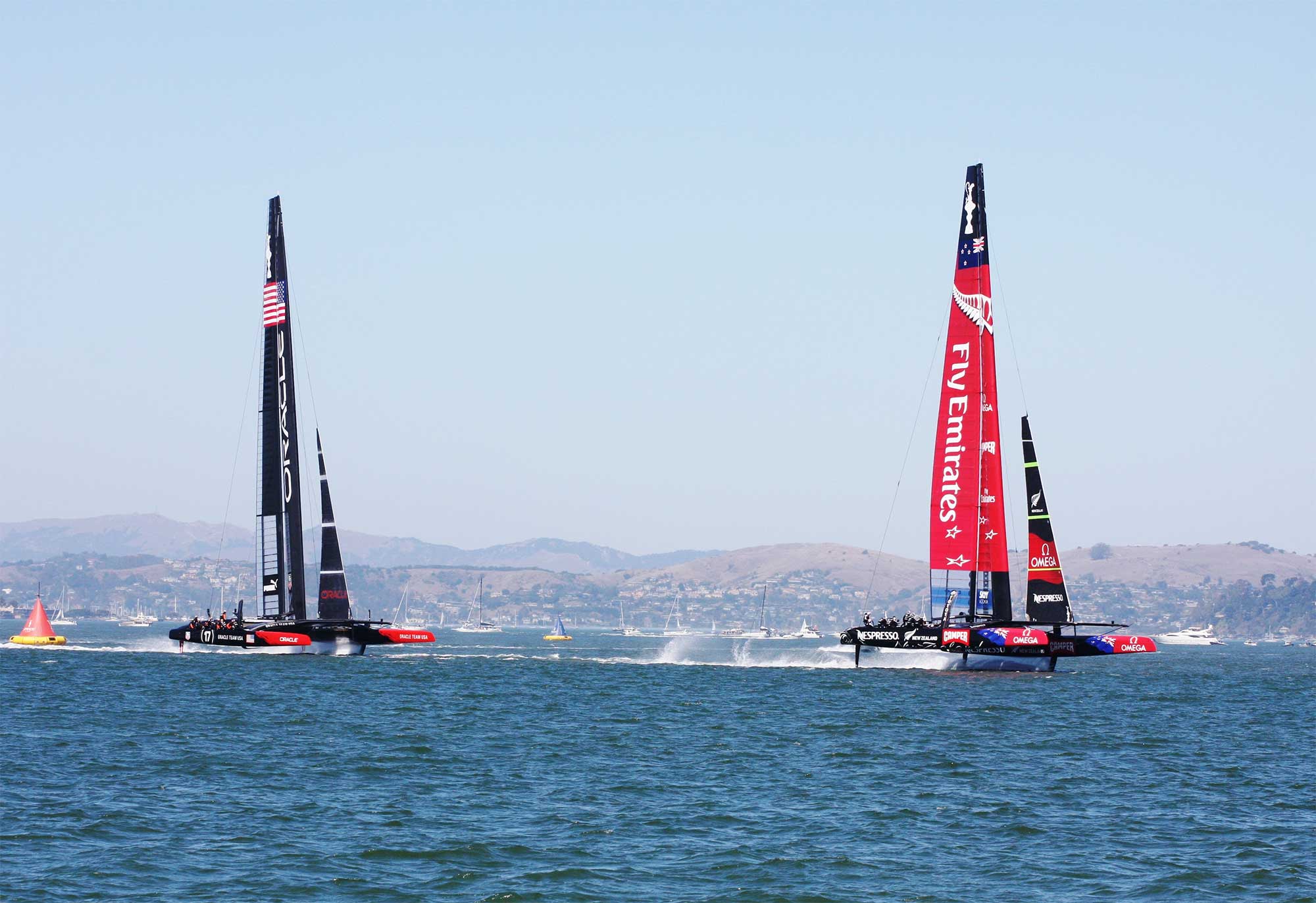
    The next Cup adopted the 22-metre AC72 catamaran. These boats combined light carbon structures, rigid wings and hydrofoils. Emirates Team New Zealand developed a configuration that allowed the catamaran to rise clear of the water and remain supported by its appendages.

    This was the decisive break with the past. A conventional yacht pushes its hull through water. A foiling catamaran lifts its hulls above the surface. Wetted area falls sharply. Speed rises until aerodynamic drag, foil drag, cavitation risk and control limits become the main constraints.

    The AC72s exceeded 40 knots. They were spectacular and dangerous. The death of Artemis Racing sailor Andrew Simpson during training in 2013 was a brutal reminder that innovation had moved faster than the sport’s safety margin.

    For 2017, the Cup moved to smaller AC50 catamarans. Emirates Team New Zealand introduced cyclists, or cyclors, to generate hydraulic power more efficiently than conventional arm grinders. Its boat exceeded 46 knots and defeated Oracle Team USA seven races to one.

    The AC75 That Made Controlled Flight the New Normal

    After winning in Bermuda, Emirates Team New Zealand replaced the catamaran with a radical concept: a 20.7-metre foiling monohull.

    The AC75 has no conventional ballast keel. It uses two canting foil arms. One foil is lowered to provide lift and lateral resistance. The windward foil is raised and acts partly as movable ballast. A rudder elevator controls pitch. Flaps on the submerged foil regulate lift.

    Above deck, a twin-skin mainsail forms a soft wing around the mast. It offers much of the aerodynamic logic of a rigid wing, but can be hoisted, lowered and reshaped.

    The second-generation AC75s raced in Barcelona in 2024 weighed about 6,200 kilograms without crew and carried eight sailors. They combined carbon structures, hydraulics, electronic flight controls, advanced software and hundreds of sensors.

    INEOS Britannia reported 120,000 components, more than 700 sensors and channels, and over 30,000 data channels on its 2024 boat. During Race 8 of the Louis Vuitton Cup Final, the British team recorded 55.6 knots, equal to 103 km/h.

    This performance did not come from one invention. It came from control. At 50 knots, a small error in pitch can cause a crash within seconds. The crew must manage ride height, foil loading, sail shape, energy, course position and tactics at the same time.

    The 38th America’s Cup is scheduled for Naples in 2027. It will retain the AC75 and AC40 platforms. Existing teams must reuse their previous AC75 hulls where available. The crew will fall to five sailors. Battery power will replace much of the human-generated hydraulic energy. A €75 million team cost cap is intended to contain escalation without ending development.

    The Technologies That Reached Cruising Yachts

    The Cup does not transfer complete boats into the cruising market. An AC75 would be an absurd offshore cruiser. It has extreme systems, limited practical payload and no tolerance for neglected maintenance.

    The transfer happens in layers.

    The Composite Structures That Reduce Weight and Fatigue

    Carbon fibre, structural foams, bonded components and engineered load paths are now common in premium yacht construction. Racing accelerated their adoption and improved manufacturing discipline.

    For a cruising yacht, lower structural weight can support more payload, a stronger safety margin or better light-wind performance. Stiffness also helps preserve rig geometry and sail shape.

    The specification must be different. A race boat is optimised for a short competitive life. A bluewater yacht must withstand repeated slamming, ultraviolet exposure, thermal cycles and imperfect maintenance. The correct goal is not minimum weight. It is minimum unnecessary weight.

    The Sail Technology That Preserves Shape

    Moulded composite sails, fibre mapping and aerodynamic simulation have moved directly into high-end cruising.

    A sail that holds its shape generates less drag and more drive. It also reduces heel and rudder load. On passage, that can improve average speed without pushing the boat harder. It can also reduce autopilot effort and electrical consumption.

    This transfer is particularly valuable because it improves both performance and control. A stable sail shape makes the yacht more predictable. That matters more offshore than a brief increase in peak speed.

    The Digital Tools That Predict Behaviour Before Launch

    Modern designers routinely use computational fluid dynamics, finite-element analysis and velocity prediction programs. These tools were not invented by the America’s Cup. The Cup accelerated their marine use and created a culture of validation.

    For an offshore catamaran, simulation can examine bridge-deck clearance, wave impact, structural fatigue, appendage loads and aerodynamic balance under realistic loading.

    Digital models reduce guesswork. They do not replace sea trials. They allow naval architects to arrive at the testing stage with better questions and fewer fundamental uncertainties.

    The Foil Research That Improved Appendages

    Most cruising yachts do not need to fly. Full foiling creates draft, complexity, impact risk and maintenance demands that conflict with remote cruising.

    Yet America’s Cup foil research has improved rudders, daggerboards, centreboards and keel profiles. Designers now understand ventilation, cavitation, section shape and load distribution more precisely.

    Some performance cruising multihulls use foil-assisted appendages to reduce effective displacement or control pitching. The concept can work. It must be judged honestly.

    A small speed gain is worthless if the system becomes vulnerable to collision, marine growth or hydraulic failure far from support. Offshore engineering must consider the consequences of failure, not merely the benefits of correct operation.

    The Control Systems That Reduce Crew Workload

    Load sensors, hydraulic controls, electric winches, integrated displays and advanced autopilots have roots across racing, aerospace and industrial engineering. The Cup has forced them to become faster, lighter and more accurate.

    For cruising, the purpose is different. The goal is not to complete a tack in seconds. It is to let a small crew manage a large yacht safely.

    Automation is useful when it supports judgement. It becomes dangerous when it hides failure modes. Offshore systems should remain diagnosable. Critical functions should have manual or redundant alternatives.

    The best cruising control system is not necessarily the most sophisticated one. It is the system that remains understandable at 03:00, in poor weather, when the nearest technician is thousands of kilometres away.

    The Offshore Lesson That Matters More Than Speed

    At Privilège Marine, we do not believe a bluewater catamaran should imitate an America’s Cup boat. The missions are opposite.

    A Cup boat must be fastest for a few races. An offshore yacht must remain capable after weeks at sea. It carries water, fuel, tenders, tools, food, personal equipment and safety systems. It must sail in waves that would stop Cup racing. It must remain manageable by an owner and a small crew.

    The relevant America’s Cup legacy is therefore methodological.

    Measure loads. Reduce drag. Control weight. Preserve sail shape. Validate structures. Improve ergonomics. Collect useful data. Design systems as parts of one coherent platform. Then apply reliability before spectacle.

    The best cruising innovation is rarely the most visible. It may be a lighter structure that allows more equipment without overloading the boat. It may be a sail that keeps its shape for thousands of hours. It may be an autopilot that uses less energy because the hull and rig are balanced.

    It may also be a machinery space that allows a pump, filter or electrical component to be reached and replaced at sea. Access is not glamorous. Offshore, it is a performance feature.

    This distinction is essential. Racing technology asks how far performance can be pushed. Bluewater engineering asks how much useful performance can be preserved without compromising safety, comfort or independence.

    The Future That Will Be Faster but More Selective

    The America’s Cup has moved from carved wooden hulls to aircraft-like control systems in less than two centuries. Its boats became faster because designers attacked every source of resistance and uncertainty.

    The next advance may not be another great jump in peak speed. Beyond 100 km/h, control, reliability, cost and safety matter as much as acceleration. The 2027 rules already reflect that reality through hull reuse, a cost cap and stored electrical power.

    The Cup will continue to produce ideas that appear excessive. That is its function. It provides a place where designers can test the outer edge of possibility.

    The cruising industry should watch closely, but copy selectively. The enduring achievement of the America’s Cup is not the flying yacht itself. It is the discipline behind it: understand the forces, remove waste, manage energy and build the boat as a coherent system.

    That discipline belongs on every serious ocean-going yacht.

  • The Hidden Geometry That Decides How a Yacht Really Sails

    The Hidden Geometry That Decides How a Yacht Really Sails

    A clear guide to keel types, foils and daggerboards, and how each choice changes stability, speed, draft and offshore comfort.

    A keel is not just a piece of structure below a yacht. It is one of the design decisions that defines how the boat moves, heels, tracks, turns, accelerates, dries out, grounds, and survives heavy weather. On a monohull, the keel normally carries ballast and creates both righting moment and lateral resistance. On a multihull, stability comes mainly from beam, not ballast, so the underwater appendages serve a different purpose: they reduce leeway, protect the hulls, manage draft, or, in extreme cases, create lift. That distinction matters. A long keel favours tracking and protection. A cruising fin keel balances performance and usability. A racing fin keel cuts drag and adds leverage. A canting keel separates ballast from symmetry. Daggerboards sharpen windward performance. Foils change the equation again by lifting part of the boat out of the water. There is no universal winner. There are only honest trade-offs.

    The keel is the boat’s hidden contract with the sea

    At Privilège Marine, we look at appendages through a bluewater lens. A yacht must sail well, but it must also remain understandable, serviceable and safe when the nearest shipyard is several days away. That is why the debate around sailboat keel types should never be reduced to speed alone.

    A keel performs two main functions. First, it resists sideways drift, known as leeway. Second, on a monohull, it often carries ballast, which helps the yacht stand back up after being pushed over by the wind. These two jobs are not identical. A deep, narrow foil creates efficient lateral lift. A heavy bulb placed low creates stability. Designers combine these functions in many ways.

    On a catamaran or trimaran, the story changes. The boat does not rely on a deep ballast keel to stay upright. Its wide stance creates stability. A Privilège Signature 510, for example, has a beam of 7.98 metres (26 ft), a draft of 1.57 metres (5 ft 10 in) and a light displacement of 16.8 tonnes. The larger Signature 650 has a beam of 9.20 metres (30 ft 2 in) and a draft of 2.04 metres (6 ft 8 in). These figures show the point clearly: a bluewater cruising catamaran gains stability from its platform, not from dragging several tonnes of lead deep below the hull.

    That is why the language must be precise. A “keel” on a monohull is usually a ballasted appendage. A “keel” on a cruising catamaran is often a shallow fixed fin or skeg-like structure that protects the hull and provides lateral resistance. It is not the same object, even if the word is the same.

    The long keel trades speed for tracking and protection

    The long keel, often called a full keel in English, is the oldest serious offshore solution. It runs along much of the hull length. It gives directional stability, protects the rudder and propeller, and gives the boat a steady feel at sea. In heavy following seas, that steadiness can be reassuring.

    The price is agility. A long-keel yacht does not tack with the crispness of a modern fin-keeler. It also reverses poorly in marinas. The boat likes to go straight. That is valuable offshore and frustrating in tight harbours.

    Brands such as Island Packet have long defended the concept for offshore cruising. Their “Full Foil Keel” approach is built around seakeeping, grounding protection and control. This makes sense for conservative bluewater owners. It makes less sense for sailors who want acceleration, pointing ability and lively handling.

    The frank view is simple: a long keel is not slow because it is badly designed. It is slower because it accepts more wetted surface and less hydrodynamic efficiency in exchange for tracking, protection and psychological comfort. For some owners, that is a fair exchange. For others, it is a brake.

    The centreboard brings freedom in shallow water

    The French term “dérive” can be misleading when translated into English. In most yacht contexts, the right words are centreboard, swing keel, lifting keel, or daggerboard, depending on the geometry. If the board pivots, “centreboard” or “swing keel” is usually correct. If it moves vertically, “daggerboard” or “lifting board” is more precise. If its angle can be adjusted for performance, “adjustable daggerboard” or “canted daggerboard” may be appropriate.

    A centreboard lets a yacht reduce draft in shallow water and increase lateral resistance offshore. This is useful in tidal regions, lagoons, rivers and shoal cruising grounds. It allows a boat to explore anchorages that a deep fin keel cannot reach.

    The trade-off is engineering. A centreboard case occupies interior volume. The pivot, lifting system and sealing surfaces require inspection. In a grounding, the loads can be severe. On a serious cruising yacht, the system must be simple, strong and accessible. If it is not, the promise of versatility becomes a maintenance liability.

    The RM 1380 is a useful example of the concept in practice. It offers either twin keels with a draft of 1.95 metres (6 ft 5 in), or a lifting keel with draft ranging from 1.45 metres to 3.35 metres (4 ft 9 in to 11 ft). That spread shows the power of the idea: shallow-water access when lifted, deep lateral plane when lowered.

    The bilge keel puts tidal freedom ahead of peak speed

    The bilge keel, or twin keel, uses two shallow keels placed to port and starboard. It is often seen in tidal regions such as Britain and northern France, where boats may need to dry out upright on mud, sand or a harbour bed.

    Its advantage is practical. A twin-keel yacht can take the ground without a cradle. It can also reduce draft and protect the hull in coastal cruising. For sailors who operate in tidal harbours, this matters more than an extra half-knot of theoretical speed.

    The cost is hydrodynamic. Two keels create more wetted surface. They are usually less efficient upwind than a single deep fin. As the boat heels, the immersed keel may not produce the same clean lift as a deep central foil. The result is more leeway and lower pointing ability.

    This does not make the bilge keel a poor design. It makes it a regional and operational design. If the yacht’s life includes drying harbours and shallow estuaries, it is rational. If the programme is ocean passage-making with long upwind legs, it is less convincing.

    The cruising fin keel became the modern default for good reason

    The cruising fin keel is the most common compromise in modern monohull yacht design. It is shorter than a long keel, deeper and more efficient, with a separate spade rudder. It gives better manoeuvrability, better tacking and less wetted surface.

    A family cruiser such as the Beneteau Oceanis 30.1 illustrates the range. It is offered with draft options from about 1.30 metres (4 ft 3 in) to 2.30 metres (7 ft 7 in), depending on configuration. Larger cruisers follow the same logic. The Oceanis 47 lists a minimum draft of 1.87 metres (6 ft 2 in) and a maximum draft of 2.47 metres (8 ft 1 in). The owner chooses between shallow-water convenience and deeper-water efficiency.

    The cruising fin keel is not glamorous, but it is effective. It works for coastal cruising, club racing, charter fleets and offshore passages. It gives acceptable speed without radical systems. It is also easier to produce at scale.

    Its weakness is exposure. A fin keel is more concentrated structurally than a long keel. Grounding loads are transferred through a smaller area. The keel-to-hull structure must therefore be engineered and inspected properly. When owners neglect this, the problem is not the concept. It is maintenance and structure.

    The racing fin keel turns ballast into leverage

    The racing fin keel is more extreme. It is deeper, narrower and often carries a bulb at the bottom. The objective is to place ballast as low as possible while reducing drag. The fin provides lateral resistance. The bulb provides stability. The hull can then be lighter, wider and more powerful.

    This is the world of sportboats, grand-prix racers and offshore race yachts. The J/70, for example, uses a lifting keel with a stainless-steel structure and lead bulb. It is only 6.93 metres (22 ft 9 in) long, with a draft of 1.50 metres (4 ft 11 in), displacement of 795 kg and ballast of 285 kg. Those numbers show a simple principle: even a small racing keelboat uses ballast depth to turn sail power into speed.

    The deeper the keel, the more efficient the righting moment. But there are costs. Deep draft limits cruising grounds. The structure must be precise. The boat may be harder to handle in shallow marinas. For a racing crew, those costs are acceptable. For a bluewater family yacht, they often are not.

    A racing fin keel is not “better” than a cruising fin keel. It is narrower in purpose. It converts design freedom into performance, then charges the owner in draft, loads and operational limits.

    Bateau privilege

    The canting keel changes the physics of righting moment

    The canting keel is one of the most important inventions in modern offshore racing. Instead of keeping the ballast on the centreline, hydraulic rams swing the keel to windward. This increases the horizontal distance between the ballast and the centre of buoyancy. In plain English, the same ballast becomes more powerful.

    The Volvo Ocean 65 is a clear example. It is a 22.14-metre (72 ft 8 in) offshore racing monohull with a maximum draft of 4.78 metres (15 ft 8 in), an empty weight of 12,500 kg, and a canting keel that moves to plus or minus 40 degrees. It also carries twin daggerboards and ballast tanks. That is not a cruising compromise. It is an integrated racing machine.

    The benefit is speed. The yacht can carry more sail area for the same ballast weight. It can remain powerful in conditions that would force a conventional keelboat to reef earlier.

    The cost is complexity. A canting keel depends on bearings, rams, hydraulics, sensors and emergency systems. It also loses lateral efficiency when canted because the keel is no longer vertical. That is why canting-keel yachts usually need daggerboards or foils to provide side force. The ballast does the stabilising. The boards do the gripping.

    For a race boat, that separation is brilliant. For a cruising yacht, it is usually excessive.

    The canting keel with daggerboards separates power from grip

    The combination of canting keel and daggerboards is central to IMOCA 60s and other high-performance offshore monohulls. The IMOCA class is limited to 18.28 metres (60 ft), with boats built to be light, powerful and strong enough for the Vendée Globe. Modern IMOCA yachts use a canting keel for righting moment, two rudders, and either foils or daggerboards for lateral resistance and lift.

    This architecture is sophisticated because it breaks the old logic of the keel. The keel is no longer expected to do everything. Once it cants to windward, its job is primarily to create stability. The daggerboard or foil on the leeward side generates much of the side force needed to stop the boat sliding sideways.

    The performance gain is real. Designers can reduce displacement, increase sail power and manage the hydrodynamic load more precisely. But the system demands skill. Board angle, foil rake, keel cant and rudder load all interact. If the crew gets the setup wrong, the boat can become slower, not faster.

    This is the point often missed in simplified discussions of “advanced keels”. The faster the appendage package becomes, the more it becomes a system. The keel is no longer a single answer. It is part of a moving network of loads.

    The foils turn appendages into lifting surfaces

    The foils debate is sometimes romanticised. Foils do not magically make every yacht better. They create hydrodynamic lift. That lift can reduce displacement, cut hull drag and increase speed. But foils also add load, ventilation risk, impact exposure and structural complexity.

    In the America’s Cup, the AC75 goes further than almost any other monohull. It has no conventional keel. Its large canting foil arms provide lift and righting leverage, while the boat flies on the leeward foil with the windward arm raised. It is a spectacular technical answer to a racing rule. It is not a sensible template for ocean cruising.

    In the Ultim trimaran world, foils have pushed offshore multihulls into another speed category. The 32-metre Gitana 17, Maxi Edmond de Rothschild, has exceeded 40 knots under sail. The newer Gitana 18, also 32 metres, has been reported with foil wings spanning more than 10 metres and a design objective centred on sustained ocean flight. These boats are laboratories as much as yachts.

    On IMOCA 60s, foils have transformed reaching performance. They help lift the hull, reduce drag and stabilise the boat at high speed. Yet they remain retractable because offshore reality is brutal. Floating objects, slamming loads and Southern Ocean sea states punish exposed appendages.

    For cruising owners, the honest conclusion is clear. Foils are fascinating. They are not automatically appropriate. A yacht designed for private bluewater voyaging must prioritise repeatable performance, repairability and comfort. Flying is exciting. Arriving safely matters more.

    The multihull problem is different from the monohull problem

    A multihull does not need a heavy keel to stand up. It relies on beam. This single fact changes the entire appendage debate.

    On a catamaran, underwater fins mainly reduce leeway and help the boat sail closer to the wind. They may also protect the hull, propeller and rudder. They are not ballast keels. That is why comparing a monohull keel with a catamaran keel can be misleading.

    A fixed mini-keel on a cruising catamaran is simple, strong and useful. It protects the hull if the boat touches bottom. It allows moderate draft. It does not intrude into the living space. It requires little handling. For a long-distance cruising catamaran, these are serious advantages.

    A daggerboard catamaran can sail higher and faster, especially upwind. The board is a more efficient foil. It can be lifted off the wind to reduce drag and lowered upwind to increase grip. Performance catamarans use this logic well.

    But daggerboards bring trade-offs. The cases take interior space. The boards need controls. They can be damaged by grounding or debris. If a board jams offshore, the owner must solve the problem at sea.

    At Privilège Marine, our design culture is shaped by bluewater cruising. The aim is not to win a windward-leeward race. It is to cross oceans with confidence, carry stores, protect the crew, and offer a stable life aboard. That is why draft, appendage protection, structural simplicity and helm balance matter as much as pure speed.

    The fixed mini-keel prioritises reliability on cruising catamarans

    The fixed mini-keel is often underestimated because it is not fashionable. It should not be. On a cruising catamaran, it offers a practical package: shallow draft, hull protection, simple construction and predictable handling.

    For an owner planning the Caribbean, the Pacific islands or long Mediterranean passages, these qualities count. The yacht can approach anchorages with less anxiety. There is no board to raise before every shoal. There is no case cutting through the accommodation. There is less to break.

    The performance penalty exists. A fixed mini-keel creates more drag than a clean retractable daggerboard when the board is correctly managed. It also points lower. A performance catamaran may feel sharper and faster with daggerboards.

    The question is not whether one is faster. The question is whether the speed gain is worth the operational cost. For many luxury bluewater catamaran owners, the answer is no. Ease of use is not a weakness. It is a design requirement.

    The daggerboard rewards active sailors

    The catamaran daggerboard is the performance sailor’s answer to leeway. It gives a deeper, cleaner foil without forcing the whole boat to carry permanent draft. Upwind, it improves lift. Reaching and running, it can be lifted to reduce drag.

    This is an elegant solution for sailors who enjoy trimming the boat actively. It is also useful in light displacement multihulls, where small reductions in drag produce visible speed gains.

    But the board is not free. It adds structure, cost and handling. It can slam in its case if poorly controlled. It can be damaged by grounding. It can create noise. It can also give the owner another system to manage when conditions deteriorate.

    For a performance crew, that is acceptable. For a family crossing an ocean at night, simplicity may have more value than a few degrees of pointing ability.

    The real choice is not speed versus comfort, but risk versus purpose

    The keel conversation is often framed badly. People ask which keel is best. The better question is: best for what?

    A long keel is credible for conservative offshore voyaging. A bilge keel is rational for tidal cruising. A cruising fin keel is the modern mainstream because it balances performance, cost and handling. A racing fin keel is a lever for speed. A canting keel is a racing tool. A canting keel with daggerboards is a system for elite offshore performance. Foils are a separate revolution, powerful but unforgiving. On multihulls, fixed keels, daggerboards and foils are not substitutes for ballast. They are instruments for grip, protection and lift.

    For Privilège Marine, the priority is clear. A bluewater catamaran must be safe, balanced, repairable and calm enough to make distance without exhausting its crew. Performance matters. But performance without serenity is the wrong bargain for an owner’s yacht.

    The underside of a yacht rarely appears in the brochure photograph. Yet it is where much of the truth lives. The keel, board or foil decides how much freedom the owner really has: freedom to cross oceans, freedom to enter shallow anchorages, freedom to sail efficiently, and freedom from unnecessary complication. That is why appendage design is not a technical footnote. It is one of the most honest statements a naval architect makes.