Privilège Global Care turns yacht delivery into long-term support through rapid response, global partners and mobile technical teams.
A long-range yacht is not finished when ownership changes hands. It enters a harder phase: real use across changing climates, service cultures and time zones. Privilège Global Care is designed for that reality. Each owner gains a direct communication structure, including a dedicated WhatsApp group and a commitment to acknowledge requests within 24 hours. Behind that first contact sits a growing network of technical partners across the Mediterranean, the Caribbean, the United States and the Pacific. When work requires shipyard knowledge, Privilège Marine can send mobile teams to the yacht rather than forcing the owner to return to France. The purpose is not to promise that nothing will fail. No serious shipyard should make that claim. It is to diagnose clearly, coordinate the right people and remain accountable over the long term. New after-sales packages and a structured refit programme are now being prepared to extend that commitment.
The Delivery Starts the Operating Relationship
The marine industry still places too much emphasis on delivery day. The yacht is polished, the documents are signed and the photographs are taken. Yet for an owner planning long-distance cruising, that ceremony is when the product begins to prove itself.
A bluewater catamaran is a network of interconnected systems. Engines, generators, batteries, inverters, pumps, watermakers, refrigeration, navigation electronics and domestic equipment must operate together. They face salt, heat, vibration, humidity and repeated load cycles. Even well-engineered equipment requires adjustment, maintenance and repair.
That is why catamaran after-sales service cannot be treated as a warranty desk. It must function as an operating relationship. The owner needs people who understand the yacht as built, not merely the component that has raised an alarm.
Privilège Marine has built ocean-going catamarans in Les Sables-d’Olonne for more than 40 years. Its yachts are conceived for owners who may spend months away from the shipyard. A World ARC circumnavigation covers about 48,152 kilometres (26,000 nautical miles) over 15 months. Even an Atlantic crossing from Gran Canaria to Saint Lucia is roughly 5,000 kilometres (2,700 nautical miles). At those distances, support cannot depend on proximity to France.
The First Response Must Create Clarity
Every Privilège owner can be connected through a dedicated WhatsApp group. This creates a direct channel between the yacht, the owner or captain and the relevant Privilège Marine contacts.
A photograph of a leaking fitting, a video of an unusual pump cycle or an alarm message can be shared immediately. The shipyard can review the yacht’s specification and determine whether the issue concerns operation, adjustment, a supplier component or deeper intervention.
Privilège Marine commits to acknowledging requests within 24 hours. The wording matters. An acknowledgement is not a completed repair. A responsible service organisation should not disguise uncertainty with an artificial deadline. The first obligation is to confirm receipt, establish urgency, identify the technical lead and explain the next step.
Some matters can be resolved remotely. Others require a local technician, a replacement part or a shipyard intervention. The owner should know which category applies and who is responsible.
The Global Network Connects Local Skills to the Shipyard
No shipyard can maintain permanent teams in every marina. The credible model is a controlled partner network combining geographical reach with access to the builder’s technical knowledge.
Privilège Marine is developing bluewater catamaran support through partners in the Mediterranean, the Caribbean, the United States and the Pacific. These regions cover many principal cruising routes, but their suppliers, lead times and labour structures differ.
The network therefore does more than provide an address. Privilège can help define the work, communicate technical information and coordinate with the owner, captain, marina, equipment manufacturer and local contractor. This reduces a common source of repair failure: several competent parties working without a single technical narrative.
The objective is an offshore sailing support network in which local execution remains connected to the yacht’s original engineering logic.
The Mobile Teams Go Where Builder Knowledge Is Required
Some repairs should not be delegated. They may involve structural work, bespoke joinery, complex system integration or a modification whose effects extend beyond one component. In these cases, Privilège Marine can deploy mobile teams to the yacht.
Returning a large catamaran to Les Sables-d’Olonne may be unreasonable. The vessel could be in Greece, the Caribbean or the Pacific, with a fixed cruising programme and seasonal weather constraints. Moving it thousands of kilometres for one intervention may create more cost and risk than the repair itself.
A mobile response brings the required competence to the vessel. The team can inspect the issue, perform or supervise the work and coordinate local resources. When a repair must be carried out by Privilège Marine, the owner should not be left to recreate the shipyard through unrelated subcontractors.
Mobility is a condition of global support.
The Communication Record Protects Long-Term Value
Fast messaging is useful, but long-term support requires memory. Every diagnosis, replacement, adjustment and upgrade contributes to the yacht’s technical history.
A mature process should connect conversations with drawings, supplier references, photographs and completed work. This helps future technicians understand what changed and why. It also matters when the yacht changes captain, cruising area or ownership.
Privilège Marine’s role is to maintain communication beyond the immediate repair. Owners should receive progress updates when several parties are involved. They should also be told directly when a delay depends on parts, access or a third-party supplier.
Social media adds continuity. It allows the shipyard to follow owners’ voyages, share guidance and maintain the Privilège community across continents. It is not a substitute for technical reporting. Safety-critical or confidential matters belong in dedicated channels. Used correctly, however, social media helps small concerns surface before they become expensive failures.
The New Packages Will Extend the Ownership Cycle
Privilège Marine is preparing a dedicated after-sales package to make support more legible and predictable. A structured offer can clarify contacts, planned inspections, technical reviews, service coordination and work outside normal warranty obligations.
The shipyard is also developing a Privilège refit programme, to be announced separately. This is a logical extension of Global Care. A yacht designed for decades of use will eventually need more than maintenance. Electronics become obsolete. Energy systems improve. Interiors age. Ownership programmes change.
Refit work is strongest when it respects the original naval architecture and system integration. The builder can distinguish between a useful upgrade and a modification that adds weight, complexity or maintenance risk.
The Strongest Warranty Is Continued Accountability
No after-sales organisation can remove distance, weather, supplier delays or physical wear. It can remove ambiguity.
That is the meaning of Privilège Global Care. The owner knows how to make contact. The request is acknowledged. The case is assessed. Local partners can be coordinated. Mobile shipyard teams can intervene when necessary. The conversation continues after the invoice and after the warranty period.
For a coastal boat, support is convenient. For a long-range Privilège, it is part of seaworthiness. Owners are not buying the fiction of a yacht that will never need attention. They are buying something more credible: a shipyard that remains present after delivery.
Inside the engineering, craftsmanship and owner-led choices that turn each Privilège catamaran into a bluewater home built to travel.
A Privilège catamaran has a recognisable identity because its design starts with the owner’s life and remains grounded in offshore reality. The yacht must cross oceans safely, support long periods aboard and retain the calm atmosphere of a private home. Naval architecture, structural construction, protected working areas, storage, tankage and technical access establish the foundation. The owner then works with the shipyard to define layouts, equipment, materials, fabrics, colours and practical details. A cabin can become an office, gym, cinema, studio or technical store. Joinery can be adapted to personal objects and routines. Textiles can be selected for climate, use and maintenance. Skilled composite specialists, carpenters, fitters, electricians and finishers turn those decisions into a coherent yacht. Each Privilège is an owner’s yacht, created for a specific way of sailing and living.
The identity begins with the owner’s life at sea
A Privilège project begins with a direct question: how will the owner actually use the yacht?
The answer may describe a couple planning a circumnavigation without permanent crew, a family spending several months each year aboard, or an owner sailing with a captain while receiving guests. Some need a serious office. Others require diving storage, larger freezers, a workshop, a school area, a library or dedicated space for sports equipment.
These differences affect the whole yacht. They influence cabin numbers, circulation, galley position, storage, energy production, refrigeration, crew accommodation and maintenance access. They also determine where the owners sleep, work and recover during a passage.
This is the basis of the bespoke Privilège catamaran. Personalisation means translating a life plan into a technically coherent vessel. The shipyard must protect weight distribution, structural integrity, ventilation, access and safety while responding to personal requests.
Privilège states that owners generally spend two or three days at the shipyard configuring their yacht. The process covers layouts, electronic and technical equipment, surface finishes, wood species, colours, fabrics and coverings. Many decisions interact. A larger appliance changes the power budget. A cabin converted into an office needs lighting, ventilation, connectivity and storage. Custom furniture may affect circulation or access to equipment behind it.
The relationship resembles a commission rather than a conventional purchase. The owner brings habits and ambitions. The shipyard brings naval architecture, construction knowledge and the discipline required to make the result reliable.
The offshore foundation supports the home
A Privilège remains a luxury bluewater catamaran before it becomes a home. Comfort depends on the yacht’s ability to carry its owners safely and calmly across distance.
The Signature 510 has an overall length of 17.09 metres (56 feet), a beam of 7.98 metres (26 feet), a full-load displacement of 22.8 tonnes and a sail area of 165 square metres (1,776 square feet). It carries 800 litres (211 US gallons) of fuel and 600 litres (158 US gallons) of fresh water. Its protected helm station provides visibility while remaining connected to the cockpit.
The Signature 600 measures 18.28 metres (60 feet), has a beam of 9.18 metres (30 feet 1 inch) and reaches 35 tonnes at full load. Its 259-square-metre (2,788-square-foot) sail plan includes a mainsail, genoa and staysail. Fuel capacity is 970 litres (256 US gallons), while fresh-water capacity is 900 litres (238 US gallons).
The Signature 650 has a hull length of 19.60 metres (64 feet 4 inches), a beam of 9.20 metres (30 feet 2 inches), a full-load displacement of 37 tonnes and fuel capacity of 2,000 litres (528 US gallons). It can carry 1,300 litres (343 US gallons) of fresh water.
These figures matter because autonomy is physical. Fuel, water, storage, refrigeration, spare parts and energy systems consume space and payload. A yacht intended for ocean crossings must carry them without turning daily life into a compromise.
The models carry CE Category A certification. Under European rules, Category A covers recreational craft designed for conditions where winds may exceed Beaufort Force 8 and significant wave height may exceed 4 metres (13 feet), excluding abnormal conditions such as hurricanes, extreme sea states and rogue waves. It is a design classification linked to stability, buoyancy, handling and other essential requirements.
Protected helm positions, secure circulation, balanced sail plans and accessible systems also protect the crew from fatigue. A difficult deck layout increases exposure. Poor storage creates repeated work. Offshore safety is closely connected to the quality of daily life.
The central owner’s suite defines the architecture
The forward owner’s suite in the nacelle is one of the clearest signatures of a Privilège.
On the Signature 510, the full-beam suite occupies the forward central section and is presented by the shipyard as the largest in its category. Its position creates panoramic views, natural light and separation from guest cabins in the hulls. The Signature 650 develops the same idea on a larger scale, creating a private apartment within the yacht.
This arrangement reflects owner-focused yacht design. Many production catamarans maximise cabin count because equal cabins and high occupancy suit charter. A private yacht follows another logic. Owners living aboard for months need privacy, storage, acoustic comfort and a space that still feels personal after a long passage.
The suite is an architectural decision rather than a decorative upgrade. Its position affects structure, windows, circulation, ventilation and the relationship between the saloon and sleeping areas. The owner can then refine wardrobes, desks, seating, lighting, bed orientation and bathroom arrangements. Each choice must support real use without obstructing maintenance or weakening the visual balance.
The customisation changes the yacht itself
A serious custom catamaran offers freedom in layout, equipment and atmosphere.
Each version requires different technical work. A cinema needs acoustic treatment, ventilation and integrated electronics. A gym needs secure fixing points, suitable flooring and safe clearances around the equipment. An office needs appropriate seating, controlled lighting, power, data connections and storage designed to hold equipment securely while sailing.
The shipyard must turn these ideas into spaces that look intentional and remain serviceable. The solution may require new furniture, a revised partition, concealed cable routes, reinforced mounting points or different access panels.
This distinction matters. Choosing a different cushion colour is an option. Converting a cabin into a working environment is a design project. It affects structure, services, lighting, acoustics, weight and circulation.
The technical specification supports autonomy
The same logic applies to onboard systems. A Mediterranean yacht, a family circumnavigation yacht and a semi-crewed yacht travelling between the Caribbean and the Pacific do not need the same energy, water or refrigeration capacity.
Solar generation, lithium batteries, inverters, watermakers, air conditioning, satellite communications and domestic appliances must be considered as one system. The electrical installation has to support normal consumption, peak demand and sensible reserves. Water production must correspond to the number of people aboard and their daily habits.
Weight distribution remains central. Heavy equipment cannot simply be placed wherever space appears available. Pumps and filters need access. Batteries require protection and ventilation. Cable routes must remain logical. Equipment likely to need regular servicing should not be buried behind permanent furniture.
The strongest specification gives the owner the required autonomy without creating unnecessary complexity. More equipment does not automatically produce a better yacht. Properly selected and integrated equipment does.
The fabrics and materials must survive the sea
Owners can select colours, fabrics, coverings, woods and surfaces. These choices establish the atmosphere of the yacht, yet appearance is only part of the decision.
Marine interiors face sunlight, humidity, salt, movement and frequent cleaning. Exterior textiles must tolerate ultraviolet exposure, spray and abrasion. Interior upholstery requires a balance between softness, durability, stain resistance and acoustic behaviour. Fabric used around a dining area faces different demands from material selected for a private cabin.
Privilège describes its approach through real wood, intelligent surfaces and composite structures chosen for durability, balance and tactile quality. The yard’s work is closer to interior architecture than simple decoration. Weight, fire behaviour, fixing methods, cleaning and access behind panels all matter.
The selection process must also consider where the yacht will sail. A boat spending long periods in tropical climates needs materials that cope with heat, powerful sunlight and humidity. A yacht used in northern waters may place greater emphasis on insulation, warmth and tactile comfort.
Fabrics influence sound as well as appearance. Upholstered panels, curtains, headboards and soft furniture absorb part of the noise reflected by hard surfaces. Their positioning can help create a calmer saloon or cabin, although textiles alone cannot correct poor acoustic planning.
A successful palette also requires restraint. A yacht places many visual elements within a compact volume. Woods, fabrics, wall coverings, flooring, metal finishes and lighting must work together through the saloon, cabins and circulation areas. Consistency creates calm. Too many competing finishes become tiring.
The purpose of custom yacht interiors is to create a personal environment that remains credible after years of use. Materials should still look appropriate after an Atlantic crossing, a tropical season and repeated daily living.
The craftsmanship appears in the unseen details
The quality of a yacht becomes clear in areas that receive little attention during a first visit.
It appears in doors that remain aligned after the structure has worked at sea. It appears in furniture that stays quiet during a night passage. It appears in the junction between a ceiling panel and a bulkhead, the finish around a locker and the way a service panel opens without dismantling half a cabin.
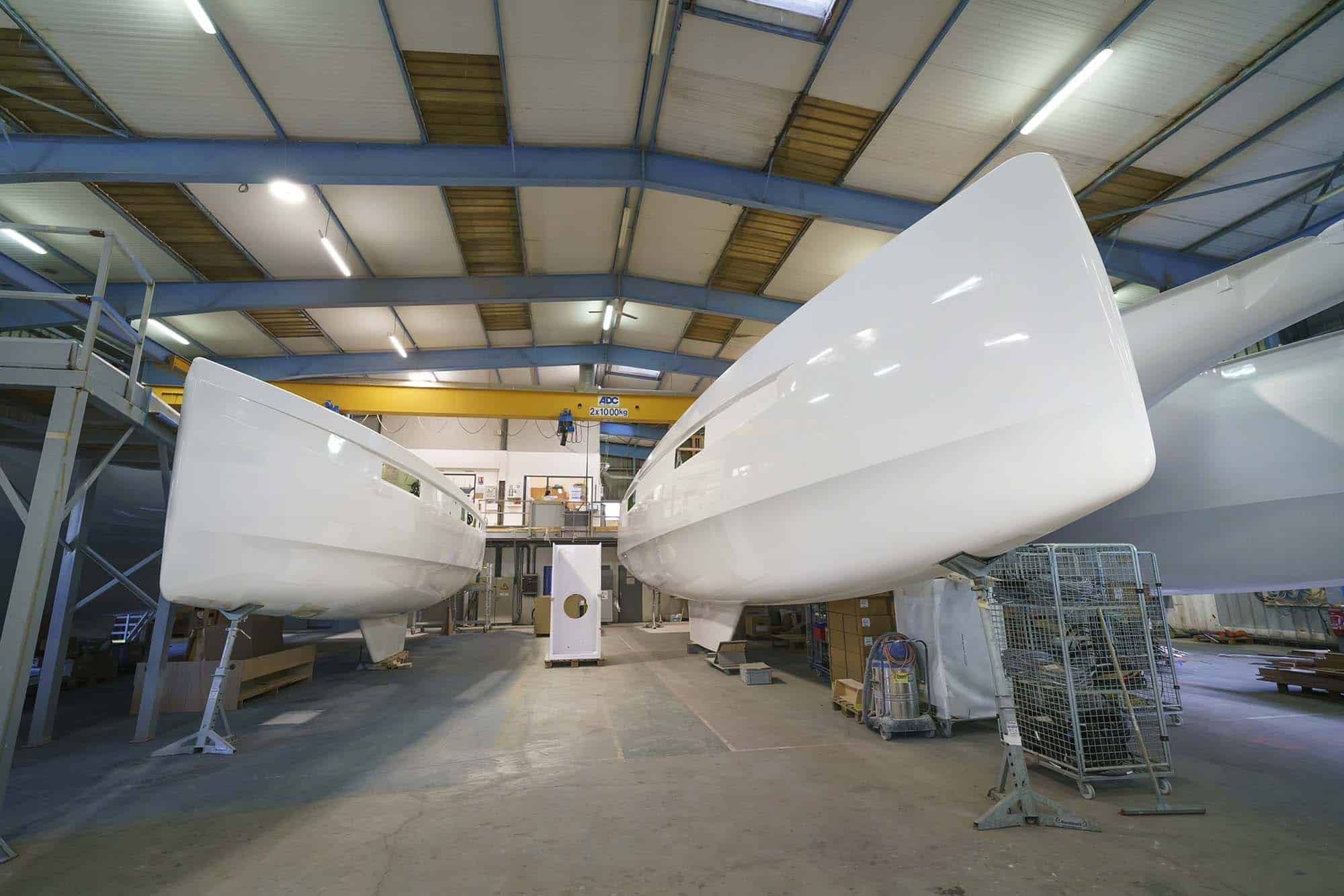
Privilège combines composite construction with detailed interior fitting in Les Sables-d’Olonne. Composite specialists prepare moulds, position reinforcement fabrics, complete the draping and manage infusion. These stages influence weight, consistency and structural quality.
Carpenters and fitters install ceilings, dress partitions, apply fine wood panels, assemble furniture and complete adjustment work aboard. Electricians, plumbers, mechanics, painters, upholsterers and finishers contribute to the same result.
Their work overlaps continuously. A cabinet may contain ventilation, wiring and access to a valve. A ceiling panel may conceal lighting, insulation and service routes. A bed base may provide storage while preserving access to technical components. The visible finish depends on how well these different trades have planned their work together.
This is why French catamaran craftsmanship cannot be reduced to visible woodwork. It is the coordination of many skills around one yacht. The owner sees a calm and coherent interior. Behind it sits a dense network of structural and technical decisions.
The people turn unusual requests into workable solutions
Custom yacht building produces requests without ready-made answers.
An owner may want to display a particular artwork, carry specialist sports equipment, install an unusual appliance, create a protected wine store or design a desk around professional equipment. Another may have precise mobility, cooking or watchkeeping requirements.
The valuable response begins by understanding the reason behind the request. Privilège teams examine dimensions, loads, fixing points, electrical demand, ventilation, drainage, sound and future maintenance. They may propose a different position, build a prototype, adjust a panel or redesign a piece of joinery.
This work also requires honesty. Added equipment creates weight. Large openings affect structure. Domestic expectations increase power demand. Complex mechanisms create maintenance. The shipyard’s responsibility is to find the strongest workable answer.
The extra mile is technical. It means solving a real problem and integrating the solution so well that it appears to have belonged in the yacht from the first drawing.
This approach depends heavily on experience. A skilled craftsperson often identifies a difficulty that remains invisible on a computer rendering. The person installing a cabinet may see that a hinge will become inconvenient at sea. An electrician may identify a better cable route. A fitter may suggest a removable panel that simplifies future maintenance.
These small interventions shape long-term ownership. They reduce noise, improve access and make the yacht easier to live with. They also explain why knowledge retained within the shipyard matters. A bespoke boat is built through hundreds of informed decisions made by people, rather than through a single dramatic design gesture.
Privilège also announced in April 2026 that SEA.AI would become standard across its catamaran range. The system uses optical and thermal cameras with onboard artificial intelligence to identify floating objects and other hazards that radar or AIS may fail to detect. The decision illustrates the same philosophy: innovation earns its place when it supports practical offshore vigilance.
The result carries a recognisable Privilège character
A Privilège has a clear design language, yet each yacht leaves the shipyard with its own identity.
The shared elements are structural seriousness, ocean capability, protected living areas, an owner-centred layout and detailed interior work. The differences come from the people who commissioned the yacht. Their route, family structure, working habits and aesthetic preferences shape the final result.
This balance is demanding. Standardisation makes production easier. Unlimited customisation can create technical inconsistency. Privilège works between the two. The platform retains the engineering discipline of a proven ocean-going catamaran. The project remains open enough to become a specific owner’s home.
That is what makes it a Privilège. The yacht can cross an ocean, protect the people aboard and support a private life with its own rhythm. Its materials have been chosen to last. Its systems have been integrated for real use. Its craftsmen have solved details that may never appear in a brochure.
The strongest expression of luxury is familiarity. The owner steps aboard and understands where everything belongs. The yacht follows routines that existed before it was built. It feels unique because it was created through a long conversation between people who know how to sail, people who know how to build and the person who will call it home.
Privilège turns ocean-racing heritage into structural strength, protected handling and genuine passage comfort for owners sailing beyond the marina.
A luxury catamaran may first attract attention through its interior, owner’s suite or exterior living spaces. Its deeper value appears once the coastline disappears. Structure, weight distribution, bridge-deck geometry, helm protection and ease of handling determine whether life aboard remains comfortable after several days at sea.
Privilège Marine approaches these questions through a culture shaped by Philippe Jeantot, winner of the first two BOC Challenges and founder of the Vendée Globe. His experience of solo circumnavigation established a clear design ethic: a yacht should remain strong, manageable and habitable when conditions become difficult.
That heritage continues through laminated structural bulkheads, vacuum-infused composite construction, protected helm stations, balanced sail plans and layouts developed around long-term ownership. Technology and expectations have evolved. The central purpose remains stable. A Privilège is conceived as a bluewater luxury catamaran whose refinement must work offshore, where comfort becomes part of safety and every design compromise eventually reveals itself.
The heritage that a hull cannot conceal
The word heritage appears throughout the luxury industry. It often refers to a founding date, an archive or a recognisable design language. In serious boatbuilding, heritage carries a more practical meaning. It influences the order in which engineering decisions are made.
Motorsport provides a useful comparison. Ferrari continues to develop cars around speed, engine response, aerodynamics and the relationship between driver and machine. Lamborghini interprets performance through a different mixture of mechanical force, architecture and visual theatre. Both companies adopt new materials, electronics and electrified powertrains. Market expectations change. Regulations change. Technology changes. Their core character still determines how those developments are applied.
Sailing places even greater pressure on this continuity. A yacht is an independent system operating in a moving and corrosive environment. It must generate and store energy, produce water, provide shelter, carry supplies and protect its occupants. It must continue functioning when shore-based support is several hundred nautical miles away.
The history of a shipyard therefore enters the boat through hundreds of decisions. It affects the amount of weight accepted in a structure. It shapes the position of the helm. It determines how rig loads pass through the yacht, how technical equipment can be reached and whether living spaces remain practical while the platform is moving.
At Privilège Marine, offshore DNA means designing from the sea inward. Strength, balance, handling and long-distance comfort establish the framework. Interior volume and personalization then develop within it.
This is a fundamentally different process from designing around accommodation density, charter capacity or immediate visual impact at a boat show. Each approach can serve a legitimate market. Only one begins with the demands of extended ocean sailing.
The racing record that became a design method
Philippe Jeantot came to sailing through endurance, technical discipline and self-reliance. Before becoming an offshore skipper, he worked as a professional deep-sea diver. In 1977, he participated in the COMEX Janus IV programme, during which divers reached a depth of 501 metres.
This background matters. Commercial diving requires detailed preparation and absolute confidence in equipment. Failure is treated as an engineering problem rather than an inconvenience. Jeantot later carried the same mentality into solo sailing.
He entered the inaugural BOC Challenge in 1982. The race covered more than 50,000 kilometres (27,000 nautical miles) around the world, with stopovers in Cape Town, Sydney and Rio de Janeiro before returning to Newport, Rhode Island.
One skipper had to manage the boat, navigation, weather analysis, repairs, sail changes, sleep and fear. Jeantot won aboard Crédit Agricole in 159 days, 2 hours and 26 minutes.
He returned for the 1986–1987 edition aboard Crédit Agricole III and won again in approximately 134 days. The second victory removed any suggestion that the first had resulted from favourable circumstances. It confirmed an exceptional understanding of offshore systems, human endurance and long-term boat management.
In 1989, Jeantot created the Vendée Globe in Les Sables-d’Olonne. The new race removed the stopovers. Its rule was direct: one skipper, one boat, around the world, without stopping and without outside assistance.
The first edition began on 26 November 1989. Thirteen sailors started. Seven finished. Jeantot placed fourth aboard Crédit Agricole IV after 113 days, 23 hours and 47 minutes at sea.
This racing record forms the historical foundation of Privilège. Jeantot founded the shipyard in Les Sables-d’Olonne in 1985 with the ambition of translating offshore knowledge into a family cruising catamaran. The goal combined three requirements: comfort, structural strength and security.
Modern Privilège catamarans are very different from solo racing yachts. They carry extensive domestic systems, large private suites and generous living spaces. Their owners follow different programmes. The connection lies in the design questions that continue to be asked.
Can the yacht be managed by a couple or a small crew? Can the watchkeeper remain protected? Can systems be inspected and repaired? Will the structure withstand repeated loading? Can the occupants sleep, eat and think clearly after several days offshore?
Racing heritage matters when it becomes a method. It has little value when it survives only as a badge.
The structure that turns two hulls into one platform
A catamaran faces a distinctive structural problem. Its two hulls move through different parts of the sea while remaining connected by the bridge structure, deck and accommodation platform.
One hull may rise as the other enters a trough. The rig applies compression and lateral loads. Waves create bending and twisting forces. The structure must absorb this movement while supporting the mast, machinery, tanks, interior and people aboard.
The visible finish reveals very little about this work. The most consequential engineering sits behind furniture, below floors and inside composite laminates.
The bulkheads that distribute offshore loads
Structural bulkheads provide much more than separation between rooms. They stiffen the yacht and help transfer loads between the hulls, deck, nacelle and rig.
Their value depends on continuity. A strong bulkhead delivers limited benefit when its connection to the hull or deck is weak. The laminate, bonding surfaces, reinforcement and quality of execution must function as one structural chain.
The construction specification of the Privilège Signature 510 describes a foam-sandwich composite structure manufactured through vacuum infusion, with carefully laminated bulkheads and joints. Structural keels are integrated into the hulls. Forward and aft crash zones provide additional separation at the extremities.
Vacuum infusion begins with dry fibres and core materials placed inside a sealed mould. Air is removed before resin is drawn through the laminate under controlled pressure. The process helps regulate resin distribution and improves consistency. It also allows the builder to control weight more accurately than with traditional open-mould methods.
The manufacturing process alone does not define strength. Fibre orientation, core density, resin quality, laminate schedules and bonding execution remain decisive. Offshore construction depends on the complete system.
The result also influences comfort. Unwanted movement between hull structure, furniture and interior linings creates creaking and vibration. Those sounds become exhausting during an overnight passage. A rigid and properly assembled platform usually feels quieter and more composed.
Structural quality therefore contributes directly to perceived luxury. The finest leather cannot compensate for a yacht that groans through every wave.
The bridge-deck geometry that controls impact and fatigue
Bridge-deck clearance is the vertical distance between the water and the underside of the structure connecting the hulls. It receives limited attention in marinas because much of it sits below the living areas. At sea, it becomes one of the most important dimensions on the yacht.
When clearance is insufficient, waves strike the underside of the bridge deck. The impact creates slamming or pounding. A hollow blow travels through the saloon and cabins. Repeated impacts disturb sleep, slow the yacht and increase fatigue.
The issue becomes more pronounced in short head seas and confused waves. Each hull generates a bow wave. Water rises between them. Pitching repeatedly changes the distance between the sea and the central structure.
Loaded displacement is critical. Water, fuel, batteries, a tender, tools, provisions, spare parts and personal possessions push the yacht deeper into the water. The clearance measured on an empty demonstration boat may not reflect the yacht prepared for an ocean crossing.
A bluewater catamaran therefore needs more than an impressive static measurement. The tunnel should remain clean. Protrusions, steps, locker bottoms and recesses can create local impact points. Weight should remain concentrated away from the extremities to limit pitching. The forward nacelle and bridge structure must be shaped to let water pass rather than meet a broad, flat surface.
No catamaran is completely immune to slamming. Loading, speed, trim, course and sea state all influence the result. The designer’s task is to reduce its frequency and severity during realistic offshore operation.
This is where comfort and seaworthiness meet. A calmer yacht allows its crew to rest. Rested sailors make better decisions. They manage weather, navigation and sail changes with greater accuracy. Passage comfort becomes a safety tool.
The helm that reduces movement and fatigue
The position of a catamaran’s helm reveals its intended use.
A high flybridge provides wide views and substantial social space. It may also separate the skipper from the cockpit and expose the watchkeeper to wind and motion. A low bulkhead helm offers shelter and connection, while visibility towards the opposite bow can become restricted.
Privilège develops a different balance. The helm sits between the cockpit and the upper living area. It provides an elevated view while keeping the skipper protected and connected with the people aboard.
On the Signature 510, the protected centralized helm is designed to provide visibility towards the yacht’s four extremities. This matters on a catamaran measuring 17.09 metres (56 feet) overall and 7.98 metres (26 feet) across the beam.
The principal sail controls are brought close to the helmsman. A balanced rig and an intuitive deck plan allow the yacht to be handled without a large professional crew. The purpose is operational rather than theatrical.
Centralized controls reduce the distance crew members must travel during reefing and sail adjustments. This advantage becomes important at night, in rain or when the deck is wet. Each avoided movement reduces exposure and physical effort.
The Signature 580 applies the same principle on a larger platform. Its helm is positioned between the cockpit and flybridge, combining visibility, weather protection and contact with life aboard. The watchkeeper remains part of the group rather than sitting alone above it.
A good helm arrangement cannot replace seamanship. Weather routing, collision avoidance, sail reduction and disciplined watchkeeping still depend on the skipper. Ergonomics create the conditions in which those judgments can be made more safely and for longer periods.
The passage performance measured over days
Top speed provides an attractive headline. Offshore owners usually care more about average speed, motion, directional stability, workload and the physical condition of the crew.
Useful passage performance is measured over several days. It asks whether the yacht maintains progress through irregular seas. It considers whether the autopilot works excessively, whether the hulls slam, whether the crew can prepare food and whether people can sleep.
The Signature 510 carries 165 square metres (1,775 square feet) of working sail. Its light displacement is 16.8 tonnes (37,000 pounds), rising to 22.8 tonnes (50,700 pounds) at full load. Fuel capacity reaches 800 litres (211 US gallons), while fresh-water capacity is 600 litres (158 US gallons).
The Signature 580 illustrates the same philosophy at a larger scale. It measures 19.10 metres (62 feet 8 inches) overall, with a beam of 9.18 metres (30 feet 1 inch). Its working sail plan totals 259 square metres (2,787 square feet). Light displacement is 29 tonnes (63,934 pounds), rising to 35 tonnes (77,162 pounds) fully loaded.
It carries 970 litres (256 US gallons) of fuel and 900 litres (237 US gallons) of fresh water. These capacities support genuine autonomy rather than short movement between marinas.
Both models hold CE Category A certification for 12 people. The classification relates to yachts designed for extended voyages in demanding wind and wave conditions. Certification provides a technical reference for stability, structure and design intent. It does not remove the skipper’s responsibility to respect weather, loading and the limitations of the yacht.
The difference between light and full-load displacement also explains why customization requires discipline. Additional batteries, refrigeration, water toys, compressors, tenders and furniture affect acceleration, trim and motion.
A semi-custom builder sometimes has to challenge an owner’s request. Personalization succeeds when the complete yacht remains coherent. Every added feature must be considered in relation to weight, energy use, storage, maintenance and the intended sailing programme.
The luxury that must continue working offshore
Luxury ashore relies on permanent infrastructure. Hotels have external electricity, water, maintenance teams, suppliers and immediate technical support. An offshore yacht carries much of its infrastructure with it.
Refinement at sea therefore has a technical foundation. It includes energy production, freshwater autonomy, ventilation, storage, refrigeration and accessible machinery. It includes a quiet sleeping environment and secure circulation. It includes furniture that remains usable when the platform accelerates or changes direction.
Privilège catamarans are designed as homes at sea because many owners spend weeks or months aboard. The yacht may serve as a residence, office, family base and long-distance transport system.
Each use creates engineering consequences. An office requires connectivity, privacy, cooling and power. Extended living requires storage and reliable water production. A larger galley changes weight distribution and electrical demand. A gym, cinema or studio requires space, ventilation and secure equipment installation.
The owner’s suite positioned forward in the central nacelle has long been one of the defining elements of Privilège design. On the Signature 510, it extends across the yacht’s width and offers panoramic forward views. Its position gives the owner a private space at the centre of life aboard.
This architecture reflects an owner-led philosophy. The yacht is developed around the people who will live aboard rather than around the maximum number of rentable cabins.
True luxury lies in relevance. A layout becomes luxurious when it reflects the owner’s life and continues to function offshore. Surface finish alone cannot deliver that result.
The technology that extends the original purpose
Heritage should guide development rather than prevent it. Privilège has adapted its forms, systems and interiors as owner expectations have evolved.
Reverse bows, larger glazed surfaces, digital switching, modern energy systems and more open circulation belong to a contemporary generation of yachts. They can coexist with an offshore design ethic when they improve the complete platform.
In April 2026, Privilège Marine announced that SEA.AI artificial vision would become standard equipment across its catamaran range. The system combines optical cameras, thermal imaging and onboard artificial intelligence to detect floating objects and other hazards that radar or AIS may miss.
The Watchkeeper 320 is offered as standard, with the higher-resolution Watchkeeper 1024 available as an option. The system operates onboard without depending on an external data connection.
The decision followed feedback from Privilège owners making long passages with small crews. Their experience confirmed the practical value of visual detection during darkness, poor visibility, busy approaches and offshore watchkeeping.
This is a direct example of DNA guiding innovation. The technology changes. The purpose remains familiar: protect the crew, reduce workload and improve awareness when help is distant.
The experienced owner who buys coherence
Experienced sailors tend to ask different questions from first-time buyers.
They want to know how the yacht behaves with full tanks and cruising equipment. They examine the helm after imagining a four-hour night watch. They look for filters, pumps, sea cocks and electrical panels. They study sail-handling routes, handholds and movement between the cockpit and deck.
They also understand the cumulative effect of small defects. Restricted access becomes serious when a pump fails at sea. An exposed helm becomes tiring after several hours. Repeated slamming changes the mood aboard. Poorly distributed weight affects every mile of a passage.
This experience produces a preference for ocean-going coherence over spectacle.
A yacht developed for coastal holidays may prioritise entertainment areas, cabin numbers and maximum openness. A long-distance cruising catamaran must also manage repeated structural loads, limited maintenance support, variable weather and human fatigue.
Privilège builds for owners who recognize this distinction. Our yachts provide private space, refined materials and extensive personalization. Each element must still serve a complete offshore platform.
The yacht should become more convincing as experience grows. It should continue revealing the logic of its design long after the first visual impression has faded.
The ocean that retains the final vote
A marina rewards appearance. A boat show rewards immediate impact. The ocean judges a yacht through repetition.
It applies thousands of load cycles to structural joints. It exposes the helm to darkness, rain and cold. It reveals poor access, weak weight discipline and tiring motion. It tests whether luxury continues to feel luxurious after ten days at sea.
This is why DNA carries unusual importance in sailing. The builder’s history influences decisions whose value may remain invisible until the yacht is far offshore.
Privilège began with a sailor who understood the ocean through solo circumnavigation. The yachts have grown larger, quieter and more sophisticated since 1985. Owners now expect private suites, advanced connectivity, intelligent safety equipment and residential comfort.
Those expectations have expanded the meaning of a luxury catamaran. They have not changed its first duty.
A Privilège must protect its owners, support their independence and remain a genuine home while crossing open water. Its structure, handling and living spaces follow the same principle.
A Privilège is offshore by nature. The farther it sails from the coastline, the clearer that identity becomes.
Privilège Marine is growing capacity without becoming mass production, protecting quality, personalization and owner-led yacht building.
Privilège Marine is increasing capacity, but we are not becoming a mass-production catamaran builder. That distinction matters. In yacht building, scale can serve two opposite strategies. It can push volume, standardization and speed. Or it can support quality, predictability, skilled teams and better delivery control. Our choice is the second path. We build a limited number of bluewater luxury catamarans each year because every Privilège is shaped around its owner, sailing programme and life aboard. A delivery time of around 12 to 18 months, depending on the model and level of personalization, is not a sign of slowness. It reflects the reality of building a serious offshore yacht. Our growth is therefore not about volume for volume’s sake. It is about strengthening people, know-how, infrastructure and individual follow-up, so that a French boat builder can remain bespoke while becoming more resilient.
The difference between capacity and mass production is not semantic
There is a common misunderstanding in the yacht market. When a shipyard says it is growing, some assume it is preparing to become industrial in the wrong sense of the word. Faster lines. More units. Less individuality. Narrower choices. Lower tolerance for special requests. That is not our strategy.
At Privilège Marine, growth means controlled capacity. It means better planning, stronger teams, improved infrastructure and more reliable delivery. It does not mean turning a bluewater catamaran into a standard product.
This distinction is essential for our owners. A Privilège is not a commodity. It is not bought from stock and handed over after a list of minor options. It is designed around a way of sailing. One owner may want a yacht for family circumnavigation. Another may want professional crew, a full-beam owner’s suite, extra freezer capacity and serious technical storage. Another may need a dedicated office, a flexible guest cabin or a layout adapted for long periods at anchor. These are not decorative choices. They shape the boat.
That is why limited production and personalization must remain linked. If we increase capacity without protecting personalization, we lose the reason owners come to us. If we protect personalization without investing in capacity, delivery can become less predictable. The right answer is not nostalgia. It is disciplined growth.
The Privilège Marine growth story is about quality before quantity
Privilège Marine has been building ocean-going catamarans in Les Sables d’Olonne, on the French Atlantic coast, for more than 40 years. This location matters. Les Sables d’Olonne is not a generic industrial address. It is a serious sailing environment, shaped by offshore culture, ocean racing and the Vendée Globe. Building yachts there means working in a community where long-distance sailing is not an abstract marketing phrase.
Our current range reflects that position. The Signature 510 is 17.09 m (56 ft) long, with a 7.98 m (26 ft) beam, 165 m² (1,775 sq ft) of sail area and CE A-12 certification. The Signature 580 is 19.10 m (62 ft 8 in) long, with a 9.18 m (30 ft 1 in) beam, 259 m² (2,787 sq ft) of sail area and a full-load displacement of 35 tonnes (77,162 lb). The Signature 650 reaches 19.60 m (64 ft 3 in) in LOA, with a 9.20 m (30 ft 2 in) beam, 264 m² (2,840 sq ft) of sail area and fuel capacity of 2 x 1,000 L (2 x 264 gal).
These are not small boats. They are complex offshore yachts. They require structural integrity, engineering consistency, finish quality and serious systems integration. A 60-foot catamaran is not simply a larger leisure product. It is a moving home, a technical platform and a long-distance sailing machine.
This is why Privilège Marine growth cannot be judged by unit numbers alone. The real measure is whether each yacht remains coherent, reliable and personal.
The limited-production model protects the owner’s yacht
Limited production is sometimes presented as a constraint. In the luxury catamaran sector, it is often a strength.
A small production cadence allows a shipyard to stay close to each project. It protects the dialogue between owner, sales team, design office, production team and after-sales support. It also allows better attention to choices that are difficult to standardize: interior layouts, circulation, material selection, cabinetry, storage, technical options, navigation equipment and owner-specific uses.
The Signature 600 illustrates this logic. It is not simply a catalogue model with a fixed interior. One of its strongest ideas is the reimagined aft portside guest cabin as a flexible space. It can become a home cinema, a gym, a dedicated office, additional storage, an artist’s studio or an XXL walk-in wardrobe. This is not a gimmick. It shows how a yacht can adapt to the owner’s real life.
That is the opposite of mass production. Mass production tends to reduce variation because variation complicates flow. Our model accepts complexity because it creates value. The goal is not to build identical yachts more quickly. The goal is to build fewer yachts with greater relevance.
A Privilège is never standard in the strict sense. It starts from proven naval architecture and a coherent range. But it becomes personal through the details that matter aboard: where the owner sleeps, where the crew moves, where the tools are stored, where the children study, where the watchkeeper rests, where technical access is kept clear and where guests can enjoy privacy without taking over the boat.
The delivery time reflects the real work behind a bluewater and bespoke catamaran
A delivery time of around 12 to 18 months, depending on the model and level of personalization, should be read honestly. It is not a delay. It is the normal time required to build a serious owner-led yacht.
A bluewater catamaran has several lives before launch. The project begins with the owner’s brief. Then come layout choices, technical specification, materials, systems definition, composite construction, structural assembly, joinery, electrical installation, plumbing, mechanical integration, deck hardware, rig preparation, finishing, commissioning and sea trials. Each phase affects the next.
Rushing this process is not a virtue. It can create hidden costs later. Poor access to systems becomes a maintenance problem. Weak planning creates rework. Late changes can affect weight, balance, wiring routes, ventilation or storage. A yacht built for ocean crossing cannot be treated like a seasonal consumer product.
This is why we invest in planning and people. The objective is not to promise impossible speed. It is to make the build process more reliable, more transparent and better controlled. Owners deserve clear follow-up. They also deserve a yacht that has not been compromised to satisfy a production target.
In luxury yacht building, the fastest answer is not always the best one. The best answer is the boat that still feels right after five years of ownership.
The investment in people is the real foundation of scale
A shipyard does not grow because a spreadsheet says it should. It grows when its people can absorb complexity without losing precision.
At Privilège Marine, investment in people is central to our luxury catamaran brand strategy. Composite specialists, engineers, cabinetmakers, electricians, plumbers, painters, upholsterers, rigging teams, project managers and quality-control staff all shape the final yacht. Their work is visible in different ways. Some of it is obvious, such as woodwork, upholstery and interior finish. Much of it is hidden, such as bonding, wiring, routing, reinforcement, access panels and technical installation.
The hidden work is often the most important. Owners rarely buy a yacht because a cable route is clean or a technical locker is well organized. But they appreciate it when something needs inspection at sea. They appreciate it when maintenance is possible without dismantling half the interior. They appreciate it when systems are logical, accessible and robust.
This is where know-how becomes value. It cannot be rushed into existence. It must be trained, transmitted and protected. A shipyard that grows too quickly can dilute its own knowledge. A shipyard that grows carefully can strengthen it.
For us, team expansion is therefore not about putting more hands on the same line. It is about protecting the quality of decision-making at every stage of the build.
PRIVILEGED DAYS by PRIVILEGE Marine, Ludovic FRUCHAUD IMACIS Copyright 2025
The infrastructure must support craftsmanship rather than replace it
There is a false opposition between craftsmanship and modern infrastructure. A serious French boat builder needs both.
Craftsmanship without proper infrastructure can become fragile. It may depend too much on individual improvisation. Infrastructure without craftsmanship can become sterile. It may produce consistency without character. The Privilège model needs the two together.
Quality infrastructure means better working conditions, better organization, better storage of materials, better control of production stages, better sequencing and better coordination between trades. It allows the team to spend time on precision rather than correction. It also reduces the risk of errors when several complex projects move through the yard at the same time.
This is the useful meaning of scale. Scale should not flatten the product. It should give the shipyard the tools to build bespoke yachts more reliably.
The European recreational boatbuilding sector is diverse. It includes thousands of companies, from series builders to one-off specialists. That diversity matters because not every boat has the same purpose. A dayboat, a charter catamaran, a racing yacht and a private bluewater catamaran do not require the same industrial logic.
Our infrastructure must reflect our purpose. We are not building for the broadest possible market. We are building ocean-going catamarans for owners who expect robustness, comfort, autonomy and a high level of individual definition.
The owner follow-up is part of the product
In a mass-market approach, the product is often defined by the unit itself. In our world, the product includes the relationship.
Individual follow-up is not a luxury extra. It is part of the build. The owner’s choices must be understood, documented, challenged when necessary and translated into a coherent yacht. A good shipyard does not say yes to everything without thinking. It explains consequences. It protects the project. It helps the owner distinguish between a useful customization and a decision that may create problems later.
This is where experience matters. Extra equipment has weight. More storage changes usage. Larger battery banks affect energy management. More refrigeration increases electrical demand. A different cabin use can change ventilation, lighting, access and noise. A yacht is a system. Personalization has to respect that system.
That is why individual follow-up is technical as much as commercial. It requires listening, but it also requires judgment. Our role is not simply to deliver a dream image. It is to build a yacht that can live safely, comfortably and intelligently at sea.
That is why each Privilège is different. The difference is not randomness. It is the result of a structured conversation between the owner’s vision and the shipyard’s experience.
The luxury catamaran market rewards coherence, not noise
The luxury catamaran market has grown more visible in recent years. Owners want space, stability, autonomy and a more residential way of living at sea. Catamarans also appeal to families and long-distance sailors because they offer generous volume and a different relationship with the water.
But visibility can create pressure. Brands can be tempted to chase volume, widen distribution too fast and promise shorter delivery times than the product deserves. That may work for some segments. It is dangerous for bespoke bluewater yachts.
A serious luxury catamaran brand strategy must be more patient. It must ask what the brand should never compromise. For Privilège Marine, the answer is clear: offshore capability, owner-led personalization, French craftsmanship, reliability and long-term comfort.
Growth must reinforce those principles. It must not blur them. A larger team should improve build control. Better infrastructure should improve quality. More capacity should reduce production bottlenecks. Clearer planning should help owners understand the process. None of these things require us to become a mass-production builder.
The market does not need another brand trying to be everything to everyone. It needs builders that know exactly what they are for.
The future of Privilège is measured in trust
We are growing capacity because the shipyard needs to serve owners with greater strength, clarity and resilience. But we are not changing the nature of what we build.
A Privilège will remain a limited-production yacht. It will remain personal. It will remain built around the owner’s sailing project, not around a factory’s need for repetition. It will continue to take time because serious work takes time. A 12-to-18-month delivery horizon is not a weakness when the result is a yacht designed for years of navigation.
The honest promise is this: we are not scaling to become ordinary. We are scaling so that our standards can be delivered with more consistency.
That is the line we intend to hold. Capacity must serve quality. Growth must serve know-how. Infrastructure must serve craftsmanship. And every Privilège must still feel like what it has always been: a yacht designed with its owner, built for the ocean and shaped to last.
In Les Sables d’Olonne, Privilège Marine and the Vendée Arctique share a rare stage where offshore racing meets bluewater craftsmanship.
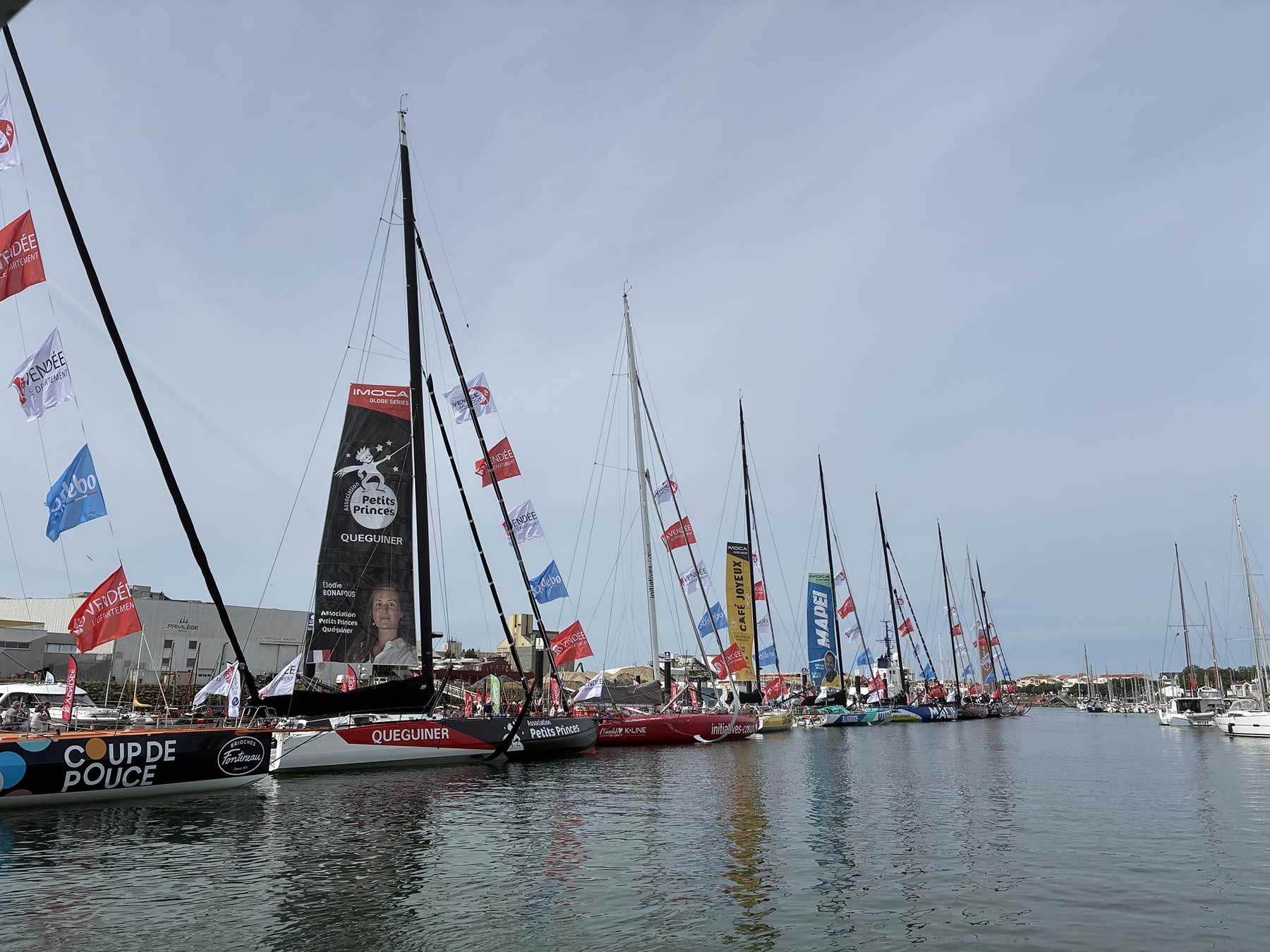
In June 2026, Les Sables d’Olonne will again become one of the most watched harbours in ocean racing. The Vendée Arctique will send nine IMOCA skippers north from Port Olona toward the Arctic Circle, before bringing them back to the Vendée coast. The race is short compared with the Vendée Globe, but it is not soft. It is single-handed, non-stop and without assistance. It covers 2,222 kilometres (1,200 nautical miles), with no fixed route. Each skipper must cross the Arctic Circle at the longitude of his or her choice, then return to Les Sables d’Olonne. For Privilège Marine, based in the same port, the week is more than a sporting moment. It is an opportunity to welcome visitors into a shipyard shaped by offshore culture, while the race village offers direct access to sailors, boats, teams and the start on Sunday, June 7.
The Atlantic port where ocean racing and boatbuilding meet
There are few places where a shipyard and a major offshore race share such a natural relationship. In Les Sables d’Olonne, the connection is not decorative. It is physical, historical and commercial. The Vendée Arctique village will stand on the Vendée Globe esplanade. The IMOCA boats will leave from Port Olona. Privilège Marine builds its bluewater catamarans just 10m away, inside the same maritime ecosystem.
That geography matters. Offshore sailing is not an abstract idea here. It is part of the local economy, the waterfront and the public imagination. Les Sables d’Olonne is the departure and arrival port of the Vendée Globe. It is also the home of a shipyard whose story began in 1985 with Philippe Jeantot, the sailor closely associated with the creation of the Vendée Globe and the original Privilège catamaran vision.
The 2026 Vendée Arctique gives that connection a fresh public stage. Visitors can come for the race village, see the IMOCA fleet, follow the start in the channel and use the same visit to discover a shipyard dedicated not to short-course racing, but to long-distance cruising. That contrast is useful. It shows two answers to the same offshore question. One is radical performance, sailed alone, under race pressure. The other is long-range comfort, safety and self-sufficiency for owners who want to cross oceans with family or guests.
The race that sends IMOCA skippers toward the Arctic Circle
The Vendée Arctique is an IMOCA race. That means the boats are the same class as those used in the Vendée Globe: 18.28-metre (60-foot) monohulls, designed for solo offshore racing at the highest level. They are not yachts in the conventional leisure sense. They are prototypes built around speed, structure, reliability, weather routing and the ability of one sailor to keep moving under extreme fatigue.
The 2026 edition is the third edition of the race. It starts on Sunday, June 7, with the official offshore start scheduled at 13:02 local time in the bay of Les Sables d’Olonne. The public programme begins earlier. The village opens at 08:00, the IMOCA boats are due to leave the pontoons at 10:30, and the public can watch the passage through the famous channel before following the live start on a big screen in the village.
The format is simple to describe and difficult to execute. The skippers leave Les Sables d’Olonne, head north, cross the Arctic Circle at 66 degrees north, then return to Les Sables d’Olonne. The official race distance is 2,222 kilometres (1,200 nautical miles). The expected duration is around eight to ten days, with arrivals projected around mid-June.
That distance may look modest beside the Vendée Globe, which circles the world. It is not a minor race. The North Atlantic can be violent, unstable and tactically unforgiving. The route takes sailors toward cold, fog, short seas and fast-moving low-pressure systems. These conditions can punish a boat that is too exposed, a skipper who sleeps too little or a routing choice made too late.
The open course that changes the strategic problem
The major change for 2026 is the open course. There is no fixed track to follow and no compulsory longitude for crossing the Arctic Circle. Each skipper must decide where to go north, where to cross 66 degrees north and how to return to the Vendée coast.
This matters because offshore racing is often decided before the public sees the obvious result. A skipper who chooses a western option may find more wind, but also harsher sea state. A skipper who sails a more conservative angle may protect the boat but lose hours that cannot be recovered. In a short race, one weather system can create the final ranking.
The Arctic Circle is the symbolic gate, but the real battlefield is meteorology. The sailors must read pressure systems, wind shifts, sea temperature, current, ice restrictions and exclusion zones. They must also manage their own human limits. An IMOCA can cover hundreds of kilometres in a day, but the sailor must remain alert enough to trim, repair, route, eat, sleep and avoid catastrophic mistakes.
This is why the Vendée Arctique is valuable within the Vendée Globe cycle. It is the first major solo test on the road to the 2028 Vendée Globe. It gives skippers a chance to validate systems, stress-test new configurations and measure themselves against rivals under a format that rewards both speed and judgement.
The fleet that mixes new-generation foilers and proven machines
Nine skippers are expected on the start line. The entry list is small but technically interesting. It includes new-generation foiling IMOCAs, recently launched platforms and older boats that have been refitted, renamed and adapted to new programmes.
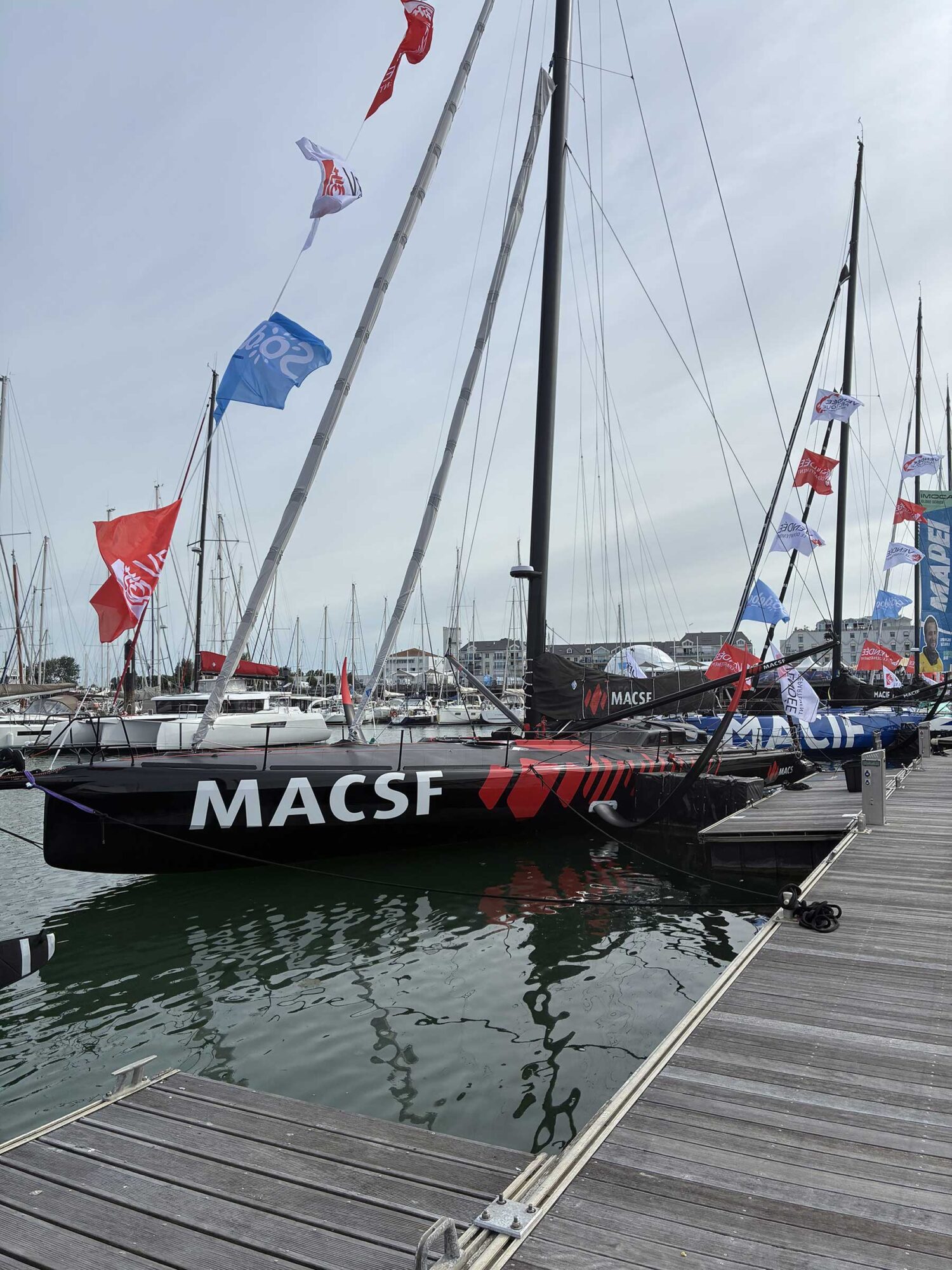
Sam Goodchild will sail MACIF Santé Prévoyance, a Guillaume Verdier design built in 2022 by CDK Technologies and MerConcept, launched in 2023. It is one of the strongest modern references in the fleet, with recent high-level results and a reputation for performance. Corentin Horeau will race MACSF, the former Paprec Arkéa, a 2022 Antoine Koch and Finot-Conq design built by Multiplast and launched in 2023. Ambrogio Beccaria enters with Allagrande Mapei, another 2022-generation foiler, launched in 2023, formerly For People.
Élodie Bonafous brings Association Petits Princes – Quéguiner, one of the newest boats in the race. Built in 2024 by CDK and MerConcept and launched in 2025, it is a sistership of MACIF Santé Prévoyance, designed by Guillaume Verdier. Violette Dorange sails Initiatives-Cœur, a Sam Manuard design built in 2022 and launched the same year. Francesca Clapcich represents 11th Hour Racing on a 2022 VPLP-designed IMOCA, formerly Malizia – Seaexplorer.
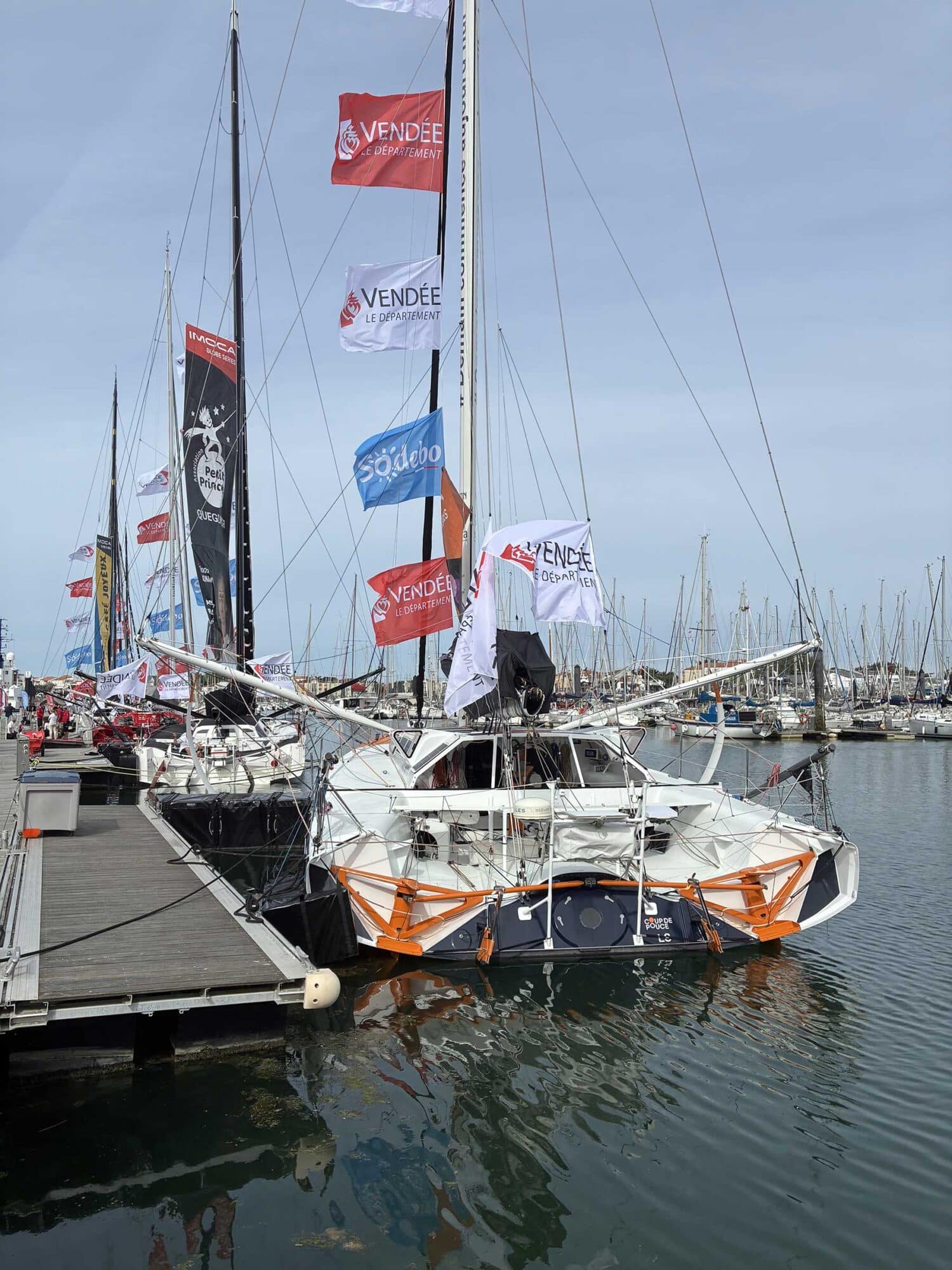
The fleet also includes boats with deeper histories. Nico d’Estais will sail Café Joyeux, the former MACIF of François Gabart, built in 2010 and launched in 2011. It has won the Vendée Globe and the Route du Rhum under previous names. Manuel Cousin’s Coup de Pouce is another VPLP-Verdier design from 2010, launched in 2010 and known through several campaigns. Arnaud Boissières will race April Marine, the former Hugo Boss from 2015, later sailed under several other names.
This mix is one of the strengths of the IMOCA class. New boats carry the latest thinking in foils, cockpit protection, hull shape and ergonomics. Older boats carry miles, data and scars. In offshore racing, new is not automatically safe, and old is not automatically slow. A proven boat in careful hands can remain dangerous. A new foiler can be fast but brutally demanding.
The technical challenge behind the spectacle
To the public, an IMOCA start is colour, sound and movement. To engineers and sailors, it is a stress test. These boats are 18.28 metres (60 feet) long, with a draught of about 4.5 metres (14.8 feet). Their masts rise to roughly 29 metres. Their sail plans can exceed several hundred square metres, depending on configuration. Modern foiling versions can reach about 75 km/h (40 knots) downwind in strong conditions.
Speed is only one part of the equation. The skipper is alone. Every manoeuvre costs energy. Every sail change involves risk. Every fast reach in a rough sea sends shock loads through the hull, foils, rig and sailor. In the far north, cold and fatigue add another layer. Condensation, reduced visibility, electronic reliability and the simple ability to stay dry become performance factors.
The 2026 course also introduces environmental and safety constraints. The skippers must respect ice exclusion areas near Greenland and biodiversity protection zones. These limits are not administrative details. They shape routing. They can close off the most direct line and force sailors to choose between longer distance, stronger wind or safer sea state.
That is why the Vendée Arctique should not be described as a promotional prologue. It is a real race. It may support qualification and preparation for the Vendée Globe, but the risks, decisions and consequences are immediate.
The village that brings the Arctic to Port Olona
From May 30 to June 7, the race village will be open to the public on the Vendée Globe esplanade. Entry is free. The official opening hours are 10:00 to 20:00 during the village week, with a special opening at 08:00 on start day.
The programme is designed for more than spectators. It includes IMOCA speed runs in the bay, meetings with skippers, public animations, food and drink areas, and educational content about the Arctic. Institutions and organisations linked to ocean science and environmental awareness are expected to be present, including IFREMER, the Institut Polaire Français, Plastic Odyssey and Under the Pole.
This is important because the Arctic is not just a backdrop. It is one of the most exposed regions in the climate system. A race that sends sailors toward high latitudes has a duty to explain what that region represents. The village can help turn a sporting event into a public conversation about oceans, ice, biodiversity and human responsibility.
For families, sailing followers and potential yacht owners, the week offers rare access. Visitors can see the teams working, understand the technology and watch the human side of offshore racing before the boats disappear north.
The start day that visitors should plan around
The essential date is Sunday, June 7. Visitors should plan to arrive early. The village opens at 08:00. The IMOCA boats are scheduled to leave the pontoons at 10:30 and pass through the channel, one of the most emotional rituals in French ocean racing. The official start is set for 13:02 offshore in the bay.
The best day is not only about seeing the boats. It is about feeling the town change tempo. The harbour fills. Teams move with purpose. Spectators line the channel. The skippers switch from public figures to sailors under pressure. Within a few hours, the village atmosphere becomes a race atmosphere.
For international visitors, this is also a practical moment to combine experiences. One day can include the Vendée Arctique village, the channel departure, the big-screen start and a visit to Privilège Marine. That combination gives a fuller understanding of Les Sables d’Olonne as a place where ocean racing and boatbuilding are not separated.
Meet us in Annapolis, MD
Our next rendez-vous will be at the Annapolis Sailboat Show, October 15–18, one of the key events of the sailing calendar in the United States. Meet our team in Annapolis and step aboard a Privilège to experience first-hand our vision of bluewater cruising — combining offshore capability, comfort and craftsmanship for owners looking to sail further.