Category: Blog

  • The New Office at Sea: Working Remotely from a Catamaran

    The New Office at Sea: Working Remotely from a Catamaran

    How remote work, offshore internet and bluewater catamarans are changing the way owners live, sail and run their professional lives.

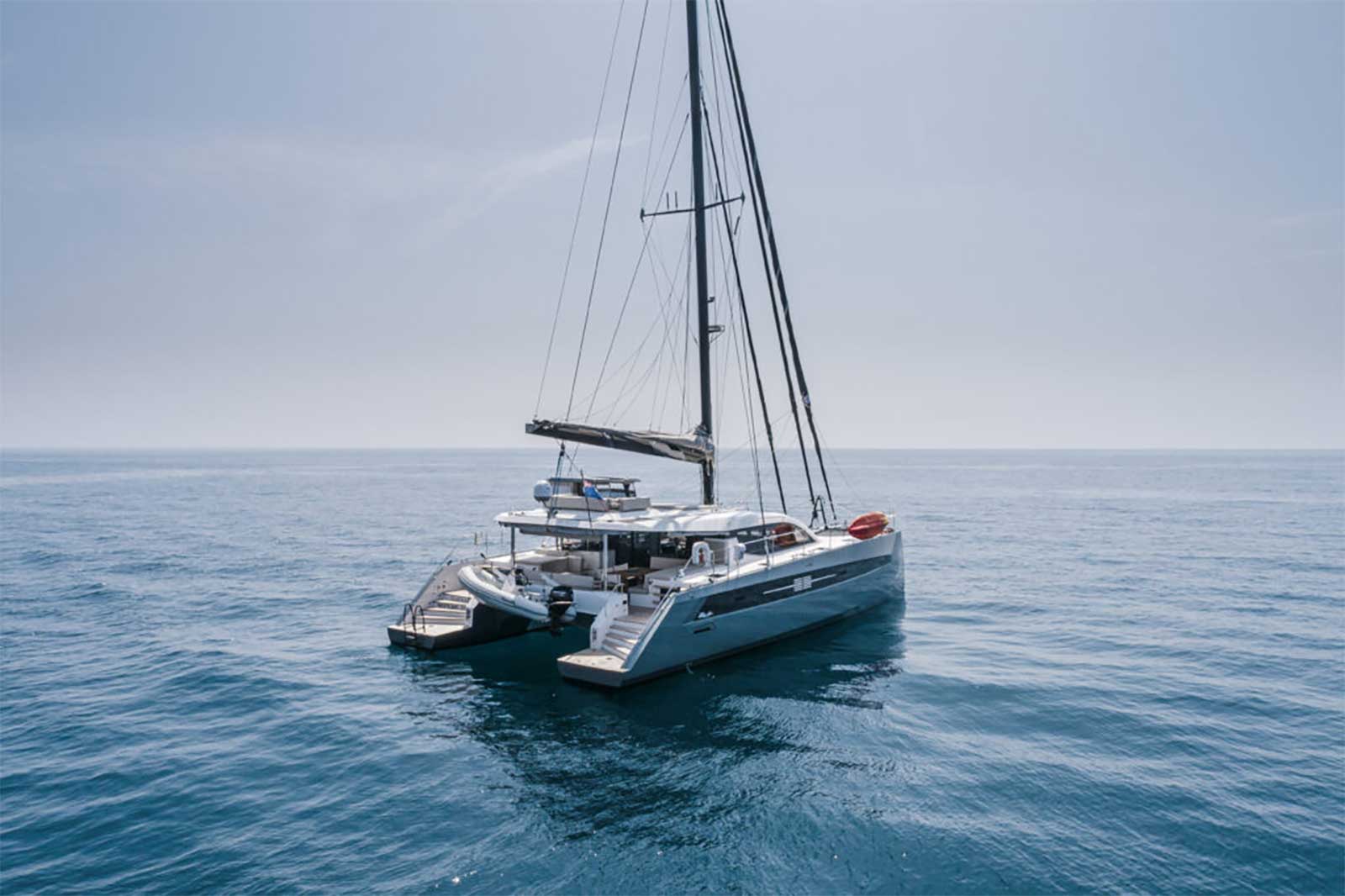
    Working from a catamaran has moved from fantasy to practical reality. The change has come from three forces: remote work culture, better satellite internet and yachts designed as genuine homes at sea. For many owners, the attraction is direct. They want professional continuity without being tied to one city, one office or one season. Yet the idea only works when the yacht is prepared as a workplace, not only as a place to sail. Internet, power, desk ergonomics, sound control, redundancy, data security and weather planning matter as much as comfort. At Privilège Marine, this is where the concept becomes serious. A bluewater catamaran must cross oceans safely. It must also support daily life with calm, privacy and technical reliability. The modern owner does not simply want escape. The modern owner wants freedom with structure, and a yacht capable of making that freedom work.

    The desire to work from sea has become a serious lifestyle choice

    The desire behind working from a catamaran is easy to understand. It is the wish to keep one’s professional life while changing the frame around it. A call begins with a horizon outside the window. A report is written while the boat lies at anchor. A strategic decision is made after a morning swim. The office has not disappeared. It has moved.

    This desire became stronger after remote work became normal in many professional sectors. Gallup’s 2026 data on remote-capable jobs in the United States shows 26% of employees working fully remotely, 52% working in a hybrid model and 22% working on site. The same research indicates that six in ten remote-capable employees want hybrid work, while about one-third prefer fully remote work. That is a large cultural shift. It explains why the yacht is no longer seen only as a holiday object.

    For entrepreneurs, investors, consultants, designers, senior executives and owners of international businesses, work is already mobile. Many no longer measure productivity by presence in a building. They measure it by output, decisions, trust and availability. This is why the image of the digital nomad sailor has matured. It is no longer limited to a young freelancer on a small boat with a laptop. It can describe an owner managing a company, a family office, a portfolio, a creative studio or a professional practice from a bluewater catamaran.

    The attraction is strong, but it must be treated with honesty. Working remotely from a cat is not a permanent holiday. It requires discipline. Calls still happen at fixed times. Deadlines still apply. Clients still expect clarity. A yacht creates freedom, but it also creates constraints: weather, power, time zones, maintenance, anchorage rules and connectivity limits. The owners who succeed are the ones who respect both sides of the equation.

    The catamaran changes the feeling of remote work

    A sailing catamaran offers a different experience from a monohull. The wide beam gives more living space. The platform is more stable at anchor. The saloon is bright. Cabins are separated by two hulls. Outdoor and indoor spaces connect naturally. These details matter when work becomes part of life on board.

    Remote work is sensitive to space. A laptop on a dining table may be enough for one email. It is not enough for a full working week. A proper workspace needs privacy, ventilation, good light, seating comfort, charging points and a surface that stays useful when the boat moves. It also needs acoustic separation. Nobody wants to join a board call from the middle of a busy saloon while guests prepare lunch.

    This is where the design of a true bluewater catamaran becomes decisive. At Privilège Marine, we build yachts as safe, capable ocean-crossing platforms. We also build them as homes. This balance is essential for remote work. The owner needs safety at sea, but also domestic intelligence. A yacht used for work must allow different parts of life to coexist. One person may be on a video call. Another may be reading. Children may be studying. Guests may be resting. The boat must absorb these routines without constant compromise.

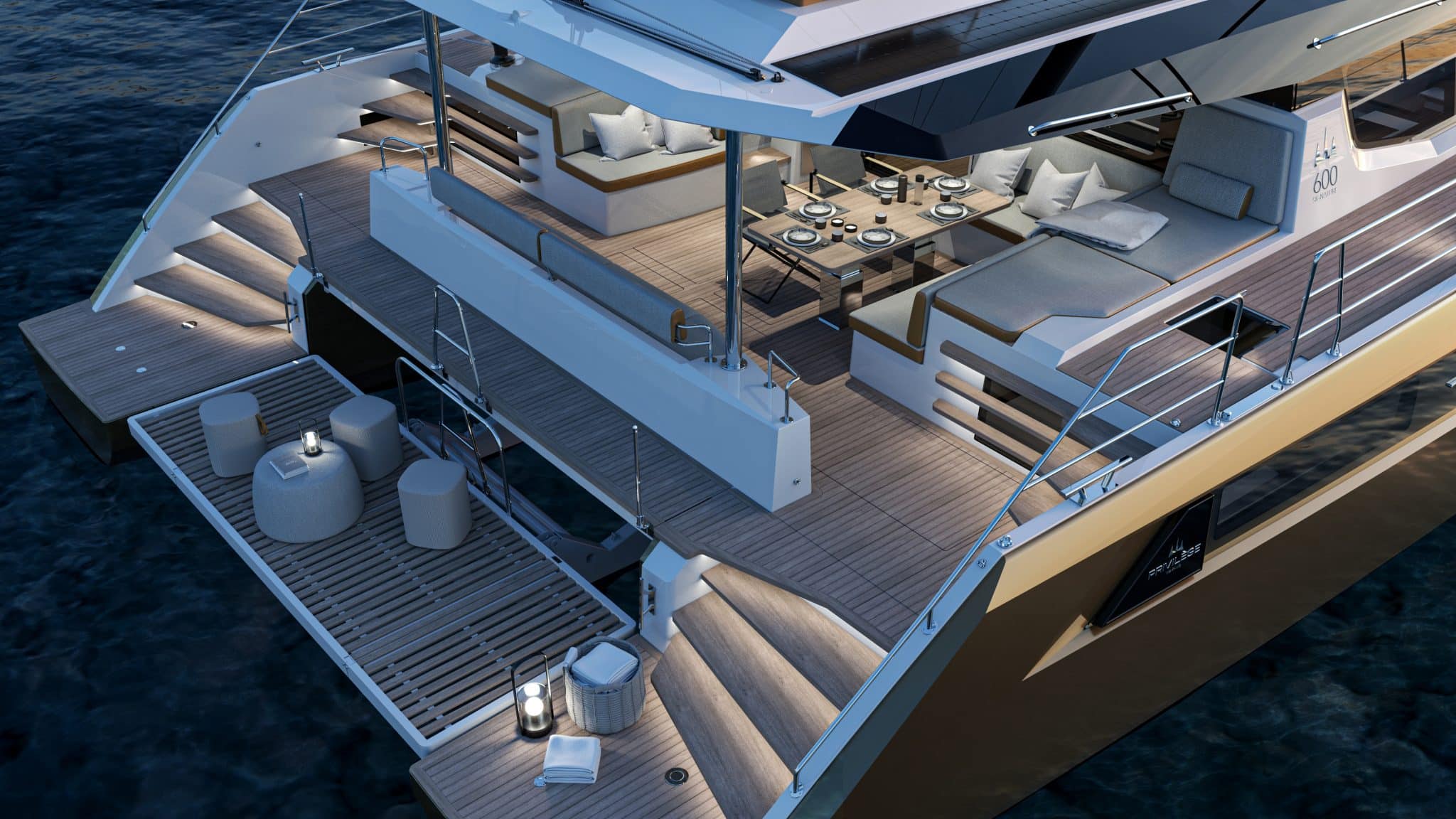
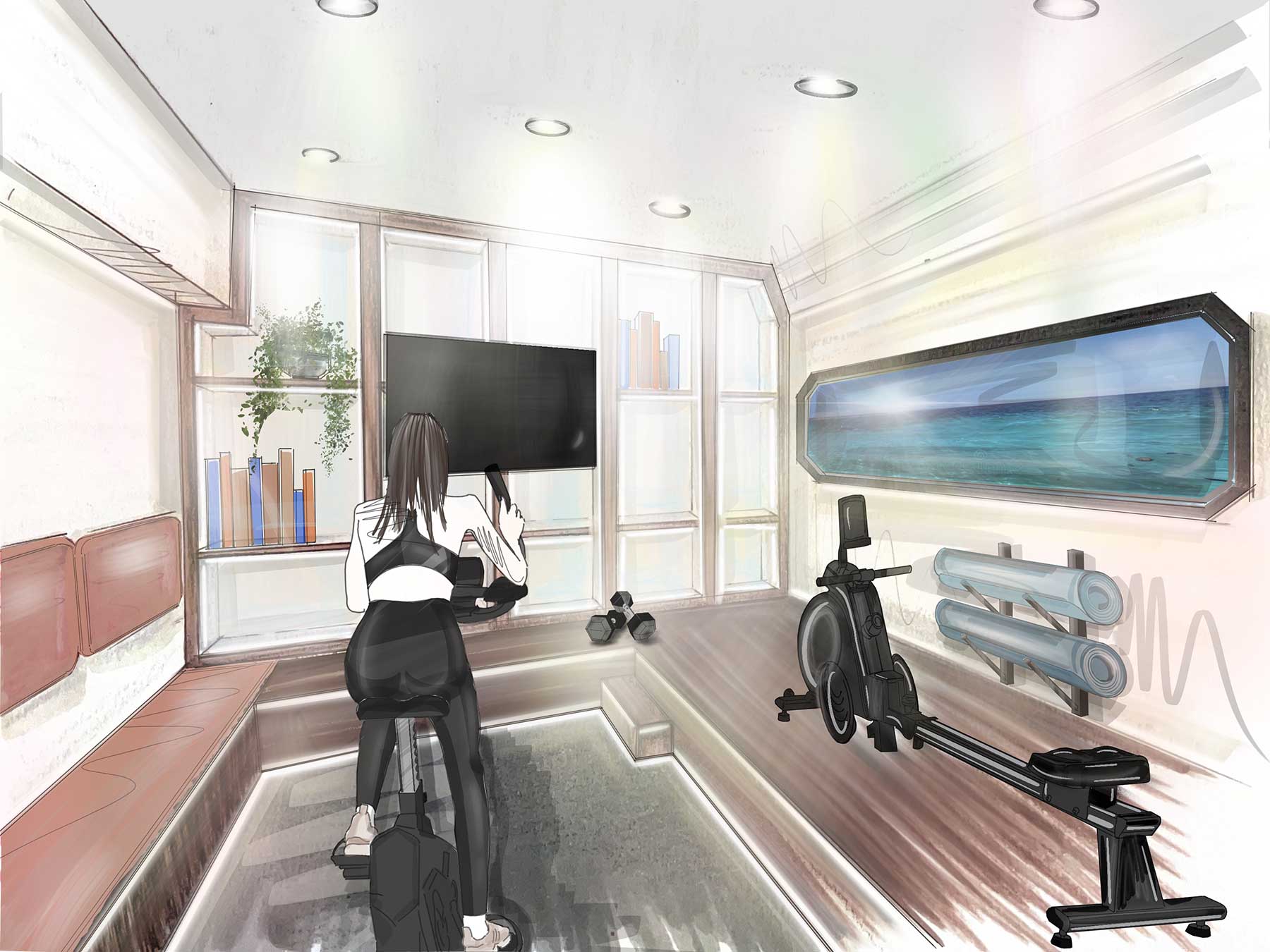
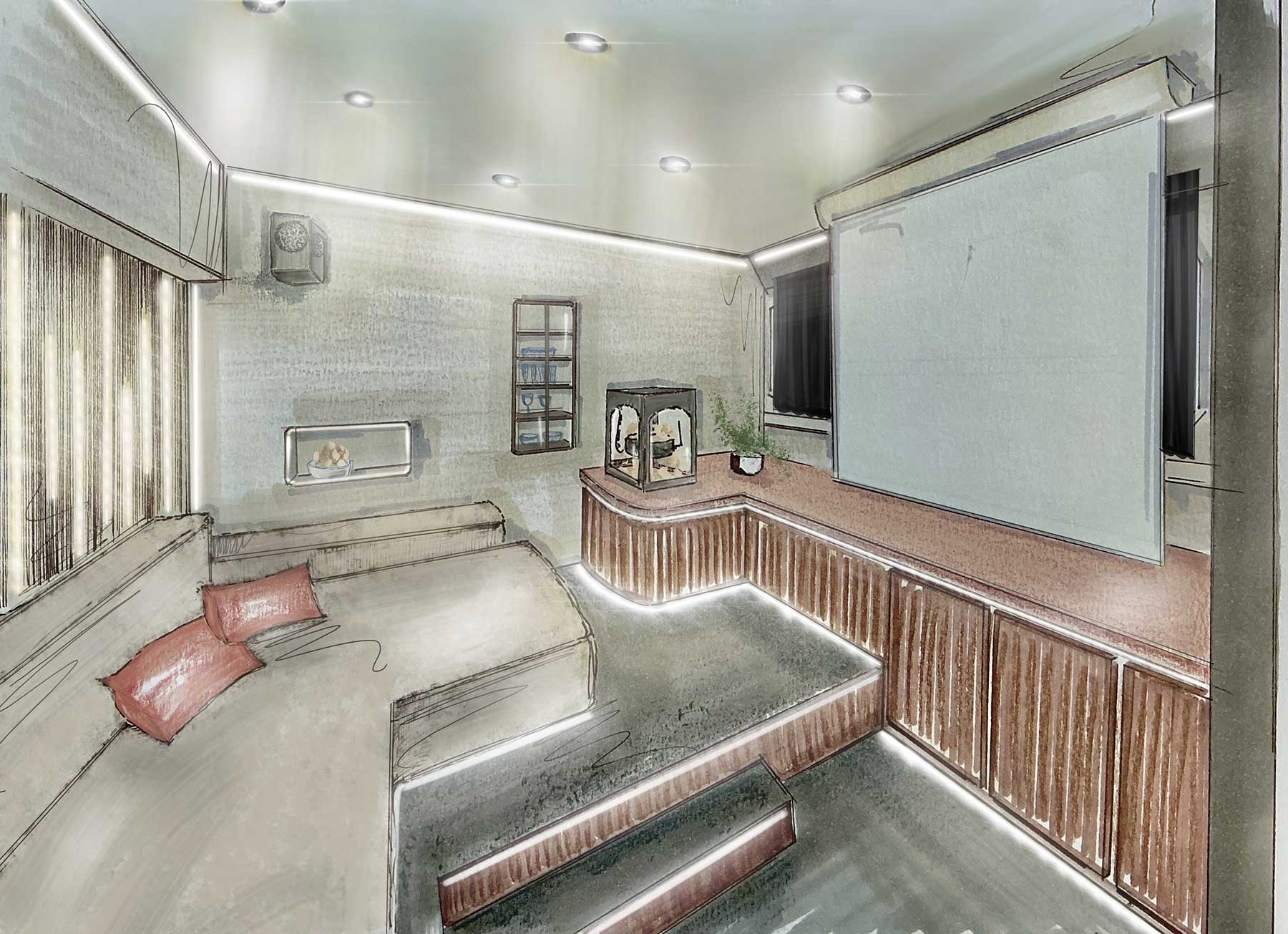
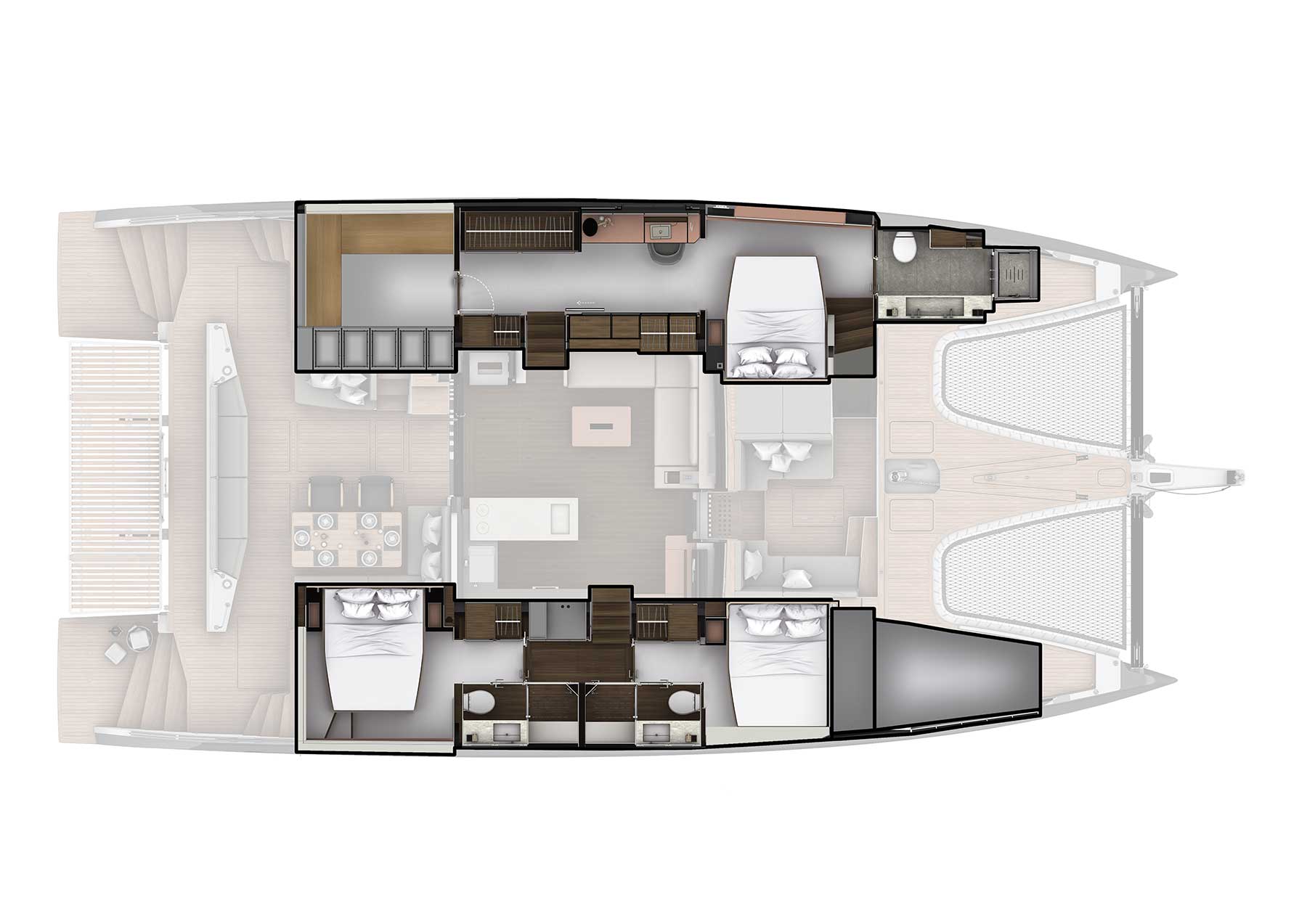
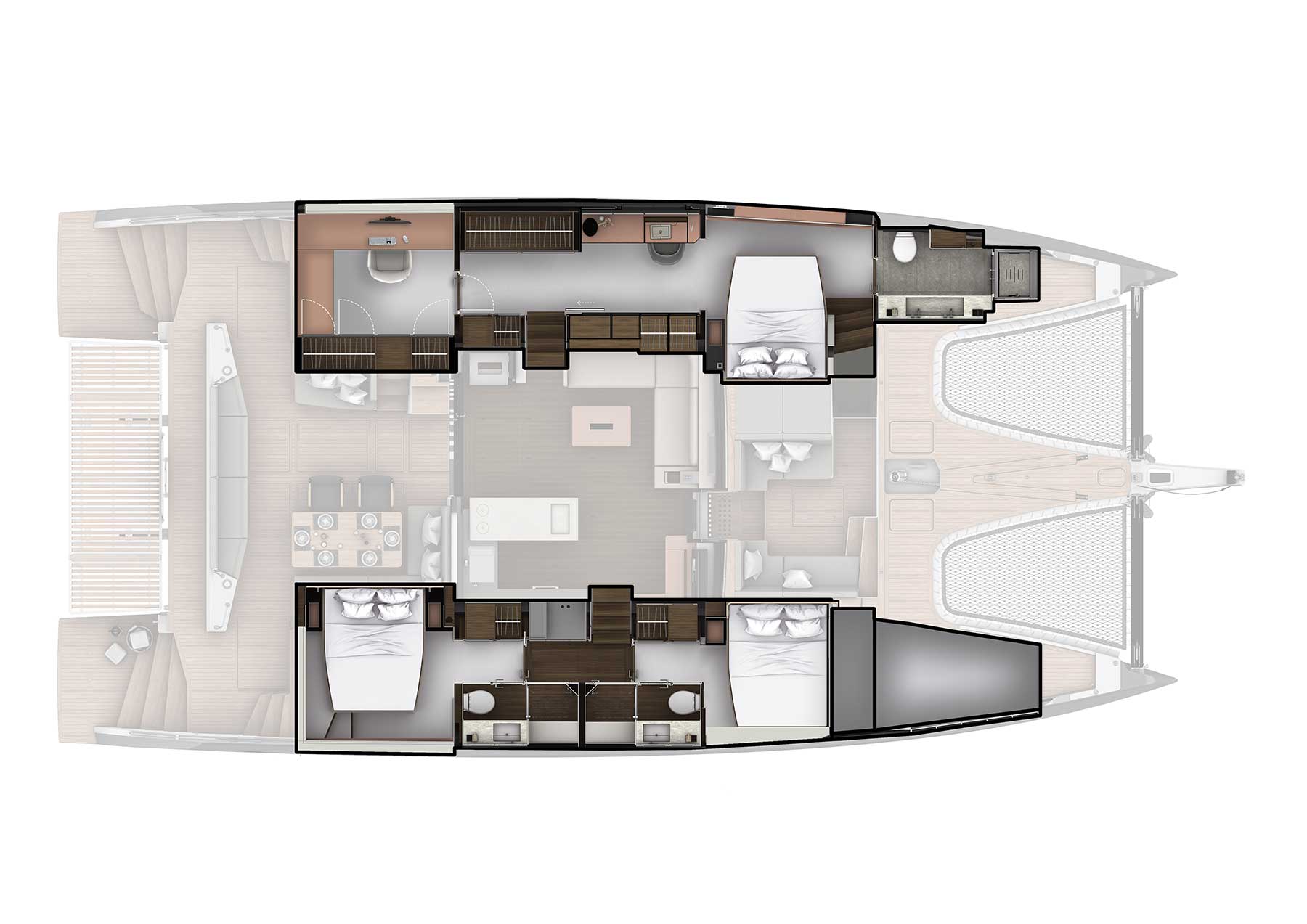
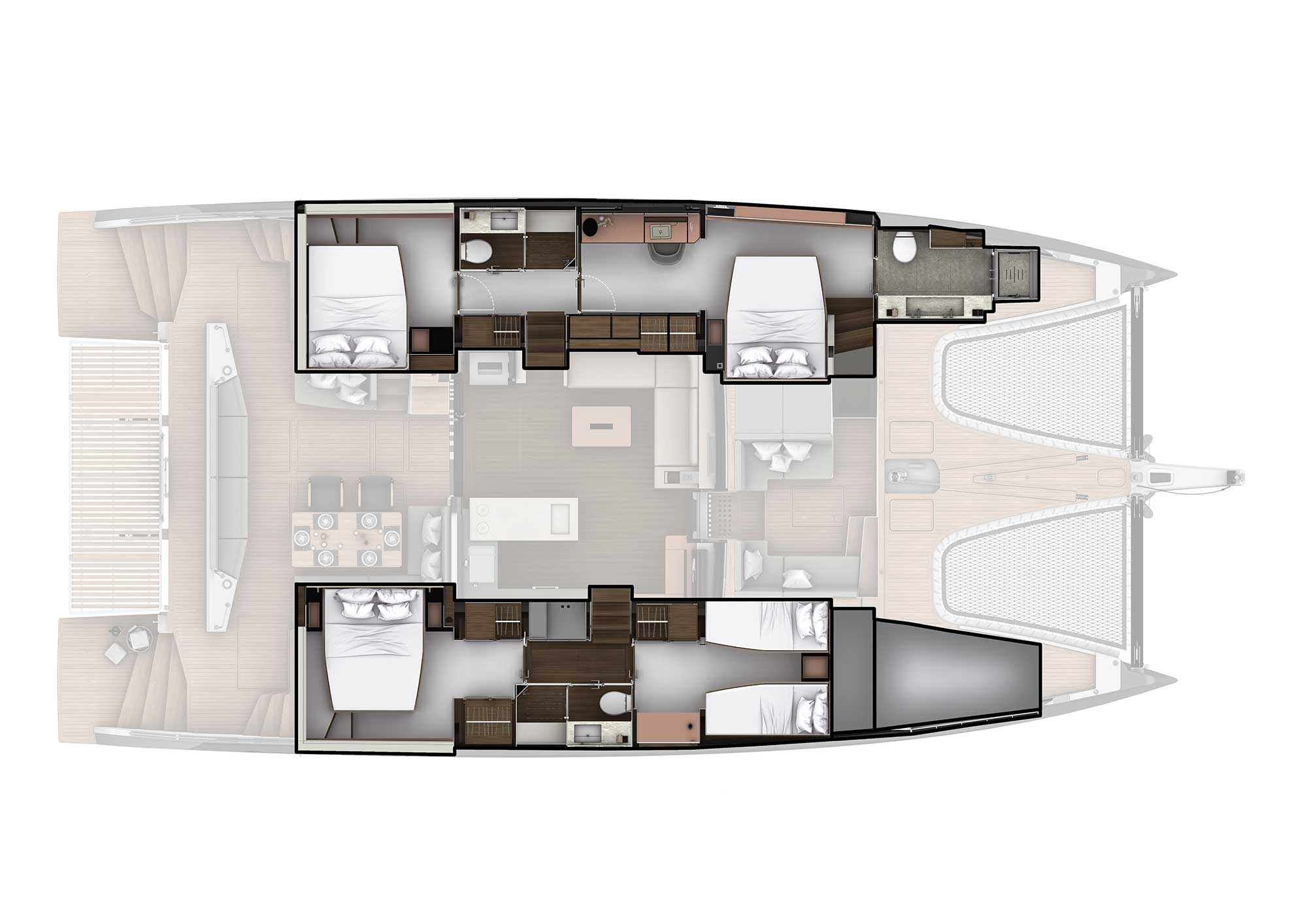
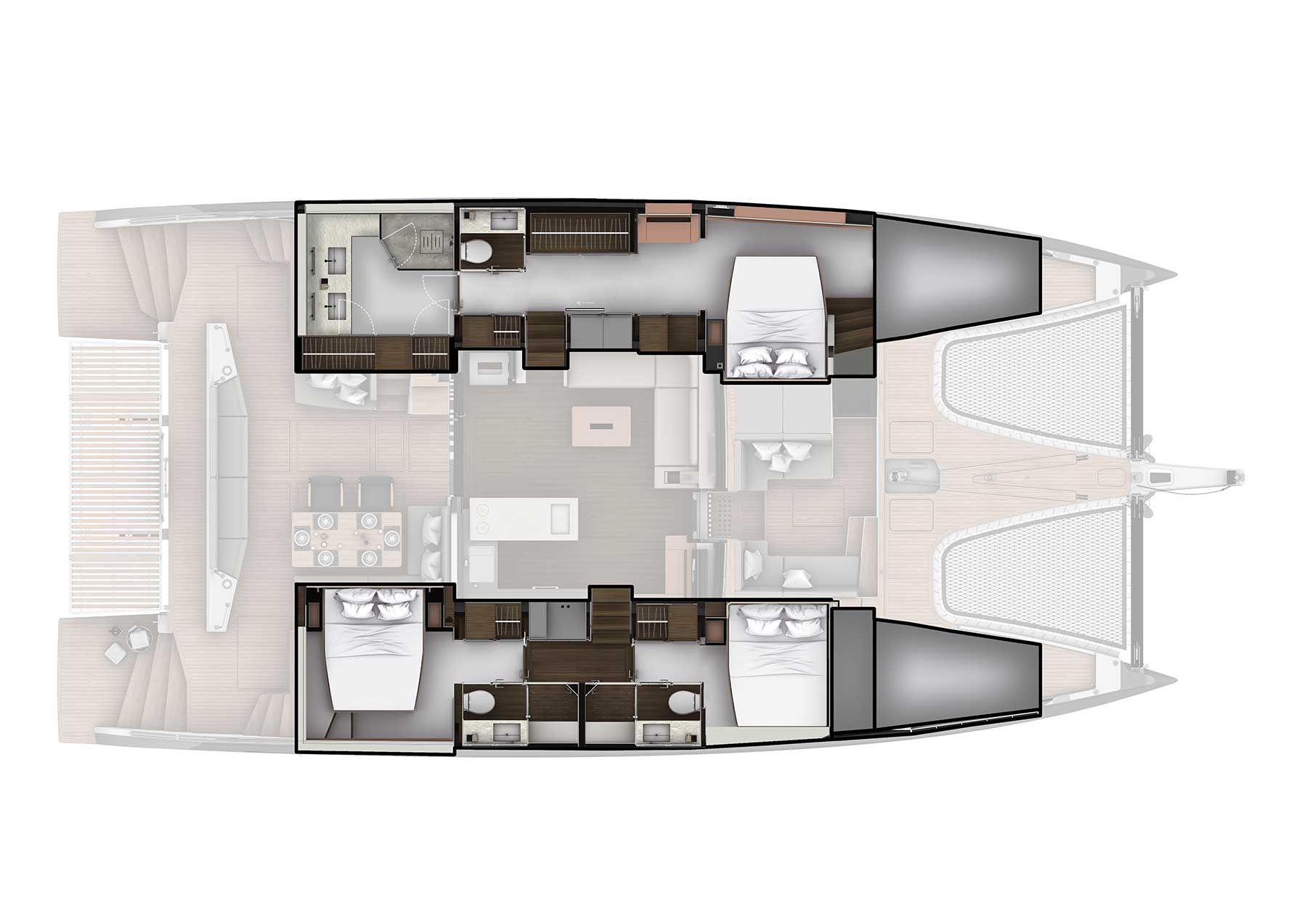
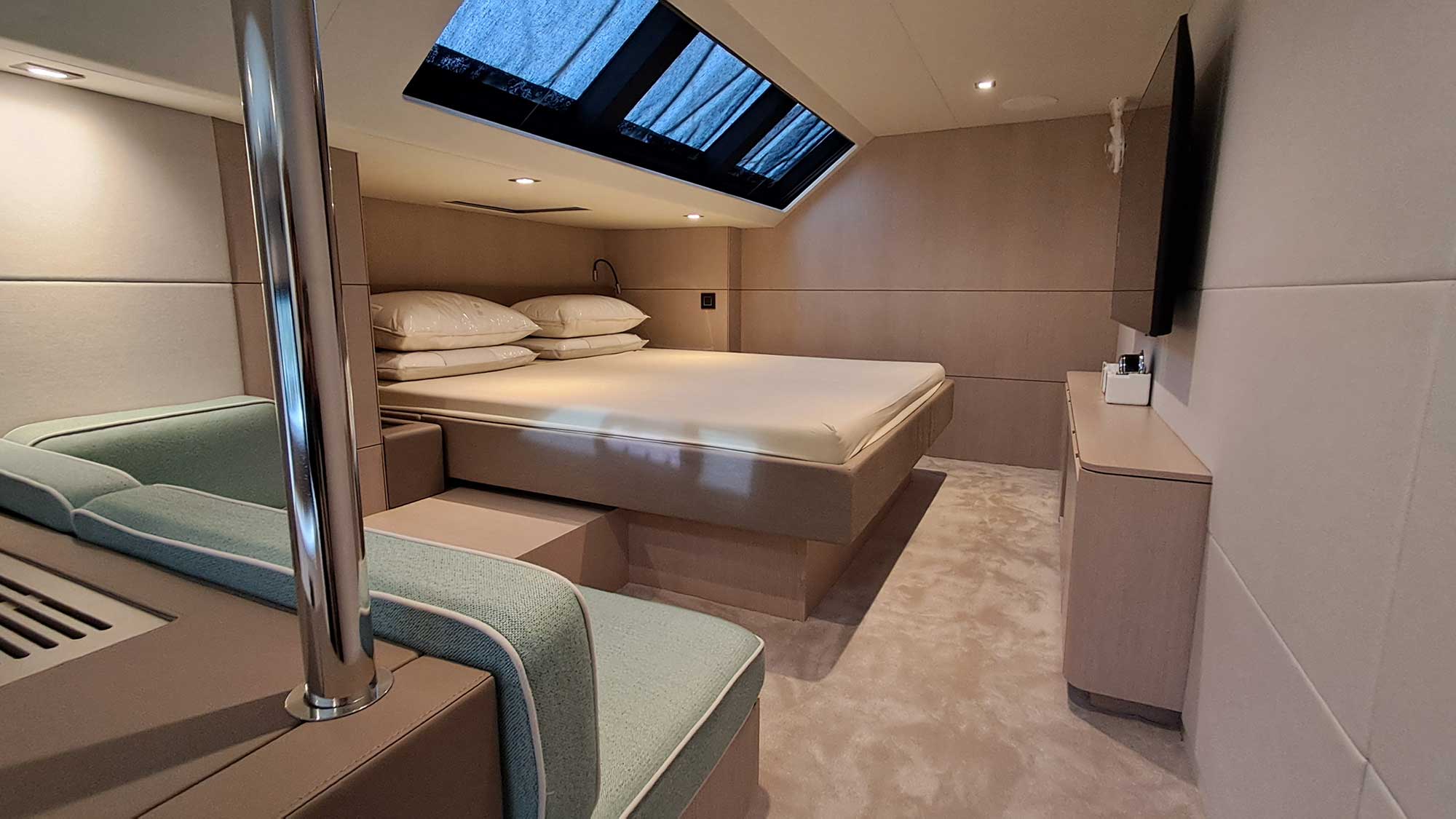
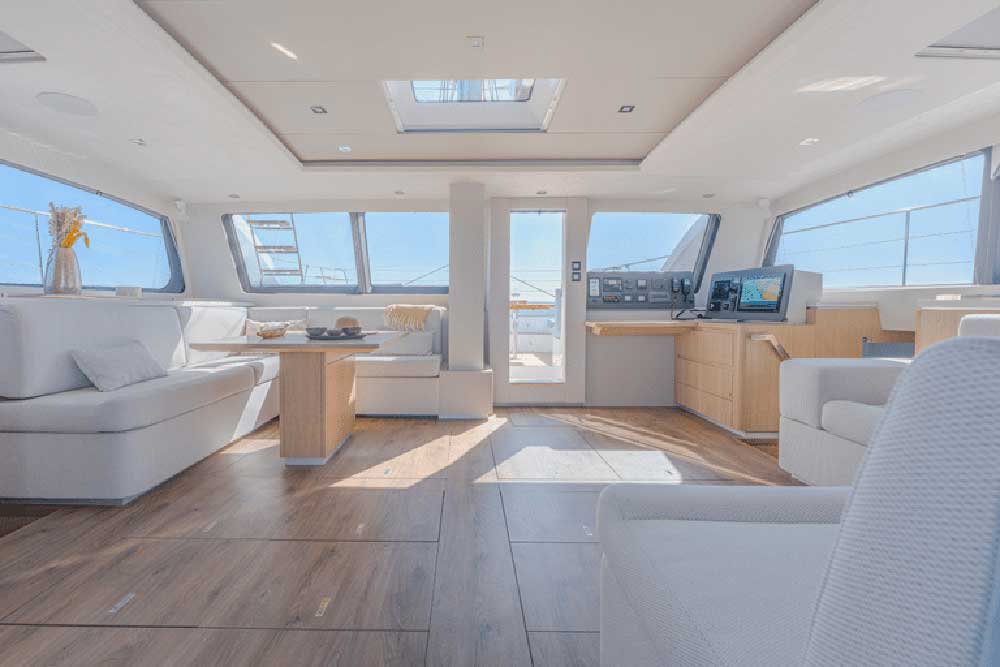
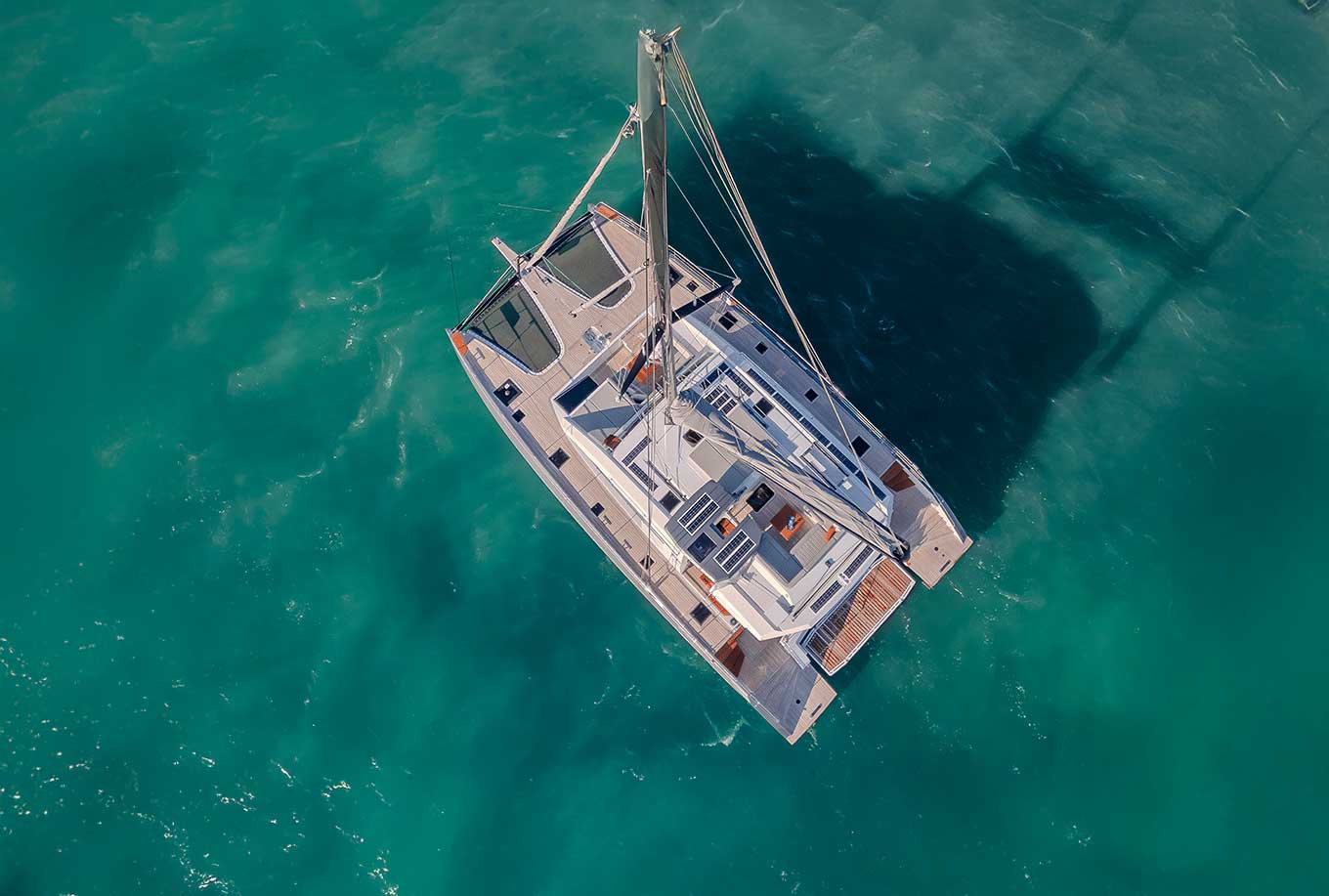
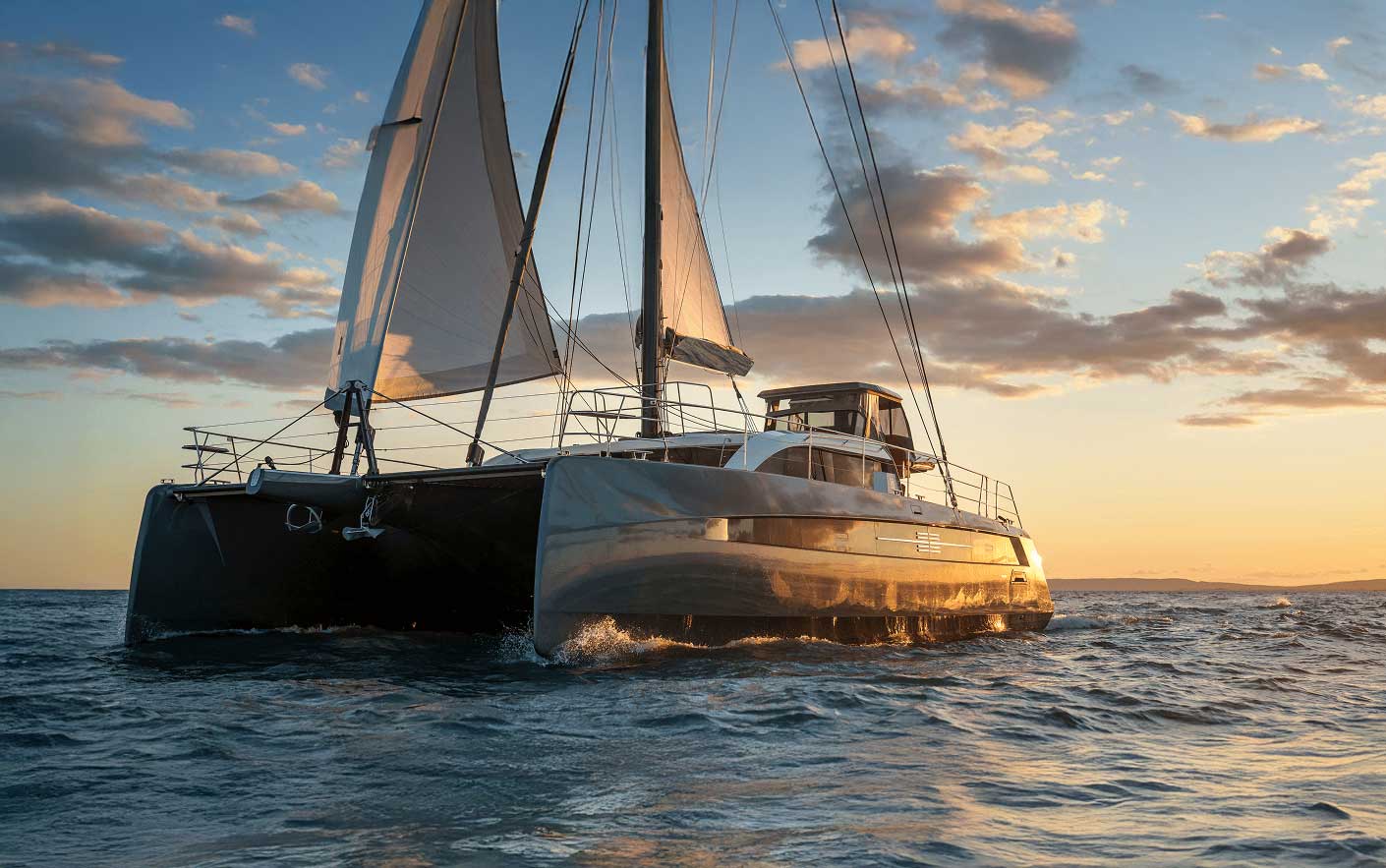
    The Privilège Signature 600 shows this evolution clearly. Its aft portside cabin can be designed as a dedicated office, private cinema, gym, storage room, artist’s studio or walk-in wardrobe. In a remote-work context, that flexibility is not decorative. It is structural. A dedicated office changes the quality of life on board. It separates work from leisure. It makes concentration easier. It gives the owner a real professional space inside a home at sea.

    The internet connection is the new technical backbone

    The central question is no longer whether a boat can connect to the internet. The question is how well it connects, where it connects and what happens when the main system fails. Working from boat internet must be designed as a system, not as a gadget.

    A modern catamaran can use several layers of connectivity. Near land, 4G and 5G routers can provide fast service, depending on local coverage and antennas. Some marine systems advertise useful coastal range up to about 46 kilometres (25 nautical miles) from shore. In a marina, shore Wi-Fi may be useful, although it is often crowded and inconsistent. Offshore, satellite becomes the primary solution.

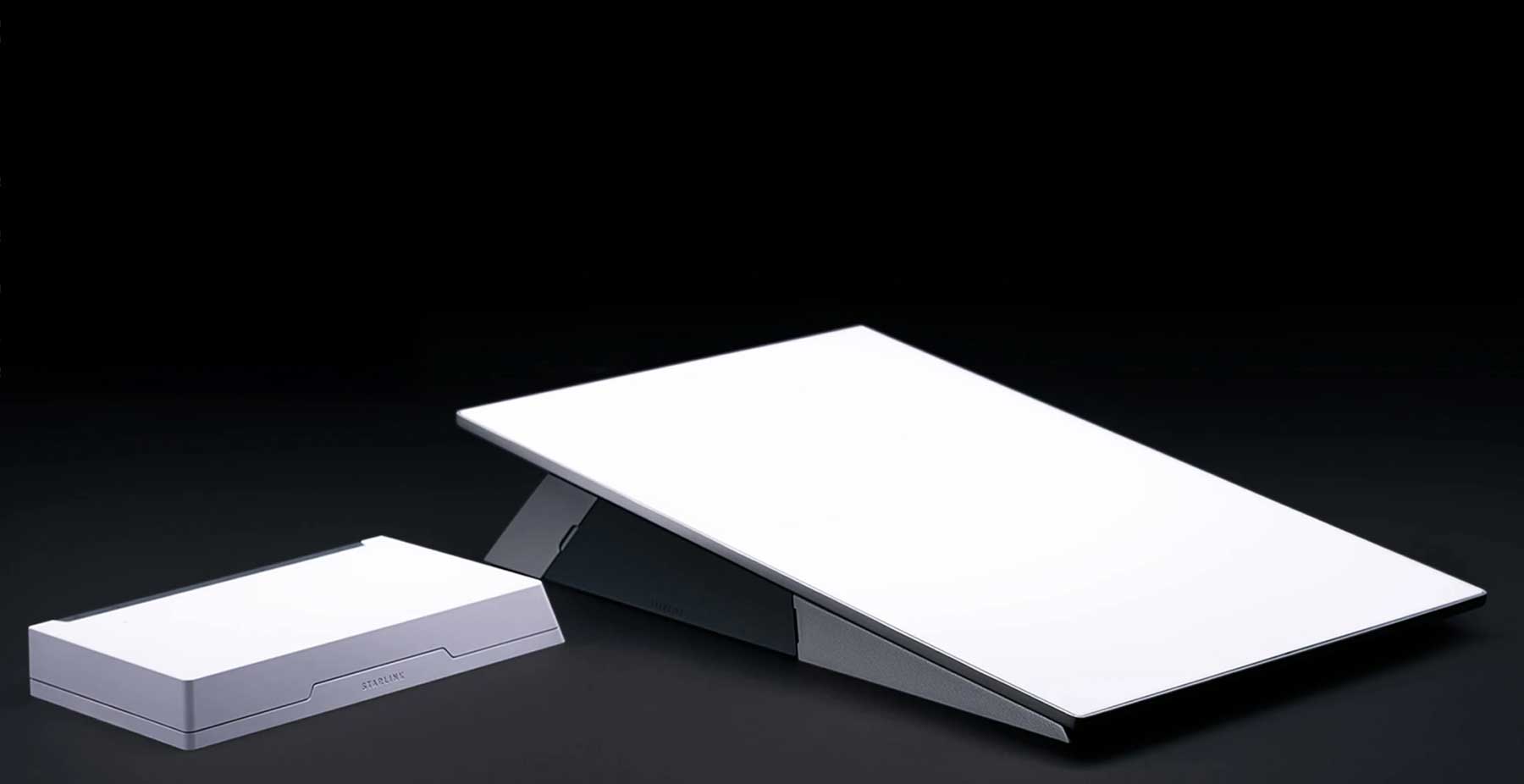
    Low Earth orbit satellites have changed expectations. Starlink Maritime, using Global Priority plans, is marketed for maritime and global connectivity, with plans starting from $250 per month and hardware listed at $1,999 in the United States. The system has made high-speed internet at sea more accessible than traditional VSAT for many yacht owners. For people trying to work from sailing catamaran remotely, this is a major development.

    The Starlink Mini also illustrates how compact satellite hardware has become. Its official specification sheet lists a terminal of 298.5 x 259 x 38.5 millimetres (11.75 x 10.2 x 1.45 inches), a weight of 1.10 kilograms (2.43 pounds), an IP67 environmental rating when installed with the DC cable and plug, and average power consumption of 25 to 40 watts. It can connect up to 128 devices. These numbers matter because space, weight and power are always serious on a yacht.

    Yet a serious offshore work setup should not depend on one system alone. Catamaran Wi-Fi offshore needs redundancy. A common architecture may include Starlink or another high-speed satellite service, a 4G or 5G marine router, marina Wi-Fi capture, an Iridium GO! exec or similar L-band backup, and a separate emergency communications system. The Iridium GO! exec, for example, uses Iridium Certus 100 and offers IP data speeds up to 88 Kbps. That is not enough for video meetings. It is enough for essential messaging, weather files, compressed email and emergency communications.

    The lesson is direct. Offshore internet should be fast enough for work and robust enough for failure.

    The bandwidth required for real work is measurable

    Video calls are often the first test. Zoom states that 1080p video can require 3.8 Mbps upload and 3.0 Mbps download. A 720p group video call can require 2.6 Mbps upload and 1.8 Mbps download. Google Meet lists up to 3.6 Mbps outbound and 3.6 Mbps inbound for 1080p video. These are not extreme numbers by land standards. At sea, they are serious because bandwidth may fluctuate.

    This is why the owner should define work needs before choosing equipment. A writer, investor or consultant who mainly uses email, cloud documents and voice calls needs one level of connectivity. A founder who runs daily video calls, transfers large files and manages a distributed team needs another. A designer, architect or engineer working with heavy files needs a more disciplined data plan.

    The practical rule is simple. The boat should be prepared for peak work, not average work. A system that handles email at anchor may fail during a three-hour video call in bad weather. The planning should include data allowance, antenna placement, router quality, onboard Wi-Fi distribution, cybersecurity and power.
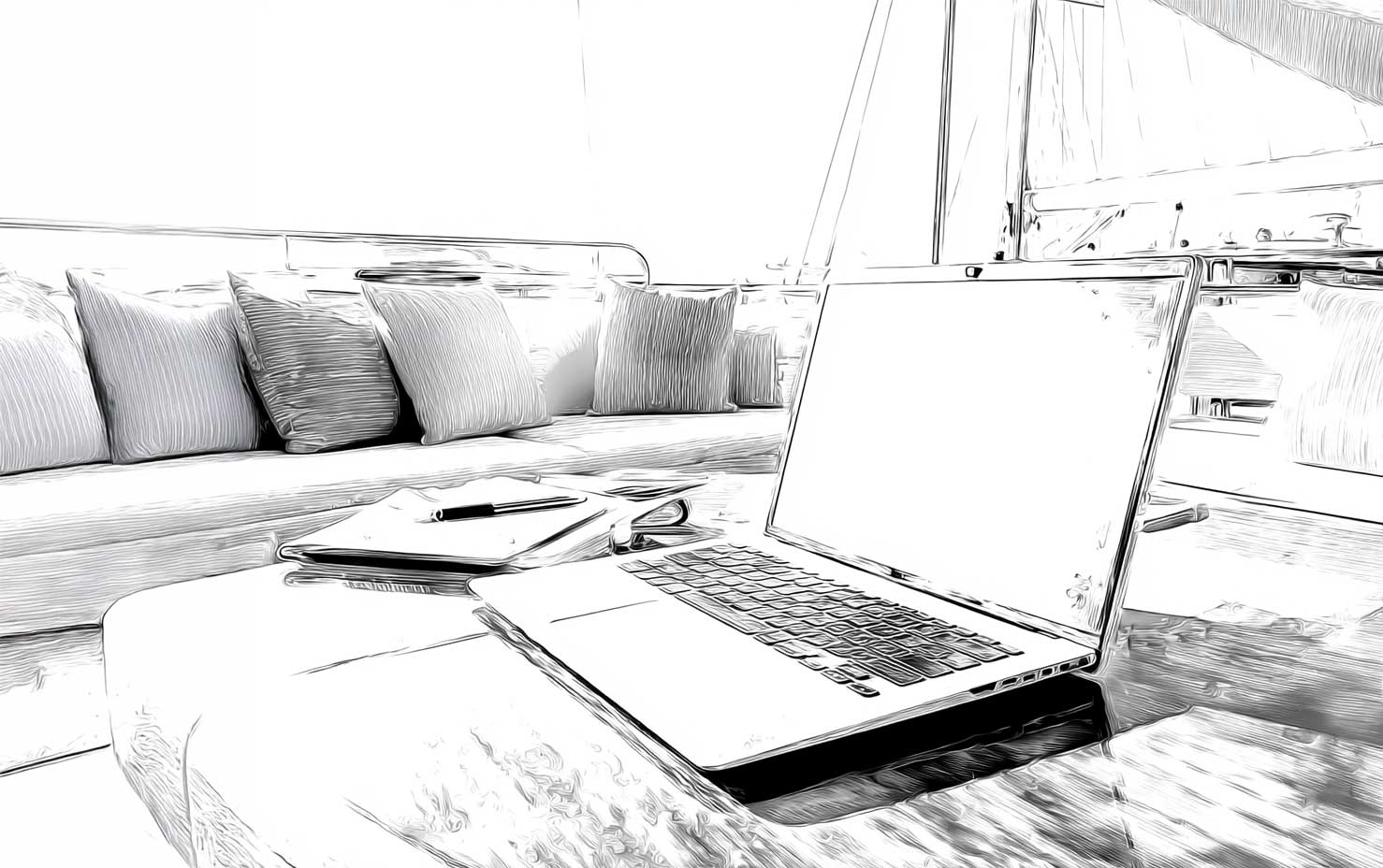
    digital nomad at sea

    The onboard network should be built like a small office

    A yacht that supports remote work needs a network architecture. The satellite terminal is only the start. The data must reach the desk, the saloon, the cabins and the cockpit. It must do so without weak zones, repeated resets or improvised cables.

    A practical setup includes a marine-grade router, external antennas, network switching, separate guest and work networks, password management and automatic failover between sources. Products such as Peplink’s MAX BR1 Pro 5G, Raymarine YachtSense Link, Digital Yacht 5G Xtream and KVH hybrid systems show how the market has moved toward multi-source connectivity. The aim is to combine satellite, cellular and shore Wi-Fi rather than depend on one path.

    The owner should also separate professional data from leisure traffic. Family streaming, children’s tablets, navigation updates and guests’ phones can consume bandwidth quickly. A professional call should not compete with a film download. Network rules can prioritise work devices, limit streaming, and reserve bandwidth for calls, cloud access and navigation.

    Cybersecurity deserves the same attention. A floating office still handles sensitive information. A remote-working owner should use a VPN when appropriate, strong passwords, multi-factor authentication, device encryption and regular updates. Cloud backups should be scheduled when bandwidth is stable. A local backup drive should remain on board. Sensitive calls should be taken in a private space with a headset, not in the cockpit during a crowded anchorage.

    The workspace must be designed before the first long passage

    A real office on a catamaran needs physical planning. The desk should face a calm visual field. The chair should support long sessions. The screen should be visible in daylight. The lighting should work at night without glare. Ventilation should be quiet. The microphone should not pick up wind, pumps, galley noise or cockpit conversation.

    The details are small, but they decide whether the owner works well. A second monitor may improve productivity. A headset with noise reduction can save a difficult call. A docking station can reduce cable clutter. A document scanner may be useful for legal and administrative tasks. A printer is rarely essential, but some owners still want one for contracts, forms or customs documents.

    Power outlets must be placed where work actually happens. USB-C charging, 230V or 110V sockets, inverter capacity and battery reserve should be planned together. This is where yacht design and electrical engineering meet daily life.

    The power system becomes part of the working day

    Remote work consumes energy. A laptop may draw 30 to 100 watts, depending on model and load. A Starlink Mini draws 25 to 40 watts on average. A router, display, phone chargers, lighting and ventilation add more. A full workday may look modest compared with air conditioning or galley equipment, but it still matters during long periods at anchor.

    This is why energy management is central to working from a boat. Solar panels, battery capacity, alternators, hydrogeneration, inverters and monitoring systems define the real autonomy of the office. The owner should know how long the network can run without engines or generator. The answer should be measured in practice, not guessed.

    On a serious bluewater catamaran, power is a safety issue as well as a comfort issue. Navigation, communications, autopilot, refrigeration, water pumps and bilge systems all depend on electrical discipline. Remote work should be integrated without weakening the yacht’s core systems.

    A practical schedule helps. Heavy uploads can be done when power generation is strong. Video calls can be grouped. Cloud backups can run at anchor during daylight. Non-essential devices can be disconnected during passages. This is not a downgrade of comfort. It is seamanship applied to digital life.

    The working rhythm must respect weather and time zones

    The sea changes the working day. Time zones shift during ocean passages. Weather windows dictate departures. Maintenance interrupts plans. A squall line does not care about a client meeting. A marina check-in may take longer than expected. A customs visit can break an afternoon.

    The successful remote-working owner builds margin into the week. Critical meetings should not be scheduled during landfall, departure or complex pilotage. Long passages should include lower-bandwidth days. Team members should understand when the owner is available and when the boat has priority. The calendar should follow the sea, not fight it.

    This does not mean work becomes less serious. It becomes better planned. A founder on a catamaran may be highly productive because distractions are fewer and the environment is calm. Gallup data shows that hybrid employees cite improved work-life balance, more efficient use of time and less burnout among the main benefits of flexible work. Those benefits can be amplified at sea, provided the owner has structure.

    The emotional side is also real. There is a special clarity in working from a quiet anchorage. There is also loneliness in long-distance remote work if routines are weak. The yacht should support both concentration and connection. Family time, exercise, reading, sailing and rest should have their place. A remote-working catamaran is a platform for life, not a machine for answering emails in exotic places.

    The Privilège approach turns freedom into a working environment

    At Privilège Marine, the starting point is always the owner. Every yacht must answer a specific way of living. For remote work, that means asking direct questions before the boat is built.

    Where will the owner work? How many hours per day? How many video calls per week? Will two people work at the same time? Is privacy essential? Will the yacht cross oceans? Will it stay mainly in the Mediterranean, Caribbean or Pacific? Is the owner managing confidential information? Does the boat need a dedicated office, or can the workspace be integrated into a cabin or saloon zone?

    These questions shape the yacht. They affect layout, electrical capacity, antenna placement, ventilation, acoustic comfort, lighting, storage and network architecture. They also affect the owner’s satisfaction years later. A yacht designed for occasional holidays will not support the same life as a yacht designed for work, family and offshore movement.

    The Privilège Signature 600 gives a clear example. With an overall length of 18.28 metres (60 feet), a beam of 9.18 metres (30 feet 11 inches), 259 square metres of total sail area (2,787 square feet), 2 x 485 litres of fuel capacity and 2 x 450 litres of freshwater capacity, it remains a serious long-distance cruising catamaran. Its customizable aft portside cabin makes the professional dimension concrete. It can become a proper office rather than an improvised corner.

    That is the difference between adding internet to a yacht and designing a yacht that can support a professional life.

    The future office will be designed around relevance

    The ability to work from sea changes what owners expect from luxury. Finish quality still matters. Materials still matter. Silence, light, storage and craftsmanship still matter. Yet relevance matters more. A yacht becomes more valuable when it supports the owner’s real life.

    For one owner, that means a private office with redundant connectivity and acoustic control. For another, it means a family learning space. For another, it means a cockpit table that works for morning emails and evening dinner. The best solution is not the most spectacular one. It is the one that fits the routine.

    The dream of working from a catamaran is powerful because it connects two modern desires. One is freedom from fixed geography. The other is the need for a stable, beautiful and reliable place to live well. A Privilège catamaran can bring those two desires together because it is built for distance and designed around the owner.

    The sea gives perspective. The yacht gives structure. The work continues. The office becomes quieter, wider and closer to the horizon.
  • The Smarter Way to Think About Financing a Catamaran

    The Smarter Way to Think About Financing a Catamaran

    A practical guide to catamaran finance, marine loans, cash purchases, credit costs, and the key differences between US and European structures.

    Buying a catamaran is a financial decision before it becomes a sailing decision. The purchase price is only the first line. The real question is how the boat will be funded, how much the credit will cost over time, and how the financing structure will affect liquidity, ownership, tax exposure, insurance, flag choice and future resale. A buyer may pay cash, use a marine loan, arrange a yacht mortgage, structure a lease, or combine personal capital with asset-backed lending. Each route changes the economics of ownership.

    For a Privilège owner, this question deserves the same level of care as layout, equipment and autonomy. A yacht built for ocean passages, private life and long-distance comfort is a long-term asset. Financing it should be approached with the same discipline: clear numbers, verified assumptions and professional advice. This article explains the main options without recommending one. It is information, not financial advice.

    The first question is whether capital or credit serves the project

    A catamaran purchase begins with a simple choice: pay cash or finance boat. The answer looks personal, but it is also technical. Cash removes interest charges. It simplifies closing. It can strengthen the buyer’s position during negotiation and reduce lender conditions. It also locks a large amount of capital into a depreciating, operating asset.

    Financing does the opposite. It preserves liquidity. It allows the owner to keep capital invested elsewhere, maintain reserves for refit, crew, insurance, cruising and unexpected maintenance, or align payments with personal cash flow. It also introduces interest, fees, paperwork, lender rights and sometimes restrictions on use.

    For a serious cruising catamaran, the financial plan should not stop at the monthly payment. The owner must calculate the total cost of credit. This includes the interest paid over the term, origination fees, mortgage registration, legal costs, survey costs, documentation costs, insurance requirements and possible foreign-exchange exposure.

    A simple example is useful. On a €1,000,000 financed amount over 15 years, a 6% annual rate produces a monthly payment of about €8,439 and total interest of about €518,942. At 8%, the payment rises to about €9,557 and total interest to about €720,174. At 8.95%, close to some long-term US public marine-loan benchmarks in 2026, the payment reaches about €10,113 and the interest cost rises to about €820,330. The boat is the same. The credit structure is not.

    This is why the interest rate is only one number. The term, deposit, residual value, currency, fees and tax treatment can change the real cost more than the headline rate suggests.

    The marine loan treats the catamaran as a financed asset

    A marine loan catamaran structure is usually secured against the boat. The lender evaluates the borrower and the vessel. The borrower is assessed through income, assets, liabilities, credit history, liquidity and residence. The vessel is assessed through value, age, builder reputation, documentation, survey, insurability and resale liquidity.

    In the United States, marine lending is relatively visible. Some lenders publish rates, terms and minimum amounts. Publicly available US examples in June 2026 show boat-loan APRs starting around 6.95% for short new-boat terms and rising toward 8.95% or more for longer terms, with used-boat rates often higher. Terms may reach 180 months, or 15 years, with some specialist lenders discussing longer terms for larger loans and strong borrowers.

    For a high-value sailing catamaran, the lender may require a substantial down payment. In practice, 10% to 30% is common in many marine-finance discussions, while larger deposits may be requested for bespoke yachts, older vessels, complex ownership structures or cross-border use. The logic is blunt. A yacht is mobile, expensive to recover, exposed to weather, and sensitive to maintenance quality. The lender wants the owner to have meaningful equity in the boat.

    The loan file also tends to include the Hull Identification Number, valuation, builder information, flag or documentation details, insurance binder, purchase contract and sometimes a marine survey. On used vessels, the survey becomes central. On a new build, the yard contract and payment schedule matter because funds may be drawn in stages before delivery.

    For a Privilège, the financing discussion should reflect the reality of the yacht itself. These are not commodity boats. They are bluewater catamarans built around offshore safety, comfort, craftsmanship and the owner’s life on board. That strengthens the need for proper documentation. A lender will want to understand not only the purchase price, but also the specification, equipment, construction stage, delivery timing and intended registration.

    The catamaran mortgage rate is only the visible part of the price

    The search term catamaran mortgage rates often leads buyers to one number. That number matters. It is also incomplete.

    A marine mortgage works by giving the lender a registered security interest in the vessel. The term “mortgage” sounds close to real estate, but a yacht is not a house. It moves across jurisdictions. It can be flagged in one country, insured in another, berthed in a third and cruised across several customs areas in one season. This mobility affects enforcement risk. Enforcement risk affects pricing.

    The total price of credit has five main layers.

    First, there is the interest rate. This may be fixed or variable. Fixed rates provide visibility. Variable rates may begin lower, but expose the owner to central-bank movements and lender margins.

    Second, there is amortisation. A fully amortising loan repays principal and interest over the term. A loan with a balloon payment keeps monthly payments lower, then requires a large final amount. That may suit some cash-flow profiles, but it creates refinancing or resale risk at maturity.

    Third, there is the deposit. A larger deposit reduces the financed amount. It can reduce risk for the lender and may improve terms. It also uses more cash immediately.

    Fourth, there are fees. These may include arrangement fees, legal fees, documentation fees, registration costs, bank charges, valuation and survey costs. They can look small beside the yacht price, but they are part of the real cost.

    Fifth, there are lender conditions. The lender may require comprehensive hull insurance, navigation-area approval, professional maintenance, restrictions on charter, restrictions on flag, or approval before moving the yacht to certain regions.

    A buyer should ask for the amortisation schedule, not only the monthly amount. The schedule shows how much interest is paid each year, how fast equity builds, and what remains outstanding if the yacht is sold after five, seven or ten years.

    The European model relies more heavily on leasing and private banking

    Europe has a different culture of yacht finance. The product often appears as a lease, a loan with a ship mortgage, or a private-bank structure secured by several assets. The documentation can be less public than in the United States. Negotiation is often more individual.

    In several European markets, yacht leasing has historically been common for new boats. A leasing company buys the yacht and leases it to the user, often with an option to purchase at the end. Public European examples indicate lease terms for sailing yachts and motor yachts of about 5 to 15 years, with down payments that can range from 10% to 50%, depending on country, lender, borrower profile and yacht status.

    A ship mortgage is closer to a secured loan. The boat is registered, and the lender’s interest is recorded. European yacht brokers and finance providers often describe financing ranges of 50% to 80% of the purchase price, with terms around 10 to 15 years. The exact structure depends heavily on the flag, borrower residence, VAT position and bank appetite.

    The European discussion also has a strong tax and customs dimension. A yacht used in the European Union by an EU resident normally requires a clear VAT-paid status or another lawful basis for relief. A non-EU resident using a non-EU boat privately may rely on Temporary Admission, usually allowing up to 18 months in EU waters without paying import VAT or customs duty, provided the conditions are met. Overstaying can make VAT and duty due.

    This is not a minor detail. On a yacht worth €2,000,000, VAT at 20% represents €400,000 before any penalties, interest or professional costs. The financing structure cannot be separated from the VAT and customs strategy.

    financing catamaran

    The United States is more standardised but still demanding

    The US market is often more transparent for consumer marine finance. Lenders publish APR ranges. Loan calculators are widely available. Borrowers may compare fixed-rate offers more easily. There is also a mature system for Coast Guard documentation, preferred ship mortgages and recreational boat lending.

    For larger documented vessels, a lender may ask for a First Preferred Ship Mortgage. This gives the lender a strong security interest. The process can involve the US Coast Guard Certificate of Documentation, title evidence, lien recording and proof of insurance. Used boats usually require a marine survey. These steps create structure and lender confidence.

    US borrowers may also consider tax treatment. Under IRS rules, a boat can qualify as a home if it has sleeping, cooking and toilet facilities. In some cases, interest on a secured loan for a qualifying primary or second home may be deductible, subject to limits and personal tax circumstances. This point should be handled by a tax adviser. It should never be assumed.

    US financing may be more accessible on paper, but it is not automatic. Credit history, debt-to-income ratio, liquidity, employment or business income, loan size, boat age and intended use all matter. A new, well-documented cruising catamaran may be easier to underwrite than an older, heavily modified yacht with uncertain maintenance records. A buyer planning private use may face different conditions from one planning charter activity.

    The cash buyer still carries a financial cost

    Cash looks clean. It avoids lender scrutiny and interest. It can speed the transaction. It also creates opportunity cost.

    If an owner uses €2,000,000 in cash to buy the catamaran, that money cannot be used elsewhere. It cannot generate portfolio income. It cannot remain available for business needs. It cannot serve as a liquidity reserve during market stress. The true cost of cash is the return the capital might have earned elsewhere, adjusted for risk and tax.

    Cash also does not remove ownership costs. Insurance, berth, maintenance, haul-out, antifouling, sails, electronics, batteries, safety equipment, professional crew, wintering and long-distance logistics remain. For bluewater cruising, an owner should also maintain a serious reserve. Offshore reliability depends on disciplined maintenance. A beautiful yacht with weak cash reserves can become a source of pressure.

    That said, cash preserves freedom. The owner can choose the flag, cruising programme and refit calendar without lender consent, subject to law and insurance. There is no amortisation schedule. There is no refinancing risk. There is no lender approval before sale. For some owners, that freedom is worth more than the potential investment return on retained capital.

    The financed buyer buys liquidity and accepts constraints

    Financing can be intelligent when it is used deliberately. Leverage has a price, but it may preserve flexibility. A buyer who finances 60% of the yacht and keeps substantial liquidity may be better prepared for refit, cruising, family needs or business volatility than a buyer who pays cash and keeps too little reserve.

    The danger is monthly-payment thinking. A lower payment does not always mean a better structure. Longer terms increase total interest. Balloon payments postpone risk. Variable rates can rise. Foreign-currency loans can become expensive if income and debt are not in the same currency.

    Currency is especially important for international owners. A euro-denominated yacht financed in dollars may expose the owner to exchange-rate risk if income, investments or resale proceeds are in another currency. The same applies to sterling, Swiss francs or other currencies. A one-point movement in the interest rate is visible. A 10% currency movement on a seven-figure balance is more painful.

    The buyer should also examine early repayment rules. Some loans allow prepayment without penalty. Others charge fees. If the owner expects to sell the boat within five years, the early-exit cost matters as much as the entry rate.

    The charter question changes the underwriting

    Some owners consider charter income to offset finance costs. This should be treated with caution. A yacht designed for private long-distance life is not the same financial object as a charter platform.

    Charter may create revenue, but it also increases wear, management complexity, insurance requirements, commercial coding, crew obligations, local tax exposure and scheduling constraints. It can affect VAT treatment, lender consent and resale condition. A lender may underwrite a private-use yacht differently from a commercial or mixed-use yacht.

    For Privilège owners, the decision is also philosophical. Many choose a yacht because it is personal. The layout, materials, systems and storage are shaped around their life at sea. Turning that yacht into a revenue asset may conflict with the original purpose. It may still be possible. It simply requires a different financial model and professional advice from the beginning.

    The honest calculation should include management commission, cleaning, maintenance acceleration, consumables, insurance uplift, crew, marketing, downtime and tax. Gross charter revenue is not net cash flow.

    The practical checklist before signing a finance offer

    A buyer should request clear answers before signing any marine finance offer.

    The first question is the financed amount. Is VAT included? Are options included? Are delivery, commissioning and registration costs included? Are tenders, solar upgrades, watermakers, lithium batteries, navigation equipment and safety systems part of the financed asset?

    The second question is the rate. Is it fixed or variable? What benchmark is used? How often can it change? What margin is added?

    The third question is the term. Is the loan fully amortising? Is there a residual value? Is there a residual value guarantee? What is the final payment?

    The fourth question is the security. Is the lender taking a marine mortgage, a personal guarantee, a corporate guarantee, a pledge over investments, or several forms of security?

    The fifth question is use. Can the yacht cross the Atlantic? Can it remain in the Caribbean? Can it enter the European Union? Is charter allowed? Is professional delivery allowed? Does the navigation area match the insurance policy?

    The sixth question is exit. What happens if the yacht is sold early? Can the loan be transferred? Is refinancing possible? What documents will be required to release the mortgage?

    The seventh question is professional review. A marine lawyer, tax adviser, insurance broker and finance specialist should review the structure. This is not bureaucracy. It is risk control.

    The financing should respect the way the owner will live at sea

    At Privilège Marine, we build catamarans around owners, not around abstract market categories. The same thinking should apply to finance. A yacht intended for family circumnavigation, Mediterranean residence, Atlantic crossings or seasonal Caribbean cruising will not produce the same financial constraints.

    A bluewater catamaran is a private world with engines, rigging, structure, autonomy systems, electronics, domestic comfort and offshore safety. Financing that yacht requires more than comparing interest rates. It requires a coherent plan for capital, liquidity, tax, insurance, flag, customs, cruising area and exit value.

    The most sensible owner is not the one who always pays cash. It is not the one who always finances. It is the one who understands the real cost of each route before signing.

    The final test is simple. The financing should support the life the yacht was built for. It should not quietly reshape it. A Privilège is designed for distance, comfort and personal freedom. The financial structure should preserve those three things with the same care that goes into the yacht itself.

  • The New Luxury at Sea Is Relevance Over Standardization

    The New Luxury at Sea Is Relevance Over Standardization

    True yacht luxury now lies in relevance: a bespoke sailing yacht shaped around ownership, life on board and long-distance cruising.

    The definition of luxury in yachting is changing. Finish quality still matters, but it no longer explains the real premium paid by serious owners. A yacht becomes valuable when it fits the way an owner lives, sails, rests, works, hosts and crosses oceans. That is the difference between a polished object and a relevant home at sea.

    For Privilège Marine, this distinction is central. From its shipyard in Les Sables d’Olonne, the company builds bluewater sailing catamarans around each owner’s real requirements. Layout, circulation, autonomy, storage, safety systems, materials, technical configuration and interior atmosphere must form one coherent whole. The result is a bespoke sailing yacht with purpose, not a standardized luxury product with expensive finishes. In a market where high-end buyers are asking for deeper personal relevance, the future of yachtbuilding belongs to yards able to listen, interpret and build around a precise way of life.

    The market is moving from visible luxury to useful luxury

    Luxury yachting has long been judged through visible signs. Glossy joinery, rare materials, large cabins, bigger glazing and impressive entertainment areas have carried much of the conversation. These elements still count. They are part of the physical experience of a yacht. Yet they do not answer the most important question an owner eventually asks at sea: does this yacht make my life easier, safer and more meaningful?

    That question is now reshaping the premium yacht market. Deloitte and Confindustria Nautica estimated the global new-build yachting market at €34.8 billion in 2023, up 7.3% year on year. The market then entered a more selective phase, with pressure on smaller boats and stronger resilience in premium and large-yacht segments. In that environment, buyers become more demanding. They are less impressed by generic luxury. They expect a yacht to solve their own life at sea.

    The superyacht data points in the same direction. The Monaco Yacht Show Market Report 2025 by SuperYacht Times counted 6,174 superyachts over 30 metres (98 feet) in operation by early August 2025. Only 915 were sailing yachts. Among the 588 new superyachts in build, only 40 were sailing yachts, equal to 7% of the construction book. Sailing yachts occupy a narrower, more intentional segment. Owners who choose sail often want more than space and prestige. They want range, silence, seamanship, autonomy and a closer relationship with the sea.

    This is why relevance has become a stronger marker of luxury than finish level alone. A surface can be expensive and still irrelevant. A layout can be impressive at a boat show and tiring after three weeks offshore. A cabin can be beautiful and poorly suited to the owner’s actual rhythm. True luxury begins when the yacht reflects use, not display.

    The owner’s lifestyle is the real specification

    The serious owner does not buy a yacht as a neutral object. He buys a way of living. That life may involve crossing the Atlantic as a couple, spending months in the Mediterranean with children, working remotely from anchorages, welcoming guests for short periods, storing equipment for diving or kitesurfing, or sailing with a reduced crew. Each scenario changes the yacht.

    This is where standardization reaches its limit. A fixed layout can be efficient for production. It can make comparisons easier. It can also ignore the real use of the boat. An owner who sails with family needs different privacy, storage and watchkeeping logic from an owner who uses professional crew. An owner who works on board needs acoustic privacy, lighting, power management and connectivity. An owner who spends months in remote anchorages needs autonomy, refrigeration, water capacity, spare-parts storage and technical access. An owner who values wellness may want a gym, a meditation area or a larger owner’s suite rather than another conventional guest cabin.

    A yacht is a system. Every choice has consequences. Moving storage affects weight distribution. Adding equipment affects electrical load. Expanding refrigeration affects energy management. Creating a media room requires ventilation, sound control and power planning. A larger wardrobe changes circulation and storage logic. A better office needs more than a desk. It needs daylight, privacy, connectivity, seating position and protection from heat.

    That is why Privilège Marine treats personalisation as an engineering and design discipline. It is not cosmetic. It begins with dialogue. How does the owner sail? Who is on board? How long are the passages? Which areas will be used every day? Which spaces must remain quiet? Where should technical systems be accessible? Which details will still matter after five years of ownership?

    The answer defines the yacht.

    The Privilège approach starts with the owner before the layout

    Privilège Marine has been building ocean-going catamarans for more than 40 years in Les Sables d’Olonne, on the French Atlantic coast. This location matters. The shipyard is based in a port shaped by offshore sailing culture, close to the world of the Vendée Globe and long-distance seamanship. The product is not conceived as a floating apartment. It is conceived as a bluewater sailing catamaran for owners who expect comfort and confidence over distance.

    The company’s range reflects that positioning. The Signature 510 is a 17.09-metre (56-foot) catamaran designed for autonomous bluewater sailing, with 165 square metres (1,775 square feet) of sail area, 800 litres (211 gallons) of fuel and 600 litres (158 gallons) of fresh water. Its full-beam owner’s suite, protected helm station and large storage capacity speak to long voyages rather than short-term appearance.

    The Signature 600 moves the concept further. At 18.28 metres (60 feet), with 259 square metres (2,787 square feet) of sail area, two 110 hp engines, two 485-litre fuel tanks and two 450-litre fresh-water tanks, it is built for long-distance cruising and extended use. Yet its most revealing feature is not only technical. It is the aft portside cabin, treated as a flexible space. Depending on the owner, it may become a home cinema, gym, office, storage room, artist’s studio or large walk-in wardrobe.

    That decision captures the Privilège philosophy. The same area of the boat can answer several lifestyles. The value lies in choosing the right answer for the owner, not in forcing every owner into the same solution.

    The Signature 650 extends the same thinking at a larger scale. With an overall length of 21.25 metres (70 feet), 264 square metres (2,840 square feet) of total sail area and fuel capacity of two 1,000-litre tanks, it is built for owners who want to explore with greater volume, comfort and autonomy. Its central owner’s suite, protected cockpit and secure circulation support long periods at sea. The yacht is still a sailing machine. It is also a private retreat.

    luxury catamaran

    The interior becomes valuable when it supports life at sea

    Interior luxury is often reduced to materials. That is too narrow. Materials matter because they create atmosphere, durability and sensory comfort. Yet the real question is how the interior behaves after the first impression.

    On a long-range sailing catamaran, the interior must support movement, sleep, storage, social life, privacy and recovery. A saloon must work at anchor and underway. A galley must be practical in real use, not only photogenic. A cabin must provide comfort without becoming a cave. Lighting must be calm at night and useful during maintenance. Ventilation matters. Handles, edges and circulation routes matter. The distance between the helm, cockpit, saloon and cabins matters because fatigue is part of sailing.

    This is the difference between standard luxury and relevant luxury. Standard luxury asks whether a space looks expensive. Relevant luxury asks whether the space works for the people who will inhabit it.

    For Privilège Marine, this is why the owner’s suite has always carried importance. The owner is not a guest on his own yacht. He should have privacy, volume and a sense of permanence. The forward or central owner’s suite found across the range is not a decorative signature. It changes the emotional balance of the yacht. It tells the owner that the boat has been organised around long-term life on board.

    The technical choices are part of the luxury experience

    The yachting industry sometimes separates luxury from engineering. Owners know this is false. Comfort at sea depends on structure, weight, sail handling, protection, visibility, noise, autonomy and safety. A beautiful yacht that is stressful to sail does not remain luxurious for long.

    Privilège Marine’s design logic places safety and usability at the centre. The Signature 510 is designed to be handled without a crew, thanks to a balanced rig and intuitive deck plan. The Signature 580 and Signature 600 use a helm position conceived to combine visibility, protection and connection with life on board. The Signature 650 adds scale without abandoning secure circulation and protected spaces.

    The integration of SEA.AI as standard equipment across the range also shows how technology can be relevant rather than ornamental. The system uses optical and thermal cameras with artificial intelligence to detect unidentified floating objects and other risks around the boat, including targets that radar or AIS may not always identify. For owners sailing at night, in reduced visibility, in busy anchorages or with a small crew, this is not a gadget. It supports vigilance. It reduces cognitive load. It adds another layer to serenity at sea.

    That is luxury in a practical form. It is not louder. It is more useful.

    The bespoke yacht is a coherent object, not a list of options

    The word bespoke is often overused in luxury markets. In yachtbuilding, it should mean something precise. A bespoke yacht is not simply a standard platform with more options. It is a coherent object shaped through decisions that fit together.

    A custom office must make sense with power, lighting, ventilation and acoustic comfort. A gym must make sense with structure, storage, air flow and movement. Extra storage must make sense with weight and access. A larger guest area must make sense with privacy and service. A media room must make sense with sound, heat and electricity. The role of the shipyard is to protect coherence.

    This is where Privilège Marine’s position is distinct. The company builds tailor-made luxury yachts with the discipline required for ocean use. The process cannot be reduced to aesthetic choice. It must reconcile the owner’s wishes with naval architecture, structure, ergonomics and long-term reliability.

    That balance is especially important on a sailing catamaran. A catamaran offers volume, stability and living space, but it also demands discipline around weight and systems. Relevance cannot become excess. A well-designed yacht must carry what the owner truly needs and avoid what will become unused complexity.

    The premium is therefore not only in choosing. It is in choosing wisely.

    The new luxury owner expects recognition without theatricality

    Across the wider luxury market, the most valuable clients are moving away from massified signals. BCG and Altagamma’s 2025 True-Luxury Global Consumer Insights describe a top-tier luxury clientele that values intimacy, recognition, excellence and personal connection. This applies directly to yachting.

    A yacht owner does not need theatrical attention. He needs to be understood. He needs a shipyard capable of translating personal use into technical and spatial decisions. The relationship should be direct, serious and precise. Good questions are more valuable than generic promises.

    This is also why editorially serious yacht luxury should be discussed with more rigour. Finish level remains part of the story, but it is no longer enough. The owner who spends years with a yacht will judge the shipyard on daily relevance: how the yacht behaves at 02:00 during a night watch, how calm the saloon feels after a rough passage, how easily guests move through the cockpit, how well the systems can be monitored, how naturally the family lives together without losing privacy.

    The best luxury disappears into use. It does not need to announce itself every minute.

    The future belongs to yachts that feel necessary

    The next phase of yacht luxury will be less about adding features and more about sharper relevance. Owners will still demand beauty. They will still expect fine materials, refined craftsmanship and technical excellence. Yet the strongest premium will go to yachts that feel inevitable once they are used.

    That is the standard Privilège Marine seeks to meet. A Privilège is not conceived as a universal answer. It is built around a particular owner, a particular rhythm and a particular ambition at sea. The yacht must cross oceans with confidence. It must feel calm. It must support autonomy. It must protect those on board. It must carry the owner’s personal way of living without compromising the fundamentals of seamanship.

    This is a frank definition of modern yacht luxury: the most valuable yacht is the one that makes the owner’s life at sea more coherent.

    For Privilège Marine, relevance is not a marketing layer. It is the reason to build differently. It is why each yacht begins with dialogue. It is why layouts remain open to interpretation. It is why engineering, craftsmanship and personalisation must be considered together. And it is why a true luxury catamaran is never only finished to a high standard. It is built to belong to one owner.

  • The Privilège 600: How a Custom Cabin Redefines Life Aboard

    The Privilège 600: How a Custom Cabin Redefines Life Aboard

    The Privilège Signature 600 transforms its aft portside cabin into a fully customizable room, extending the idea of a true home at sea.

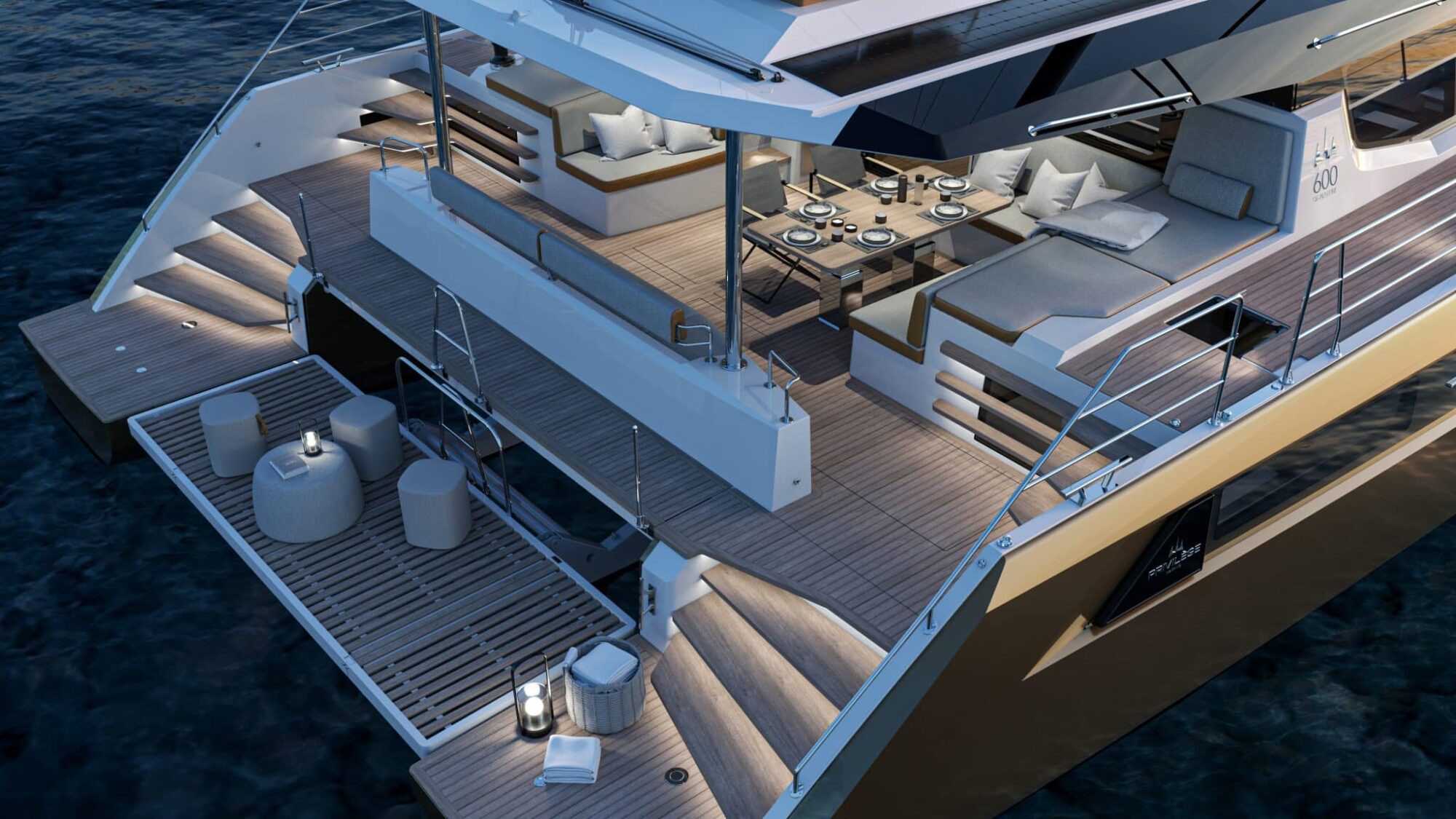
    The Privilège Signature 600 marks a precise evolution in the way a luxury bluewater catamaran can be designed around its owner. Built as the natural successor to the Signature 580, it keeps the proven offshore platform, the 18.28-metre length (60 ft), the 9.18-metre beam (30 ft 11 in) and the owner-focused DNA that define Privilège Marine. Its most distinctive innovation is the aft portside cabin, which becomes a fully customizable room rather than a fixed guest cabin. It can be designed as a private cinema, gym, office, storage room, artist’s studio or walk-in wardrobe. Combined with the full owner’s hull concept, this flexible space pushes the yacht closer to the idea of a house at sea. The result is not decorative personalization. It is a deeper way to shape life on board.

    The Signature 600 reflects a more mature idea of personalization

    The new Privilège Signature 600 is not a radical break from the Privilège philosophy. It is a more refined expression of it. The model builds on the Signature 580, one of the shipyard’s important bluewater catamarans, and develops the concept further with a calmer interior language, more architectural continuity and a stronger sense of private ownership.

    At Privilège Marine, personalization has never meant choosing only fabrics, veneers or decorative details. It means designing a yacht around the way its owner lives. This difference matters. Many yachts offer options. A true bespoke catamaran asks a deeper question: how will the owner use the yacht at anchor, at sea, with family, with guests, during long passages, during work, and during months away from land?

    The Signature 600 answers that question with a specific architectural choice. The aft portside guest cabin becomes a flexible, open-ended room. It is no longer treated only as a sleeping space. It becomes a blank page.

    That choice changes the conversation between shipyard and owner. The yacht is no longer only arranged around a standard accommodation plan. It becomes a more personal environment, where one area can be assigned to a passion, a routine, a professional use or a practical need. This is a significant development in the 60-foot catamaran segment, where many interiors still follow predictable patterns.

    The aft portside cabin becomes a room with a purpose

    The aft portside cabin on the Signature 600 is the centre of this evolution. It can remain a guest cabin if the owner wants maximum accommodation. It can also become something far more personal.

    A private home cinema is one possible direction. It gives the owner a quiet, enclosed space for films, sport, family evenings or music, away from the main saloon. At anchor, this creates a different rhythm on board. The yacht gains a retreat that does not compete with the cockpit, flybridge or dining area.

    A gym is another practical option. Long-distance cruising often changes daily routines. Owners who spend months on board need ways to maintain strength, mobility and balance. A dedicated fitness room can include compact equipment, resistance systems, yoga mats, ventilation and secure storage. On a catamaran designed for extended cruising, health is not a luxury detail. It becomes part of endurance.

    A dedicated office is also increasingly relevant. Many owners now expect to work from the yacht. Satellite communications, remote management, video calls and digital business have changed how people use private yachts. A proper office needs more than a desk. It needs sound control, storage, charging points, lighting, seating comfort and privacy. The Signature 600 can turn this area into a serious workspace, not a temporary corner of the saloon.

    For long-distance cruising, additional storage can be equally valuable. A yacht that crosses oceans needs spare parts, tools, safety equipment, food stores, dive equipment, technical supplies and personal belongings. The difference between a beautiful yacht and a practical offshore home often appears in storage discipline. A dedicated storage room can make life at sea calmer and safer.

    The same space can become an artist’s studio, a dressing room, a children’s learning room, a hobby room or an expansive walk-in wardrobe. The point is not to multiply ideas for their own sake. The point is to give the owner a useful room with a defined role.

    The full owner’s hull changes the hierarchy on board

    The Signature 600 also pushes forward the idea of the full owner’s hull. In a conventional layout, guest accommodation often dominates the design logic. Cabins are multiplied. Berths are counted. The yacht is judged by how many people it can sleep.

    Privilège Marine takes a different view. A yacht designed for an owner should first serve the owner’s life on board. Guest comfort remains important, but it should not dilute the private experience.

    The owner’s hull concept creates a stronger personal territory. It gives the owner a more generous and coherent suite, with privacy, storage, circulation and daily comfort. On a 60-foot bluewater catamaran, this matters because the yacht is large enough to be lived in for long periods, yet still compact enough to remain personal and manageable.

    The aft portside customizable room reinforces this logic. It gives the owner another way to shape the private side of the yacht. A guest cabin is useful for some owners. A personal cinema, gym, office or wardrobe may be far more valuable for others. This is the key point. The best layout is the one that fits the real owner, not an imaginary market average.

    This approach is frank. A yacht should not pretend to be all things to all people. It should be designed around the people who will actually live aboard.

    The house at sea concept becomes more concrete

    The phrase “house at sea” is often used too easily in yachting. Many interiors look residential at boat shows. That does not mean they function as homes during real cruising.

    A house at sea must support daily life. It must offer private areas, shared areas, storage, light, ventilation, movement, quietness and practical routines. It must work at anchor and underway. It must remain comfortable during a passage, not only during a marina visit. It must let people read, sleep, cook, work, train, rest and receive guests without turning every activity into compromise.

    The Signature 600 moves this concept forward because the customizable aft portside cabin gives the yacht a room that would normally exist in a house. It may be a media room, a dressing room, a studio or an office. These are not typical yacht categories. They are domestic categories. They belong to the language of private homes.

    This is important for owners who spend long periods on board. A yacht used for weekends needs beds and bathrooms. A yacht used as a floating residence needs a richer spatial logic. It needs places for different parts of life.

    The Signature 600 remains a sailing catamaran. Its 259 square metres of total sail area (2,787 sq ft), including a 121-square-metre mainsail (1,302 sq ft), a 92-square-metre genoa (990 sq ft) and a 46-square-metre staysail (495 sq ft), confirm that this is still a yacht built for passage-making. Yet the interior evolution shows that offshore capability and residential comfort can be developed together.

    The technical platform keeps the customization serious

    Personalization has value only when the technical platform can support it. A customizable room on a weak or confused yacht is a marketing gesture. On the Signature 600, the concept rests on a proven bluewater base.

    The yacht has an overall length of 18.28 metres (60 ft), a beam of 9.18 metres (30 ft 11 in) and a draft of 1.85 metres (6.07 ft). Empty displacement is listed at 29 tonnes (63,934 lb), rising to 35 tonnes (77,162 lb) at full load. The fuel capacity is 2 x 485 litres (256 gal), and freshwater capacity is 2 x 450 litres (237 gal). The model is designed with 4 to 5 cabins and carries CE A-12 certification.

    These numbers matter because the Signature 600 is not only an interior project. It is a long-distance cruising catamaran. The custom room must be integrated into the yacht’s balance, weight distribution, systems, ventilation, electrical load, safety plan and maintenance access.

    A cinema may require screen placement, acoustic treatment, power management and sound isolation. A gym needs secure equipment, non-slip flooring and ventilation. An office needs lighting, connectivity, power outlets and privacy. Storage needs weight discipline and safe access. A walk-in wardrobe needs humidity control, materials that tolerate marine life and practical organisation.

    A true customized yacht layout cannot be improvised late in the process. It must be planned with design, engineering and use in mind. This is where a shipyard with a hands-on, artisanal culture has an advantage. The owner’s idea can be translated into a working room rather than a decorative concept.

    The design language supports calm rather than spectacle

    The Signature 600 was developed in continuity with Cabinet Marc Lombard and Darnet Design. This matters because the boat’s evolution is not only technical. It is also architectural.

    The interior approach focuses on softened lines, harmonized materials, indirect light and a greater sense of continuity between spaces. The goal is not visual drama for a first impression. It is a calmer onboard atmosphere for long-term living.

    This is an important distinction. Many yacht interiors are designed to impress quickly. Long-distance owners need something different. They need spaces that remain pleasant after weeks on board. They need light that is comfortable. They need surfaces that do not feel aggressive. They need circulation that does not interrupt life. They need storage that disappears into the design.

    The aft portside custom room benefits from this wider language. Whether it becomes a cinema, office, gym or wardrobe, it can be integrated into the yacht’s overall atmosphere. It does not need to feel like an added module. It can feel like part of the home.

    This is where personalization becomes subtle. The room may be highly specific, but it should still belong to the boat.

    The owner’s lifestyle becomes the design brief

    The most serious design question is simple: what does the owner actually do on board?

    Some owners sail as a couple and receive guests occasionally. Others travel with children. Some want to cross the Atlantic. Others want to move between the Mediterranean and the Caribbean. Some need privacy for remote work. Some want a yacht that can host family for several weeks. Some want to live aboard for extended periods and need storage, wardrobe space and personal routines.

    The Signature 600 allows the shipyard to turn these answers into architecture. A remote-working owner may choose a calm office with professional lighting, charging stations, sound insulation and dedicated communications equipment. A family may prefer a media room for children and guests. A sport-focused owner may choose a gym. A long-distance cruising owner may prioritise stores and technical organisation. An owner who treats the yacht as a true residence may want a wardrobe large enough to support changing climates and longer seasons.

    This is why the aft portside cabin is more than a design feature. It is a planning tool. It forces a useful conversation before the yacht is built. It asks the owner to define priorities.

    That conversation creates a better yacht. It also reduces disappointment later. A standard layout may look efficient on paper and still fail the owner’s life. A tailored layout begins with life and then shapes the yacht around it.

    catamaran 600 Privilege Marine

    The Privilège philosophy is visible in one room

    The Signature 600’s customizable aft portside cabin may appear to be one interior detail. In reality, it expresses the wider Privilège Marine philosophy.

    Each Privilège is conceived around its owner. The shipyard’s work combines French craftsmanship, offshore safety, comfort, reliability and performance. The yachts are built in Les Sables d’Olonne, a place shaped by ocean sailing culture and long-distance passage-making. The Signature 600 belongs to that world. It is designed for owners who want a private yacht with real range, not a floating showroom.

    The customizable room makes this philosophy visible. It shows that personalization can be structural in the owner experience. It can influence daily habits, privacy, storage, work, leisure and wellbeing. It can change how the yacht feels after a month at sea or at anchor.

    This is the difference between decoration and design. Decoration changes the look. Design changes the use.

    The new luxury is the freedom to define the yacht

    The Privilège Signature 600 enters a market where volume, lifestyle imagery and charter-oriented layouts often dominate the discussion. Its response is more specific. It offers a 60-foot luxury catamaran that remains rooted in offshore sailing while giving the owner a more meaningful role in the design of life aboard.

    The aft portside cabin is the clearest example. It gives up the comfort of a predetermined answer and replaces it with a better question: what should this yacht make possible for its owner?

    That question is at the heart of Privilège Marine. A yacht built for long-distance cruising should not force every owner into the same pattern. It should provide strength, safety, comfort and coherence, then leave room for personal vision.

    The Signature 600 does exactly that. It keeps the ocean-capable platform. It enhances the sense of space. It protects the owner’s private world. It turns one cabin into a room with meaning. In doing so, it brings the idea of a house at sea closer to reality.

    The result is a yacht that does not simply accommodate an owner. It understands that the owner’s way of living is the real starting point.

  • The Sailor’s Sky: How Reading Clouds Sharpens Judgment at Sea

    The Sailor’s Sky: How Reading Clouds Sharpens Judgment at Sea

    A practical guide to reading clouds at sea, from pressure and fronts to low clouds, high clouds, squalls and offshore decisions.

    Reading clouds remains one of the oldest and most useful skills in sailing. Modern forecasts, satellite images and routing software have changed navigation, but the sky still gives direct evidence of what the atmosphere is doing above the yacht. Clouds show rising air, moisture, instability, pressure changes and approaching fronts. For a sailor, this is practical knowledge. Cirrus may announce a warm front. Cumulus may mark a fair-weather sea breeze. Stratocumulus may show a stable marine layer. Nimbostratus often means prolonged rain. Cumulonimbus demands immediate respect because it can bring squalls, lightning, violent wind shifts and steep seas. A Privilège catamaran is built for bluewater sailing, but good design never removes the need for observation. The best sailors read forecasts, instruments and clouds together. The eye remains part of seamanship.

    The sky remains a working instrument for sailors

    A yacht at sea is surrounded by instruments. The chartplotter shows position. The barometer shows pressure. The AIS shows traffic. The GRIB file gives wind forecasts. Radar shows rain cells. Satellite communications bring updated routing. Yet the sky remains the most immediate instrument on board.

    Clouds are visible evidence of air in motion. They show where moisture is rising, where air is stable, where a front is approaching, where heat is building, and where a quiet morning may become a difficult afternoon. For a sailor, reading clouds is not romantic folklore. It is part of risk management.

    At Privilège Marine, we build bluewater catamarans designed to cross oceans with confidence. That confidence depends on robust structure, reliable engineering and thoughtful comfort. It also depends on judgment. A well-prepared sailor does not look at clouds instead of the forecast. He reads them against the forecast. When the sky contradicts the model, the sailor pays attention.

    Clouds rarely give one single answer. They provide clues. A line of dark bases to windward, a halo around the sun, a sudden tower of cumulus, or a low grey ceiling over cold water can all change a sailing decision. The question is not simply “Will it rain?” The better questions are: will the wind increase, will visibility fall, will the sea steepen, will a squall arrive, and should we reef now?

    The science of cloud formation begins with rising air

    Clouds form when moist air cools to its dew point and water vapour condenses into tiny droplets or ice crystals. This usually happens because air rises. As air rises, pressure decreases. The air expands and cools. If it contains enough moisture, condensation begins around microscopic particles such as salt, dust or aerosols.

    For a sailor, this basic process explains much of the sky.

    The air that rises through heat

    On sunny days, land heats faster than sea. Warm air rises over land, and cooler marine air moves in to replace it. This creates the sea breeze. Small cumulus clouds may form above the heated land or along convergence lines where air streams meet. Near coasts, this is often the first visual sign that the afternoon breeze is developing.

    A sailor approaching the Vendée coast, the Balearic Islands or the Caribbean shore can often see this process before feeling it. The clouds appear over land first. The breeze follows. The effect can be useful in coastal sailing. It can also complicate docking, anchoring or a late-afternoon return to harbour.

    The air that rises over a front

    A front is the boundary between different air masses. Warm air can rise gradually over colder air. Cold air can undercut warmer air and force it upward sharply. Both processes create cloud, but the cloud signatures differ.

    A warm front often begins with high cloud. Thin cirrus may appear first, followed by cirrostratus, then altostratus and nimbostratus. The cloud thickens over hours. Rain may arrive before the surface front. The wind often backs or veers depending on hemisphere and local pattern. The barometer tends to fall.

    A cold front is often more abrupt. The cloud may build vertically. Showers and cumulonimbus can form. Wind direction may shift quickly. Gusts can be severe. The sky may clear after the front, but the sea can remain rough.

    The air that rises through convergence

    Convergence happens when air flows together from different directions and is forced upward. At sea, convergence can occur along sea-breeze fronts, between trade wind streams, near islands, or ahead of squall lines. It often produces cumulus streets, showers and local acceleration zones.

    A sailor crossing the Atlantic or moving between Caribbean islands should treat lines of cloud with care. A line of cumulus can indicate usable wind. A darker, taller, more organised line can indicate squalls.

    The main cloud families give a useful order to the sky

    The World Meteorological Organization recognises ten main cloud genera. For practical sailing, it helps to group them by height and form.

    The broad height bands are simple. Low clouds usually have bases below about 2,000 metres (6,500 feet). Middle clouds usually sit between about 2,000 and 7,000 metres (6,500 to 23,000 feet). High clouds usually have bases above about 5,000 metres (16,500 feet). These limits vary with latitude and season, and some clouds grow vertically through several layers.

    The ten classic cloud genera are cirrus, cirrocumulus, cirrostratus, altocumulus, altostratus, nimbostratus, stratus, stratocumulus, cumulus and cumulonimbus. A sailor does not need to recite Latin names for pleasure. He needs to understand what they imply.

    The high clouds warn of changes above the horizon

    High clouds are usually made of ice crystals. They often appear before the weather changes at sea level. Their value lies in timing. They can tell a crew that the atmosphere is already changing far above the mast.

    The cirrus that signals upper-level movement

    Cirrus clouds are thin, white and fibrous. They can look like hair, feathers or brush strokes. Alone, they may mean little. In a developing pattern, they can be the first visible sign of an approaching warm front or upper-level moisture.

    For sailors, cirrus deserves attention when it spreads, thickens or arrives from a consistent direction. A sky that begins with isolated wisps and gradually becomes veiled may indicate that a frontal system is advancing. On a long passage, that is the moment to compare the sky with the barometer and the forecast.

    The cirrostratus that softens the sun

    Cirrostratus is a thin high veil. It can produce halos around the sun or moon because ice crystals refract light. A halo does not guarantee bad weather, but it often suggests increasing upper-level moisture. When cirrostratus follows cirrus and the barometer falls, a sailor should expect a more organised change.

    The practical decision may be simple. Check the latest forecast. Inspect the deck. Prepare foul-weather gear. Consider sail plan before darkness. A cloud sign is most useful when it triggers preparation early.

    The cirrocumulus that shows waves aloft

    Cirrocumulus appears as small white patches, ripples or grains. It is less common than cirrus and often short-lived. It shows structure in the upper air and can indicate instability or wave motion aloft. For sailors, it is less decisive than cirrostratus or cumulonimbus, but it contributes to the general reading of the sky.

    The middle clouds show the next stage of weather development

    Middle clouds are often more operationally important because they thicken the sky, reduce solar heating and signal that weather is moving closer to the surface.

    The altostratus that turns the day grey

    Altostratus forms a grey or bluish sheet. The sun may appear as a weak disk, then disappear as the layer thickens. This cloud often belongs to frontal weather. It suggests broad uplift and increasing moisture.

    At sea, altostratus matters because it changes the mood and the energy balance. The light fades. The air feels damp. The wind may become more organised. If the barometer is falling, the yacht is likely moving into a more active pressure pattern.

    The altocumulus that deserves a second look

    Altocumulus appears as rounded patches or layers. It can look like a mackerel sky. Many forms are harmless. One form deserves special attention: altocumulus castellanus. It has small towers rising from a middle cloud layer and indicates instability aloft.

    For a sailor, castellanus in the morning can be an early warning. It suggests that the atmosphere is ready to build vertical clouds later in the day if moisture and lift increase. In warm waters, coastal zones and tropical passages, this can be a warning sign for showers or thunderstorms.

    The nimbostratus that means persistent rain

    Nimbostratus is a thick, dark, layered cloud that brings prolonged rain or snow. It is less dramatic than cumulonimbus, but it can be exhausting offshore. Visibility may fall. Decks remain wet. Watchkeeping becomes colder. Solar production drops. The sea can become confused if the wind shifts with the frontal system.

    This cloud calls for endurance rather than emergency. The sailor should protect crew rest, manage energy, secure ventilation, and reduce avoidable deck work.

    sailor clouds

    The low clouds speak directly to the boat

    Low clouds are close enough to affect visibility, wind perception and immediate decisions. They often reflect the marine layer, local stability, surface cooling or shallow uplift.

    The stratus that lowers the world

    Stratus is a low, grey sheet. When it reaches the surface, it becomes fog. For sailors, stratus means visibility risk. In busy coastal waters, fog is a serious operational problem. AIS, radar, sound signals, lookout discipline and speed control become central.

    Stratus often forms in stable air. It can appear over cold water when moist air moves above it. It may also form at night as the surface cools. A low ceiling with drizzle may look gentle, but it can make navigation demanding near traffic lanes, fishing gear, headlands and harbour entrances.

    The stratocumulus that marks a stable marine layer

    Stratocumulus is common over oceans. It appears as low rolls, patches or a broken grey-white layer. It often signals a relatively stable boundary layer. It may bring light showers, but it usually lacks the violence of deep convection.

    For bluewater sailors, stratocumulus can be a sign of a steady trade-wind environment. It may also indicate limited solar charging and a cooler deck. In the Atlantic trades, rows of stratocumulus and cumulus can show wind direction and flow structure. The sailor can read the cloud streets like a rough sketch of the air.

    The cumulus that begins as fair-weather information

    Cumulus clouds have flat bases and cauliflower tops. Small cumulus with clear spacing usually indicates fair-weather convection. It can be good news. The air is rising locally, but vertical growth remains limited.

    The danger begins when cumulus grows taller, darker and more organised. A small cotton cloud can become towering cumulus if the atmosphere is unstable. If it continues to build, it may become cumulonimbus. The sailor watches the top. Sharp, rising towers mean active uplift. A spreading anvil means the cloud has reached a high level and the storm has matured.

    The cumulonimbus cloud is the sailor’s hard warning

    Cumulonimbus is the cloud that demands action. It is a dense, towering cloud with major vertical development. Its top often reaches above 10 kilometres (35,000 feet), and its vertical extent can range from about 3 kilometres to more than 15 kilometres (10,000 to 50,000 feet). It can produce heavy rain, lightning, hail, violent downdrafts, waterspouts and abrupt wind shifts.

    For sailing, the most dangerous part is often the gust front. Cold air descends inside the storm, hits the sea surface and spreads outward. The result can be a sudden wall of wind arriving before the rain. A yacht carrying too much sail can be overpowered within minutes.

    On a catamaran, the response must be early. Multihulls have great form stability. They sail fast and level. They also reward disciplined reefing because they do not heel progressively like a monohull. A Privilège is built for offshore confidence, but seamanship still decides the sail plan. When a cumulonimbus is building to windward, the correct question is not whether the boat can carry the canvas now. The question is what the boat should carry when the squall arrives.

    The visual signs are clear. Watch for a dark base, sharp vertical towers, an anvil top, curtains of rain, a shelf cloud, rapid movement, lightning, or a sudden cool outflow at deck level. At night, lightning behind cloud can reveal structure before radar shows the strongest rain. Offshore, the crew should reef early, secure loose gear, close vulnerable openings, brief the watch, and keep clear of metal during electrical activity where possible.

    The barometer gives clouds their pressure context

    Clouds show visible moisture and motion. Atmospheric pressure gives the wider structure. The barometer helps the sailor decide whether a cloud is local, frontal or part of a deepening system.

    A slow fall may indicate an approaching low or front. A rapid fall deserves attention. A rising barometer often indicates improving or stabilising conditions, although strong winds can persist after a front. The absolute number matters less than the trend, speed of change and relation to the forecast.

    For example, high cloud arriving with a steady pressure fall gives a stronger warning than high cloud under stable pressure. Growing cumulus under a hot afternoon sky may be local convection. Growing cumulus with falling pressure and an approaching trough carries more risk. A grey low layer under steady high pressure may be a marine layer rather than an incoming storm.

    The best sailors keep a simple pressure log. Time, pressure, cloud type, wind direction, wind strength and sea state. After a few days offshore, this record becomes valuable. It shows whether the yacht is experiencing forecast conditions or entering something different.

    The sailor reads clouds with wind, sea and time

    A cloud has meaning because of context. The same cloud can matter differently depending on season, latitude, sea temperature, time of day and route.

    In the Mediterranean, a summer cumulonimbus over land can spill gusts towards the coast. In the Caribbean, morning cumulus may grow into afternoon squalls. In the Bay of Biscay, layered cloud and falling pressure may announce a frontal passage. In the trade winds, low cloud streets can help confirm wind direction and consistency. In high latitudes, low cloud and fog may become the main navigational threat.

    Time also matters. Small cumulus at 10:00 may be normal. Fast-growing towers at 10:00 suggest stronger instability. A halo around the moon after sunset may matter if pressure is falling. A black line of cloud at dawn may be an approaching squall line rather than harmless sunrise shadow.

    This is where marine weather becomes a habit rather than a forecast download. The sailor looks, records, compares and decides. Reefing, delaying departure, changing watch routines, selecting an anchorage, altering course by 20 degrees or preparing radar guard zones are all practical outcomes of cloud reading.

    The modern forecast and the human eye must work together

    A serious skipper uses professional forecasts. He updates weather files. He studies synoptic charts. He understands pressure systems. He uses radar, satellite imagery and routing tools. He also goes on deck.

    Technology has blind spots. A forecast may resolve the broad flow but miss a local thunderstorm. A GRIB file may show average wind and understate gusts. A model may describe the next six hours well, then fail around a coastline, island, headland or thermal effect. The cloud above the yacht can reveal that difference.

    The discipline is simple. If the forecast says stable conditions and the sky shows rapid vertical development, believe the sky enough to prepare. If the barometer falls faster than expected, re-check the weather. If a line of cloud advances from windward, reduce exposure before it arrives. If fog forms near shipping lanes, treat visibility as the main hazard.

    Good seamanship is rarely dramatic. It is a series of early, calm adjustments.

    The sailor who looks up makes better decisions

    Reading clouds will never replace modern meteorology. It gives the sailor a sharper relationship with the sea around him. It turns the sky from scenery into information.

    For Privilège owners, this matters because bluewater cruising is about freedom with responsibility. A yacht capable of crossing oceans gives its crew time, range and comfort. The crew must still interpret the world outside the cockpit. Clouds show that world in motion.

    The most useful cloud is not always the most beautiful. A thin veil of cirrostratus may warn of tomorrow’s front. A low stratus deck may force a radar watch. A morning castellanus field may suggest afternoon instability. A dark cumulonimbus may demand reefs before the first gust touches the water.

    The sailor who reads clouds gains minutes, sometimes hours. At sea, those minutes matter. They allow sails to be reduced without panic. They allow crew to rest before bad weather. They allow a yacht to enter a harbour in daylight or remain offshore until visibility improves. They turn observation into judgment.

    The sky has always spoken to sailors. The best ones still listen.

  • The Right Season to Sail West Across the Atlantic

    The Right Season to Sail West Across the Atlantic

    When to sail east to west across the Atlantic, why the trade wind route matters, and how to prepare a yacht, crew and paperwork properly.

    Crossing the Atlantic from East to West is not a delivery trip. It is a full ocean passage, a test of seamanship, preparation, patience and judgement. The classic route runs from Europe towards the Canary Islands, then west across the trade wind belt to the Caribbean. For most cruising yachts, the best departure window from the Canaries is late November to January. This timing reduces exposure to the Atlantic hurricane season and allows crews to benefit from more settled north-easterly trade winds. The passage from Las Palmas de Gran Canaria to Rodney Bay, Saint Lucia, is about 2,700 nautical miles, or roughly 5,000 kilometres, and usually takes 18 to 21 days for an average cruising yacht. A good crossing is never improvised. It requires a sound boat, a realistic route, disciplined weather routing, careful provisioning, reliable communications and properly prepared customs, immigration and insurance documents.

    The Atlantic crossing remains one of sailing’s purest adventures

    There are many ways to use a yacht. Some are social. Some are coastal. Some are seasonal. Crossing the Atlantic belongs to another category. It is a passage that changes the way a crew understands a boat.

    At Privilège Marine, we build catamarans for owners who do not see the horizon as a limit. A true bluewater catamaran is not designed only for marina life, charter brochures or short summer hops. It must be able to keep moving safely for weeks. It must remain comfortable when the crew is tired. It must protect people during squalls, support watchkeeping at night, carry stores without losing its balance, and give confidence when the nearest harbour is several days away.

    That is the real interest of an Atlantic crossing east to west. The passage forces clarity. Every choice made before departure becomes visible at sea: the quality of the rig check, the logic of the sail inventory, the condition of the autopilot, the realism of the provisioning plan, the calm of the skipper, and the ability of the crew to live together in a small offshore society.

    The romance is real, but it is not enough. There will be superb days: long following seas, flying fish on deck at dawn, warm nights under a moonless sky, and the strange satisfaction of noon positions slowly eating into the chart. There will also be fatigue, chafe, broken blocks, salt everywhere, confused seas, sudden squalls and long hours of conservative decisions. That is why the crossing is a real adventure. Not because it is reckless, but because it is serious.

    The best season is defined by hurricanes and trade winds

    The first question is simple: when should a yacht cross the Atlantic from Europe to the Caribbean? The honest answer is that the best window is usually from late November to January, with December often considered the centre of the season.

    The reason is meteorological, not romantic. The official Atlantic hurricane season runs from June 1 to November 30. The statistical peak is around September 10, with most activity concentrated between mid-August and mid-October. Leaving too early in autumn may feel efficient, but it increases exposure to late tropical systems or disturbed weather near the eastern Caribbean.

    Waiting too long has another cost. By February and March, the trade winds can be stronger and more established. That can produce a fast passage, but also a more muscular one, with bigger seas, more pressure on the rig, and a higher chance of tired crew and damaged gear. Many experienced skippers still cross then, but it is not always the most comfortable choice for a family yacht or a newly formed crew.

    November is a transition month. It is attractive because it is the traditional departure period for many Atlantic rallies, including the ARC from Las Palmas to Saint Lucia. Yet early November can still be unsettled. A prudent skipper does not sail because a date was printed in a calendar. He sails because the weather window is acceptable.

    For a private owner planning carefully, the strongest answer is this: move the yacht south through Europe, Portugal, Madeira or the Canary Islands during September, October and early November; prepare in the Canaries; then depart when the tropical risk has reduced and the north-easterly trades are properly in place.

    The classic route follows the logic of the North Atlantic

    The traditional westbound route exists because the ocean makes it logical. The North Atlantic is shaped by large-scale wind and current systems. The Azores High helps generate the clockwise circulation that supports the north-easterly trade winds. These winds push air from the subtropical high-pressure belt towards lower pressure nearer the equator, while the rotation of the Earth bends them into a north-east to south-west flow.

    For sailing yachts, that creates the famous trade wind route. From the Canary Islands, the common strategy is not to sail a straight line west at all costs. The older saying was to “sail south until the butter melts”, then turn west. The modern version is more precise: sail far enough south to find stable trades, then shape the westward leg according to weather, sea state, crew condition and destination.

    This is why a route from the Canary Islands to Caribbean often begins with a south-westerly component. Boats may head towards the latitude of Cape Verde before committing fully west. The objective is not to add miles for pleasure. It is to reduce the risk of being trapped near the southern edge of the Azores High, where light winds can lead to days of motoring, fuel anxiety and slow progress.

    The distance from Las Palmas de Gran Canaria to Rodney Bay, Saint Lucia, is about 2,700 nautical miles, or close to 5,000 kilometres. In practice, many yachts sail closer to 2,800 or 3,000 nautical miles, depending on how far south they go and how much they route around weather. An average cruising yacht often takes 18 to 21 days. A faster multihull can do better, but speed should not be the only measure of success. A clean arrival with a rested crew and an intact yacht is the result that matters.

    The currents help, but the wind still writes the passage

    Currents matter on an Atlantic passage, but they should not be exaggerated. The wind is the main engine. The current is the background assistance or penalty.

    From Europe, the Canary Current forms part of the eastern side of the North Atlantic gyre. Farther south, the west-setting North Equatorial Current broadly supports the movement towards the Caribbean. Near the islands, local effects can matter more than oceanic theory: acceleration zones in the Canaries, wind shadows behind high volcanic islands, acceleration near headlands, and confused seas where swell, current and local wind meet.

    A westbound yacht should also understand what not to do. The Gulf Stream is a powerful current, moving at about one to three knots in places, but it is not the main helper for the classic Europe-to-Caribbean crossing. It is more relevant to routes near the American coast and to return passages towards Bermuda, the Azores and Europe.

    On the westbound leg, a favourable current may add comfort and distance over the ground. It does not remove the need for good sail trim, sensible routing and active watchkeeping. A catamaran that sails efficiently at moderate angles will often make better daily runs by avoiding deep, slow dead-downwind sailing. Apparent wind, sail balance and sea state matter. On many performance-capable cruising catamarans, the best solution is often a controlled downwind angle, with planned gybes, rather than simply pointing the bows at the waypoint and dragging canvas behind the boat.

    The best departure ports are chosen before the ocean starts

    A serious crossing does not begin at the edge of the Atlantic. It begins in the shipyard, then in the maintenance plan, then in the staging ports.

    For an owner leaving from Les Sables d’Olonne, the journey south is part of the preparation. The Bay of Biscay demands respect, especially in autumn. Portugal offers useful stops such as Cascais and Lagos. Madeira can be a valuable intermediate landfall. The Canary Islands remain the most established launch platform for a westbound passage because they offer marinas, repair services, provisioning, chandlery, crew changes and a community of other ocean-bound yachts.

    Las Palmas de Gran Canaria is the best-known departure port. It is the start of the ARC and one of the most practical places in the Atlantic to complete final preparations. Tenerife, Lanzarote, La Gomera and Gran Canaria also provide alternatives depending on weather, berth availability and the owner’s programme.

    The Cape Verde option deserves special attention. Stopping in Mindelo breaks the passage into two more manageable legs: roughly 850 nautical miles from the Canaries to Cape Verde, then about 2,000 to 2,200 nautical miles to the Caribbean, depending on the final landfall. This route has clear advantages. It gives the crew a first offshore test, allows repairs before the longest leg, and places the yacht farther south, where the trades are often more reliable.

    The trade-off is administrative and logistical. Cape Verde adds a clearance stop, possible marina congestion, and another departure procedure. For many crews, it is still worth it. A controlled pause before the main ocean leg can be more intelligent than forcing a nonstop passage with unresolved technical issues.

    Atlantic Ocean Crossing

    The Caribbean landfall should match the yacht’s next life

    Saint Lucia is the symbolic landfall for many crews because Rodney Bay is the finish of the ARC. It offers marina services, customs and immigration, provisioning, repairs and onward access to the Windward Islands. The Pitons also provide one of the most memorable arrivals in the Caribbean.

    But Saint Lucia is not the only answer. Martinique, especially Le Marin, is highly practical for French-speaking owners and yachts needing technical support. Guadeloupe can suit those planning to cruise the French Antilles. Antigua is attractive for yachts heading north towards the Leeward Islands, English Harbour, Falmouth Harbour and the winter superyacht circuit. Barbados can be a logical first landfall for a more southerly route because it lies farther east than many Caribbean islands. Grenada is useful for yachts planning to remain in the southern Caribbean or continue west.

    The right arrival point depends on four questions. Where will the yacht cruise after arrival? Where can the crew fly home or join? Where are the repair and marina services suitable for the boat? What are the customs and immigration requirements for the flag, owner and crew?

    This last point is not paperwork for later. It is passage planning. Arrival after three weeks at sea is not the moment to discover that a crew member needs a visa, that an online pre-arrival form was required, or that the insurance policy excludes a named area.

    The paperwork is part of seamanship

    Administrative preparation is less glamorous than sail selection, but it is part of good seamanship. Before departure, the skipper should verify passports, visas, crew lists, boat registration, radio licence, MMSI registration, EPIRB registration, insurance, vaccination or health declarations where relevant, and the clearance requirements of the departure and arrival countries.

    For yachts leaving the Schengen area, non-EU crew must pay close attention to the Entry/Exit System. Since April 2026, the EU Entry/Exit System records short-stay non-EU nationals electronically at external borders. ETIAS, the European travel authorisation for visa-exempt travellers, is scheduled to begin later in 2026. These systems matter for crew joining or leaving the yacht in Europe, and for any later return.

    On the Caribbean side, many islands require pre-arrival information, customs forms and immigration declarations. Saint Lucia, for example, uses formal entry ports such as Rodney Bay Marina, and vessels may remain for up to three months unless an extension is requested. SailClear and national immigration portals are increasingly common in the region. Requirements differ between islands, so the skipper should check each country before departure, not during the final night at sea.

    The traditional yellow Q flag still has meaning. On arrival, the yacht should follow local procedures, fly the correct signal where required, and ensure nobody goes ashore before clearance unless authorised. Firearms, drones, pets, prescription medicines, alcohol, spare parts and high-value equipment may all trigger specific rules. A luxury yacht has no exemption from customs law.

    The boat must be prepared for repetition, not drama

    Ocean preparation is not mainly about surviving a single storm. It is about reducing the number of small failures that become serious because the yacht is far from land.

    The essential list is long. The rig should be inspected before departure, including terminals, spreaders, halyards, sheaves and attachment points. Downwind sails must be checked for cloth condition, furling reliability and chafe points. Reefing systems must work under load. Preventers, barber haulers, blocks, sheets and spare lines must be sized for repeated use. Autopilots deserve particular attention because they may steer for most of the passage. A spare drive unit, spare ram parts or a proven emergency steering plan can change the outcome of a crossing.

    Energy management is equally important. A modern cruising catamaran depends on navigation instruments, autopilot, communications, refrigeration, lighting, watermaker, pumps and domestic systems. Solar, alternators, generator capacity and battery health should be assessed realistically. A watermaker is valuable, but the yacht should still carry stored water. Redundancy is not pessimism. It is respect for distance.

    Safety equipment must be current and accessible: liferaft, EPIRB, AIS, lifejackets, tethers, jacklines, flares or electronic distress signals, grab bag, medical kit, satellite communications and fire equipment. Crew must know where things are and how they work. A safety briefing the evening before departure is too late if people have not practised.

    The catamaran changes comfort, but not responsibility

    An Atlantic passage on a catamaran is different from the same crossing on a monohull. The platform is level. Watchkeeping can be less tiring. The saloon offers wide visibility. The galley is easier to use. Cabins remain more liveable. Families and guests often adapt better because the boat does not heel for weeks.

    These are real advantages. They are also sometimes misunderstood. A catamaran is not a floating apartment that happens to cross oceans. It is a sailing vessel with high loads, high stability and its own rules. Because it does not heel like a monohull, it does not always give the same physical warning when overpressed. Sail reduction must be early and disciplined. Squalls at night must be treated seriously. Apparent wind can rise quickly. A comfortable boat can make crews complacent if procedures are weak.

    This is why Privilège Marine places offshore use at the centre of the design conversation. Weight distribution, helm protection, visibility, structural integrity, storage, access to systems, ventilation, machinery layout and watchkeeping ergonomics all matter at sea. The Atlantic does not reward decorative thinking. It rewards coherent design.

    The realistic planning calendar begins months before departure

    A sensible westbound programme often looks like this. In spring and summer, the owner completes technical works, safety updates and offshore training. In late summer, the yacht performs loaded sea trials. In September or October, the boat moves south from northern Europe, allowing time for Biscay, Portugal, Madeira or Morocco if needed. In November, the yacht reaches the Canary Islands for final checks, provisioning and crew arrival. In late November, December or January, the crew departs on the main crossing.

    This schedule has one great advantage: it keeps pressure under control. The most dangerous phrase before an ocean passage is “we have to leave tomorrow”. No private yacht has to leave tomorrow. Flights can be changed. A berth can be extended. Fresh food can be bought again. A weather window cannot be negotiated with.

    The best time to cross the Atlantic is therefore not a fixed date. It is the intersection of season, weather, yacht readiness and crew readiness. If one of those four elements is missing, the departure is premature.

    The final decision belongs to the skipper, not the calendar

    A well-prepared Atlantic crossing from East to West is one of the most satisfying passages a yacht can make. It has history, logic, beauty and technical depth. It links Europe with the Caribbean through a route shaped by trade winds, currents and centuries of seamanship.

    But the crossing should never be sold as easy. It is accessible to well-found yachts and competent crews. It is not casual. The ocean is generous with patient sailors and unforgiving with hurried ones.

    For owners, the reward is not only arrival in Saint Lucia, Martinique, Antigua or Grenada. The reward is the confidence built during the passage: the knowledge that the yacht can cross an ocean, that the crew can work together, and that distance can be managed with judgement rather than anxiety.

    That is the real privilege of the Atlantic. Land disappears. The boat becomes the world. And after nearly 5,000 kilometres of moving water, the first Caribbean hill on the horizon feels less like a destination than proof that the preparation was worth it.

  • The Hidden Geometry That Decides How a Yacht Really Sails

    The Hidden Geometry That Decides How a Yacht Really Sails

    A clear guide to keel types, foils and daggerboards, and how each choice changes stability, speed, draft and offshore comfort.

    A keel is not just a piece of structure below a yacht. It is one of the design decisions that defines how the boat moves, heels, tracks, turns, accelerates, dries out, grounds, and survives heavy weather. On a monohull, the keel normally carries ballast and creates both righting moment and lateral resistance. On a multihull, stability comes mainly from beam, not ballast, so the underwater appendages serve a different purpose: they reduce leeway, protect the hulls, manage draft, or, in extreme cases, create lift. That distinction matters. A long keel favours tracking and protection. A cruising fin keel balances performance and usability. A racing fin keel cuts drag and adds leverage. A canting keel separates ballast from symmetry. Daggerboards sharpen windward performance. Foils change the equation again by lifting part of the boat out of the water. There is no universal winner. There are only honest trade-offs.

    The keel is the boat’s hidden contract with the sea

    At Privilège Marine, we look at appendages through a bluewater lens. A yacht must sail well, but it must also remain understandable, serviceable and safe when the nearest shipyard is several days away. That is why the debate around sailboat keel types should never be reduced to speed alone.

    A keel performs two main functions. First, it resists sideways drift, known as leeway. Second, on a monohull, it often carries ballast, which helps the yacht stand back up after being pushed over by the wind. These two jobs are not identical. A deep, narrow foil creates efficient lateral lift. A heavy bulb placed low creates stability. Designers combine these functions in many ways.

    On a catamaran or trimaran, the story changes. The boat does not rely on a deep ballast keel to stay upright. Its wide stance creates stability. A Privilège Signature 510, for example, has a beam of 7.98 metres (26 ft), a draft of 1.57 metres (5 ft 10 in) and a light displacement of 16.8 tonnes. The larger Signature 650 has a beam of 9.20 metres (30 ft 2 in) and a draft of 2.04 metres (6 ft 8 in). These figures show the point clearly: a bluewater cruising catamaran gains stability from its platform, not from dragging several tonnes of lead deep below the hull.

    That is why the language must be precise. A “keel” on a monohull is usually a ballasted appendage. A “keel” on a cruising catamaran is often a shallow fixed fin or skeg-like structure that protects the hull and provides lateral resistance. It is not the same object, even if the word is the same.

    The long keel trades speed for tracking and protection

    The long keel, often called a full keel in English, is the oldest serious offshore solution. It runs along much of the hull length. It gives directional stability, protects the rudder and propeller, and gives the boat a steady feel at sea. In heavy following seas, that steadiness can be reassuring.

    The price is agility. A long-keel yacht does not tack with the crispness of a modern fin-keeler. It also reverses poorly in marinas. The boat likes to go straight. That is valuable offshore and frustrating in tight harbours.

    Brands such as Island Packet have long defended the concept for offshore cruising. Their “Full Foil Keel” approach is built around seakeeping, grounding protection and control. This makes sense for conservative bluewater owners. It makes less sense for sailors who want acceleration, pointing ability and lively handling.

    The frank view is simple: a long keel is not slow because it is badly designed. It is slower because it accepts more wetted surface and less hydrodynamic efficiency in exchange for tracking, protection and psychological comfort. For some owners, that is a fair exchange. For others, it is a brake.

    The centreboard brings freedom in shallow water

    The French term “dérive” can be misleading when translated into English. In most yacht contexts, the right words are centreboard, swing keel, lifting keel, or daggerboard, depending on the geometry. If the board pivots, “centreboard” or “swing keel” is usually correct. If it moves vertically, “daggerboard” or “lifting board” is more precise. If its angle can be adjusted for performance, “adjustable daggerboard” or “canted daggerboard” may be appropriate.

    A centreboard lets a yacht reduce draft in shallow water and increase lateral resistance offshore. This is useful in tidal regions, lagoons, rivers and shoal cruising grounds. It allows a boat to explore anchorages that a deep fin keel cannot reach.

    The trade-off is engineering. A centreboard case occupies interior volume. The pivot, lifting system and sealing surfaces require inspection. In a grounding, the loads can be severe. On a serious cruising yacht, the system must be simple, strong and accessible. If it is not, the promise of versatility becomes a maintenance liability.

    The RM 1380 is a useful example of the concept in practice. It offers either twin keels with a draft of 1.95 metres (6 ft 5 in), or a lifting keel with draft ranging from 1.45 metres to 3.35 metres (4 ft 9 in to 11 ft). That spread shows the power of the idea: shallow-water access when lifted, deep lateral plane when lowered.

    The bilge keel puts tidal freedom ahead of peak speed

    The bilge keel, or twin keel, uses two shallow keels placed to port and starboard. It is often seen in tidal regions such as Britain and northern France, where boats may need to dry out upright on mud, sand or a harbour bed.

    Its advantage is practical. A twin-keel yacht can take the ground without a cradle. It can also reduce draft and protect the hull in coastal cruising. For sailors who operate in tidal harbours, this matters more than an extra half-knot of theoretical speed.

    The cost is hydrodynamic. Two keels create more wetted surface. They are usually less efficient upwind than a single deep fin. As the boat heels, the immersed keel may not produce the same clean lift as a deep central foil. The result is more leeway and lower pointing ability.

    This does not make the bilge keel a poor design. It makes it a regional and operational design. If the yacht’s life includes drying harbours and shallow estuaries, it is rational. If the programme is ocean passage-making with long upwind legs, it is less convincing.

    The cruising fin keel became the modern default for good reason

    The cruising fin keel is the most common compromise in modern monohull yacht design. It is shorter than a long keel, deeper and more efficient, with a separate spade rudder. It gives better manoeuvrability, better tacking and less wetted surface.

    A family cruiser such as the Beneteau Oceanis 30.1 illustrates the range. It is offered with draft options from about 1.30 metres (4 ft 3 in) to 2.30 metres (7 ft 7 in), depending on configuration. Larger cruisers follow the same logic. The Oceanis 47 lists a minimum draft of 1.87 metres (6 ft 2 in) and a maximum draft of 2.47 metres (8 ft 1 in). The owner chooses between shallow-water convenience and deeper-water efficiency.

    The cruising fin keel is not glamorous, but it is effective. It works for coastal cruising, club racing, charter fleets and offshore passages. It gives acceptable speed without radical systems. It is also easier to produce at scale.

    Its weakness is exposure. A fin keel is more concentrated structurally than a long keel. Grounding loads are transferred through a smaller area. The keel-to-hull structure must therefore be engineered and inspected properly. When owners neglect this, the problem is not the concept. It is maintenance and structure.

    The racing fin keel turns ballast into leverage

    The racing fin keel is more extreme. It is deeper, narrower and often carries a bulb at the bottom. The objective is to place ballast as low as possible while reducing drag. The fin provides lateral resistance. The bulb provides stability. The hull can then be lighter, wider and more powerful.

    This is the world of sportboats, grand-prix racers and offshore race yachts. The J/70, for example, uses a lifting keel with a stainless-steel structure and lead bulb. It is only 6.93 metres (22 ft 9 in) long, with a draft of 1.50 metres (4 ft 11 in), displacement of 795 kg and ballast of 285 kg. Those numbers show a simple principle: even a small racing keelboat uses ballast depth to turn sail power into speed.

    The deeper the keel, the more efficient the righting moment. But there are costs. Deep draft limits cruising grounds. The structure must be precise. The boat may be harder to handle in shallow marinas. For a racing crew, those costs are acceptable. For a bluewater family yacht, they often are not.

    A racing fin keel is not “better” than a cruising fin keel. It is narrower in purpose. It converts design freedom into performance, then charges the owner in draft, loads and operational limits.

    The canting keel changes the physics of righting moment

    The canting keel is one of the most important inventions in modern offshore racing. Instead of keeping the ballast on the centreline, hydraulic rams swing the keel to windward. This increases the horizontal distance between the ballast and the centre of buoyancy. In plain English, the same ballast becomes more powerful.

    The Volvo Ocean 65 is a clear example. It is a 22.14-metre (72 ft 8 in) offshore racing monohull with a maximum draft of 4.78 metres (15 ft 8 in), an empty weight of 12,500 kg, and a canting keel that moves to plus or minus 40 degrees. It also carries twin daggerboards and ballast tanks. That is not a cruising compromise. It is an integrated racing machine.

    The benefit is speed. The yacht can carry more sail area for the same ballast weight. It can remain powerful in conditions that would force a conventional keelboat to reef earlier.

    The cost is complexity. A canting keel depends on bearings, rams, hydraulics, sensors and emergency systems. It also loses lateral efficiency when canted because the keel is no longer vertical. That is why canting-keel yachts usually need daggerboards or foils to provide side force. The ballast does the stabilising. The boards do the gripping.

    For a race boat, that separation is brilliant. For a cruising yacht, it is usually excessive.

    The canting keel with daggerboards separates power from grip

    The combination of canting keel and daggerboards is central to IMOCA 60s and other high-performance offshore monohulls. The IMOCA class is limited to 18.28 metres (60 ft), with boats built to be light, powerful and strong enough for the Vendée Globe. Modern IMOCA yachts use a canting keel for righting moment, two rudders, and either foils or daggerboards for lateral resistance and lift.

    This architecture is sophisticated because it breaks the old logic of the keel. The keel is no longer expected to do everything. Once it cants to windward, its job is primarily to create stability. The daggerboard or foil on the leeward side generates much of the side force needed to stop the boat sliding sideways.

    The performance gain is real. Designers can reduce displacement, increase sail power and manage the hydrodynamic load more precisely. But the system demands skill. Board angle, foil rake, keel cant and rudder load all interact. If the crew gets the setup wrong, the boat can become slower, not faster.

    This is the point often missed in simplified discussions of “advanced keels”. The faster the appendage package becomes, the more it becomes a system. The keel is no longer a single answer. It is part of a moving network of loads.

    The foils turn appendages into lifting surfaces

    The foils debate is sometimes romanticised. Foils do not magically make every yacht better. They create hydrodynamic lift. That lift can reduce displacement, cut hull drag and increase speed. But foils also add load, ventilation risk, impact exposure and structural complexity.

    In the America’s Cup, the AC75 goes further than almost any other monohull. It has no conventional keel. Its large canting foil arms provide lift and righting leverage, while the boat flies on the leeward foil with the windward arm raised. It is a spectacular technical answer to a racing rule. It is not a sensible template for ocean cruising.

    In the Ultim trimaran world, foils have pushed offshore multihulls into another speed category. The 32-metre Gitana 17, Maxi Edmond de Rothschild, has exceeded 40 knots under sail. The newer Gitana 18, also 32 metres, has been reported with foil wings spanning more than 10 metres and a design objective centred on sustained ocean flight. These boats are laboratories as much as yachts.

    On IMOCA 60s, foils have transformed reaching performance. They help lift the hull, reduce drag and stabilise the boat at high speed. Yet they remain retractable because offshore reality is brutal. Floating objects, slamming loads and Southern Ocean sea states punish exposed appendages.

    For cruising owners, the honest conclusion is clear. Foils are fascinating. They are not automatically appropriate. A yacht designed for private bluewater voyaging must prioritise repeatable performance, repairability and comfort. Flying is exciting. Arriving safely matters more.

    The multihull problem is different from the monohull problem

    A multihull does not need a heavy keel to stand up. It relies on beam. This single fact changes the entire appendage debate.

    On a catamaran, underwater fins mainly reduce leeway and help the boat sail closer to the wind. They may also protect the hull, propeller and rudder. They are not ballast keels. That is why comparing a monohull keel with a catamaran keel can be misleading.

    A fixed mini-keel on a cruising catamaran is simple, strong and useful. It protects the hull if the boat touches bottom. It allows moderate draft. It does not intrude into the living space. It requires little handling. For a long-distance cruising catamaran, these are serious advantages.

    A daggerboard catamaran can sail higher and faster, especially upwind. The board is a more efficient foil. It can be lifted off the wind to reduce drag and lowered upwind to increase grip. Performance catamarans use this logic well.

    But daggerboards bring trade-offs. The cases take interior space. The boards need controls. They can be damaged by grounding or debris. If a board jams offshore, the owner must solve the problem at sea.

    At Privilège Marine, our design culture is shaped by bluewater cruising. The aim is not to win a windward-leeward race. It is to cross oceans with confidence, carry stores, protect the crew, and offer a stable life aboard. That is why draft, appendage protection, structural simplicity and helm balance matter as much as pure speed.

    The fixed mini-keel prioritises reliability on cruising catamarans

    The fixed mini-keel is often underestimated because it is not fashionable. It should not be. On a cruising catamaran, it offers a practical package: shallow draft, hull protection, simple construction and predictable handling.

    For an owner planning the Caribbean, the Pacific islands or long Mediterranean passages, these qualities count. The yacht can approach anchorages with less anxiety. There is no board to raise before every shoal. There is no case cutting through the accommodation. There is less to break.

    The performance penalty exists. A fixed mini-keel creates more drag than a clean retractable daggerboard when the board is correctly managed. It also points lower. A performance catamaran may feel sharper and faster with daggerboards.

    The question is not whether one is faster. The question is whether the speed gain is worth the operational cost. For many luxury bluewater catamaran owners, the answer is no. Ease of use is not a weakness. It is a design requirement.

    The daggerboard rewards active sailors

    The catamaran daggerboard is the performance sailor’s answer to leeway. It gives a deeper, cleaner foil without forcing the whole boat to carry permanent draft. Upwind, it improves lift. Reaching and running, it can be lifted to reduce drag.

    This is an elegant solution for sailors who enjoy trimming the boat actively. It is also useful in light displacement multihulls, where small reductions in drag produce visible speed gains.

    But the board is not free. It adds structure, cost and handling. It can slam in its case if poorly controlled. It can be damaged by grounding. It can create noise. It can also give the owner another system to manage when conditions deteriorate.

    For a performance crew, that is acceptable. For a family crossing an ocean at night, simplicity may have more value than a few degrees of pointing ability.

    The real choice is not speed versus comfort, but risk versus purpose

    The keel conversation is often framed badly. People ask which keel is best. The better question is: best for what?

    A long keel is credible for conservative offshore voyaging. A bilge keel is rational for tidal cruising. A cruising fin keel is the modern mainstream because it balances performance, cost and handling. A racing fin keel is a lever for speed. A canting keel is a racing tool. A canting keel with daggerboards is a system for elite offshore performance. Foils are a separate revolution, powerful but unforgiving. On multihulls, fixed keels, daggerboards and foils are not substitutes for ballast. They are instruments for grip, protection and lift.

    For Privilège Marine, the priority is clear. A bluewater catamaran must be safe, balanced, repairable and calm enough to make distance without exhausting its crew. Performance matters. But performance without serenity is the wrong bargain for an owner’s yacht.

    The underside of a yacht rarely appears in the brochure photograph. Yet it is where much of the truth lives. The keel, board or foil decides how much freedom the owner really has: freedom to cross oceans, freedom to enter shallow anchorages, freedom to sail efficiently, and freedom from unnecessary complication. That is why appendage design is not a technical footnote. It is one of the most honest statements a naval architect makes.

  • How Starlink Made the Offline Ocean a Thing of the Past

    How Starlink Made the Offline Ocean a Thing of the Past

    How Starlink turned offshore internet from a luxury into an operational requirement for liveaboards, remote workers and modern bluewater catamarans.

    Internet on board is no longer a secondary comfort feature. It has become part of the operating logic of modern bluewater cruising. Starlink has changed expectations because it brings low-latency, high-speed satellite internet to yachts that once depended on weak coastal cellular signals, expensive VSAT contracts or slow emergency communications. For remote workers afloat, it makes video calls, cloud work and client contact realistic. For liveaboards, it changes daily life, from schoolwork and banking to Netflix after night watch. For passage makers, it improves access to weather files, routing updates and shore support. The distinction between Starlink Maritime, standard Starlink and Starlink Mini matters because ocean use, in-motion use, hardware durability and priority data are not the same. On a serious bluewater catamaran, connectivity must be engineered, not improvised. This is why Privilège Marine now integrates Starlink Maritime as standard across its yachts.

    The end of the disconnected ocean

    For decades, going offshore meant accepting digital absence. The sea was a place where communication narrowed to VHF range, SSB radio, satellite phones and expensive marine broadband systems. That model made sense when sailing was mainly separated from work, school, media and constant digital administration. It makes far less sense today.

    The modern bluewater owner is not always retired. Many are entrepreneurs, consultants, investors, designers, engineers, lawyers or families who need reliable access to the shore while living at sea. A yacht is no longer only a leisure platform. For many owners, it is also a home, a workplace and a moving base for long-distance travel.

    This is the real reason Starlink became so important. It did not simply improve internet on board. It changed the level of connectivity that owners consider normal. A few years ago, sending emails from mid-Atlantic was a technical achievement. Today, owners increasingly expect video calls, cloud access, weather routing, software updates, online banking, school platforms and streaming services to work from anchorages and passages.

    This shift is not cosmetic. It changes yacht design. It changes the electrical system. It changes the network architecture. It changes how owners plan passages. It also changes what a builder must deliver. A yacht marketed for bluewater living cannot treat internet as an afterthought.

    The low-orbit advantage that made Starlink different

    Traditional satellite internet at sea often relied on geostationary satellites. These orbit at roughly 35,786 km above the equator. That distance creates an unavoidable latency penalty because every signal must travel tens of thousands of kilometres to space and back. Even when bandwidth is acceptable, the delay can make video calls, remote desktops and real-time collaboration frustrating.

    Starlink uses low Earth orbit satellites. The operational altitude is generally below 600 km, depending on the orbital shell. That shorter distance is the technical reason the system feels different. Starlink itself describes latency as around 25 milliseconds in low-orbit conditions, compared with more than 600 milliseconds for traditional geostationary satellite links. At sea, performance varies, but the user experience is still much closer to terrestrial broadband than to older marine satellite systems.

    This matters because modern internet is not only about download speed. Latency is what makes a video call feel natural. It is what allows cloud software to respond without long pauses. It is what makes messaging, banking, file synchronisation and remote work feel usable rather than barely possible.

    The scale of the network also matters. By June 2026, public satellite tracking and space industry reporting placed the Starlink constellation above 10,000 satellites launched. That figure explains part of the service’s momentum. More satellites mean more opportunities for a terminal to see the network, especially when the antenna has a clear sky view. It does not remove every limitation. Rain, obstruction, network congestion, routing and plan type still matter. But it gives Starlink a structural advantage over older, smaller satellite systems.

    The remote worker afloat has changed the yacht brief

    The phrase remote worker afloat sounds casual, but it describes a serious design requirement. A person working from a yacht needs more than occasional email. They need stable connectivity during the working day, enough upload capacity for calls and file transfer, and a local network that separates work devices from guest entertainment and ship systems.

    A consultant on a Privilège catamaran in the Balearics may need to join a board meeting. A couple crossing from the Canary Islands to the Caribbean may need to receive weather files while still keeping contact with clients. A family spending a season in Greece may need online schooling, telemedicine access and administrative tools. None of this is exotic anymore. It is normal life moved offshore.

    The yacht must therefore be configured like a small, mobile office. That means a proper router, clean cable routing, access points distributed through the saloon and cabins, and the ability to prioritise traffic. A navigation tablet, a child’s streaming service and a laptop on a video call should not all compete blindly for the same bandwidth.

    For this reason, internet on board is now closer to energy management than to entertainment. It is part of the infrastructure of living aboard. Owners who plan to cruise full time should treat the system with the same seriousness as watermakers, lithium batteries, solar arrays, navigation electronics and safety equipment.

    The liveaboard reality is not only work

    It would be a mistake to discuss Starlink only through the language of productivity. Life aboard is also life. People want to watch a film. They want to call family. They want to upload photographs, manage accounts, follow news, stream sport and relax after a night passage. The informal phrase “Netflix and chill” captures something real. Comfort at sea is not only about leather, joinery and air conditioning. It is also about maintaining ordinary routines far from shore.

    This matters especially for families and long-term liveaboards. The emotional cost of isolation can be underestimated. A good internet connection can help a child follow lessons, a teenager remain in contact with friends, and owners stay connected to their wider life without cutting short a voyage.

    But serious builders must also be frank. Starlink is not magic. It is not a substitute for seamanship. It should not become the only way to obtain weather information. It should not be the only communication method on board. A prudent yacht still carries VHF, AIS, EPIRB, appropriate satellite safety devices and navigation systems that do not depend on consumer broadband.

    The right way to see Starlink is therefore clear. It is a powerful broadband layer. It is not the whole communications plan.

    Starlink for boat

    The difference between Starlink Maritime and standard Starlink

    The most common mistake is to speak about Starlink as one product. It is not. The hardware, the plan and the permitted use case matter.

    Starlink Maritime refers to ocean-capable use through Global Priority data plans. These are designed for maritime and other high-demand users who need in-motion service where Starlink coverage is available. Starlink’s maritime offer has recently been presented with entry pricing around 250 dollars per month in the United States, with hardware costs around 1,999 dollars. In Europe, the French Starlink business maritime page has shown pricing from about 250 euros per month, with hardware around 1,800 euros. These prices must be treated carefully because Starlink changes plans and pricing often by country and by data tier.

    The key point is not the exact monthly price. The key point is the service class. Maritime and Global Priority plans provide access to priority data on the ocean. After the priority allotment is exhausted, Starlink has described reduced fallback speeds for maritime use, such as up to 1 Mbps download and 0.5 Mbps upload in some plan structures. That is enough for basic messaging and essential functions, but not for full broadband comfort.

    Standard Starlink hardware and Roam plans can be attractive because they are cheaper and easy to buy. They may work well in marinas, anchorages, lakes, rivers and coastal areas depending on the plan and country. But standard kits are not the same as a professional maritime installation. Starlink support information states that using Standard 4, Standard 4 X or Starlink Mini while in motion on boats is not supported. That distinction is important. A sailor may find informal workarounds online. A shipyard building a bluewater yacht should not base a standard specification on workarounds.

    This is why Starlink Maritime vs standard is not just a pricing discussion. It is a question of intended use, warranty logic, motion, ocean coverage, antenna visibility, installation quality and owner expectations.

    The Starlink Mini is useful, but not a full yacht system

    Starlink Mini has become popular with sailors because it is compact, light and efficient. The current official specification lists the Mini at about 1.10 kg, or 1.53 kg with kickstand and 15 m cable. Its stated power consumption is typically 25 to 40 W, with 12 to 48 V input. For a small boat, a delivery trip, a backup kit or a temporary installation, that is attractive.

    On a sailboat, the appeal is obvious. A Mini can be placed under a sprayhood, on deck, on a rail mount, near a cockpit table or temporarily in a clear position at anchor. It can be powered more easily than larger terminals and stored when not in use. It gives owners a low-power way to obtain broadband in many cruising situations.

    But the Mini has limits. It is not the same answer as a permanently installed maritime-grade system on a luxury bluewater catamaran. It is more exposed to ad hoc mounting problems. It can be shaded by the boom, mast, coachroof, solar panels or people moving on deck. It may be moved, unplugged or installed with poor cable discipline. It is also not the correct foundation for a premium builder promising a yacht ready for offshore living.

    The Mini is best understood as a flexible tool. It is excellent for portability and backup. It is not the same thing as an integrated communications architecture designed into the yacht from the beginning.

    The correct way to mount Starlink on a catamaran

    Mounting Starlink on a catamaran is not complicated in principle, but the details matter. The antenna needs a rigid position, a clear view of the sky and protection from avoidable impact. On a sailing catamaran, the most obvious locations are the aft arch, the coachroof, a dedicated pole, a radar arch or a custom hardtop structure. Each has trade-offs.

    Aft arches are common because they already carry solar panels, antennas and sometimes davits. The risk is shadowing. Solar panels, stainless structures, radar domes and the boom can interrupt sky view. On a catamaran, the mast and mainsail can also create moving obstructions, especially on certain headings.

    A coachroof position can be cleaner, but it must avoid foot traffic, lines and deck work. A pole mount can improve clearance, but it adds windage and must be engineered properly. A low-profile flat mount can be elegant and robust, especially on a hardtop, but the builder must consider drainage, service access, cable radius and protection from green water.

    The best installation is not the highest installation. It is the cleanest one. The antenna should have the widest practical sky view, minimal shading, secure fastening, protected cable runs and integration into the yacht’s network cabinet. Cables should not be cut casually, crushed, sharply bent or routed through areas where water intrusion is likely. Power quality also matters. A yacht’s electrical environment is not the same as a house. Inverters, chargers, generators, lithium batteries and shore power changes can introduce issues if the system is not designed properly.

    On a Privilège catamaran, this is precisely why integration at the build stage matters. The shipyard can plan the antenna position, network distribution, power supply and interior Wi-Fi coverage before the owner ever steps aboard. That is different from adding a dish after delivery with improvised brackets and visible cables.

    The Privilège Marine standard is about readiness, not gadgetry

    Privilège Marine builds bluewater catamarans for owners who expect to live aboard, cross oceans and remain comfortable for long periods. In that context, the decision to integrate Starlink Maritime as standard across all Privilège yachts is not a marketing flourish. It is a recognition that connectivity has become part of the modern offshore specification.

    This is consistent with the way a serious long-range catamaran should be conceived. A yacht is not a collection of independent options. It is a system. Safety, comfort, autonomy and communication must work together.

    A Privilège owner may use Starlink for remote work, family communication, entertainment, weather tools, telemedicine, banking, security updates and marina coordination. Guests may see only the convenience. The owner sees something larger: the yacht can remain connected without losing its ability to travel far.

    This does not mean every owner will use the same data plan or cruise in the same way. Some will spend months in the Mediterranean. Others will cross the Atlantic. Some will be full-time liveaboards. Others will use the boat seasonally. But the underlying requirement is shared. The yacht should be ready for high-quality satellite internet without forcing the owner to solve basic installation questions after delivery.

    That is the difference between equipment and integration. Equipment is a box. Integration is the confidence that the system belongs on the boat.

    The passage maker needs bandwidth, but also discipline

    For passage makers, Starlink changes the rhythm of offshore sailing. Weather routing can be updated more often. GRIB files, synoptic charts and routing advice can be downloaded without the same anxiety over data volume. Crew can communicate with shore. Owners can monitor business. Families can reassure relatives during ocean crossings.

    Yet more bandwidth can also create bad habits. A boat at sea should not become dependent on consumer internet for decisions that require seamanship. The watch system, weather analysis, navigation routine and emergency communications must remain robust if broadband fails.

    This is especially true offshore. Rain fade, antenna blockage, network congestion, account issues, plan limits or hardware faults can still occur. Owners should keep alternative systems for safety messaging and emergency alerts. They should download critical weather files, not only view them through live apps. They should train crew to navigate and communicate without assuming constant broadband.

    The honest view is simple. Starlink makes passage making more informed and more comfortable. It does not make the sea less serious.

    The new expectation for bluewater catamarans

    The rise of Starlink for boats has created a new benchmark. Buyers now ask about satellite internet at sea in the same conversation as solar capacity, battery banks, watermakers, air conditioning and sail handling. That is rational. A yacht designed for long-range cruising must support the way people actually live.

    For the luxury catamaran market, this has consequences. Owners do not want exposed cables, weak saloon Wi-Fi, overloaded routers or antenna locations chosen after everything else is finished. They want a clean system that supports the whole yacht. They want internet that works in the owner’s suite, guest cabins, cockpit, saloon and navigation station. They want the crew and guest networks separated. They want streaming to work without compromising navigation tools. They want remote work to be realistic.

    This is also why the phrase Starlink on sailboat can be misleading. A small cruising monohull, a charter catamaran and a bespoke bluewater catamaran do not have the same needs. The equipment may share a brand name, but the design standard should not be the same.

    A Privilège yacht is built around extended life aboard. The connectivity system must match that ambition. It should be discreet, robust, serviceable and properly integrated into the yacht’s electrical and digital architecture.

    The connected ocean is now a design decision

    Starlink became incontournable because it solved a real problem at the right moment. Owners wanted to go farther without disconnecting completely from work, family and daily life. The older marine internet market was too slow, too expensive or too complex for many private yachts. Starlink brought a new balance: high-speed access, lower latency, simpler hardware and a price structure that made broadband at sea feel normal.

    But normal does not mean simple. The difference between a consumer kit placed on deck and a proper maritime installation remains significant. The plan must match the cruising programme. The antenna must see the sky. The network must be stable inside the yacht. The power supply must be clean. The system must be supported by other communications tools when safety is involved.

    For Privilège Marine, integrating Starlink Maritime as standard is therefore a statement about what modern bluewater cruising has become. The ocean is still remote. The yacht is still independent. The owner still needs judgment, seamanship and preparation. But life at sea no longer has to mean life offline.

  • Owner’s Suite vs. Charter Layout: What Actually Changes Life Aboard

    Owner’s Suite vs. Charter Layout: What Actually Changes Life Aboard

    Owner’s suite or charter layout? The choice changes privacy, storage, comfort and the real meaning of life aboard a luxury catamaran.

    The difference between an owner’s suite and a charter layout is not cosmetic. It changes the way people live, sleep, move, store, work and recover at sea. A charter catamaran is usually designed to carry more guests for short periods. Its logic is commercial. It needs cabins, heads, berths and equal accommodation. An owner’s catamaran follows a different rule. It is built around the daily life of the people who will actually live aboard. This is where Privilège Marine occupies a specific position. Its yachts are not conceived as floating hotel rooms but as long-distance homes for private owners. A full-beam owner suite, private circulation, serious storage, natural light, acoustic separation and adaptable spaces can change the experience more than an extra cabin ever will. On a bluewater liveaboard catamaran, the question is not only how many people can sleep aboard. It is who can truly live there.

    The cabin count is not a detail. It is the business model

    In yacht brochures, layouts often appear as neutral diagrams. They are not neutral. They reveal the purpose of the boat.

    A charter layout is designed around occupancy. Four cabins, five cabins or six cabins make sense for a fleet operator. More cabins mean more guests, easier cabin allocation and a clearer commercial proposition. The Moorings 5000, for example, is listed as a 50 ft 6 in catamaran with four cabins, four toilets, four showers and capacity for up to 10 passengers. Lagoon’s 55 is offered with 8 to 16 berths and 4 to 6 cabins. These figures are not accidents. They reflect a market where a boat must work for one-week holidays, rotating guests and revenue.

    There is nothing wrong with that model. It serves a valid purpose. A charter catamaran must be easy to sell by the week. It must offer symmetry. It must avoid arguments between guests. It must maximize use of the available interior envelope.

    An owner’s catamaran starts from a different question. It does not ask how many cabins can fit into the hulls. It asks how the owner wants to live. That single change alters the whole design brief. A cabin can become a study. A forepeak can become a technical locker. A guest cabin can become storage for long passages. A corridor can become a private route between the owner’s suite and the saloon. Volume stops being a number. It becomes personal space.

    That is the first serious difference between a charter boat and a private bluewater yacht. One is optimized for temporary occupancy. The other is designed for continuity.

    The owner’s suite changes the rhythm of life aboard

    A catamaran owner suite is often described in square metres, bed size and glazing. Those are useful details. But the deeper point is behavioural. The owner’s suite changes the rhythm of the day.

    On many production catamarans, the owner’s version means one hull is given over to the owner. This is already a major step up from a symmetrical charter arrangement. It usually brings a larger bed, a private bathroom, a desk area and more storage. On a Privilège, the concept goes further because the owner’s suite is often placed in the nacelle or rostrum, using the full beam of the yacht rather than simply occupying a hull.

    The Privilège Signature 510 makes this clear. At 17.09 m (56 ft) overall, with a beam of 7.98 m (26 ft), it includes a full-beam owner’s suite positioned forward in the nacelle. The shipyard presents it as the largest in its category. This matters because the owner is no longer placed in a narrow hull corridor. The suite gains width, light and separation. It becomes a central private apartment.

    On the Signature 650, the logic is even more explicit. The central owner’s suite is set within the nacelle, with panoramic forward-facing views. On a 19.60 m (64 ft 3 in) yacht with a 9.20 m (30 ft 2 in) beam, that forward volume is not just a sleeping cabin. It is one of the defining spaces aboard.

    This is where the expression luxury catamaran cabin can be misleading. Luxury is not only leather, joinery or lighting. It is waking up without feeling buried in the hull. It is having enough room to dress properly. It is being able to read, work or rest without occupying the saloon. It is having a private retreat after a night watch, a difficult passage or a long evening with guests.

    For a private owner, that is not indulgence. It is endurance.

    The charter layout compresses privacy into symmetry

    The charter layout has one great strength. It is democratic. Each couple gets a similar cabin. Each guest knows where they stand. On a one-week charter in Greece, the Caribbean or Croatia, that symmetry is practical. Nobody wants to pay the same share and receive the weak cabin.

    But symmetry has a cost. It breaks the boat into repeated private boxes. It gives everyone a cabin, yet rarely gives the owner a home. It can produce good sleeping accommodation, but it often leaves limited room for personal possessions, technical storage, quiet work or long-term routines.

    A charter-oriented catamaran is usually judged at anchor. The question is simple: does it provide enough beds, showers, refrigeration, sun pads and social space for a holiday group? A private long-range catamaran must also be judged after several weeks at sea. Where do wet-weather clothes dry? Where do spares live? Where is the printer, the medical kit, the compressor, the offshore safety equipment, the extra bedding, the tools, the charts, the winter clothing, the dive gear, the children’s school materials or the owner’s professional equipment?

    These are not small questions. They decide whether life aboard feels controlled or chaotic.

    That is why losing one cabin can be the intelligent decision. A private owner may be better served by three exceptional cabins and serious storage than by five cabins that remain half-used outside guest periods. Space that creates revenue in charter can create comfort in private ownership. The best layout is not the one with the highest berth count. It is the one that matches the real use of the yacht.

    The storage question is the real test of liveaboard design

    Storage is the least glamorous subject in yacht design. It is also one of the most important.

    A bluewater liveaboard catamaran is not a weekend apartment. It is a moving home, a technical platform and a self-contained base for remote cruising. Owners who sail long distances carry more than clothes. They carry filters, pumps, lines, shackles, tools, chargers, medicine, food, spare parts, documents, safety gear and sometimes specialist equipment for diving, photography, fishing, remote work or children’s education.

    This is where layout becomes engineering. Storage cannot simply be added at the end. It has to be planned into the yacht. Heavy equipment must be placed intelligently. Frequently used items must be accessible. Emergency gear must not be buried. Personal storage must not invade the saloon. Technical storage must not become a guest cabin by default.

    Privilège Marine’s positioning is clear on this point. The Signature 510 is listed with 600 L (158 gal) of fresh water, 800 L (211 gal) of fuel and a full-load displacement of 22.8 tonnes (50,700 lb). The Signature 580 carries 2 x 450 L of fresh water, 2 x 485 L of fuel and a full-load displacement of 35 tonnes (77,162 lb). The Signature 650 increases this again, with 2 x 650 L of fresh water and 2 x 1,000 L of fuel.

    These figures matter because autonomy is not abstract. Tankage, equipment and storage shape the cruising range and the comfort margin. A long-distance yacht needs reserves. It also needs places to put those reserves without turning the interior into a storeroom.

    In a private owner layout, storage volume is not leftover space. It is part of the yacht’s core architecture.

    The private route through the boat matters as much as the bed

    Privacy aboard is often reduced to cabin doors. That is too simple. Real privacy depends on circulation.

    A private owner does not only need a larger bed. The owner needs a way to move through the yacht without constantly passing through guest territory. This matters at sea, when watches change. It matters in the morning, when some people are asleep and others are already in the cockpit. It matters with crew aboard. It matters when children, friends or family occupy guest cabins for several weeks.

    Private access between an owner’s suite and the main saloon can change the feeling of the entire yacht. It makes the suite part of the owner’s daily route, not a compartment at the end of a hull. It reduces friction. It makes the boat calmer.

    The Privilège 510 illustrates this with a full-beam owner’s suite positioned forward in the nacelle. The Privilège 650 develops the same principle at a larger scale with a central owner’s suite and forward-facing views. The design is not only about space. It is about hierarchy. The owner’s area has a defined status aboard.

    That hierarchy is normal on a private yacht. It is less visible on a charter catamaran, where the design must avoid privilege between guests. This is the honest difference. Charter layouts try to equalize the cabins. Owner layouts deliberately create a primary private domain.

    For long-term ownership, that distinction changes everything.

    The acoustic boundary separates comfort from endurance

    A yacht is never silent. Hulls move. Water passes. Ropes work. Bulkheads transmit vibration. Engines, generators, pumps, watermakers, air conditioning and autopilots all create sound. At anchor, small noises become noticeable. Offshore, repeated noise becomes fatigue.

    This is why acoustic separation is a serious design subject. It is not only about insulation. It is about distance, structure, equipment placement, doors, joinery, ventilation routes and the way cabins are arranged around technical zones.

    A charter guest may accept noise for a week. An owner living aboard for months will not. Poor acoustic separation makes a boat tiring. It affects sleep. It reduces the feeling of privacy. It turns technical systems into permanent background stress.

    Owner-focused design can address this more intelligently because the priorities are clearer. The owner’s suite can be separated from machinery zones. Guest cabins can be placed with privacy in mind. Technical spaces can be isolated. Materials can be chosen not only for appearance but for durability and sound behaviour. The result is not laboratory silence. It is a quieter, more stable domestic atmosphere at sea.

    This is one reason why a bespoke approach matters. A couple sailing alone does not need the same acoustic plan as a family with teenagers, a captain, rotating guests and a remote-work routine. The layout must follow the life aboard.

    The owner’s yacht is a platform for a sailing project

    A private catamaran is rarely bought for one generic use. It is bought for a project.

    One owner may want to cross the Atlantic with family. Another may plan to live aboard in the Mediterranean for six months a year. A third may want to sail with a captain but retain strong private areas. Another may need a real office because the yacht is also a base for business. Some owners want a gym. Others want a wine cellar, a workshop, a library, a school area, a media room, a diving locker or additional freezer capacity.

    This is where the language of options becomes too weak. A bespoke catamaran is not a boat with a choice of fabrics. It is a boat whose interior, storage, equipment and circulation are shaped around a defined life.

    The Privilège Signature 600 shows this direction clearly. The model keeps the bluewater DNA of the 580 while refining the interior experience. Its aft portside guest cabin is presented as a flexible, open-ended space. It can become a home cinema, a gym, an office, additional storage, an artist’s studio or a large walk-in wardrobe. That is not a superficial upgrade. It reflects a mature understanding of private ownership.

    A yacht that will be used for two weeks does not need that level of personal adaptation. A yacht that will carry its owners across oceans does.

    The Privilège difference is a design philosophy, not an option list

    Privilège Marine has built its reputation around luxury long-distance cruising catamarans from Les Sables d’Olonne, on the French Atlantic coast. The location is not incidental. This is a sailing town shaped by offshore culture, the Vendée Globe and ocean racing. The brand’s connection to bluewater sailing is part of its identity.

    The Signature 510, 580, 600 and 650 express that identity at different scales.

    The Signature 510 makes the owner suite the centre of the yacht

    The 510 is a 17.09 m (56 ft) catamaran designed for autonomous bluewater sailing. Its 7.98 m (26 ft) beam is used to create a full-beam owner’s suite forward in the nacelle. It is also offered with 3 to 4 cabins and CE A-12 certification. This is important because the yacht is not trying to be a small charter platform with the maximum possible berth count. It is presented as a long-distance owner’s boat that can be handled without a crew.

    The Signature 580 and 600 refine space for longer ownership

    The Signature 580 is 19.10 m (62 ft 8 in) long, with a beam of 9.18 m (30 ft 1 in), 259 m² (2,787 sq ft) of total sail area and 4 to 5 cabins. Its design emphasizes circulation, connection between interior and exterior spaces, protected helm visibility and a more residential experience aboard.

    The Signature 600 builds on this platform with a stronger emphasis on interior fluidity, indirect light, material harmony and adaptable use. The point is not only to make the yacht look more contemporary. It is to make long-term living feel calmer and more coherent.

    The Signature 650 turns the owner suite into a private sanctuary

    The Signature 650 is listed at 19.60 m (64 ft 3 in) LOA, with a 9.20 m (30 ft 2 in) beam, 264 m² (2,840 sq ft) of total sail area and 3 to 5 cabins. Its central owner’s suite in the nacelle gives the owner a rare position aboard: forward-facing views, natural light and strong spatial separation from the guest accommodation.

    This is not the usual cabin logic of a charter catamaran. It is closer to the logic of a private residence at sea.

    The honest comparison is that charter can be excellent, but it is not the same life

    There is no need to dismiss charter catamarans. The best of them are practical, spacious and well adapted to their mission. For a group holiday, a four-cabin catamaran with equal cabins and en-suite heads is often exactly right. It is easy to book, easy to share and easy to understand.

    But it is a mistake to confuse that model with ownership.

    An owner’s yacht has to answer harder questions. Can the owners rest properly after a passage? Can they store what they need for real autonomy? Can they host guests without losing their own privacy? Can they work aboard? Can they live with the sound of the boat? Can they move through the yacht naturally? Can they keep technical systems accessible? Can the interior still feel good after months, not days?

    These questions are not solved by adding more cabins. They are solved by design discipline.

    For Privilège Marine, the answer lies in building each yacht around the owner’s requirements, sailing plans and life aboard. That is why each Privilège is different. The owner’s suite is not just a larger bedroom. It is the visible part of a broader philosophy: the yacht must fit the owner, not the other way around.

    The real luxury is a boat that stops asking for compromise

    The next phase of luxury catamaran design is unlikely to be defined by more decoration. The market already has plenty of polished interiors, large windows and social decks. The more interesting question is fit.

    A serious private yacht should feel obvious to its owner. The cabin plan should match the way people sleep, work, host and recover. The storage should match the sailing programme. The owner’s suite should protect privacy without isolating the owner from life aboard. The technical spaces should support autonomy without invading daily comfort. The yacht should be capable of crossing oceans, but also of making breakfast, reading quietly, working remotely and sleeping well in an anchorage.

    That is what separates a charter layout from an owner’s catamaran. One is measured by occupancy. The other is measured by quality of life.

    On paper, the change may look like a cabin lost. Aboard, it often feels like a home gained.

  • Privilège Marine Expands Capacity While Protecting Bespoke Yacht Building

    Privilège Marine Expands Capacity While Protecting Bespoke Yacht Building

    Privilège Marine is growing capacity without becoming mass production, protecting quality, personalization and owner-led yacht building.

    Privilège Marine is increasing capacity, but we are not becoming a mass-production catamaran builder. That distinction matters. In yacht building, scale can serve two opposite strategies. It can push volume, standardization and speed. Or it can support quality, predictability, skilled teams and better delivery control. Our choice is the second path. We build a limited number of bluewater luxury catamarans each year because every Privilège is shaped around its owner, sailing programme and life aboard. A delivery time of around 12 to 18 months, depending on the model and level of personalization, is not a sign of slowness. It reflects the reality of building a serious offshore yacht. Our growth is therefore not about volume for volume’s sake. It is about strengthening people, know-how, infrastructure and individual follow-up, so that a French boat builder can remain bespoke while becoming more resilient.

    The difference between capacity and mass production is not semantic

    There is a common misunderstanding in the yacht market. When a shipyard says it is growing, some assume it is preparing to become industrial in the wrong sense of the word. Faster lines. More units. Less individuality. Narrower choices. Lower tolerance for special requests. That is not our strategy.

    At Privilège Marine, growth means controlled capacity. It means better planning, stronger teams, improved infrastructure and more reliable delivery. It does not mean turning a bluewater catamaran into a standard product.

    This distinction is essential for our owners. A Privilège is not a commodity. It is not bought from stock and handed over after a list of minor options. It is designed around a way of sailing. One owner may want a yacht for family circumnavigation. Another may want professional crew, a full-beam owner’s suite, extra freezer capacity and serious technical storage. Another may need a dedicated office, a flexible guest cabin or a layout adapted for long periods at anchor. These are not decorative choices. They shape the boat.

    That is why limited production and personalization must remain linked. If we increase capacity without protecting personalization, we lose the reason owners come to us. If we protect personalization without investing in capacity, delivery can become less predictable. The right answer is not nostalgia. It is disciplined growth.

    The Privilège Marine growth story is about quality before quantity

    Privilège Marine has been building ocean-going catamarans in Les Sables d’Olonne, on the French Atlantic coast, for more than 40 years. This location matters. Les Sables d’Olonne is not a generic industrial address. It is a serious sailing environment, shaped by offshore culture, ocean racing and the Vendée Globe. Building yachts there means working in a community where long-distance sailing is not an abstract marketing phrase.

    Our current range reflects that position. The Signature 510 is 17.09 m (56 ft) long, with a 7.98 m (26 ft) beam, 165 m² (1,775 sq ft) of sail area and CE A-12 certification. The Signature 580 is 19.10 m (62 ft 8 in) long, with a 9.18 m (30 ft 1 in) beam, 259 m² (2,787 sq ft) of sail area and a full-load displacement of 35 tonnes (77,162 lb). The Signature 650 reaches 19.60 m (64 ft 3 in) in LOA, with a 9.20 m (30 ft 2 in) beam, 264 m² (2,840 sq ft) of sail area and fuel capacity of 2 x 1,000 L (2 x 264 gal).

    These are not small boats. They are complex offshore yachts. They require structural integrity, engineering consistency, finish quality and serious systems integration. A 60-foot catamaran is not simply a larger leisure product. It is a moving home, a technical platform and a long-distance sailing machine.

    This is why Privilège Marine growth cannot be judged by unit numbers alone. The real measure is whether each yacht remains coherent, reliable and personal.

    The limited-production model protects the owner’s yacht

    Limited production is sometimes presented as a constraint. In the luxury catamaran sector, it is often a strength.

    A small production cadence allows a shipyard to stay close to each project. It protects the dialogue between owner, sales team, design office, production team and after-sales support. It also allows better attention to choices that are difficult to standardize: interior layouts, circulation, material selection, cabinetry, storage, technical options, navigation equipment and owner-specific uses.

    The Signature 600 illustrates this logic. It is not simply a catalogue model with a fixed interior. One of its strongest ideas is the reimagined aft portside guest cabin as a flexible space. It can become a home cinema, a gym, a dedicated office, additional storage, an artist’s studio or an XXL walk-in wardrobe. This is not a gimmick. It shows how a yacht can adapt to the owner’s real life.

    That is the opposite of mass production. Mass production tends to reduce variation because variation complicates flow. Our model accepts complexity because it creates value. The goal is not to build identical yachts more quickly. The goal is to build fewer yachts with greater relevance.

    A Privilège is never standard in the strict sense. It starts from proven naval architecture and a coherent range. But it becomes personal through the details that matter aboard: where the owner sleeps, where the crew moves, where the tools are stored, where the children study, where the watchkeeper rests, where technical access is kept clear and where guests can enjoy privacy without taking over the boat.

    The delivery time reflects the real work behind a bluewater and bespoke catamaran

    A delivery time of around 12 to 18 months, depending on the model and level of personalization, should be read honestly. It is not a delay. It is the normal time required to build a serious owner-led yacht.

    A bluewater catamaran has several lives before launch. The project begins with the owner’s brief. Then come layout choices, technical specification, materials, systems definition, composite construction, structural assembly, joinery, electrical installation, plumbing, mechanical integration, deck hardware, rig preparation, finishing, commissioning and sea trials. Each phase affects the next.

    Rushing this process is not a virtue. It can create hidden costs later. Poor access to systems becomes a maintenance problem. Weak planning creates rework. Late changes can affect weight, balance, wiring routes, ventilation or storage. A yacht built for ocean crossing cannot be treated like a seasonal consumer product.

    This is why we invest in planning and people. The objective is not to promise impossible speed. It is to make the build process more reliable, more transparent and better controlled. Owners deserve clear follow-up. They also deserve a yacht that has not been compromised to satisfy a production target.

    In luxury yacht building, the fastest answer is not always the best one. The best answer is the boat that still feels right after five years of ownership.

    The investment in people is the real foundation of scale

    A shipyard does not grow because a spreadsheet says it should. It grows when its people can absorb complexity without losing precision.

    At Privilège Marine, investment in people is central to our luxury catamaran brand strategy. Composite specialists, engineers, cabinetmakers, electricians, plumbers, painters, upholsterers, rigging teams, project managers and quality-control staff all shape the final yacht. Their work is visible in different ways. Some of it is obvious, such as woodwork, upholstery and interior finish. Much of it is hidden, such as bonding, wiring, routing, reinforcement, access panels and technical installation.

    The hidden work is often the most important. Owners rarely buy a yacht because a cable route is clean or a technical locker is well organized. But they appreciate it when something needs inspection at sea. They appreciate it when maintenance is possible without dismantling half the interior. They appreciate it when systems are logical, accessible and robust.

    This is where know-how becomes value. It cannot be rushed into existence. It must be trained, transmitted and protected. A shipyard that grows too quickly can dilute its own knowledge. A shipyard that grows carefully can strengthen it.

    For us, team expansion is therefore not about putting more hands on the same line. It is about protecting the quality of decision-making at every stage of the build.

    The infrastructure must support craftsmanship rather than replace it

    There is a false opposition between craftsmanship and modern infrastructure. A serious French boat builder needs both.

    Craftsmanship without proper infrastructure can become fragile. It may depend too much on individual improvisation. Infrastructure without craftsmanship can become sterile. It may produce consistency without character. The Privilège model needs the two together.

    Quality infrastructure means better working conditions, better organization, better storage of materials, better control of production stages, better sequencing and better coordination between trades. It allows the team to spend time on precision rather than correction. It also reduces the risk of errors when several complex projects move through the yard at the same time.

    This is the useful meaning of scale. Scale should not flatten the product. It should give the shipyard the tools to build bespoke yachts more reliably.

    The European recreational boatbuilding sector is diverse. It includes thousands of companies, from series builders to one-off specialists. That diversity matters because not every boat has the same purpose. A dayboat, a charter catamaran, a racing yacht and a private bluewater catamaran do not require the same industrial logic.

    Our infrastructure must reflect our purpose. We are not building for the broadest possible market. We are building ocean-going catamarans for owners who expect robustness, comfort, autonomy and a high level of individual definition.

    The owner follow-up is part of the product

    In a mass-market approach, the product is often defined by the unit itself. In our world, the product includes the relationship.

    Individual follow-up is not a luxury extra. It is part of the build. The owner’s choices must be understood, documented, challenged when necessary and translated into a coherent yacht. A good shipyard does not say yes to everything without thinking. It explains consequences. It protects the project. It helps the owner distinguish between a useful customization and a decision that may create problems later.

    This is where experience matters. Extra equipment has weight. More storage changes usage. Larger battery banks affect energy management. More refrigeration increases electrical demand. A different cabin use can change ventilation, lighting, access and noise. A yacht is a system. Personalization has to respect that system.

    That is why individual follow-up is technical as much as commercial. It requires listening, but it also requires judgment. Our role is not simply to deliver a dream image. It is to build a yacht that can live safely, comfortably and intelligently at sea.

    That is why each Privilège is different. The difference is not randomness. It is the result of a structured conversation between the owner’s vision and the shipyard’s experience.

    The luxury catamaran market rewards coherence, not noise

    The luxury catamaran market has grown more visible in recent years. Owners want space, stability, autonomy and a more residential way of living at sea. Catamarans also appeal to families and long-distance sailors because they offer generous volume and a different relationship with the water.

    But visibility can create pressure. Brands can be tempted to chase volume, widen distribution too fast and promise shorter delivery times than the product deserves. That may work for some segments. It is dangerous for bespoke bluewater yachts.

    A serious luxury catamaran brand strategy must be more patient. It must ask what the brand should never compromise. For Privilège Marine, the answer is clear: offshore capability, owner-led personalization, French craftsmanship, reliability and long-term comfort.

    Growth must reinforce those principles. It must not blur them. A larger team should improve build control. Better infrastructure should improve quality. More capacity should reduce production bottlenecks. Clearer planning should help owners understand the process. None of these things require us to become a mass-production builder.

    The market does not need another brand trying to be everything to everyone. It needs builders that know exactly what they are for.

    The future of Privilège is measured in trust

    We are growing capacity because the shipyard needs to serve owners with greater strength, clarity and resilience. But we are not changing the nature of what we build.

    A Privilège will remain a limited-production yacht. It will remain personal. It will remain built around the owner’s sailing project, not around a factory’s need for repetition. It will continue to take time because serious work takes time. A 12-to-18-month delivery horizon is not a weakness when the result is a yacht designed for years of navigation.

    The honest promise is this: we are not scaling to become ordinary. We are scaling so that our standards can be delivered with more consistency.

    That is the line we intend to hold. Capacity must serve quality. Growth must serve know-how. Infrastructure must serve craftsmanship. And every Privilège must still feel like what it has always been: a yacht designed with its owner, built for the ocean and shaped to last.