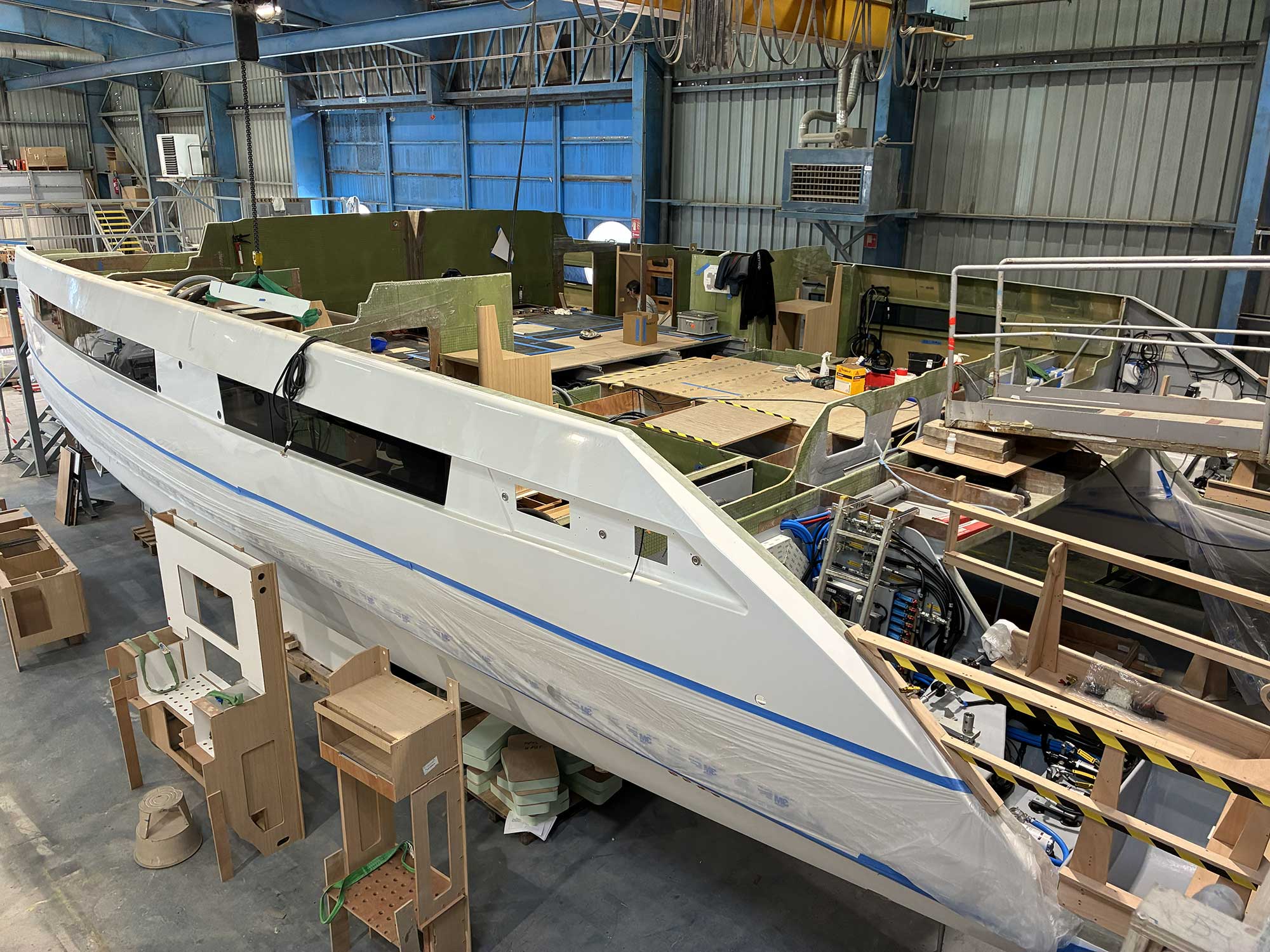
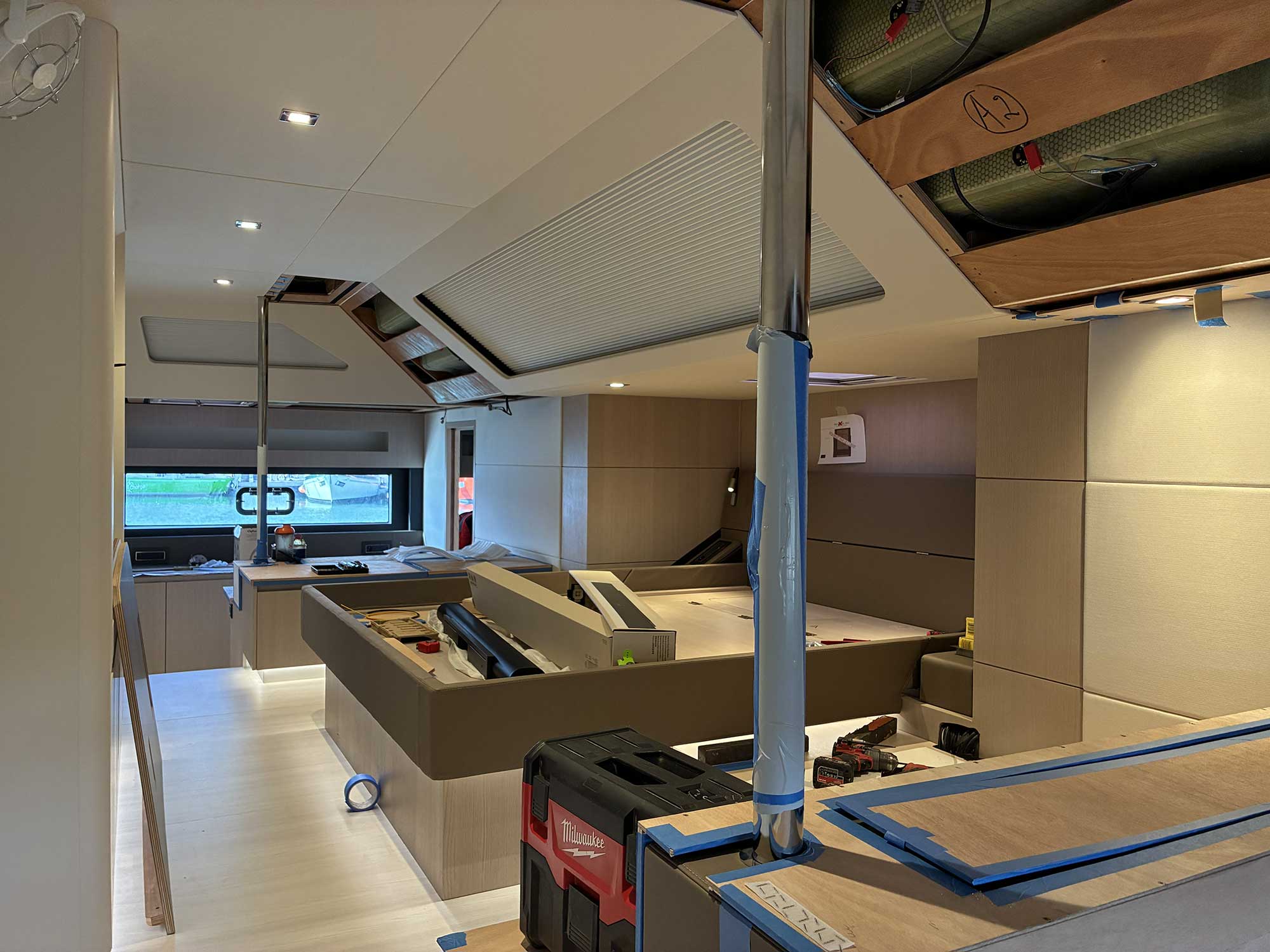
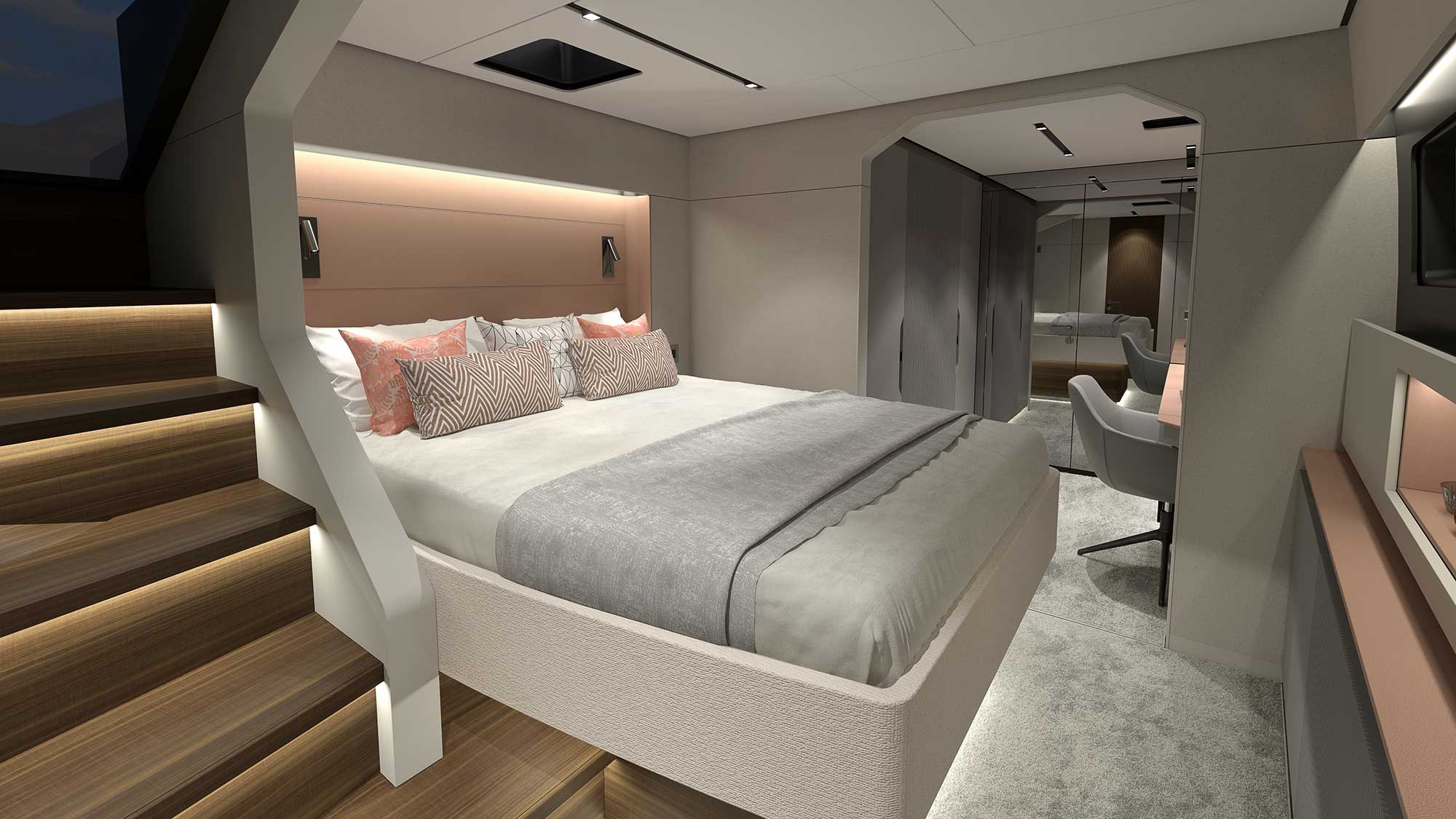
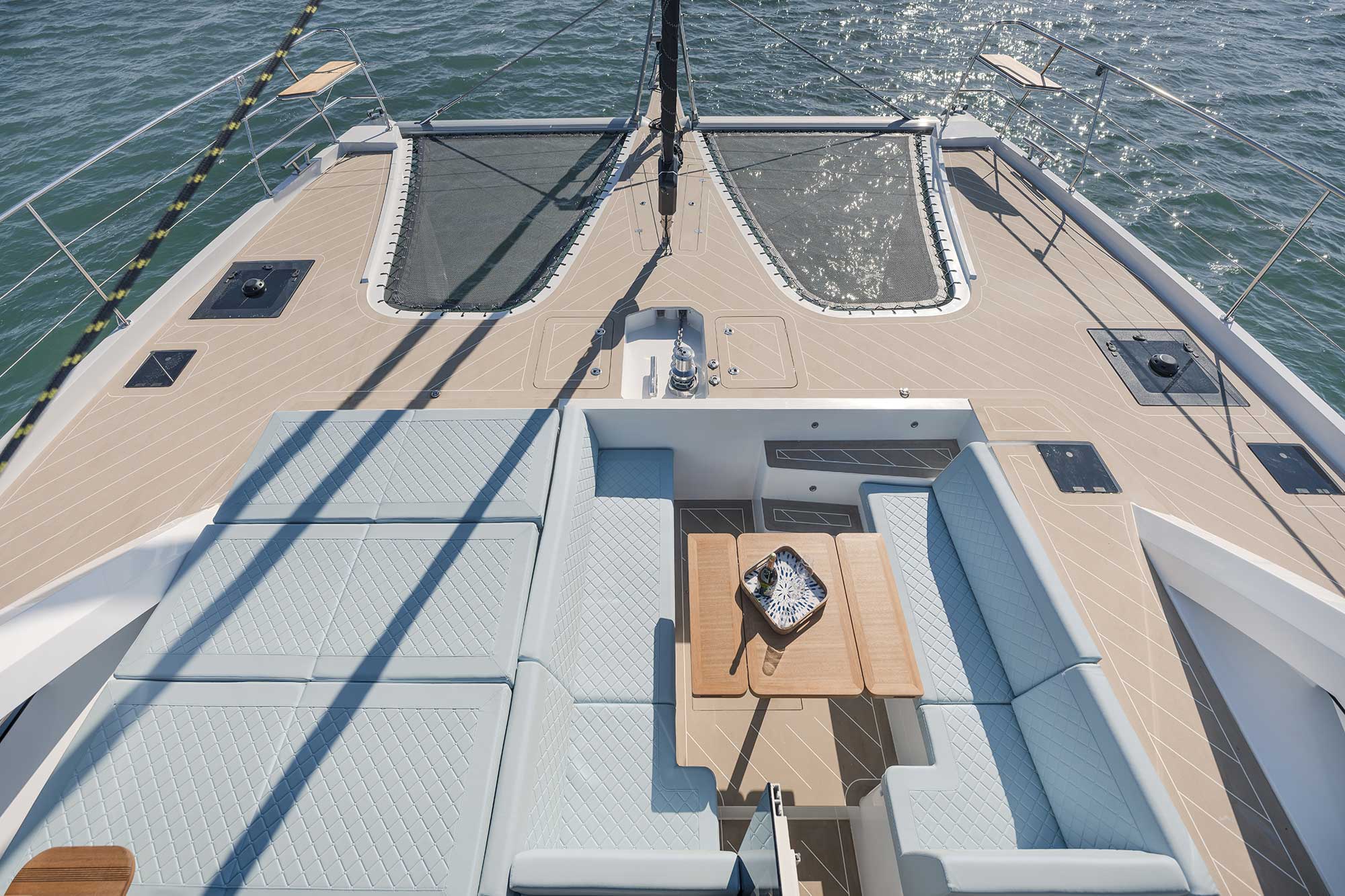
A yacht can be personalised during construction or modified after delivery. The difference affects cost, engineering freedom, safety and long-term ownership.
A yacht can be made personal in two fundamentally different ways. One is to build it around its owner from the start. The other is to take a largely standard yacht and adapt it during commissioning or after delivery. The distinction reaches far beyond fabrics and furniture.
On a production yacht, commissioning can add electronics, safety equipment, communications, watermakers, solar panels and other hardware. It can refine the boat. It cannot easily rewrite architecture that has already been engineered and built. Moving structural bulkheads, rerouting major systems or substantially changing weight distribution can create technical, regulatory and financial consequences.
At Privilège Marine, personalization is part of the construction process. Layout, equipment, electrical capacity, storage, materials and living spaces are considered together, before installation makes changes difficult. The yacht is therefore priced and engineered as the yacht the owner intends to use, rather than as a standard platform awaiting another layer of work after purchase.
The difference begins long before the yacht reaches the water
The word “customization” is used loosely in yachting. It can describe anything from selecting upholstery to redesigning a cabin. Those two decisions have almost nothing in common technically.
A production yacht is normally built around a predetermined engineering package. Hull geometry, structural bulkheads, machinery spaces, cable routes, plumbing, tank locations and major furniture modules are largely established. Owners may choose from layouts, finishes and equipment packages. This makes production efficient and keeps delivery times predictable.
New yacht commissioning begins at another stage. It prepares a completed or nearly completed yacht for service. It can include antifouling, mast stepping, sails, navigation equipment, safety equipment, communications systems, tender installation, sea trials and final technical checks.
That process is necessary and valuable. It is simply different from designing a yacht around an owner.
The distinction can be seen in published market pricing. A 2025 Leopard 46 price and option sheet listed a standard yacht at €699,000 before tax. The same document showed €17,439 for transport, documentation and commissioning, plus €8,381 for post-delivery commissioning. Selected options on the example yacht totalled €205,195.
The lesson is broader than one model. A headline yacht price and a ready-to-sail yacht price can describe very different products.
The structure determines what can still be changed
Once a boat is built, physical reality becomes the main constraint.
Moving a sofa is easy. Moving a load-bearing bulkhead is not. Installing a television is straightforward. Creating a cinema room with acoustic treatment, ventilation, dedicated electrical circuits and integrated cabinetry requires considerably more planning.
The same applies to an office, gym, enlarged galley or serious long-range cruising storage.
A sailing catamaran is especially sensitive because equipment affects weight distribution, trim and sailing performance. Batteries, generators, watermakers, refrigeration, tenders and additional furniture all have mass. Their location matters as much as their weight.
Electrical changes also propagate through the yacht. A larger lithium battery bank may require different charging equipment, cable sections, protection devices, ventilation arrangements, monitoring and inverter capacity. More air conditioning can increase generator requirements. More refrigeration changes the daily energy budget.
What appears to be one option can therefore become a chain of engineering decisions.
The American Boat & Yacht Council currently maintains standards covering AC and DC electrical installations, lithium batteries, generators, fuel systems, water systems and numerous other onboard systems. In Europe, substantial post-construction modifications can also have conformity implications when they significantly affect structure, stability, propulsion or safety.
Total personalization still has to respect physics.
That is why the best moment to make a major change is usually before the relevant part of the yacht has been built.
The Privilège approach integrates the owner into the engineering process
Privilège Marine starts from a proven bluewater platform and develops the yacht around its owner’s programme.
That distinction matters.
The objective is not to create an experimental prototype every time. Offshore reliability depends on proven naval architecture, structural engineering and controlled construction. Personalization takes place within that disciplined technical framework.
The Signature 600 illustrates the principle clearly. At 19.70 metres overall (63 feet), with a beam of 9.18 metres (30 feet), an empty displacement of approximately 29 tonnes and CE Category A certification for 12 people, it remains first and foremost an ocean-going sailing yacht.
Yet its aft portside space is deliberately conceived as an open brief. It can become a cinema, office, gym, studio, substantial storage room or walk-in wardrobe.
That is architectural customization, rather than decoration.
If an owner chooses an office, the discussion begins before cabinetry is installed. Where should the desk face? How much natural light is required? Where should Starlink and network equipment sit? How many 230-volt outlets are needed? Is additional cooling required? Should acoustic insulation separate video calls from adjacent cabins?
A gym produces another specification. Equipment weight matters. So do floor reinforcement, ventilation, clear headroom and safe stowage at sea.
Long-distance storage produces another.
The room may occupy the same physical volume, but the resulting yacht is different because its systems architecture has been developed around its use.
The cost advantage comes from doing work once
Retrofitting is frequently expensive for a simple reason: finished work has to be undone before new work can begin.
Installing additional cabling during construction may involve placing cable runs before liners and furniture are fitted. Installing the same cable later can require dismantling panels, protecting completed interiors, creating access, routing around existing services and rebuilding everything afterwards.
The owner is effectively paying for installation, removal and reinstallation.
The economics become more severe when a change involves plumbing, cabinetry, ventilation ducts, structural reinforcement or large equipment that cannot pass through existing access points.
There is also an opportunity cost. A newly delivered yacht that immediately spends several weeks undergoing modifications is an asset the owner has bought but cannot fully use.
At Privilège, the agreed personalization is incorporated into the specification and into the configured price during the build process. This gives the owner visibility over what the yacht being discussed will actually cost.
That does not mean an owner can change the specification indefinitely without financial consequences. A major request introduced after the design or production freeze may require additional engineering and a change order. Serious yachtbuilding requires that discipline.
The important distinction is that personalization agreed during the project is not treated as an afterthought added to an artificially low headline price.
The real value is a yacht that works as one system
A bespoke sailing catamaran should not feel like a standard boat carrying a collection of expensive additions.
Every major system interacts with another.
A larger tender influences lifting equipment and weight aft. More solar capacity affects deck geometry and charging architecture. Greater refrigeration increases electrical consumption. A watermaker requires power, plumbing, filtration and maintenance access. A professional office depends on communications, power, cooling, seating and acoustic privacy.
For a bluewater cruising yacht, these interactions matter thousands of miles from a shipyard.
Privilège has built ocean-going catamarans in Les Sables-d’Olonne since 1985. Our yachts are intended to cross oceans safely, but they are also designed as homes in which owners may spend months at a time.
Those two functions belong together.
A floating home that cannot tolerate heavy weather has failed as a yacht. An exceptionally capable yacht that does not fit its owner’s life has failed as a home.
The most meaningful form of yacht customization therefore happens before the yacht is finished. It brings the naval architect, designers, electricians, carpenters, systems engineers and owner into the same project.
Commissioning can make a standard yacht more complete. Integrated personalization can make the yacht itself different.
For an owner intending to cross oceans and live aboard for years, that distinction may ultimately matter far more than the length of the options list.
Performance catamarans chase speed. Cruising cats pursue comfort. A different bluewater philosophy shows why serious sailors increasingly expect both.
Bluewater catamarans have traditionally forced owners towards one of two philosophies. Performance-oriented yachts reduce weight, carry powerful sail plans and use narrow hulls to generate speed. They can be thrilling, yet the same characteristics can demand greater attention from the crew, create higher loads and make exposed watches exhausting offshore. At the opposite end of the spectrum, high-volume cruising catamarans prioritise accommodation, payload and ease of use. Their additional weight and fuller hulls can compromise acceleration and sailing ability, particularly in light conditions.
There is a third approach. Sustainable performance treats speed, seaworthiness and human endurance as parts of the same equation. At Privilège Marine, this means designing an ocean-going catamaran that sails efficiently while protecting the people aboard. A protected helm, balanced sail plan, secure circulation, structural strength and genuine residential comfort all contribute to the same objective: covering serious distances safely and arriving with energy left for the destination.
The traditional choice divides speed from comfort
For decades, sailing yacht design has been governed by an uncomfortable truth: every design decision has consequences.
A performance cruising catamaran wants low displacement, narrow hulls, a generous sail plan and efficient appendages. Carbon construction, daggerboards and tall rigs can extract remarkable speed from relatively little wind.
The current Comar Yachts C-Cat 48 illustrates the philosophy. It has a published light displacement of just 9.7 tonnes and carries 180 square metres (1,938 sq ft) of sail. Carbon daggerboards extend its draft from 0.90 metres (3 ft) to 2.95 metres (9.7 ft), and Comar says the yacht can maintain double-digit speeds. Significantly, the latest C-Cat 48 also incorporates an interior helm station for difficult weather — evidence that performance builders themselves recognise the importance of crew protection offshore.
At the more extreme end, the Gunboat 68 uses all-carbon construction, daggerboards and a light displacement of about 17.8 tonnes. Gunboat has reported sea-trial speeds above 21 knots on one 68 and 15 to 16 knots upwind in 12 to 18 knots of breeze. These figures demonstrate what lightweight multihulls can achieve.
Speed, however, is only one measure of a bluewater yacht.
The fast catamaran asks more from its crew
High performance changes the environment on board.
As a yacht accelerates, the apparent wind experienced by the crew changes in both angle and intensity according to the yacht’s course. On a reach, a fast catamaran can bring the apparent wind significantly forward. At an exposed helm, spray, cold air and rain arrive with considerably greater force.
For an afternoon sail, this can be exhilarating. During a three-hour night watch in poor weather, the calculation changes.
Some performance catamarans use exposed aft steering positions because they give the helmsman direct visibility of the sails and an immediate connection with the boat. Others provide dual positions or an internal helm. HH Catamarans, for example, offers its HH52 with either aft swing helms or a forward cockpit and central helm. Gunboat installations have combined internal and external steering positions. These solutions reveal the fundamental design problem: the place that feels superb when actively sailing in good conditions is not always the place where an owner wants to spend the middle of a wet Atlantic night.
The important issue is fatigue management.
Fatigue accumulates through exposure, noise, movement, poor sleep and repeated physical effort. A maritime field study of 198 seafarers found very short sleep periods and classified 22.2 per cent of its pupillometric assessments in a range described as unfit for duty. A private sailing yacht is clearly a different environment from a commercial ship, but the human-factors principle is universal: tired watchkeepers make worse decisions.
On an ocean passage, protecting the skipper is therefore a safety issue as much as a comfort issue.
The sea punishes badly managed speed
There is another consequence of performance: motion.
A catamaran does not heel like a monohull, yet it still pitches, accelerates vertically and interacts violently with short seas. When the water rises into the tunnel between the hulls and strikes the underside of the bridgedeck, the result is wet-deck slamming.
Slamming should not be simplistically associated with fast boats. Hull geometry, loading, bridgedeck clearance, wave direction, speed and sea state all matter. A heavy cruising catamaran with poor clearance can slam badly. A lightweight performance catamaran with carefully designed clearance can behave very well.
The physics, however, are uncompromising. Experimental work published in Ocean Engineering found a strong relationship between relative impact velocity and wet-deck slam force. Other research has shown that increasing wet-deck height can reduce slamming loads in certain sea states. Bridgedeck geometry matters enormously.
This is why chasing the highest possible number on the speed display misses the point offshore. A competent skipper will reduce sail when the sea state demands it. The fastest theoretical boat frequently spends an ocean passage operating well below its potential because crew comfort, structural loads and safety become the governing factors.
The meaningful number is sustainable passage speed.
The comfortable catamaran faces the opposite problem
The other end of the market presents a different compromise.
Large saloons, multiple cabins, enormous flybridges, domestic equipment, oversized refrigerators, air-conditioning systems, water toys and generous tankage all add weight. Wider hull sections create more accommodation but also more wetted surface and hydrodynamic resistance.
Payload matters particularly on a cruising catamaran. Owners rarely sail a long-distance yacht at the lightship displacement printed in the brochure. Food, water, fuel, tender, outboard engine, tools, spare parts, batteries, personal belongings and cruising equipment gradually change the boat.
A design centred mainly on interior volume can therefore become reluctant in light air. The engines start earlier. Sailing becomes something done when conditions are convenient rather than the yacht’s natural mode of transport.
There is nothing inherently wrong with that philosophy. It suits owners whose programme consists mainly of coastal cruising, charter or short passages between marinas.
It is a weaker answer for an owner who genuinely wants to cross oceans.
The third approach treats performance as endurance
At Privilège Marine, our position is deliberately different.
We build bluewater catamarans first. They must be capable of spending weeks at sea. They must also function as real homes once they arrive.
That requirement changes what performance means.
A Privilège is not designed around a record-breaking top-speed figure. It is designed to maintain useful sailing performance while carrying the systems, stores and living spaces required for serious cruising.
The Signature 510 illustrates that balance. It measures 15.24 metres (50 ft) overall, has a light displacement of 17 tonnes and carries 165 square metres (1,776 sq ft) of working sail, including an 88-square-metre (947 sq ft) mainsail, a 57-square-metre (613 sq ft) genoa and a 20-square-metre (215 sq ft) staysail. It is certified CE Category A for 12 people.
Under European rules, Category A means a recreational craft is designed for conditions where wind may exceed Beaufort Force 8 and significant wave height may exceed 4 metres (13 ft), excluding abnormal conditions such as hurricanes, violent storms and rogue waves. Certification does not replace seamanship, but it establishes the seriousness of the design brief.
The larger Signature 600 carries 259 square metres (2,788 sq ft) of sail and has a light displacement of 29 tonnes. Its 1,000 litres (264 US gal) of fuel and 900 litres (238 US gal) of fresh water illustrate another part of the equation: a genuine long-distance yacht must carry useful payload without turning itself into a floating apartment that has forgotten how to sail.
The protected helm changes an ocean passage
One of the clearest expressions of this philosophy is the helm station.
On the Signature 510, the helm is elevated enough to provide strong visibility yet remains connected to the cockpit. It is protected by a windscreen and hardtop. The principal sailing functions can be concentrated around the steering position. The skipper remains close to the people aboard rather than isolated on a flybridge.
This becomes important at 0300.
Rain should not become an endurance test. Spray should not force the watchkeeper to spend hours soaked in foul-weather gear when yacht architecture can provide protection. Reefing should not require unnecessary movement around the deck when conditions deteriorate.
Protection preserves concentration.
It also changes how an owner uses the boat. A couple can consider longer passages with greater confidence. Watch changes become simpler. Sail reduction can happen earlier because controls are accessible. The skipper can remain alert rather than spending energy simply resisting the weather.
That is practical luxury.
The floating home still has to cross an ocean
Comfort begins below deck as well.
A genuinely comfortable offshore yacht needs secure circulation, usable berths, storage, ventilation, manageable noise levels and spaces positioned with motion in mind. A huge cabin has little value if the crew cannot sleep in it at sea.
Privilège’s characteristic full-beam owner’s suite places the owner’s accommodation centrally in the nacelle. The broader philosophy extends through the boat: owners need enough storage for extended cruising, real tank capacity, protected living areas and layouts designed around months aboard rather than a weekend demonstration.
The Signature 650 carries 2,000 litres (528 US gal) of fuel and 1,300 litres (343 US gal) of fresh water in the yard’s current specification. Its working sail area is 264 square metres (2,842 sq ft). It combines those cruising capacities with Category A certification and a helm designed around visibility and protection.
This is where performance with comfort becomes more than a slogan.
The yacht has to sail well with the owner’s life aboard.
The best passage leaves energy for the destination
The sailing industry sometimes treats performance as a race between numbers.
For a bluewater owner, the more useful question is different: how much energy does the yacht require from its crew to cover 1,500 or 3,000 nautical miles?
Peak speed matters. Light-air efficiency matters. Ability to point matters. So do protection, sleep, movement, noise, sail handling and confidence in the structure.
A yacht capable of extraordinary speed can be the right choice for an owner who enjoys an active, technically demanding sailing experience. A spacious cruising platform can be ideal for predominantly coastal use.
Privilège occupies the territory between those extremes deliberately. The objective is serenity at speed, rather than speed at any cost.
A real bluewater catamaran should make distance easier. It should allow its owners to cross an ocean safely, sail enough to enjoy the journey, live properly while doing it and step ashore ready to explore.
That may be the most relevant definition of performance in long-distance cruising: not simply arriving first, but arriving rested.
Heel, fatigue, space, safety and autonomy often drive sailors towards two hulls. Here is when a catamaran becomes the rational next boat.
For many experienced sailors, moving from a monohull to a catamaran is less about changing the way they sail than changing the way they want to live at sea. The decisive criteria are usually practical: less heel, easier movement, lower physical fatigue, more living space, greater storage capacity, better privacy and useful mechanical redundancy. A cruising catamaran also creates a more stable platform at anchor and makes everyday activities such as cooking, sleeping, working and keeping watch considerably easier. Yet two hulls are not an automatic guarantee of safety. Catamarans require disciplined sail reduction, careful loading and a design genuinely engineered for offshore use. This distinction matters. Privilège Marine builds around precisely that combination: catamaran stability, bluewater capability, protected handling, generous storage and residential comfort. The result is a yacht conceived not simply to cross an ocean, but to make living across that ocean sustainable.
The Heel Angle Eventually Becomes a Quality-of-Life Question
Experienced monohull sailors rarely abandon monohulls because they suddenly dislike sailing. Many have spent decades appreciating the feedback, balance and responsiveness of a yacht sailing properly on its keel.
What changes is often the crew.
A cruising monohull commonly settles into its sailing groove at around 15 degrees of heel. In stronger conditions, the angle can increase considerably before sail is reduced. That is entirely normal sailing behaviour.
It also affects almost everything happening inside the boat.
Walking means compensating for the angle. Cooking requires bracing against the galley. A glass, computer or book must be secured. Sleeping on the wrong tack can become uncomfortable. Moving through the cockpit means reaching for a handhold before taking the next step.
After three hours, this may be part of sailing. After three days, it becomes work.
The physics of a cruising catamaran are fundamentally different. Instead of obtaining much of its stability from a deep ballasted keel, a catamaran derives enormous initial form stability from the distance between its hulls. Cruising World has illustrated the difference with an example in which a wind load producing roughly 15 degrees of heel on a cruising monohull produces around three degrees on a comparable catamaran.
That changes life aboard.
The floor remains close to horizontal. People move more naturally. Meals stay on tables. Cooking is easier. Watchkeeping is less physically demanding. Owners still use handrails and proper offshore procedures, but they are no longer compensating continuously for a boat living at an angle.
For many sailors, this is the first serious reason to consider a catamaran.
The Crew’s Energy Becomes More Valuable Than Sailing Tradition
Fatigue is one of the least glamorous subjects in yacht ownership and one of the most important offshore.
A boat that constantly requires its crew to brace, climb, balance and compensate consumes energy. On an overnight passage, this matters. On a transatlantic passage, it becomes a safety consideration.
A catamaran offers low-angle sailing and usually far less rolling at anchor. The motion offshore remains real. Catamarans can pitch, hobbyhorse and generate sharp accelerations in confused seas. Poorly designed boats can also suffer bridgedeck slamming when waves strike the underside of the nacelle.
This is why the question should never simply be: monohull or catamaran?
The better question is: what catamaran?
Hull shape, bridgedeck clearance, displacement, weight distribution and structural stiffness all affect offshore behaviour. Loading also matters because excessive weight lowers the hulls and reduces bridgedeck clearance.
For Privilège, comfort at sea begins with naval architecture rather than upholstery. The hulls, structural bulkheads, weight distribution and bridgedeck geometry are conceived for extended offshore use. The objective is a yacht whose comfort continues when the marina is hundreds of nautical miles behind.
This distinction becomes increasingly important with age. A sailor of 55 or 65 may possess considerably more experience than at 35 while having much less interest in spending every passage fighting the boat.
Experience often changes the definition of performance. Preserving the crew can become more important than preserving tradition.
The Width Changes What You Can Carry and How You Live
The space advantage of a cruising catamaran is immediately visible, yet the implications go much further than having a bigger saloon.
Two hulls separated by several metres create an entirely different architectural platform.
Consider the Privilège Signature 510. It measures 17.09 metres (56 ft) overall and 7.98 metres (26 ft) across the beam. Its light displacement is 16.8 tonnes, rising to 22.8 tonnes at full load.
That six-tonne difference illustrates the scale of the operational load envelope required for people, liquids, equipment, provisions and cruising gear.
The yacht carries 800 litres (211 US gal) of fuel and 600 litres (158 US gal) of fresh water. Storage is integrated throughout the boat for extended cruising.
Move to the Signature 650 and the scale becomes more pronounced. The yacht reaches 21.25 metres (approximately 70 ft) overall with a beam of 9.20 metres (30 ft 2 in). Full-load displacement reaches 37 tonnes.
These dimensions change what ownership can mean.
There is space for tools and spare parts. Diving equipment can have a dedicated place. Water toys need not occupy the saloon. Provisions for weeks at sea can be stored properly. A work area can remain a work area rather than becoming a dining table every evening.
For owners spending months aboard, storage capacity is not a luxury feature. It is part of autonomy.
The Boat Eventually Becomes a Home Rather Than a Weekend Machine
The strongest reason to move towards a catamaran often appears after the sailing day has ended.
A cruising yacht spends an extraordinary amount of its life anchored, moored or in port. The owner still lives aboard during those hours.
The catamaran then exploits its full width.
The saloon sits above the water between the hulls, creating panoramic views and a natural connection between cockpit and interior. Cabins can be separated from one another. Guests gain privacy. Ventilation can improve. The galley becomes part of the main living area rather than a space buried below decks.
Privilège pushes this architectural advantage further through its forward full-beam owner’s suite.
On the Signature 510, the owner is not simply allocated one of the hulls. The suite extends into the central nacelle. It creates a wider sleeping environment with forward views and greater separation from guest accommodation.
That matters because long-term owners gradually stop measuring a yacht by the number of cabins.
They begin measuring privacy, circulation, natural light, storage, noise and the distance between where they sleep and where everyone else lives.
The boat has become a home.
The Safety Case Becomes About Exposure, Stability and Redundancy
Catamaran safety requires precision because simplistic claims are misleading.
A catamaran possesses very high initial stability and does not normally heel deeply under sail. That reduces the likelihood of crew losing balance and makes movement around the vessel easier.
It also changes the yacht’s warning signs.
A ballasted monohull heels progressively as aerodynamic load increases. The crew feels the boat becoming overpowered. The sails move away from the vertical and shed some of their effective force.
A catamaran remains relatively upright. High loads can therefore build without the dramatic heel that warns a monohull sailor to react.
Reefing early is essential.
The relationship between wind speed and aerodynamic force makes this particularly important: approximately speaking, aerodynamic pressure rises with the square of wind speed. Doubling wind speed can create roughly four times the aerodynamic pressure.
There is another fundamental distinction. A ballasted monohull can possess substantial self-righting ability following a knockdown. An inverted cruising catamaran should not be expected to right itself in the same way.
Modern standards explicitly recognise this issue. ISO 12217-2 includes specific provisions for habitable multihulls covering susceptibility to inversion, escape arrangements and flotation when inverted.
Catamaran safety therefore comes from design and seamanship working together.
Every current Privilège is certified in European Design Category A, the category applicable to recreational craft designed for conditions where wind may exceed Beaufort Force 8 and significant wave heights may reach 4 metres and above, excluding abnormal conditions such as hurricanes, violent storms and rogue waves.
Certification provides a technical baseline. Offshore preparation goes further.
The Twin-Hull Architecture Creates Useful Redundancy
The second hull also changes the machinery architecture.
Every current Privilège uses two diesel engines, one in each hull. The Signature 510, for example, carries two engines rated at approximately 58.8 kW each (80 hp).
The practical benefit extends beyond additional power.
If one propulsion system becomes unavailable, another remains. Two engines also provide differential thrust during harbour manoeuvres, allowing the skipper to apply ahead thrust on one side and astern thrust on the other.
Privilège extends this principle through system redundancy.
Depending on specification, this can include segregated tanks, multiple bilge pumps, dual autopilot arrangements, alternative electrical generation, multiple navigation resources and more than one means of anchoring.
Redundancy does not mean duplicating every object aboard. It means ensuring that the loss of one critical function does not immediately create an emergency.
For owners planning long-distance sailing, this distinction can become more persuasive than another knot of theoretical boat speed.
The Privilège Formula Brings the Criteria Together
There is a risk in treating all catamarans as equivalent.
They are not.
Some are developed principally for charter utilisation. Some prioritise minimum displacement and maximum sailing performance. Others concentrate on interior volume. Each design brief creates compromises.
A genuine bluewater catamaran must resolve several objectives simultaneously.
It needs structural integrity. It needs sensible displacement and load capacity. It needs adequate bridgedeck geometry. It needs manageable sail handling. It needs secure circulation. It needs accessible machinery. It needs protected watchkeeping positions and enough storage to operate away from shore.
It must then provide a home that owners actually want to inhabit.
This has been central to Privilège since the brand’s origins in the offshore experience of Philippe Jeantot, twice winner of the BOC Challenge and founder of the Vendée Globe.
The current Signature 510 demonstrates the philosophy particularly clearly. Its balanced rig and deck layout are designed for short-handed operation. Its protected helm station remains connected with the cockpit while providing visibility around the yacht. Its storage and tankage support extended cruising. Its owner’s suite gives the private accommodation the importance it deserves.
Safety technology has also evolved. Since 2026, SEA.AI optical and thermal machine-vision technology has been fitted as standard across the Privilège range to help identify objects that conventional AIS or radar may fail to show clearly.
The objective is coherent rather than spectacular: create a yacht in which offshore capability and residential comfort reinforce one another.
The Moment to Change Comes When the Boat Must Serve Your Life
The monohull remains one of sailing’s great machines. Its balance, feedback and ability to work to windward explain why generations of sailors remain deeply attached to it.
Yet yacht ownership evolves.
At some point, an experienced sailor may realise that he is choosing routes partly to avoid uncomfortable sea states. His partner may no longer enjoy passages at 20 degrees of heel. Guests may tolerate the boat rather than enjoy it. Storage may have consumed every cabin. Moving around the boat may require more effort than the sailing itself.
These are meaningful signals.
The transition from monohull to catamaran often occurs when the owner stops asking which boat produces the purest sailing sensation and starts asking which boat will allow him to sail farther, stay aboard longer and bring the people he loves with him.
That is precisely where Privilège positions its yachts.
The promise is larger than two hulls. It is a floating home capable of crossing oceans: stable enough to make daily life natural, robust enough to take distance seriously, spacious enough for long-term ownership and engineered so that comfort does not have to end when the passage begins.
For many lifelong monohull sailors, that is ultimately the criterion that matters.
How to plan an Atlantic crossing: the route, weather, systems, safety gear, sails, spares, watches, provisions and practical failure control.
A safe Atlantic crossing begins months before departure. The classic westbound passage runs for about 5,000 kilometres (2,700 nautical miles) from the Canary Islands to the Caribbean and takes an average cruising yacht around 18 to 21 days. The checklist must cover far more than safety equipment. It must test the route, crew, sails, steering, energy production, water supply, communications, food storage and repair capability as one operating system. The strongest crews reduce sail early, inspect for chafe every watch and preserve several ways to steer, navigate, communicate, pump water and generate electricity. They carry food for a delayed arrival and keep potable water outside the watermaker’s production chain. At Privilège Marine, we see an ocean-going catamaran as both a bluewater yacht and a home. The crossing plan must protect both functions. The real standard is simple: the boat must still work tired, at night and after its first equipment failure.
The Route Must Be Chosen Before It Is Optimised
The classic westbound Atlantic crossing starts in the Canary Islands and finishes in the Lesser Antilles. The Atlantic Rally for Cruisers sails from Las Palmas de Gran Canaria to Rodney Bay, Saint Lucia. Its route covers about 5,000 kilometres (2,700 nautical miles), and the average yacht completes it in 18 to 21 days. The 2026 ARC is scheduled to depart on November 22.
A second option runs through Mindelo in Cabo Verde. This divides the passage into two offshore legs and allows the yacht to refuel, reprovision and make final repairs. It also creates another departure decision. A stop becomes valuable only when it supports the plan rather than adding pressure to leave on a fixed date.
The passage plan should cover the entire voyage from berth to berth. The International Maritime Organization divides voyage planning into appraisal, detailed planning, execution and continuous monitoring. That means studying the yacht’s limitations, weather, charts, currents, traffic, ports, reporting systems and emergency alternatives before departure.
The route file should contain:
The intended route and acceptable deviations.
Areas of increased traffic or fishing activity.
Minimum fuel and water thresholds.
Alternative Caribbean landfalls.
Medical diversion options.
Weather-routing criteria.
Conditions that would delay departure.
Daily position-reporting procedures.
Passport, registration, insurance and crew documentation.
A route drawn by routing software remains a forecast. It should never become an instruction that overrides the sea in front of the yacht.
The Departure Window Must Follow the Weather
The official Atlantic hurricane season runs from June 1 to November 30. Tropical systems can still form outside those dates. The climatological peak occurs around September 10, with most activity concentrated between mid-August and mid-October.
This explains the traditional late-November departure from the Canary Islands. It does not make every late-November day suitable.
A safe departure requires a genuine weather window. The crew should examine the position of the Azores High, the development of the north-easterly trade winds, swell direction, frontal activity north of the route and any tropical disturbance leaving the African coast.
Use several sources. Compare GRIB models with synoptic charts and official forecasts. Obtain professional routing when the skipper lacks the experience to interpret model disagreement. Keep receiving weather after departure through satellite communications, SSB radio or another proven offshore system.
The eastbound crossing follows a different logic. A Caribbean-to-Europe passage normally uses spring weather systems and often routes through the Azores. It requires its own plan and should never be treated as the westbound route in reverse.
The Yacht Must Complete a Crossing Before Departure
A marina test proves that equipment starts. An offshore trial proves that the yacht can operate continuously.
Several months before departure, complete a technical survey of the rig, steering, propulsion, electrical system, safety equipment and all underwater fittings. Follow it with an offshore shakedown long enough to run every major system under realistic loads.
Test both engines at cruising revolutions. Check cooling-water flow, exhaust temperature, belt tension, alternator output, saildrive seals and fuel quality. Open and close every seacock. Test every bilge alarm. Run the watermaker, generator, air-conditioning, refrigeration, radar, autopilot and satellite systems together.
Record actual electricity consumption over 24 hours. A theoretical energy budget is insufficient. The figures must include the autopilot, navigation electronics, refrigeration, communications, pumps and domestic loads used during a real passage.
A Privilège is designed as a true bluewater catamaran, with structural strength, engineering reliability and long-term use at the centre of the project. The same discipline must continue in operation. Salt, heat, vibration and continuous loading affect even high-quality equipment.
The technical plan should preserve redundancy in five critical areas:
Steering.
Electrical generation.
Navigation.
Communications.
Fresh water.
One spare component rarely creates redundancy. A complete alternative function does. A spare autopilot display is useless when the failed part is the hydraulic drive. A second chartplotter offers little protection when both units depend on the same power supply and GPS antenna.
The Safety Equipment Must Be Reachable in Seconds
Safety equipment belongs where the crew can reach it during an emergency. It should never sit beneath provisions, luggage or tools.
The World Cruising Club’s 2026 requirements call for an offshore liferaft large enough for everyone aboard. On a multihull, it should remain deployable when the yacht is upright or inverted. The raft must be accessible and ready to launch within 15 seconds. A registered 406 MHz EPIRB with internal GPS is also required, along with long-range communications, DSC VHF, a handheld VHF, AIS and personal AIS crew-overboard beacons.
Every person should have a properly fitted lifejacket with a light, whistle, spray hood, crotch strap, harness and personal beacon. Jacklines should allow movement from the cockpit to working areas with minimal clipping and unclipping. Crew should be able to connect their tether before stepping outside.
The rule at night is one hand for the boat. Clip on before leaving the protected area. Nobody goes forward without informing the watchkeeper. In deteriorating conditions, nobody goes alone.
The yacht also needs a tested crew-overboard recovery system. Finding the casualty solves only half the problem. The crew must be able to lift an exhausted or unconscious person over a high freeboard. Practise with a realistic weight before departure.
A multihull should carry pumping arrangements for each hull and watertight compartment. The 2026 ARC requirements specify an emergency pumping capacity of at least 200 litres per minute (3,200 US gallons per hour). They also require an emergency tiller or independent steering method and a proven way to steer with a rudder disabled or missing.
The Sail Plan Must Reduce Loads Before Trouble Starts
An Atlantic crossing is usually a downwind passage, yet downwind sailing creates its own failures. Sails remain loaded for days. Sheets rub against blocks, stanchions and guardrails. Preventers cycle under shock loads. Squalls can add wind rapidly during darkness.
A catamaran provides less heeling feedback than a monohull. The crew must reef according to wind speed, sea state and equipment loads rather than waiting for discomfort.
The standing order should be reef early. A conservative sail plan is usually faster over an entire passage because it reduces fatigue, damage and emergency manoeuvres.
Inspect the following at least once per watch:
Mainsail battens, cars and reefing points.
Genoa sheets and furling line.
Downwind sail tack, head and clew.
Preventers and boom attachments.
Halyards at mast exits and sheaves.
Blocks, shackles and soft connections.
Guardrails near loaded lines.
Trampoline and forward lashings.
Move a line before its cover is cut through. Add chafe protection where a lead cannot be changed. Mark high-load lines with tape so that movement becomes visible. Chafe control is one of the cheapest forms of offshore reliability.
Carry a storm jib and either a storm trysail or a third mainsail reef that substantially reduces area. The World Cruising Club also strongly recommends a drogue or sea anchor for severe conditions. The correct equipment, attachment points and deployment method must be validated for the individual yacht before departure.
The Spares Must Match the Failures You Can Repair
The spare-parts inventory should reflect the yacht’s exact equipment. Generic boxes of screws create weight without solving the most likely failures.
For the engines and generator, carry fuel and oil filters, impellers, belts, suitable lubricants, coolant, hoses, hose clamps, electrical relays and starter components. Carry the tools needed to change them in a moving engine room.
For the water system, include pump diaphragms, pressure switches, filter cartridges, connectors and a complete repair kit for the watermaker. For the electrical system, carry fuses, breakers, cable, terminals, heat-shrink material, a crimping tool and a reliable multimeter.
For the rig and deck equipment, carry spare sheets, low-stretch line, webbing, sail-repair materials, shackles, soft shackles, blocks and replacement fasteners.
The autopilot deserves special attention. It may steer for hundreds of hours. Carrying a second pilot with an independent drive is stronger than carrying only electronic spares. Balance the sail plan so the pilot works lightly. Excessive pilot activity is often a sail-trim warning before it becomes an equipment failure.
Store spares by system. Label every container. Maintain a searchable inventory showing location, quantity and part number. The person repairing a pump at 03:00 should not have to empty five lockers to find the seal.
The Watch System Must Protect Human Performance
Fatigue creates poor decisions long before it creates sleep.
The skipper should establish the watch system during the shakedown passage. Every watchkeeper must be able to steer, trim sails, use radar and AIS, reef, start an engine, make a distress call and wake the skipper early.
Three or more competent watchkeepers make rest easier to protect. Two-person crews need stricter routines because each person carries more continuous responsibility. The exact system may use two-hour, three-hour or rotating watches. The schedule should provide predictable sleep rather than theoretical equality.
Night instructions should define when to wake the skipper. Examples include:
A wind increase beyond the agreed limit.
A squall approaching the route.
A vessel with an uncertain closest point of approach.
A sail, steering or electrical alarm.
A change in barometric pressure.
Any doubt about the yacht’s position or condition.
The best standing order is direct: wake the skipper while the situation is still easy.
The Food Plan Must Survive a Delayed Arrival
Provision from a written menu. Plan three meals a day, snacks and a 20% reserve for slower progress or an unexpected diversion. The World Cruising Club also recommends a mixture of fresh, frozen and ambient food because refrigeration and freezers can fail.
Use fresh produce first. Inspect fruit and vegetables every day. Remove damaged items immediately. Keep onions and potatoes separated. Protect eggs from movement and store dry goods in sealed containers.
Prepare several meals before departure and freeze them in flat portions. They are easier to stack, defrost quickly and reduce galley work during the first days, when seasickness is most likely.
Keep a complete ambient-food reserve that requires little water and minimal cooking. Include food that crew will eat when tired or unwell. A nutritionally perfect meal has no value when nobody can prepare it in a rough sea.
Store heavy supplies low and near the yacht’s centre. Secure every bottle, tin and appliance. Divide essential food between more than one locker so that a leak or access problem does not compromise the whole supply.
The Water Plan Must Assume the Watermaker Stops
A watermaker increases comfort and autonomy. It should never become the only source of drinking water.
European Food Safety Authority reference values place adequate total daily water intake at 2 litres for women and 2.5 litres for men under normal conditions. Heat, physical work, seasickness and illness can increase requirements. Passage planning must also include cooking and medical needs.
Measure the crew’s real consumption during the shakedown passage. Carry enough tanked water to manage a meaningful watermaker failure. Add sealed emergency containers stored separately from the main tanks.
The emergency grab bag should contain additional drinking water. World Cruising Club guidance recommends 2 litres per person in a sealed container, or a hand-operated desalinator with suitable containers.
Monitor tank levels manually as well as electronically. Tank senders fail. Taste water before transferring it. A contaminated tank can remove a large part of the yacht’s reserve in one mistake.
The Daily Routine Finds Small Failures Early
Complete a daily systems round at the same time each day.
Inspect the bilges, engines, rudders, steering gear, batteries, charging sources, water tanks, rig, sail attachments, deck fittings and safety equipment. Log pressures, temperatures, engine hours, fuel use, water production and battery state.
Look for changes rather than obvious failures. A small quantity of belt dust, a warmer electrical connection, a rising pump-cycle frequency or a few drops beneath a shaft seal may provide days of warning.
The most common offshore problems are often manageable when found early:
A chafed line should be rerouted or replaced before its core is exposed. A struggling autopilot calls for sail balancing and early investigation. A charging failure requires immediate load reduction and isolation of reserve capacity. A watermaker fault should trigger water conservation before the tanks become low. A small sail tear should be repaired before the next squall enlarges it.
Crew problems deserve the same attention. Treat seasickness early under an agreed medical plan. Protect sleep. Encourage regular meals and hydration. Resolve tension before fatigue turns it into conflict.
The Crossing Is Won Through Preparation, Not Equipment Volume
A serious Atlantic crossing checklist does not aim to carry a second yacht in spare parts. It creates a yacht and crew capable of adapting when one part of the system stops working.
The route must leave room for weather. The sail plan must control loads. The energy system must support essential functions after one charging source fails. The water plan must survive without daily production. The watch system must keep judgement intact.
Privilège catamarans are designed to cross oceans safely while remaining true homes at sea. That comfort becomes an operational advantage when storage is organised, machinery is accessible, working areas are protected and the crew can rest properly.
The Atlantic rarely demands heroism. It asks for disciplined decisions repeated for several weeks. The strongest crossing is usually the quietest one: fewer urgent repairs, fewer exhausted manoeuvres and no pressure to defend a schedule that the weather has already rejected.
The Privilège rostrum strengthens the forward structure, manages rig loads and creates exceptional space for a private owner’s suite.
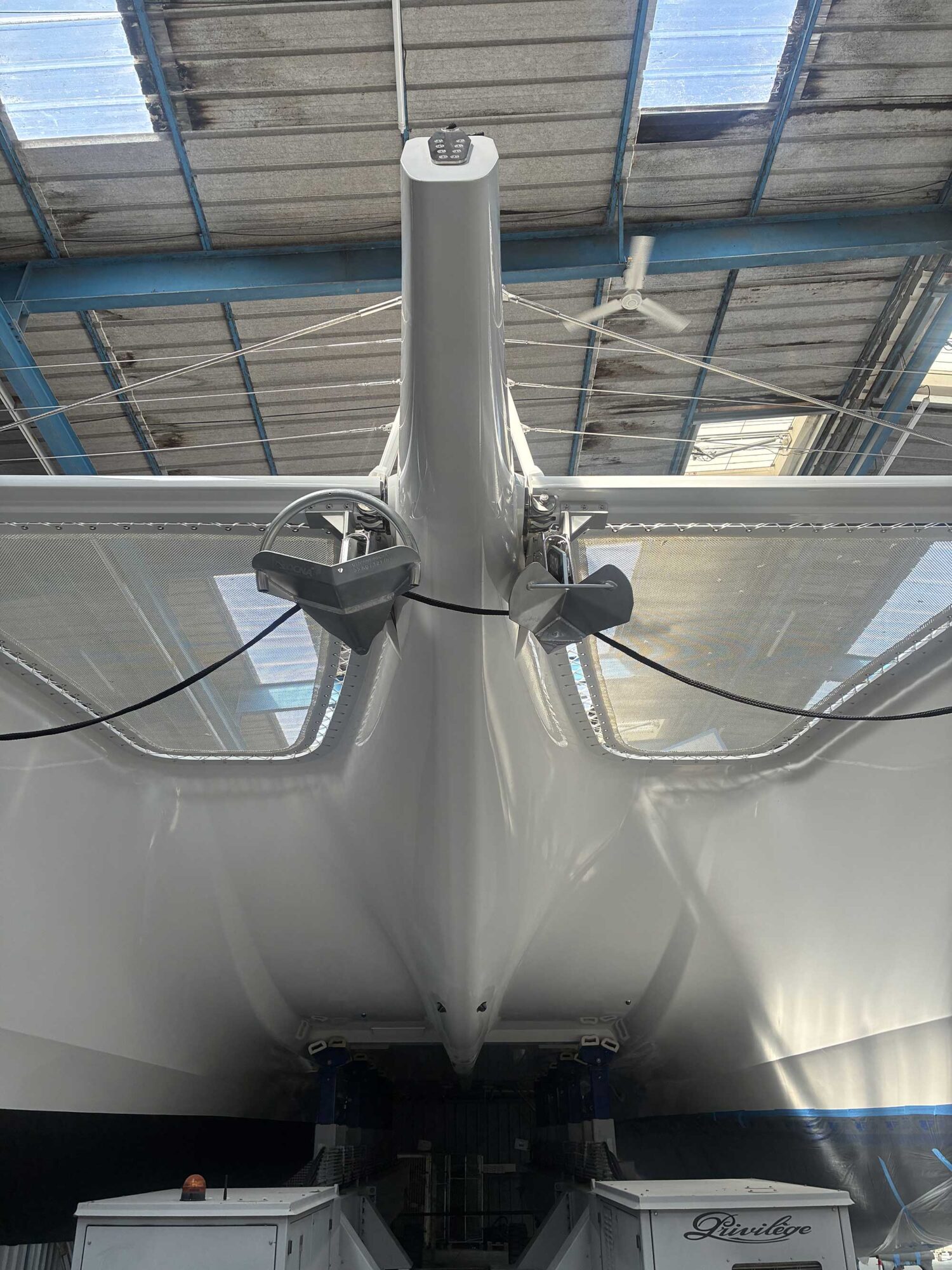
The Privilège rostrum is a forward central pod built into the architecture of the catamaran. In French, the shipyard calls it the rostre. In English, “forward central pod” or “central nacelle” describes its function more clearly. The structure extends forward of the mast between the two hulls. It helps stiffen the yacht longitudinally, supports the forward beam through a third structural point and spreads loads created by the forestay and rig. Its shape can also add reserve buoyancy and reduce spray or bow immersion in demanding seas. The same volume produces a second benefit: real living space above the water. On the Signature 510, it forms the heart of a full-beam owner’s suite. On the Signature 650, the central nacelle creates a private apartment with panoramic forward views. Offshore strength and domestic comfort therefore come from the same piece of naval architecture.
The Rostrum Begins as a Structural Decision
A catamaran places two hulls beneath one wide platform. At sea, that platform works under complex loads. Each hull may rise and fall at a different moment. One bow can meet a wave while the other remains partly unsupported. The mast compresses the main structure, while the forestay, shrouds and sails apply changing forces.
The Privilège rostrum addresses this problem through geometry. The forward central pod extends from the main nacelle towards the forward beam. It adds structural depth along the centreline and connects the forward part of the yacht to the main platform.
The result is greater catamaran structural rigidity in an area exposed to repeated bending, torsion and impact. Privilège introduced this architecture during the brand’s early development and refined it across successive generations. Its recognisable form endured because the engineering remained useful.
The Forward Pod Changes How Loads Travel
Structural strength depends on the route taken by a load. Concentrated forces create local stress. A continuous structure spreads those forces across a larger area.
Historic Privilège technical literature describes the rostrum as reinforcing longitudinal rigidity and diffusing forestay compression forces into the nacelle. The wording requires precision. The forestay works in tension. Its reaction creates high loads at the bow attachment, the mast and the surrounding structure.
The rostrum acts as a load-distribution structure. It provides another substantial route through which rig loads can travel before being absorbed by the nacelle, forward beam and hull connections.
The Third Support Point Reinforces the Forward Beam
A conventional forward beam spans the distance between two bows. Privilège supports this area through the two hull connections and the central pod, creating a third structural support.
The arrangement strengthens the forward structure and provides a coherent location for the dolphin striker, rig attachments, anchor gear and associated reinforcements. On the historic Privilège Série 7, the robust forward beam and mechanically welded dolphin striker were integrated with the nacelle.
The larger Privilège 745 used the same central volume for its anchor locker, windlasses and sail storage. Its technical literature explained that the rostrum increased mechanical resistance while distributing forestay loads through the yacht’s longitudinal structure.
This integration matters offshore. A windlass can experience severe dynamic loads when the yacht pitches. Rig forces change continuously as wind pressure, sail area and sea state evolve. Both systems require foundations designed into the yacht from the beginning.
The Same Structure Creates the Owner’s Suite
The rostrum also creates habitable volume above the water and forward of the saloon.
Many catamarans place the owner’s cabin inside one hull, where width remains constrained by the hull form. Privilège uses the centre of the yacht to create a full-beam owner’s suite with a different sense of space.
The Signature 510 measures 17.09 metres (56 feet) overall and 7.98 metres (26 feet) across the beam. Its forward suite draws on the width of the platform rather than the width of one hull. It offers panoramic views, extensive storage and clear separation from the guest cabins.
The arrangement changes the experience of living aboard. The cabin becomes a private destination with space for wardrobes, drawers, dressing areas and a substantial bathroom. Owners can withdraw from the social areas while remaining connected to the centre of the yacht.
The Signature 650 develops the same principle on a larger scale. Its beam reaches 9.20 metres (30 feet 2 inches). The central owner’s suite sits within the nacelle and gains panoramic forward-facing views. The room functions as a private apartment within an ocean-going catamaran.
The rostrum therefore turns structural volume into useful living space. One piece of naval architecture performs several jobs.
The Sea Decides Whether the Geometry Works
Forward volume must be shaped carefully. Its underside can meet waves before other parts of the bridgedeck. Clearance, curvature, length and immersion influence bridgedeck slamming loads.
Research into catamarans with centre bows shows that changes in centre-bow geometry and wet-deck clearance can alter slamming forces and vertical bending moments. The designer must balance internal space, structural depth, reserve buoyancy and wave interaction.
Privilège uses a suspended central form instead of a third full-length hull. In demanding seas, the volume can provide reserve buoyancy as the bows press into a wave. It can also reduce spray passing through the forward netting and create a more secure working surface near the mast and anchor gear.
The benefit comes from the complete design. Weight distribution, bridgedeck clearance, hull shape and speed remain decisive. The rostrum belongs first in the naval architecture. Its interior possibilities follow from that engineering decision.
The Privilège Approach Makes Comfort Structural
Privilège Marine builds bluewater catamarans for owners who may live aboard for months and cross oceans. Comfort therefore has a technical meaning.
A quiet cabin depends partly on stiffness. Secure movement requires stable surfaces and protected circulation. Reliable anchoring requires reinforced foundations and accessible machinery. Interior volume must coexist with weight control, ventilation, drainage and maintenance access.
The rostrum brings these requirements together. It strengthens the forward platform, supports working areas, provides storage and technical volume, and creates a private room that feels like part of a home.
This is the core Privilège idea: comfort begins with structure.
The owner’s suite is luxurious because the architecture makes it possible. The yacht remains reassuring because the same architecture contributes to the strength beneath it.
The Signature Endures Because It Solves Real Problems
The Privilège rostrum became visually distinctive because it solved several problems at once. It reinforces the yacht. It improves the load path around the forward beam and rig. It creates usable volume above the water. It supports anchoring and sail-handling functions.
On selected models, it also makes possible one of the most recognisable owner’s suites in the bluewater catamaran market.
That combination explains its longevity. The rostrum gives a Privilège a recognisable profile, yet its real value sits beneath the surface. The shape exists because the yacht must remain strong at sea and generous to live in.
Why experienced monohull sailors are moving to catamarans for flatter passages, lower fatigue and a more practical life on long ocean voyages.
The move from a monohull to a catamaran often begins with a change in priorities. Experienced sailors may still value the balance, feedback and tradition of a monohull. Long passages then expose the cost of permanent heel. Cooking, sleeping, watchkeeping and maintenance require continuous physical effort. A cruising catamaran keeps its living spaces much closer to level. That can reduce fatigue and make life aboard easier to sustain over several weeks. The trade-off requires clear judgement. A catamaran has a different motion, greater beam, higher marina costs and less warning through heel when sail loads increase. It must be sailed according to its reefing plan and loading limits. For owners who intend to cross oceans and live aboard properly, comfort becomes part of seamanship. A well-designed bluewater catamaran gives the crew more energy for navigation, weather decisions and life at sea.
The romance of heel eventually meets the reality of daily life
The phrase “sailing at 45 degrees” captures a familiar frustration, although 45 degrees is far beyond the normal working angle of a cruising monohull. A modern monohull sailing upwind will commonly settle around 15 to 20 degrees of heel. Beyond about 20 degrees, many cruising yachts develop more weather helm, more leeway and higher loads without producing a proportionate gain in speed.
The physical effect remains substantial. At 20 degrees, a cabin sole rises by roughly 36 centimetres over a horizontal distance of 1 metre. A person crossing the saloon is effectively walking up or down a steep ramp. A saucepan moves towards the leeward side of the cooker. A locker door carries its own weight when opened. A sleeping body presses against a lee cloth.
For an afternoon sail, this can feel alive and engaging. During a passage lasting ten or twenty days, it becomes a continuous demand on the body. Muscles remain active while standing, washing, dressing and preparing food. Sleep becomes more fragmented. Simple maintenance tasks require bracing.
The monohull remains one of sailing’s most elegant machines. Its heel communicates wind pressure and balance. Its ballast keel creates the righting moment that allows it to recover from severe angles. Yet purity of sensation is only one part of long-distance sailing. The quality of a voyage also depends on how well people can eat, rest, think and work after several days at sea.
The catamaran changes the source of stability
The monohull uses ballast and heel as part of its equilibrium
A monohull resists wind pressure through hull form and ballast. The aerodynamic force on the sails creates a heeling moment. The keel and displaced hull create a righting moment. The yacht settles at the angle where those forces reach equilibrium.
Heel therefore belongs to the operating logic of the boat. It also provides feedback. A rising angle, heavier helm and water moving closer to the rail tell the crew that the sail plan needs adjustment. A well-sailed monohull can be kept at a sensible angle through reefing, sail trim and course selection.
The catamaran uses beam and separated buoyancy
A catamaran develops stability through the distance between its two hulls. As wind pressure loads the rig, the leeward hull carries more displacement while the windward hull carries less. The wide platform produces a large righting moment at a small angle.
The practical result is a yacht that sails close to level. Plates remain on the table. People can use the galley with both feet on the floor. Cabins, bathrooms and workspaces retain their intended geometry.
This architecture also creates several distinct living zones. Two hulls and a central nacelle can separate machinery, technical storage, guest accommodation and private space more effectively than a monohull of comparable length. The gain comes from beam rather than length alone.
The comfort advantage becomes measurable after several days
Comfort at sea is often presented as an interior-design subject. Offshore, it becomes a question of human performance.
Research involving Royal Navy crews found relationships between deck acceleration and difficulty with physical tasks, cognitive work and motion sickness. Medical studies also identify low-frequency movement around 0.2 hertz as especially capable of provoking motion sickness. The response varies by person and sea state, but the operational lesson is clear. Motion affects judgement, appetite, sleep and work capacity.
A catamaran produces a different motion pattern. The platform generally rolls through smaller angles. It can still pitch sharply, move diagonally in a confused sea and experience rapid transverse acceleration. Waves can strike the underside of the central structure and create bridgedeck slamming.
The design details determine the result. Hull fineness, weight distribution, bridgedeck clearance, nacelle shape and sailing speed all influence comfort. A low central structure may meet waves repeatedly. Excess weight lowers the boat, reduces clearance and increases wetted surface. Heavy equipment placed far forward can aggravate pitching.
This is why loading discipline remains fundamental on a bluewater cruising catamaran. Generous volume encourages owners to carry tools, spares, water toys, provisions and domestic equipment. The naval architecture sets a payload envelope. Respecting it protects performance, structure and motion comfort.
The flat platform transforms work, sleep and watchkeeping
The galley becomes a reliable working space
Food preparation reveals the difference immediately. A gimballed cooker helps on a monohull, yet the cook still stands on a sloping floor. Chopping, draining boiling water and opening refrigeration demand care.
On a catamaran, the galley works more like a domestic workspace. Worktops stay level. Several people can move through the saloon without repeatedly climbing across the heel angle. Regular meals become easier to prepare.
That has a safety value. Tired crews often simplify meals, eat less or rely on snacks. A practical galley supports nutrition, hydration and morale throughout the passage.
The cabins support actual recovery
A berth on a monohull can be secure with good lee cloths and the correct orientation. Its comfort often depends on the tack and sea state. A catamaran offers a more stable sleeping surface under sail.
Cabin position still matters. Forward cabins experience greater vertical movement. Spaces closer to the centre of pitch are usually calmer. Ventilation, sound insulation and access remain essential.
At Privilège Marine, the central owner’s suite has long formed part of the design identity. On the Signature 510, the full-beam suite sits forward in the nacelle and combines privacy, panoramic visibility and direct integration into the main living platform. The central volume becomes the owner’s primary space.
The helm supports sustainable watch systems
A passage crew needs repeatable routines. A protected helm position, clear visibility and short movement paths reduce exposure and unnecessary effort.
The Signature 510 places the helm so the person on watch remains connected to the cockpit and interior. The yacht measures 17.09 metres overall (56 feet), with a beam of 7.98 metres (26 feet). Its balanced rig and deck plan are intended for operation by a couple or family without a permanent professional crew.
That objective matters more than size alone. Controls must be reachable. Sail loads must be managed through appropriate hardware. Reefing must remain practical. The crew should be able to move between helm, navigation station, galley and rest areas safely at night.
The ocean rewards a nuanced comparison
A catamaran generally offers more comfort at anchor, on reaching courses and during everyday life aboard. Certain sea states can still be demanding.
Short, steep waves taken directly ahead may produce rapid pitching. Quartering seas can create an irregular corkscrew motion. Bridgedeck impacts can generate noise and shock. A light performance catamaran may react quickly, while an overloaded cruising catamaran may become slower and less responsive.
A monohull can sometimes move through a head sea with a more regular rhythm. Its ballast creates inertia. Its narrower beam changes the way it meets certain wave patterns. Some sailors prefer this motion offshore, even while accepting the heel.
The useful comparison concerns the owner’s complete programme. Where will the yacht sail? How many people will live aboard? How much equipment will be carried? How often will the route involve hard sailing to windward? How much time will be spent at anchor?
For many long-distance owners, the catamaran’s largest gain appears across the full voyage. The yacht remains easier to inhabit underway and after arrival. The saloon, cockpit and cabins continue to work without a fundamental change in posture or circulation.
The safety case depends on disciplined multihull seamanship
The missing heel signal changes reefing decisions
A monohull communicates rising load through heel. A catamaran can carry increasing rig loads while remaining visually level. The crew must read wind speed, apparent wind angle, boat speed, sea state and the manufacturer’s reefing schedule.
This is the central lesson for sailors changing from a monohull to a multihull. Reefing by numbers replaces reefing by sensation. The correct reefing thresholds come from the yacht’s documentation and sail plan, rather than from a universal rule.
The wide platform creates high initial stability. A cruising catamaran will generally remain inverted after a full capsize, whereas a ballasted monohull is designed to recover from large angles within its stability range. Capsize is rare on properly operated cruising catamarans, but the consequence requires respect. Early reefing, conservative sail selection and speed control in heavy seas are core multihull skills.
The certification defines a serious design framework
The Privilège Signature 510 carries CE certification A-12. Under the European Recreational Craft Directive, Category A applies to craft designed for winds that may exceed Beaufort Force 8 and significant wave heights of 4 metres (13 feet) and above, excluding abnormal conditions such as hurricanes, violent storms and rogue waves.
Certification defines the design scope. Weather routing, maintenance, crew competence and loading remain decisive.
Privilège was founded within the offshore culture of Les Sables-d’Olonne and Philippe Jeantot, the sailor who won the BOC Challenge twice and created the Vendée Globe. That inheritance gives comfort a precise meaning. It concerns endurance, autonomy and the preservation of human capacity over distance.
The practical costs deserve equal attention
The move to a catamaran changes ownership ashore. Beam limits marina availability. A berth may cost more because the yacht occupies greater width. Haul-out facilities need suitable travel lifts or wide platforms.
Twin engines provide redundancy and excellent manoeuvrability under power. They also create two propulsion systems to service, with two sets of filters, cooling circuits and drive components.
The greater deck and interior area increase cleaning and maintenance. Large glazing, multiple heads, refrigeration, watermakers, electrical systems and domestic equipment add comfort while creating technical responsibility.
A catamaran provides more usable living volume, and that volume must be maintained. The decision becomes rational when the additional stability, space and privacy directly support the owner’s intended life.
The bluewater market has already shifted
Ocean rallies show how strongly multihulls have entered long-distance cruising. In the 2024 Atlantic Rally for Cruisers, 45 multihulls represented 32 per cent of the 140-boat fleet departing for the Caribbean. In 2025, 32 multihulls joined a fleet of 145 starters on the direct route from Las Palmas de Gran Canaria to Saint Lucia, a passage of about 5,000 kilometres (2,700 nautical miles).
These are private cruising yachts crossing an ocean, often with couples, families and mixed-experience crews. Their presence reflects a change in what owners expect from long-distance sailing. Passage speed matters. Recovery, privacy and practical living matter just as much.
The strongest cruising catamarans seek both. Slender hulls, controlled weight and an efficient sail plan support passage-making. Protected working areas, storage and well-designed accommodation preserve the crew.
The Privilège approach begins with the owner’s real life
At Privilège Marine, we build homes capable of crossing oceans. That principle shapes the design conversation from the beginning.
Many owners arrive after years of monohull sailing. They understand sail trim, weather routing and the satisfaction of a balanced helm. Their questions have become more practical. Can they cook safely during a night passage? Can they sleep before the next watch? Can they carry several months of equipment without damaging the yacht’s behaviour? Can family members live aboard without turning every shared space into a dormitory?
The answer involves layout, materials, systems, storage and service access. Heavy equipment needs correct placement. Machinery must remain accessible. Private and shared spaces require separation. The helm needs protection while maintaining a connection with the sea.
A bespoke bluewater catamaran allows these choices to follow the owner’s routines. One owner needs an office. Another needs a workshop, a gym, additional refrigeration or accommodation for a professional crew member. Each choice must be integrated into the weight study, electrical architecture, ventilation, plumbing and circulation plan.
The better sailing life is the one that can be sustained
Changing from a monohull to a catamaran usually reflects experience rather than rejection. The monohull offers direct feedback, elegant efficiency and a deep connection with sailing history. The catamaran offers a flatter platform, broader living space and a different relationship between movement and distance.
For coastal weekends, heel may remain part of the pleasure. For owners preparing to live aboard, cross oceans and welcome people for long periods, sleep, food, privacy, storage and physical recovery become central design criteria.
Discomfort proves very little. Judgement, preparation and crew condition determine the quality of a passage. The sea remains demanding enough. The yacht should give its people the strength to meet it.
Seasickness comes from a clash of senses. A catamaran’s level ride calms it, and a larger bluewater cat calms it most. Here is the science.
Seasickness begins in the brain, not the stomach. It comes from a conflict between what the inner ear feels and what the eyes see, and the motion that provokes it most sits at a very specific, slow frequency. A monohull’s rhythmic roll lands squarely in that danger zone. A catamaran does not. With two hulls and a wide beam, a cat sails almost flat, heeling only a few degrees, and that level ride removes the main trigger of nausea at sea. Size then sharpens the advantage. A larger bluewater catamaran carries a longer waterline, more weight and greater bridgedeck clearance, so it rides over waves with a slower, gentler motion. This article explains why seasickness happens, what calms it, why a catamaran beats a monohull for queasy crews, and how a small cat and a large one differ at sea.
The Clash of Signals Behind a Churning Stomach
Seasickness is a form of motion sickness, and the leading explanation is the sensory conflict theory, set out by Reason and Brand in 1975. The brain builds its sense of balance from three streams of information: the vestibular system in the inner ear, the eyes, and the position sensors in muscles and joints. When these streams disagree, the brain reads the mismatch as a warning. Below deck, the inner ear feels the boat moving while the eyes see a cabin that appears still. That contradiction triggers the response. Many researchers believe the body treats the confusion as a sign of poisoning and reacts as if to expel a toxin. That is why the symptoms run from cold sweat and pallor to yawning, headache, nausea and vomiting.
The motion that provokes sickness is surprisingly specific. Laboratory and shipboard studies agree that vertical oscillation near 0.2 Hz, roughly one rise and fall every five seconds, is the most nauseogenic. The provocative band runs from about 0.1 to 0.3 Hz, and motion faster than about 0.5 Hz becomes far less troubling. A landmark survey of more than 20,000 ferry passengers found that the incidence of vomiting rose in step with the strength of vertical acceleration and with the time spent in it. Susceptibility varies widely between people, and reported seasickness on sea travel ranges from around three percent in mild conditions to sixty percent in rough weather. Prolonged exposure also brings the sopite syndrome, a heavy drowsiness and apathy that drains a crew even without vomiting.
The Steps That Settle the Stomach Before It Turns
The fastest relief is to give the eyes and the inner ear the same story. Looking at the horizon, or at the distant coast, lets vision confirm the motion the body feels. Taking the helm helps even more, because the brain predicts the movements it commands and largely cancels the conflict. That is why the person steering rarely feels sick while a passenger below does. Fresh air, a position low and near the centre of the boat, steady hydration and avoiding alcohol all reduce the odds. Eating light, dry food and keeping busy on deck help too.
Medication works for many people. Scopolamine, worn as a small patch behind the ear, is widely used for prevention, and antihistamines such as cinnarizine, meclizine and dimenhydrinate are common over-the-counter choices, though they tend to cause drowsiness. Ginger and acupressure wristbands that press the P6 point on the wrist help some sailors, with mixed evidence behind them. A doctor or pharmacist should guide any choice of drug. The body also adapts. Most people grow their sea legs within two or three days as the brain learns the new pattern of motion, which is one reason a steadier boat shortens the misery.
The Level Ride That Sets a Catamaran Apart
A catamaran attacks seasickness at its source. Resting on two hulls set far apart, it has enormous initial stability and sails almost upright. A cruising cat rarely heels more than five degrees, while a monohull routinely sails heeled at twenty to thirty degrees or more. The wide beam works like a built-in stabiliser, so the boat resists rolling instead of swinging through it. That level ride is the heart of the comfort difference.
The physics line up with the medicine. A typical cruising monohull rolls with a period of roughly three to six seconds. That places its motion right inside the 0.1 to 0.3 Hz band the body tolerates worst, and the rhythm repeats for hour after hour. A catamaran answers waves with a short, stiff motion of small amplitude, spending little time in that provocative range. The crew can stand, cook, read and sleep without bracing against a constant tilt. A galley stays usable. A saloon table stays level. Children and first-time guests stay calm. Less heel and less roll mean less of the repetitive lateral swing that confuses the inner ear, which is the core reason a catamaran is better for seasickness.
The Honest Caveat About a Catamaran’s Motion
A catamaran is not motion-free, and frankness serves the reader here. Because a cat is stiff rather than soft, it can react quickly to short, steep chop, producing a brisker movement than the slow pendulum of a heavy monohull. The bigger issue is bridgedeck slamming. When a wave strikes the underside of the platform that links the two hulls, it lands a sharp, hollow blow that shakes the boat. That impact is jarring and tiring, and it disturbs sleep, even though its quick, high-frequency jolt is not the classic trigger of nausea. The cure for it is design, and design is where size and pedigree start to matter.
The Difference Between a Small and a Large Catamaran
Length changes everything about how a catamaran feels at sea. A longer hull has a longer waterline, and a longer waterline lengthens the natural period of pitch and heave, which makes the motion slower and gentler. A larger cat also carries more weight, and loaded displacement smooths the ride by giving the boat the inertia to push through a wave rather than dance on top of it. A small, light catamaran reacts to every short wave. Its quick, snappy motion sits closer to the frequencies that unsettle the stomach, and its lower bridgedeck slams more readily once it is loaded with fuel, water and stores.
Clearance is the decisive measurement. A practical offshore guideline allows about 0.7 inches of bridgedeck clearance for every foot of overall length. A 13.7 m catamaran (45 ft) would want roughly 0.80 m (31.5 in), a 15.2 m catamaran (50 ft) about 0.89 m (35 in), and an 18.3 m catamaran (60 ft) about 1.07 m (42 in). A larger hull gives the designer the room to deliver that clearance and still provide generous living space. A small hull forces a compromise, and the sea finds it. Weight distribution matters as well. Concentrating heavy items near the centre reduces pitching, while heavy ends swing the platform through a wider arc and invite more pounding.
The Numbers That Explain a Calmer Ride
Concrete figures show the gap. The Privilège Signature 580 measures 19.10 m (62 ft 8 in), with a beam of 9.18 m (30 ft 1 in) and a full-load displacement of 35 tonnes (77,162 lb). The Signature 650 carries a full-load displacement of 37 tonnes (81,600 lb). That mass is what lets a yacht ride through a seaway with a settled, sea-kindly motion rather than reacting to each crest. The penalty for getting clearance wrong is measurable too. Experienced multihull sailors report that heavy slamming can cut boat speed by 5.6 to 7.4 km/h (3 to 4 knots), which lengthens a passage and wears down the crew. A larger, well-designed bluewater cat avoids that tax and the fatigue that comes with it.
The Privilège View of Comfort at Sea
At Privilège Marine, comfort is treated as an offshore engineering target, not a marina feature. Each yacht is designed as a true floating home, built to cross oceans while keeping the people aboard rested and well. Generous bridgedeck clearance, disciplined weight distribution and a clean tunnel let the sea pass between the hulls instead of striking the boat. The result is a platform that stays composed when the wind moves forward and the water turns short and irregular. A crew that is not fighting the motion can sleep, eat and think clearly, and a clear-headed crew is a safer one.
Seasickness is the first thing many newcomers fear about life at sea, and it is the first thing a good catamaran quietly removes. The level ride answers the science, the size sharpens the advantage, and careful design turns a comfortable boat into a calm one. The measure of an ocean catamaran is whether the table stays set, the bunk stays restful and the horizon stays a pleasure rather than a remedy. On a boat built around that idea, the sea becomes a place to live, not merely to survive.
How professional sailors manage sleep at sea, from bluewater cruising watches to Vendée Globe micro-naps, fatigue control and safer ocean passages.
Sleep at sea is a matter of seamanship before it is a matter of comfort. On an ocean passage, the right question is not whether the boat can be trusted. A well-built bluewater catamaran, reliable instruments, radar, AIS, autopilot and alarms all reduce workload. They do not remove the need for judgment. Professional sailors know this. They treat sleep as part of the navigation plan, not as an interruption to it. Cruising crews can often keep a near-normal rhythm if they are enough people on board and if the watch schedule is well designed. Solo racers cannot. Vendée Globe skippers use polyphasic sleep, short naps, fatigue monitoring and strict preparation because they must remain capable of reacting at any moment. For owners crossing oceans, the lesson is clear: the safer the boat, the more disciplined the sleep plan must be.
The first rule of sleep at sea is that the boat is always moving
On land, sleep is built around stability. The room is still. The floor does not pitch. The bed does not slide. The night has a predictable rhythm. At sea, the body rests inside a machine that never stops working.
This changes everything.
A yacht sailing offshore is constantly exposed to wind shifts, squalls, waves, traffic, floating objects, sail loads, autopilot corrections and small technical alerts. Even a calm night can change quickly. A 10-knot breeze can become 25 knots under a rain cloud. A quiet shipping lane can produce a fast merchant vessel on a crossing course. A sail that looked perfectly trimmed at midnight can be overpowered at 02:00.
That is why professional sailors do not think of sleep as a private activity. They think of it as part of watchkeeping. The person resting is still part of the safety system. The person awake must know when to wake the skipper, when to reduce sail, when to check radar, when to make a visual inspection, and when to accept that tiredness is becoming a risk.
At Privilège Marine, this distinction matters. A bluewater catamaran is designed to cross oceans with confidence. It must protect its crew, carry them comfortably, and reduce unnecessary fatigue. Yet comfort does not replace seamanship. It supports it. The better the yacht, the more efficiently the crew can manage energy, decisions and rest over time.
The aim is not to fight sleep. The aim is to sleep at the right moment, in the right place, with the right alarms, with the right person awake, and with enough margin to wake up before the boat needs urgent action.
The professional sailor does not simply sleep less
The popular image of the offshore racer is misleading. It suggests a heroic sailor staying awake for days, surviving on instinct and adrenaline. That is poor seamanship. A tired sailor becomes slow, emotional and imprecise. The first errors are small: a forgotten check, a delayed reef, a wrong interpretation of a radar echo, a poor food choice, a bad sail trim decision. Later, fatigue becomes dangerous.
Most adults need about seven hours or more of sleep in 24 hours. Sleep also follows cycles of roughly 80 to 110 minutes, moving through light sleep, deep sleep and REM sleep. Offshore sailing disrupts those cycles. The professional response is not bravado. It is sleep management.
Solo and short-handed racers often use sleep management offshore sailing techniques. They divide rest into short naps. They sleep before they collapse. They avoid long, uncontrolled periods of exhaustion. They try to wake at points in the sleep cycle that allow them to function quickly.
A solo offshore sailor may take naps of 20 to 40 minutes. In more stable conditions, he may try to sleep for about 90 minutes, close to one full sleep cycle. During heavy weather, coastal traffic, sail changes or tactical moments, he may sleep far less. During a long ocean passage in settled conditions, he may rebuild some sleep debt.
This is why “sleep like a professional sailor” means the opposite of sleeping randomly. It means planning rest as deliberately as sail choice, routing or fuel management.
The instruments help the sailor sleep, but they do not stand watch alone
Modern sailing instruments have transformed offshore rest. AIS identifies many commercial vessels and yachts equipped with transponders. Radar can detect targets that AIS does not show. Autopilots steer accurately for long periods. Wind instruments monitor shifts and load. Chartplotters help track traffic, course and position. Alarms can be set for CPA, depth, wind speed, course deviation and battery levels.
These tools are essential. They allow longer and safer rest than previous generations could expect. They also create a temptation: the belief that a yacht far from land, with alarms active and a good autopilot, can be left to look after itself.
That belief is dangerous.
The International Regulations for Preventing Collisions at Sea require every vessel to maintain a proper look-out by sight, hearing and all available means. This applies offshore as well as near the coast. Distance from land reduces some risks. It does not remove them. Commercial ships, fishing vessels, unlit craft, drifting containers, whales, squalls and gear failures can still appear.
On a crewed bluewater catamaran, instruments should be treated as a layered safety system. The watchkeeper looks outside, checks instruments, listens to the boat, scans the horizon, verifies sail shape and confirms that the autopilot is steering correctly. Alarms support that person. They do not replace him.
On a solo boat, the situation is more severe. A solo sailor must sleep, yet the legal and practical tension remains. This is one reason elite skippers invest so much time in alarm discipline, radar settings, AIS range, autopilot reliability and cockpit ergonomics. They are not sleeping because the boat no longer needs them. They are sleeping because they have trained the boat and themselves to buy short windows of rest.
The cruising sailor can often preserve a more human rhythm
A bluewater cruising crew has one major advantage over a Vendée Globe skipper: there is more than one person on board. That changes the sleep equation.
With three or four competent adults, a watch system can protect real rest. A classic arrangement might use three-hour or four-hour watches at night, with flexible daytime naps. Some crews prefer a rotating system so the same person is not always awake at 03:00. Others use a fixed rhythm because the body adapts better when the schedule is predictable.
There is no universal answer. The correct sailing watch schedule depends on crew size, experience, weather, traffic, boat speed, sea state and the distance from hazards. A couple crossing an ocean double-handed will face a very different sleep problem from a family sailing with a professional skipper and two additional crew members.
The six-hours-on, six-hours-off pattern can look attractive because it is simple. Yet maritime fatigue research has repeatedly warned that this structure can fragment sleep and increase tiredness. Many sailors discover the same truth at sea. Six hours off rarely means six hours asleep. It includes handover, food, clothing changes, washing, small repairs, weather checks and the time needed to calm the brain.
For a cruising owner, the priority should be quality of rest. A three-hour night watch may feel harder at first, but it can protect the crew from long periods of low alertness. A four-hour watch may suit stronger crews and settled weather. The best yachts make this easier by reducing noise, vibration, unnecessary movement and discomfort.
This is where a Privilège catamaran’s design philosophy becomes practical rather than decorative. A true floating home gives the crew real cabins, protected living spaces, secure movement, accessible systems and places where sleep can be deep enough to restore judgment. Comfort is not only luxury. Offshore, comfort becomes a safety factor.
The Vendée Globe turns sleep into a competitive discipline
The Vendée Globe is the purest laboratory for professional sailor sleep. It is a solo, non-stop, unassisted race around the world, sailed on 18-metre IMOCA monohulls. The theoretical course is about 45,000 kilometres (24,300 miles), from Les Sables-d’Olonne down the Atlantic, across the Indian and Pacific oceans, around the three great capes, and back to France.
In 2025, Charlie Dalin won the race in 64 days, 19 hours, 22 minutes and 49 seconds, breaking the previous record by more than nine days. That number is not only a sailing statistic. It shows the intensity of the modern IMOCA era. These boats are fast, violent and noisy. Foils have increased speed, but they have also increased shock, vibration and physical stress.
A Vendée Globe skipper cannot “go to bed” in the normal sense. He sleeps in fragments. He wakes to check weather files, trim sails, inspect the boat, adjust the autopilot, manage energy, eat, communicate with race control when allowed, and make strategic decisions. The boat may be travelling at more than 20 knots, which means it can cover more than 37 kilometres in one hour. A one-hour nap is therefore a serious decision.
The best skippers train for this before the start. They learn their fatigue thresholds. They test alarm systems. They identify which bunk position is safest. They prepare food that can be eaten quickly. They build routines to wake, assess and act within seconds. They also learn when not to optimize. A tired skipper who spends 30 minutes chasing a tiny gain may lose more performance through fatigue than he gains through trim.
This is one of the frank lessons from ocean racing: the fastest sailor is often the one who knows when to rest.
The race bunk is a safety device, not a bedroom
The Vendée Globe has also changed the meaning of a bunk. On a cruising yacht, a cabin is part of life aboard. On an IMOCA, a sleeping position is closer to a cockpit extension. It must keep the sailor close to instruments. It must protect him from being thrown across the cabin. It must allow fast exits. It must work when the boat slams, accelerates and lands heavily after a wave.
Damien Seguin’s experience before the 2024-2025 Vendée Globe illustrates the point. After being thrown several metres inside a foiling boat during a transatlantic race, he worked on a more secure sleeping arrangement for the next Vendée Globe. The question was not softness. The question was whether he could fall asleep without fearing the next impact.
This is also relevant to bluewater cruising. Owners do not need an IMOCA-style coffin bunk. They do need sea berths that work when the yacht is moving. A large bed in a beautiful cabin is excellent at anchor. Offshore, the crew also needs lee cloths, secure handholds, low-risk movement, ventilation, darkness, and a sleeping place where the body does not fight every roll or pitch.
On a catamaran, motion differs from a monohull. There is less heeling, which helps daily life and reduces muscular fatigue. There can still be quick accelerations, bridge-deck impacts in poor seas, and noise from water flow. Design quality matters. Weight distribution, bridgedeck clearance, insulation, cabin placement and structural stiffness all influence the crew’s ability to rest.
A yacht that lets people sleep well helps them sail well.
The owner’s passage plan should include a sleep plan
Many ocean passage plans focus on route, weather, fuel, water, provisioning and arrival formalities. Sleep is often treated as something that will happen naturally. That is a mistake.
A serious bluewater cruising sleep plan should be written before departure. It should define watches, handover rules, wake-up triggers and minimum rest expectations. It should state when the skipper must be called. Examples are simple: a vessel within a defined CPA limit, wind above a set threshold, lightning, sudden wind shift, autopilot fault, unexpected sail noise, battery alarm, water ingress alarm, or any doubt in the watchkeeper’s mind.
The phrase “wake me if you are unsure” is not enough. At sea, inexperienced crew often delay waking the skipper because they do not want to disturb him. Professional crews remove that hesitation. They define triggers in advance. They make waking the skipper a sign of discipline, not weakness.
The plan should also include caffeine rules. Coffee is useful. It is also easy to misuse. A watchkeeper who drinks strong coffee near the end of a watch may ruin his next rest period. Alcohol should be avoided on passage. Heavy meals before night watches can increase drowsiness. Dehydration increases fatigue. Poor clothing makes people cold and irritable.
Sleep at sea is a system. The system includes food, hydration, watch length, cabin comfort, alarms, deck layout, weather routing and crew culture.
The safest sleep comes from reducing unnecessary workload
A well-designed yacht gives its crew more rest by reducing avoidable work. This is central to long-distance sailing. Every difficult movement, every exposed manoeuvre, every hard-to-reach valve, every unclear electrical panel and every noisy cabin consumes energy. Over one night, the difference may seem small. Over an Atlantic crossing, it becomes significant.
Privilège Marine builds bluewater catamarans around this reality. Ocean comfort is not about adding softness to a boat that remains demanding. It is about designing a yacht as a coherent living and sailing system. The owner, family and crew must be able to move safely, understand the boat, access equipment, manage watches and recover properly.
This is also why customization matters. A retired couple crossing the Atlantic with occasional professional crew does not have the same sleep needs as a family with children, a remote-working owner, or a highly experienced sailor planning long passages with friends. Cabin layout, crew accommodation, watch station visibility, galley safety, storage, technical access and acoustic comfort all affect fatigue.
The best offshore yacht is not the one that promises the crew will never be tired. That promise would be false. The best yacht is the one that helps the crew stay clear-minded for longer.
The professional lesson for owners is discipline, not imitation
Cruising sailors should not imitate Vendée Globe sleep patterns without need. A 20-minute nap strategy belongs to solo racing, emergency conditions or very short-handed passages. It is not a lifestyle objective. It is a controlled response to an extreme situation.
The real lesson from the Vendée Globe is more useful: prepare your sleep before you need it. Know who is awake. Know what the alarms mean. Know when to reef. Know when to wake the skipper. Know where to sleep when the sea becomes rough. Know how fatigue changes your personality. Some sailors become slow. Some become overconfident. Some become anxious. Some stop eating. The sea exposes these patterns quickly.
A professional sailor respects fatigue because fatigue is honest. It shows up in decisions before it shows up in drama.
For a Privilège owner, the goal is to combine the discipline of offshore racing with the intelligence of bluewater cruising. Use the instruments. Trust the engineering. Enjoy the comfort. Sleep properly when the watch system allows it. Then wake with enough clarity to make good decisions.
The ocean rewards yachts that are well built. It rewards crews that are well rested even more.
A true bluewater catamaran is engineered to cross oceans safely. Here is why charter-spec boats fall short and what real offshore capability demands.
The best catamaran for offshore sailing is the one engineered, from the keel up, to cross oceans in safety and in comfort. A real bluewater catamaran is defined by structural strength, generous bridgedeck clearance, careful weight distribution and true self-sufficiency. Charter-spec boats are built around berth count and quick turnaround, and they struggle once the nearest harbour is two weeks astern. Buying the wrong boat is the most expensive mistake in cruising. At Privilège Marine, the ocean crossing is the design brief, not an afterthought. For forty years, our shipyard in Les Sables d’Olonne has built catamarans that are also true floating homes, shaped around their owners. Even fast performance multihulls tend to ease their pace at sea, settling into the steady rhythm a Privilège holds naturally. This article explains what real offshore capability requires, and why it matters before you sign.
The Ocean Does Not Forgive a Charter-Spec Compromise
An ocean crossing is a different discipline from a long coastal hop. The Atlantic trade-wind route from Las Palmas to Saint Lucia runs about 2,700 nautical miles (5,000 km) and takes the average cruising yacht eighteen to twenty-one days. For most of that passage, no safe harbour is within reach. Weather shifts. Squalls arrive at night. Gear works loose. Crews grow tired. The Atlantic Rally for Cruisers, which has guided more than 8,000 boats across the ocean since 1986, exists for one reason: crossing an ocean rewards preparation and punishes improvisation.
A catamaran carries a specific risk here. A monohull can be knocked flat and still right itself. A multihull, once capsized by an exceptional sea, stays inverted. That single fact raises the bar for offshore safety. Motion, structure and seamanship matter more, not less, on two hulls. The boat has to resist the loads, keep the crew rested, and stay controllable when the wind passes Force 8.
The Gap Between a Marina Showpiece and a Sea Boat
Most catamarans look similar at the dock. Wide beam, bright saloon, twin engines, a cockpit built for entertaining. Look closer and the priorities diverge. A charter-spec catamaran is designed around revenue: maximum cabins, fast turnaround, a week at a time in protected waters. Full-beam glass doors and light scantlings serve that life well. They serve an ocean poorly. Multihulls now make up thirty to forty percent of the ARC fleet, and many first-time buyers discover the difference only once provisions, fuel and water are aboard, and the boat sits low and slams in a seaway.
The Anatomy of a Real Bluewater Catamaran
A true bluewater catamaran starts with the structure. Vacuum-infused laminates produce a hull that is stiffer, lighter for its strength and more resistant to impact. Generous bridgedeck clearance keeps waves from hammering the underside of the platform, the slamming that exhausts a crew and stresses the boat. Weight is carried low and central, so the motion stays predictable when the yacht is fully loaded. These choices are invisible in a brochure photograph. They decide how the boat behaves on day twelve.
The Numbers That Separate Ocean Boats From Coastal Ones
Certification gives a useful floor. CE Category A covers vessels built for extended, self-sufficient voyages in winds above Force 8 (over 40 knots) and significant wave heights above 4 m (13 ft), short of abnormal conditions such as hurricanes. Every Privilège is certified CE Category A. The Signature 510 measures 17.09 m (56 ft) and displaces 22.8 t (50,700 lbs) fully loaded. The Signature 600 stretches to 18.28 m (60 ft) and 35 t (77,162 lbs) at full load. That displacement buys reserve. It is the margin that lets a boat carry stores, water and fuel for weeks and still sail with composure.
The Systems That Keep a Crew Independent at Sea
Self-sufficiency is the heart of bluewater capability. A real offshore catamaran carries serious tankage, energy and storage. The Signature 510 holds 800 L (211 gal) of fuel and 600 L (158 gal) of fresh water. The Signature 600 doubles much of that, with twin 485 L (256 gal) fuel tanks and twin 450 L (237 gal) water tanks. Add a watermaker, lithium storage and solar, and the crew stops depending on marinas. Deep storage matters just as much. Food, spares and safety gear need a proper home, not a forward bunk.
The Mistake of Buying the Wrong Boat
Buying the wrong boat is the costliest error in cruising, measured in money and in confidence. A catamaran chosen for its charter-style volume can feel generous at the dock and fragile at sea. Owners then spend heavily to reinforce, re-rig and re-equip, or they simply sail less because the boat is uncomfortable when it matters. The honest test comes three weeks out, short-handed, with the family aboard and the weather turning. A boat-show walkthrough tells you little about that. Short-handed crews in particular need a boat that forgives fatigue.
The Privilège DNA, Forty Years of Ocean Crossings
Privilège Marine has built ocean-going catamarans for forty years from Les Sables d’Olonne, on the French Atlantic coast, a town shaped by offshore racing and long-distance sailing. The DNA is plain: boats made to cross oceans, year after year, with confidence. Naval architecture comes from Cabinet Marc Lombard, with interior and exterior design by Darnet Design. Each hull is built to last and tailored to its owner. A Privilège is a true floating home, planned around how a family actually lives aboard, with a full-beam owner’s suite and layouts shaped to the owner’s life rather than to a charter spreadsheet. Safety and comfort are treated as one brief.
The Safety Standard Now Built Into Every Hull
In 2026, Privilège became the first multihull builder to fit SEA.AI as standard across its entire range. The system pairs optical and thermal cameras with artificial intelligence to spot floating debris, lost containers and other craft that radar and AIS can miss, by night or in poor visibility. The Watchkeeper 320 is standard, and the Watchkeeper 1024 is offered as an option. That extra set of eyes earns its place on a night watch, when the off-watch crew is asleep and the sea ahead is dark.
The Pace That Comfort Chooses
Speed sells, and a light performance multihull can post daily runs above 250 nautical miles (460 km). At sea, though, most crews choose comfort over the number on the log. They reef early, ease the boat and protect sleep, gear and nerves. A press of canvas that batters the bridgedeck and throws the off-watch from their bunks makes for a slow, tiring passage, whatever the log says. So the quick cats slow down. They converge on the steady, sea-kindly motion a heavier bluewater design holds without trying. That is the rhythm a Privilège is built around from the first sketch: far, safe and settled, with the saloon still feeling like home when the trades blow up.
The best catamaran for ocean crossings is the one you forget to worry about. It carries its load without complaint, holds its motion through a building sea, and lets the crew arrive rested. That is the standard Privilège has pursued for four decades, and it is why the question deserves a clear answer long before the lines come off the dock.
A bluewater catamaran must serve real life at sea. Privilège Marine explains why lifestyle-led layouts outlast fashion-led interiors.
A luxury bluewater catamaran is not judged only by its fabrics, surfaces or styling. Those elements matter, but they can change. A layout is different. It defines how the owner wakes up, cooks, works, hosts, rests, stores equipment, moves at sea and lives during long passages. For Privilège Marine, this distinction is central. We build ocean-crossing catamarans that must also work as floating homes. A colour palette may be updated in a refit. A timber veneer may be replaced. Lighting, upholstery and hardware can evolve with taste. The core arrangement of cabins, storage, galley, circulation, watchkeeping areas and private spaces has a deeper impact. It shapes the owner’s daily life for years. In a luxury sailing catamaran, fashion can create appeal. Lifestyle creates value. The best yacht layout design starts with the owner’s real use, not with a trend board.
The real test of a yacht begins after the first season
The launch of a luxury yacht often focuses attention on the visible. The first photographs show the saloon, the materials, the lighting, the cushions, the tableware and the mood. This is understandable. Design sells emotion. It gives a yacht its first impression. Yet a luxury bluewater catamaran is not a showroom. It is a vessel made for movement, distance and repeated use.
The real test starts after the delivery cruise. It starts when the owner spends several weeks aboard. It starts when the yacht crosses from the Mediterranean to the Caribbean. It starts when guests arrive with luggage, water toys, diving gear, spare parts, food supplies and expectations. It starts when two people live aboard for months and need privacy, silence, safe circulation and proper storage.
At Privilège Marine, this is where our view of luxury becomes clear. A yacht must be beautiful. It must also function with discipline. On a bluewater catamaran, the interior is not decoration around a hull. It is part of the vessel’s operating logic. It affects weight distribution, access to systems, ventilation, storage, crew routines, privacy and safety.
This is why lifestyle-led layout matters more than fashionable styling. A fashionable interior can impress at a boat show. A well-conceived layout supports life at sea after the novelty has passed. The difference becomes obvious at anchor, underway and during long-distance cruising.
A 54-foot or 60-foot catamaran offers generous volume compared with a monohull of similar length. That volume creates opportunity, but also risk. Poorly planned space can look impressive and still be tiring to use. A large saloon can feel luxurious in photographs and impractical at sea if handholds, seating geometry and circulation are weak. A guest cabin can look elegant and still fail as a long-term storage solution. A galley can appear residential and still disturb watchkeeping routines if it is placed without thought.
The best yacht layouts begin with a simple question: how will the owner really live?
The owner’s routine should decide the plan
There is no universal owner. Some sail as a couple. Some sail with family. Some use a skipper and hostess. Some bring friends for short periods. Some want privacy from crew. Some need a proper office. Some plan ocean crossings. Some use the yacht mainly in the Mediterranean with seasonal passages. Some want a large owner’s suite. Others prefer more guest cabins and flexible spaces.
A production-led approach often begins with market averages. It asks how many cabins will be easiest to sell. It follows the plan that seems safest commercially. That may work for charter-focused boats, where cabin count and quick turnover matter. It is less convincing for an owner-focused bluewater catamaran.
A private owner does not live by averages. A yacht that will be used for serious cruising should be shaped around the owner’s real pattern of life. The layout should consider who sleeps aboard, who works aboard, who cooks, who maintains the yacht, how often guests join, how much equipment is carried, and whether the yacht is operated with or without crew.
This is the reason Privilège Marine treats personalization as a technical subject, not as a decorative option. A custom yacht interior begins with use. Materials come later. The layout must answer practical questions.
Where does the owner sleep on passage? Where do guests put wet clothing? Can the galley function safely when the yacht is moving? Is there enough freezer capacity for long cruising? Can tools and spare parts be stored without invading living spaces? Can the owner work privately during a transatlantic passage? Can children move safely between cockpit and saloon? Can crew service the yacht without disturbing the owner’s cabin?
These are not minor details. They are the difference between a yacht that is admired and a yacht that is lived in.
The layout carries more value than the colour palette
Interior fashion changes quickly. Beige gives way to grey. Gloss gives way to matte. Dark veneers return. Light oak becomes dominant. Curves come back. Bronze hardware replaces stainless steel. Textile trends move faster than the construction cycle of a yacht.
A yacht built for long ownership cannot be governed by this rhythm. Colours, fabrics, veneers, carpets, wall coverings, lighting scenes and loose furniture can be changed through time. Aesthetic updates are part of normal ownership. The global yacht maintenance and refit market was valued at USD 2.5 billion in 2023 and is forecast to reach USD 4.9 billion by 2032, according to Global Market Insights. The same report states that refit represented around 70 percent of the market in 2023. Owners clearly update yachts. They refresh them, modernize them and adapt them.
The lesson is simple. Materials can evolve. A layout is far more consequential.
Moving a cushion is easy. Moving a structural bulkhead is another matter. Changing a fabric can be done in a winter period. Rebuilding a cabin arrangement affects joinery, systems, wiring, plumbing, ventilation, lighting, air-conditioning ducts and weight. On a catamaran, it can also affect balance between hulls. A poor initial plan is expensive to correct and sometimes impossible to correct elegantly.
This is why the layout should be treated as a long-term decision. The yacht’s plan should outlast fashion. It should be calm, rational and adaptable. It should allow the owner to change atmosphere without having to change the boat’s logic.
The strongest luxury sailing catamarans are not the ones that follow a momentary visual language. They are the ones that can age well because their architecture is right.
The bluewater catamaran must work as a home and as a vessel
A bluewater catamaran has a double role. It must be a safe ocean-going platform. It must also be a home. These two roles cannot be separated.
The Privilège Signature 510 illustrates the point. With a length overall of 17.09 metres (56 feet), a beam of 7.98 metres (26 feet), 600 litres (158 US gallons) of fresh water and 800 litres (211 US gallons) of fuel, it is designed for autonomous bluewater sailing. Its CE A-12 certification, storage capacity and protected helm station are not lifestyle details. They are part of its long-distance purpose.
Inside, the Signature 510 includes one of the clearest examples of layout as lifestyle: the full-beam owner’s suite forward in the nacelle. This is more than a large cabin. It changes the owner’s relationship with the yacht. It gives privacy, panoramic views and a residential feeling that supports long periods aboard. For a couple planning distance sailing, this matters more than a fashionable finish.
The Signature 580 shows the same philosophy at a larger scale. At 19.10 metres (about 62 feet 8 inches) overall, with a beam of 9.18 metres (30 feet 1 inch), 2 x 485 litres of fuel and 2 x 450 litres of fresh water, it offers a different level of volume. The flybridge, forward cockpit access, saloon connection and 4-to-5 cabin arrangement create a broader range of use. The owner can host, sail with crew, welcome family or create more private guest separation.
These figures matter because they show that layout cannot be discussed only as design. Capacity, circulation and accommodation are linked. A long-range cruising catamaran must carry people, water, fuel, equipment, provisions, safety gear, tools and personal objects. The more serious the sailing programme, the more the layout must absorb real life.
The storage question is a luxury question
Storage is rarely glamorous. It is also one of the most honest measures of a yacht.
A boat used for short coastal trips can hide a lack of storage. A liveaboard yacht cannot. Owners who sail for weeks or months need space for spare filters, belts, pumps, tools, bedding, foul-weather gear, medical supplies, provisions, personal luggage, cleaning products, water toys, paddleboards, diving equipment, safety gear and sometimes professional equipment.
Poor storage has a direct effect on comfort. Loose objects occupy cabins. Technical items invade guest areas. Cockpit lockers become overloaded. The yacht begins to feel smaller than it is. The owner feels the compromise every day.
Good storage is different. It is planned, distributed and accessible. It respects the difference between daily-use objects, heavy technical items, long-term spares and personal belongings. It avoids placing weight thoughtlessly. It allows the yacht to remain calm, ordered and safe at sea.
This is where long-term experience changes design priorities. A fashion-led interior may remove storage to create a cleaner visual effect. A bluewater layout must resist that temptation. Minimalism at sea can become inconvenience if it removes practical capacity.
At Privilège Marine, long-term liveaboard comfort means accepting the reality of objects. Owners bring life aboard. A yacht should make room for that life without losing elegance.
The flexible cabin is becoming a serious design tool
The modern yacht owner often lives differently from the traditional cruising family. Remote work is now normal. Owners may want a private office with acoustic separation. They may want a gym, a media room, an art space, a children’s cabin, a walk-in wardrobe, a technical storage room or a treatment room. These uses are not decorative fantasies. They reflect how people with time, mobility and global lives actually use yachts.
The new Privilège Signature 600, unveiled in 2026, makes this shift explicit. The yacht evolves from the Signature 580 and focuses on the quality of life aboard, the feeling of space and the ability to shape the yacht around the owner’s way of living at sea. One defining feature is the aft portside cabin, treated as a flexible space rather than a fixed answer. It can become a cinema, gym, office, storage area, artist’s studio or walk-in wardrobe.
This approach is important because it moves personalization beyond colours. It recognizes that a cabin can be more valuable as a function than as another berth. For some owners, the fifth cabin is less useful than a proper office. For others, storage is more valuable than a sofa. For another family, a media room may make the yacht more enjoyable during long periods at anchor.
The market often counts cabins. Owners count usefulness.
This is one of the clearest differences between a charter logic and an owner logic. Charter value often rewards maximum berths. Private value rewards relevance. A yacht designed for its owner should not apologize for that. It should be frank about priorities.
The galley reveals the owner’s lifestyle more than expected
The galley is one of the most revealing decisions in yacht layout design. It tells us whether the yacht is intended for private family use, professional service, social entertaining or long-distance autonomy.
A galley-up arrangement connects cooking with the saloon and cockpit. It suits owners who cook themselves, enjoy informal life and want the person preparing food to remain part of the conversation. A galley-down arrangement can create separation, free social space and support crewed service. Neither is universally better. Each answers a different lifestyle.
The wrong choice is costly because the galley is a technical zone. It involves refrigeration, ventilation, electrical loads, gas or induction choices, water supply, storage, waste management and safety. It also affects smell, noise, movement and service routes.
For long-distance cruising, the galley must be secure underway. Work surfaces need usable geometry. Storage must prevent movement. Cold storage should match the intended autonomy. The cook must be able to brace. The path from galley to cockpit must be logical. A beautiful galley that fails during a passage is not luxurious.
This is where the motorboat industry offers useful lessons, especially in the way it treats residential comfort, sightlines and owner experience. Yet a sailing catamaran cannot simply copy a motor yacht. It heels less than a monohull, but it still moves. It must respect weight, sea state, watch systems and access to sailing functions. The result should feel residential without forgetting the ocean.
The owner’s suite should be designed around rest, privacy and time
In bluewater cruising, the owner’s cabin is not only a place to sleep. It is the private centre of the yacht. It must allow recovery after watches, privacy when guests are aboard, storage for long ownership and a sense of calm during changing weather.
This is why the position and structure of the owner’s suite matter. A forward nacelle suite, as seen in the Privilège Signature 510, creates a strong owner identity. It allows the yacht to feel like a private residence rather than a collection of cabins. Other owners may prefer a hull-based suite with greater separation from guest circulation. The right answer depends on the use.
Privacy has practical dimensions. Can guests cross the yacht without passing the owner’s door? Can crew access technical spaces without entering private zones? Can one person sleep while another uses the saloon? Is the bathroom arrangement suitable for long-term use? Is there enough wardrobe volume for extended cruising? Is the bed accessible from both sides? Can the cabin ventilate naturally?
These details sound small until they are repeated every day. Repetition is the true measure of comfort. A layout that works once at a boat show may fail after three months aboard. A layout that respects routines gains value with time.
The circulation plan protects safety and serenity
Circulation is one of the least discussed elements of catamaran interior design. It deserves more attention.
At sea, people move in imperfect conditions. They carry mugs, plates, tools, bags, jackets and children’s items. They move at night. They move when tired. They move when the yacht accelerates or slows in a sea. Good circulation reduces friction. It also reduces risk.
On a catamaran, the relationship between cockpit, saloon, helm station, flybridge, side decks and cabins is central. The Signature 510’s protected helm station is designed to offer visibility while remaining connected to cockpit life. The Signature 580’s helm position, forward cockpit access and flybridge arrangement show how movement between navigation, relaxation and social areas becomes part of the yacht’s character.
A yacht layout should never make daily movement feel like negotiation. Clear pathways, proper steps, protected transitions, visible handholds and logical access to technical systems support comfort. They also support confidence.
This is part of offshore safety. Safety is not only equipment. It is the way a yacht allows people to behave when tired, wet or in motion.
The market rewards personalization, but owners need discipline
The luxury yacht market continues to expand. Grand View Research estimated the global yacht market at USD 10.34 billion in 2025 and projected it to reach USD 15.52 billion by 2033. It also identified the 20-to-50-metre segment as the largest length category by revenue share in 2025. This is the area where many serious owner-operated and crew-assisted yachts sit.
At the same time, Capgemini reported that global high-net-worth individual wealth rose 4.7 percent in 2023, while the HNWI population increased 5.1 percent. This matters because the modern yacht buyer is often more experienced, more mobile and more demanding. He may own several homes. He may compare the yacht with private aviation, boutique hotels, architecture, wellness spaces and remote working environments. He expects relevance.
Yet personalization requires discipline. A bespoke yacht should not become a catalogue of impulses. The best layouts are personal, but not chaotic. They prioritize. They distinguish between essential use and occasional fantasy. They protect resale without sacrificing ownership pleasure. They allow a future refit to update the atmosphere without destroying the original intelligence of the plan.
This is why the dialogue between owner, shipyard, naval architect and designer is essential. The owner brings lifestyle. The shipyard brings experience. The naval architect protects performance and safety. The interior designer translates use into atmosphere. When these roles work together, the yacht becomes coherent.
The best layout is the one that still makes sense ten years later
A yacht built for ocean cruising should be judged over time. The question is not only whether it looks current at launch. The question is whether it still makes sense after ten years of ownership, refits, passages, guests, maintenance and changing family needs.
This is where layout has its deepest value. A good plan can receive new materials. It can accept updated lighting. It can be refreshed with new textiles. It can adapt through soft changes because its core logic is strong. A weak plan keeps asking the owner to compromise.
At Privilège Marine, our position is clear. A bluewater luxury catamaran should be built around life, not fashion. It should cross oceans with confidence. It should provide the comfort of a real home. It should reflect the owner’s habits, ambitions and private rhythm. It should also be honest about what cannot be changed easily.
Fashion has a place. It gives pleasure, identity and freshness. It should sit on top of a stronger structure. In yacht design, the lasting luxury is not the colour chosen for the first season. It is the ease of living created for every season after that.
The owners who understand this make better boats. They choose layouts that support how they live, not how a trend says they should live. They know that a yacht is not a static object. It is a private world in motion. The layout is the architecture of that world.
The smartest decision is to design it around real life from the beginning.